
Today, there are several ways to cut up a chicken, depending on its intended use. The bird's parts are used to prepare several portions, which are then used for frying, boiling, and shashlik. Chicken is stuffed with meat or vegetables. The main thing is to learn how to cut up a chicken carcass correctly.
Preparatory process
Before reaching store shelves and tables, a chicken carcass undergoes several stages of preparation. The sequence is as follows:
- Poultry slaughter. The reared bird is caught, held upside down, placed in a cramped space, and given water to drink, which allows for complete intestinal cleansing. Then, an electric shock is applied (in industrial farms), or the chicken's head is chopped off, and an artery is severed.
- Bleeding of the carcass. The chicken carcass is hung by its legs so that the blood drains into a container provided.
- Plucking feathers. The bird is first scalded in boiling water, which facilitates the easy removal of all feathers from the carcass.
- Gutting. All internal organs are removed from the carcass.
- Cutting into parts. The resulting carcass is cut into portions.
Tools
Before butchering, be sure to prepare your tools and work surface. Gutting a carcass is considered a dirty process, so it's recommended to cover the table and all surrounding items with plastic wrap. Wearing an apron and rubber gloves is recommended.
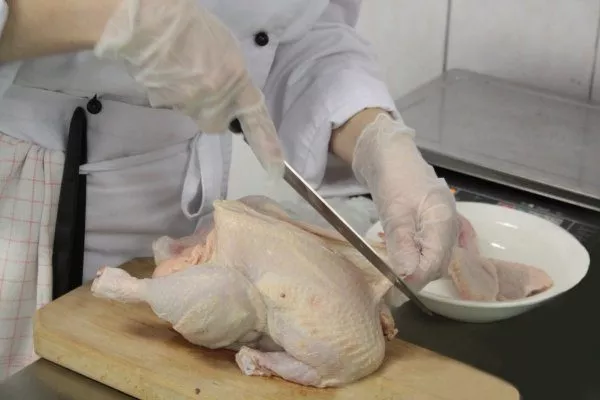
To cut up poultry you will need the following tools:
- Cutting board. Working with chicken requires a cutting board. For cutting meat, it's recommended to choose a hard plastic board. Wooden surfaces absorb odors and are therefore unsuitable for this task. Alternatively, if you have no other board besides wood, it's advisable to cover it with heavy-duty plastic film before using it.
- Capacity. Be sure to prepare a container - it will hold the pulled out giblets or prepared portioned pieces.
- Knives. There are special knives for gutting and cutting, with curved tips. If such a tool is not available, wide and narrow knives made of thick steel and with sturdy handles will do.
- Carving fork. With its help, you can carefully remove the heart, lungs, intestines, crop, liver, and gizzard from the carcass. A fork allows you to do everything quickly, without straining or contaminating the surface.
- Kitchen scissors. They are used for cutting tendons from wings and legs. If such scissors are unavailable, a sharp knife can be used as a substitute.
- ✓ The knife should be made of thick steel to easily cut bones.
- ✓ The knife handle should be rubberized to prevent slipping.
- ✓ The blade should be long enough to easily cut large carcasses.
Having a set of kitchen tools on hand is ideal when cutting up chicken. However, it's not always possible to purchase a complete set. For this reason, using several knives of different sizes is acceptable. Tools should be well sharpened and washed.
Gutting and removing unnecessary parts
After plucking the feathers, the chicken must be prepared for butchering. This is done by thoroughly removing the internal organs. If the chicken contains giblets, this will lead to rotting and spoilage, and the chicken will ultimately have to be discarded, making it unfit for consumption.
Before slaughter, the bird should be fasted for 12 hours to ensure that no undigested food remains in its intestines. This ensures that any remaining food is completely eliminated with the feces. This facilitates the subsequent evisceration process without any complications. After removing the internal organs, they don't need to be discarded; they can be used to prepare poultry feed by washing and thoroughly chopping them.
What to do and in what order:
- Remove the anus. Turn the chicken carcass over onto its back. Using a sharp knife, begin cutting around the anus, taking care not to insert the blade too deeply to avoid puncturing the intestines. If the intestines are accidentally cut, the remaining contents will leak out, causing the meat to spoil completely and the chicken to be unfit for consumption. Do not pull out the anus.
- Make a cut by running a knife from the anus to the keel. This process is carried out no less carefully so as not to damage the bird's intestines.
- Get rid of the entrails. The entrails are removed into a prepared container. The intestines are carefully removed, gently tugging at the anus. After the intestines are removed, the stomach and liver are removed. The liver is removed without separating it from the gallbladder, which is removed afterwards. This minimizes the risk of crushing the gallbladder and spoiling the product.
- Get the goiter. Typically, a bird's crop is empty during slaughter. However, if the animal was slaughtered without preparation or died in an accident and its crop is full, removing it requires making an incision in the skin of the neck and removing the organ through the incision.
- Remove the genitals. When butchering a chicken, the ovaries are removed, and when butchering a rooster, the testicles are removed. This process requires a sharp knife.
- Get the heart. It is cut out with the same knife as the genitals.
- Rinse the carcass. After all the entrails of the carcass have been removed, it must be rinsed under cold running water.
This evisceration system is ideal for quickly cleaning the carcass and further using the bird for cooking.
In the video, a man explains and demonstrates in detail how to gut a chicken at home. What to do and how:
The classic way of cutting up a carcass
With practice, cutting up a chicken will take much less time, resulting in neat pieces and a whole breast. You'll learn to work carefully, not only to keep the work surface clean but also to minimize waste.
The classic method of cutting is suggested. Follow the instructions:
- Wash the carcass thoroughly, dry it a little, and pat dry with a kitchen towel.

- Place the bird on a cutting board with the back facing down. Grasp the leg and pull it away from the body, cutting the skin.
- Hold the carcass with one hand and grasp the leg and thigh with the other. Separate the thigh from the carcass, twisting it slightly upward. This will help separate the joints and release the femur.
- Now you can easily remove the leg and thigh by twisting it inside out and turning the carcass over. Make a cut all the way down to the tail to completely remove the leg.
- Cut the second leg using the same method. Next, begin separating the wings. Feel the shoulder joint with your hands—it's where the wing connects to the carcass. Cut along it.
- Separating the breast from the back is easy, the main thing is to cut in the right direction. This is determined by the white fat line.
- Cut off the breast from the other side in the same way.
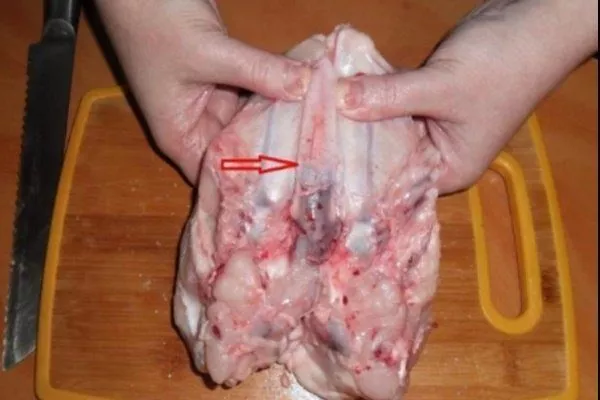
- There's cartilage running the entire length of the breast—it needs to be removed. To do this, lightly cut the top of the brisket, where the two bones are. Cut between them until the knife hits the dark cartilage.
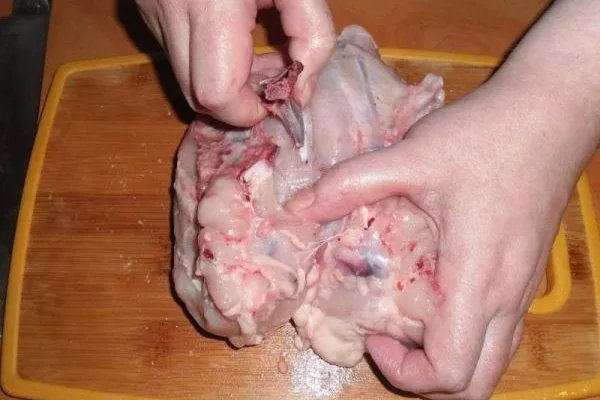
- You can't do this without using your hands. To remove the bone and cartilage without damaging the carcass, use your thumbs to lift the bone, push it upward, and then slide your fingers underneath.
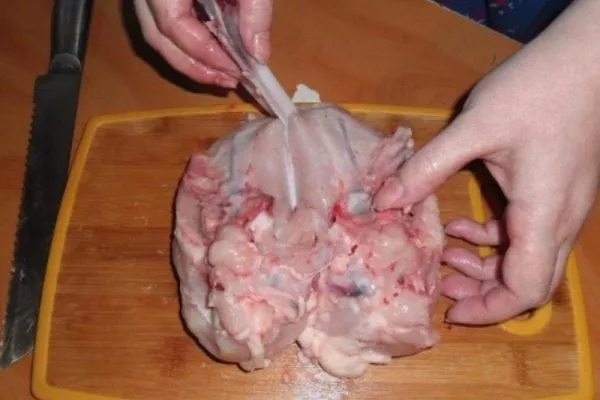
- Without removing your fingers, move the breast downwards, pushing and squeezing the cartilaginous bone.
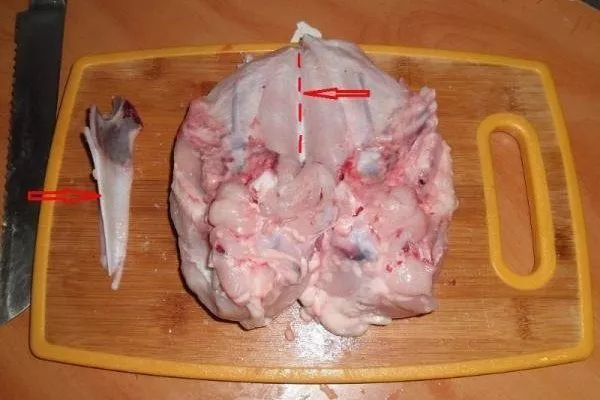
- The cartilage is almost completely removed. To complete the process, grasp the cartilaginous bone and gently pull it.
- The process of removing bone and cartilage is complete.
- Divide the breast into two parts.
- The chicken breast contains rib bones, which are removed by cutting with a knife. The chicken breast is left intact or cut into two pieces.
- The chicken leg is divided into two parts – the drumstick and the thigh. The thigh is cut at the joint.
- The wings are also cut to make them more attractive and to ensure ease of use later.
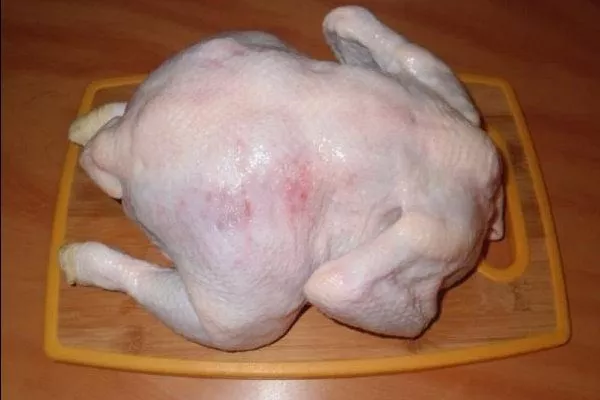
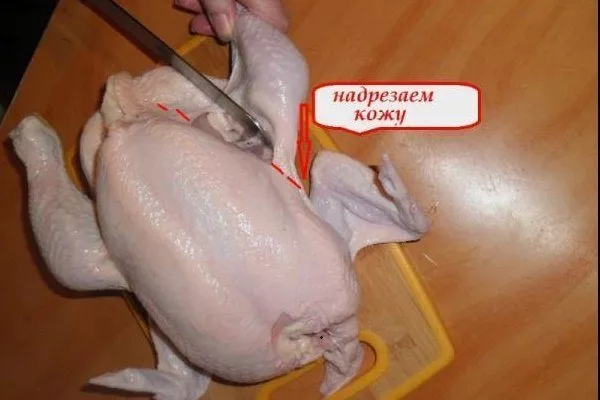
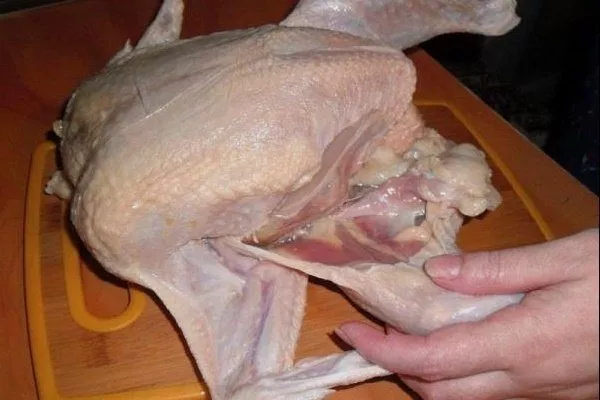
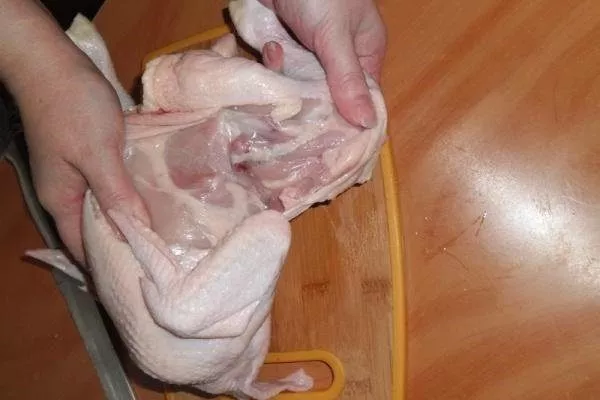
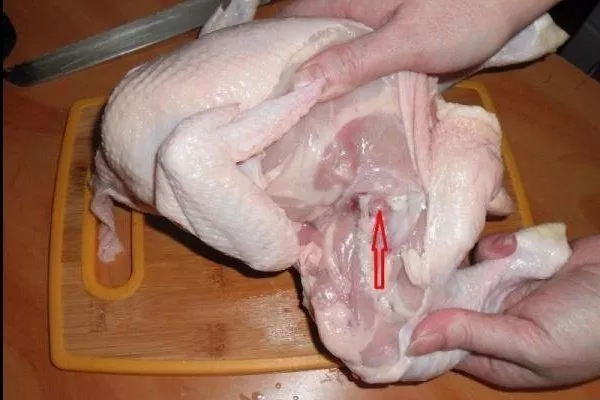
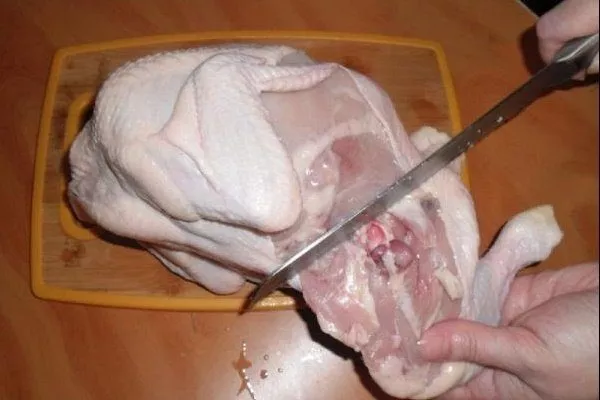
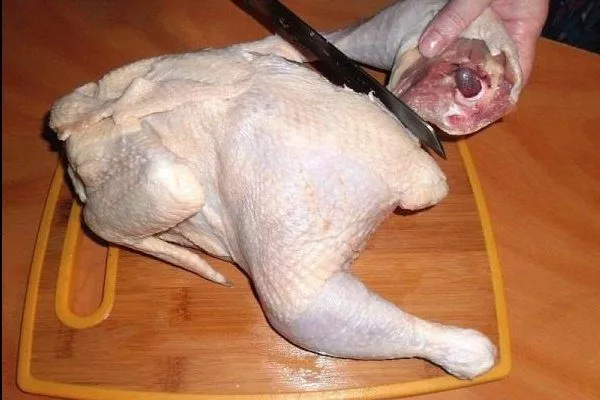
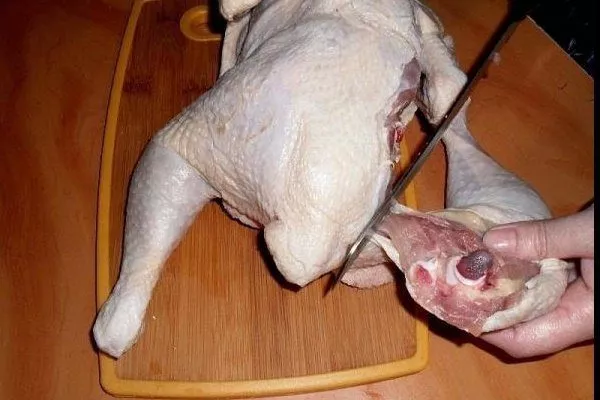
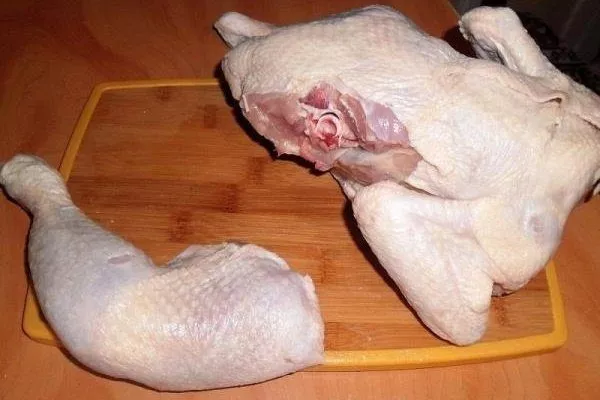
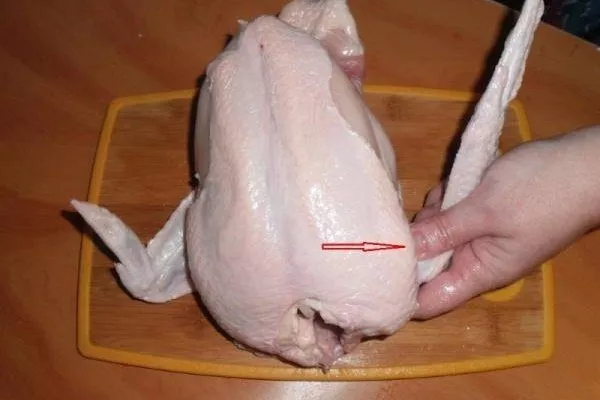
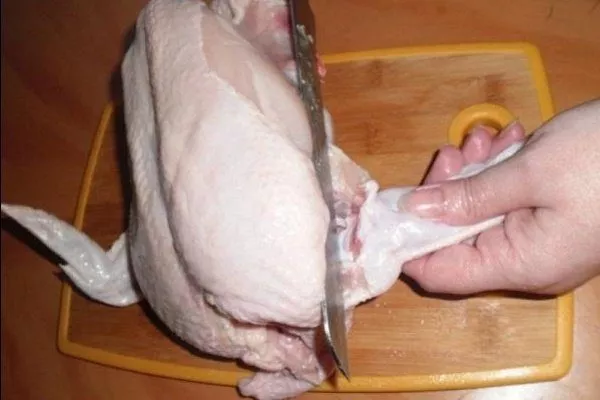
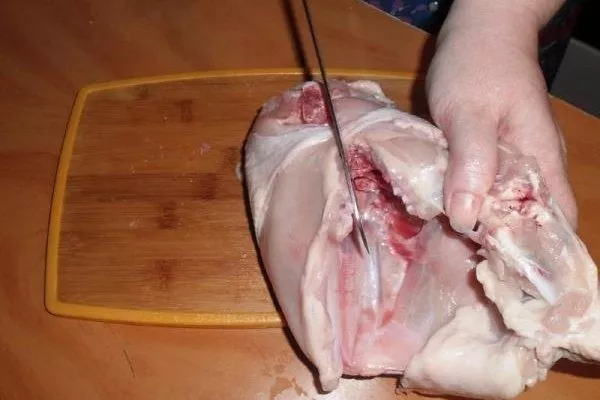
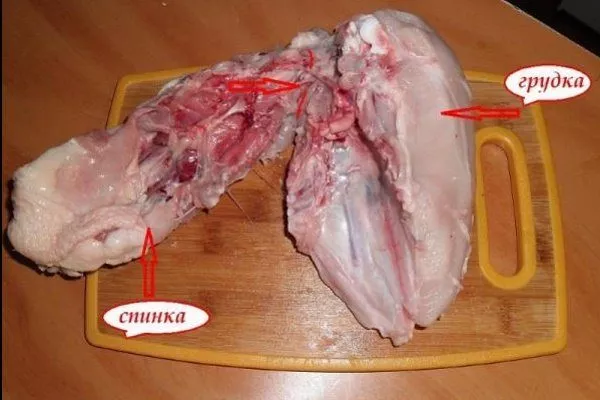
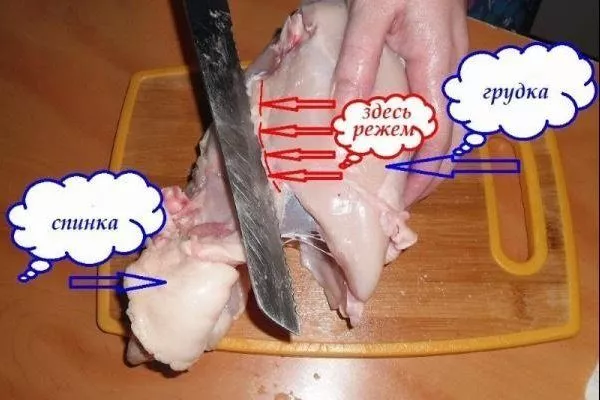
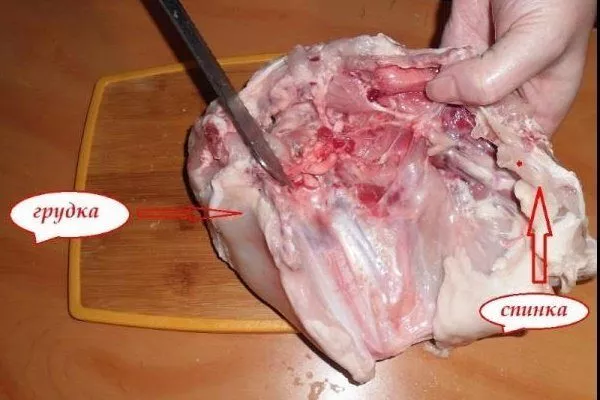
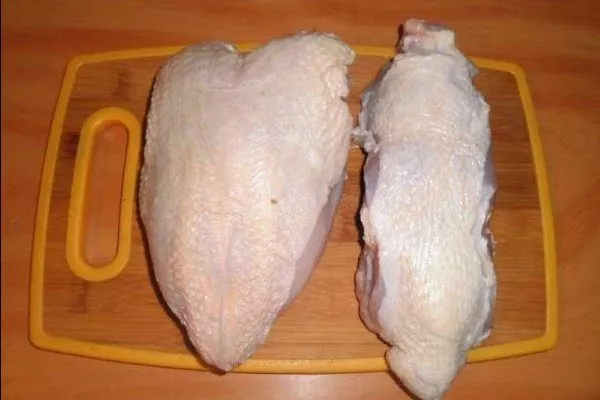
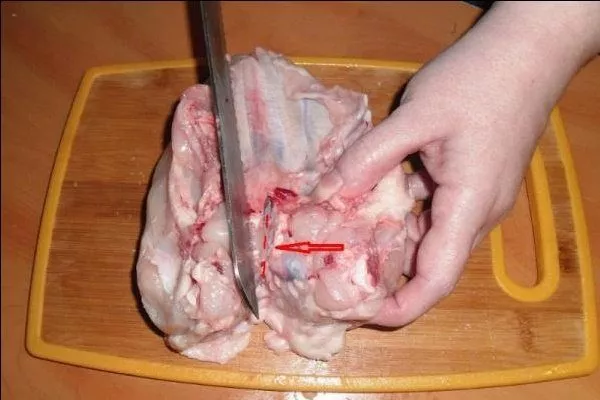
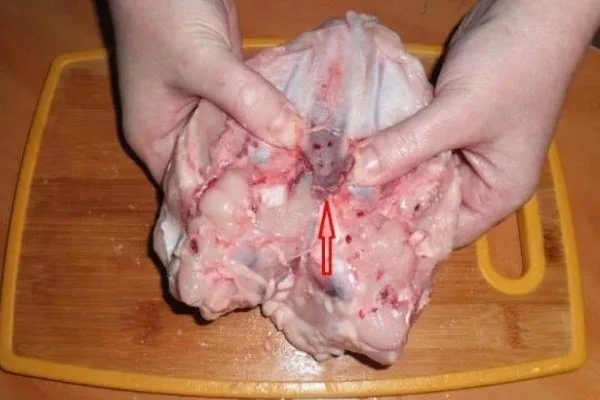
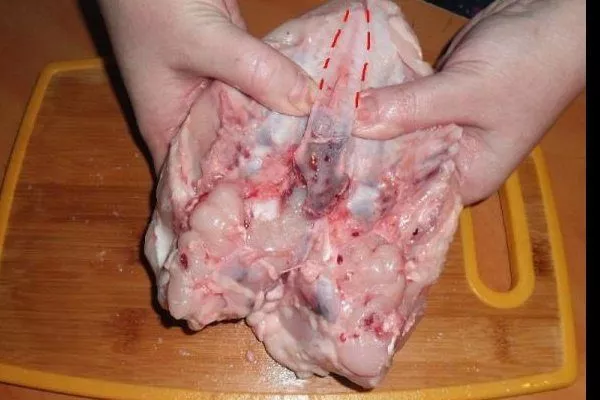
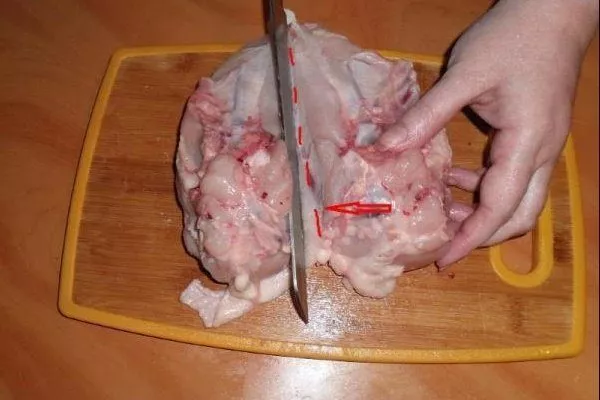
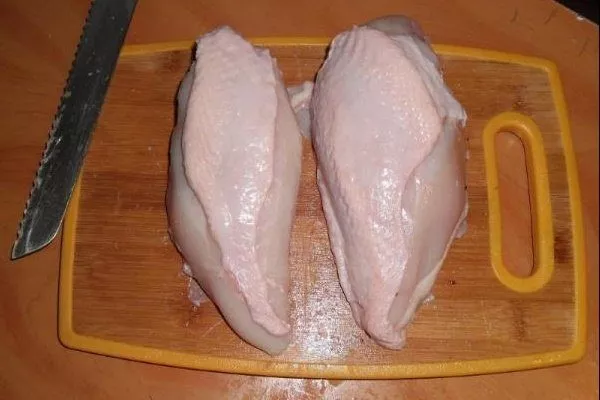
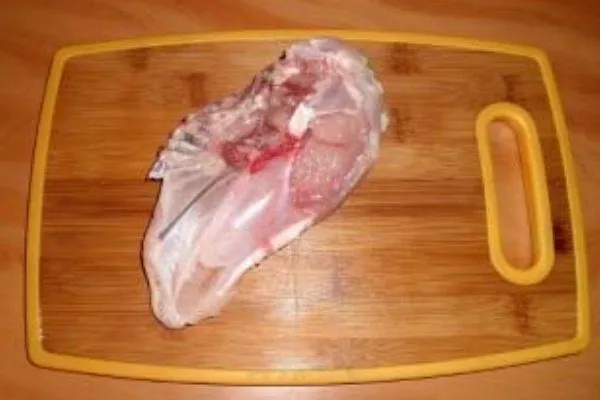
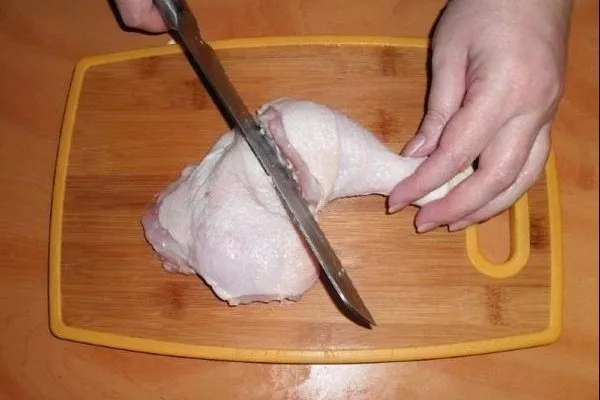
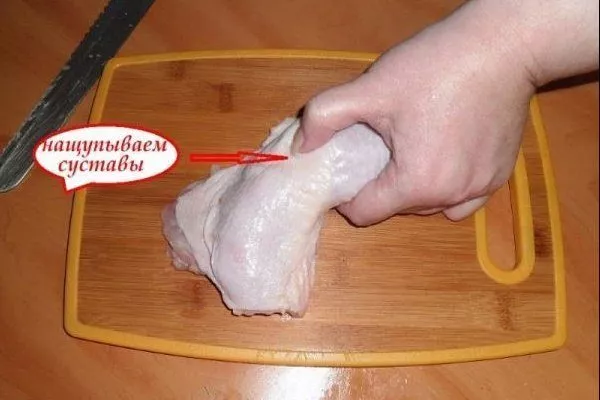
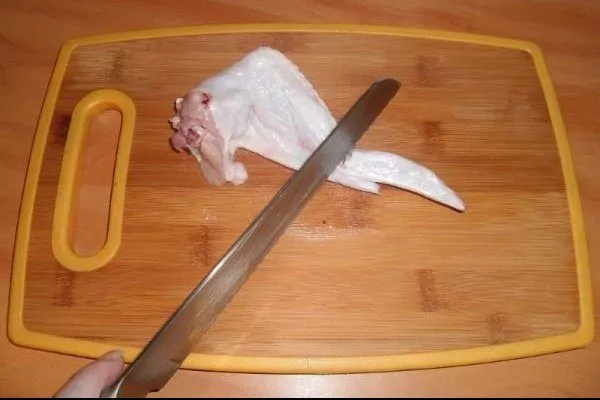
This method can yield 8 or even 10 servings of chicken. As an added bonus, the back and breast bones can be used to make a flavorful chicken broth.
In half
Another popular method for cutting the chicken is halving it. This method is especially suitable for preparing chicken tabaka. Follow these steps:
- Place the bird breast-side up, supporting it with your hand. Make cuts on both sides of the spine, then remove it.
- Make a cut into the breastbone (keel) and then turn the carcass over. The breastbone is removed by simply pulling it out of the flesh.
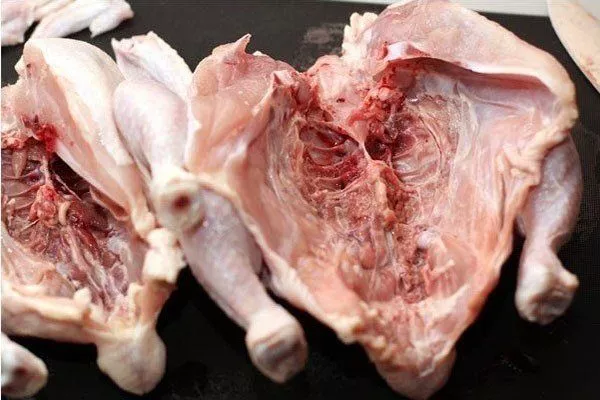
The chicken is left unwrapped or divided lengthwise into two equal parts, depending on what dish the hostess will be preparing.
Into 8 parts
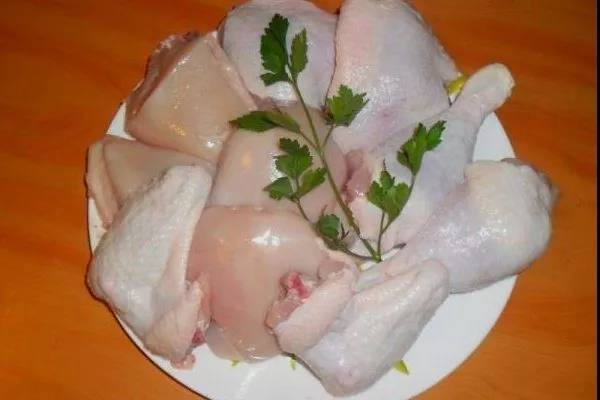
The most economical option is to buy a chicken and cut it up into pieces. This way, you can cut the bird into 8 pieces, which can then be used for boiling, frying, or baking. An added bonus is that cutting up the chicken yields chicken broth for making soups and borscht.
For the cutting process, it is essential to use a well-sharpened knife so that there are no difficulties when cutting off parts, cutting the skin and tendons.
After purchasing chilled poultry that has not been frozen, begin the cutting process:
- Gently pull the leg away from the body of the bird and cut through the skin with a knife, then through the meat to the joint. Turn the thigh sideways – this will help separate the two bones. Cut the leg away from the body. Repeat with the other leg. Divide the resulting pieces into the thigh and drumstick. Cut with a knife where the two main bones meet. This will create four delicious pieces.
- Place the chicken on its side, split the rib bones, and cut the breast and wings away from the back. After these manipulations, you'll have a chicken breast and back for the broth.
- Transfer the breast to a cutting board, skin side up, and trim the skin around the neck. Using your hands and a knife, remove the cartilage bone in the center of the breast. The cartilage can also be used for making broth. Cut each breast half in half, just below the wing. This will create four more pieces of meat. Remove the top wing and use it for broth.
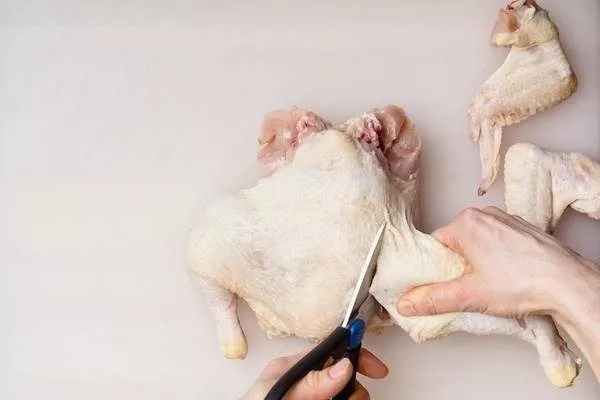
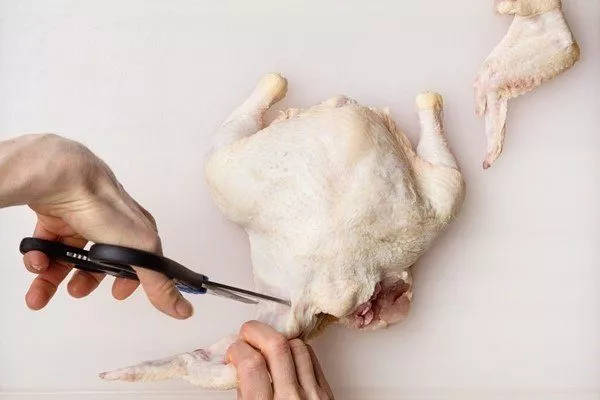
The result was eight nearly identical pieces of meat, which will be used to prepare delicious dishes. Cutting up chicken is a simple process, especially with regular practice.
If you need to cut a chicken into 8 pieces, but the instructions make it difficult to understand how to do it, then a video will come to the rescue, where everything is explained in detail:
No waste
If a housewife knows how to cut up a chicken without leaving any waste, she's truly a genius, as this is an art form in itself. This option is considered the most cost-effective. The process itself is simple and takes minimal time.
They operate according to the following scheme:
- Separate the legs. Place the carcass on its back, grasp the leg with one hand, and pull it to the side, where a cut is made where it connects to the body. With a sharp movement, twist the leg out of the joint and finally draw a knife across the skin to separate it from the body.
- Separate the wings. Make an incision at the shoulder joint and completely separate the wing by pulling it slightly to the side.
- Divide in half. Make a cut along the spine and in the middle of the breast of the carcass.
- Separate the breast and back. Run a knife along the joint where the ribs meet.
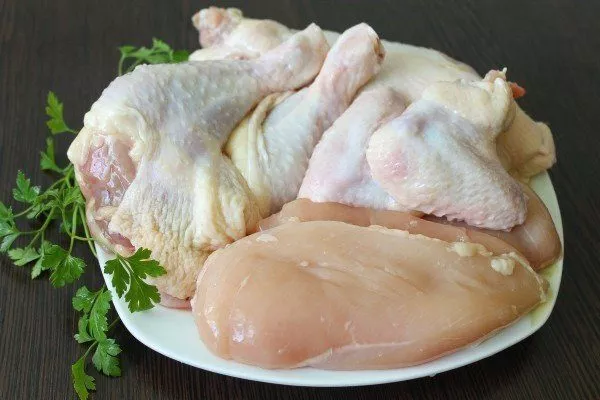
If the bird is large, each breast half is cut into two more pieces. The pieces are placed in the freezer for storage.
The video shows a surprising way to cut up a chicken without leaving any waste—everything is recycled. The man cuts up the carcass in just a few minutes, without dirtying the work surface:
Into equal portions
If you've previously been accustomed to buying individual chicken parts and haven't had the trouble of cutting up chilled chickens, a handy step-by-step guide to cutting up portions will come in handy. This process may seem complicated and confusing at first, but that's only at the start, and the second attempt will be seamless.
Cutting the bird into portions involves cutting out 8 pieces and the back. This is very convenient, as you won't have to spend money on pre-cooked meats. Here's the step-by-step cutting process:
- Place the carcass breast-side up. Now let's begin separating the thighs. Use a knife to score the skin—for ease, pull the leg away from the body. Hold the leg in your hand and run the knife along the skin at the base of the thigh. Firmly snap the thigh off, holding it to the side—the joints and protruding white bone will be visible.
- Cut the joint at the white bone. Move the knife in the same direction – the thigh will separate completely from the carcass. Repeat the same steps with the other leg.
- Two chicken legs will yield four servings: two drumsticks and two thighs. To separate the chicken legs, feel the joint between the bones with your finger and press with the blade of a knife.
- The next step is cutting off the wings. Repeat the same steps as with the thigh. Holding the wing in place with your hand, cut the skin, then bend the wing to the side and cut the joint under the bone. Repeat the same process with the other wing.
- Now separate the chicken breast from the back. Using kitchen scissors or a sharp knife is recommended. Place the chicken on its side, back side up. There's a strip of fat on both sides under the breast; cut through it starting from the bottom up. Next, cut all the way to the top on the left side. Repeat the same process on the other side of the chicken. This separates the back from the breast. The back is used for making broth.
- Next, you need to begin cutting the chicken breast into portions. First, cut the breast in half, turn it skin-side up, and make a slit down the middle with a knife, cutting into the bone.
- The brisket is considered one of the hardest bones, so you'll need to apply maximum force. With firm pressure, you'll be able to cut the breast into two equal halves along the bone.
- Next, carefully separate the fillet from the rib bones and remove the skin. Bend the fillet to the side and cut it away from the bone with the tip of a knife.
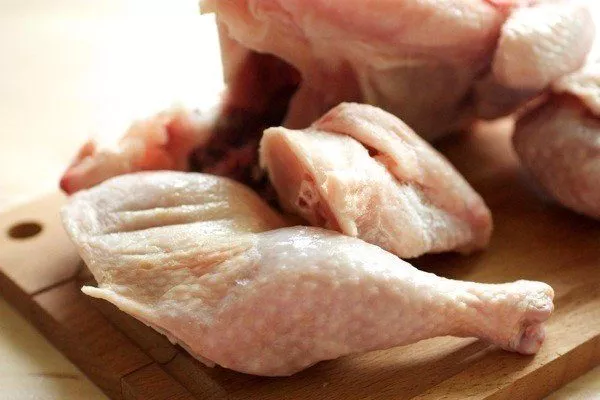
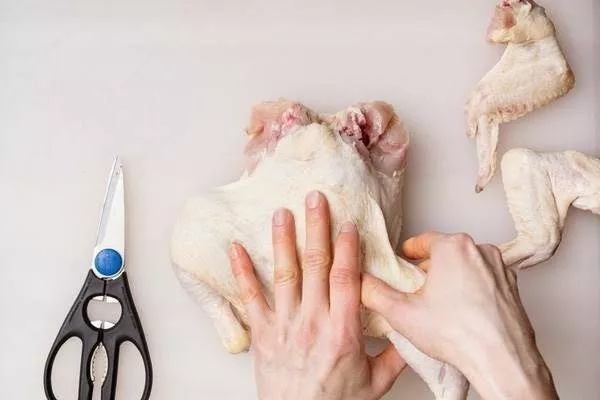
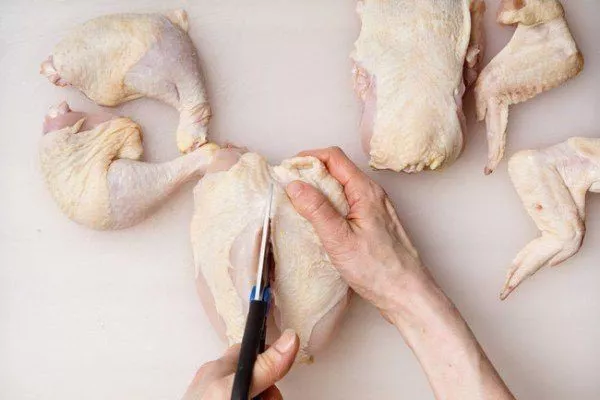
This way I managed to get 8 portioned pieces of chicken and the back for making chicken broth.
The man in the video shows how to quickly and neatly cut up a chicken into portions in his kitchen without making any mess:
Boneless cutting
When preparing ground meat, meatloaf, or semi-finished meat products, knowing how to separate meat from bone comes in handy. It's important not only to be able to cut meat, but also to preserve the attractive appearance of the pieces. It's best to remove bones from the entire carcass, without damaging the skin.
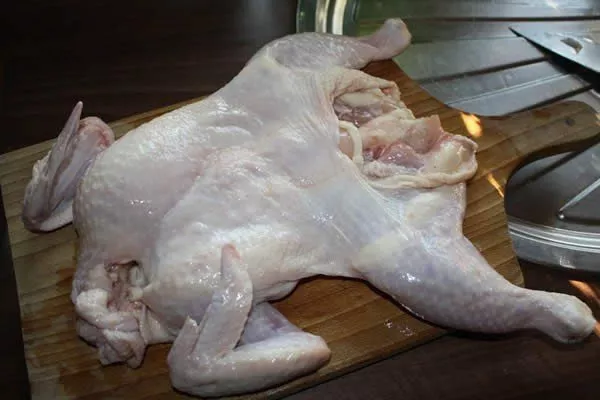
Farmers who supply chicken to restaurants may face this requirement. Such skill is highly valued and considered a plus for the seller. For boneless cutting, use the sharpest possible knife. The process involves two cutting methods: open and closed.
Open method
For the open method of separating meat from the bone, follow this procedure:
- Make vertical cuts along the entire back of the chicken. Starting with the breast is acceptable, but this can cause damage to the carcass. The back bones are located very close to the skin and can tear it if pressed.
- Using a knife, carefully scrape the meat off the skeleton, starting from the tail and working upward. Break the ischium, wing, and hip joints to expose the ribs. Use your hands to help move the meat.
- Free the femur completely by cutting the tendons in a circular motion. Push the meat away with your fingers.
- Carefully peel the flesh down to the cartilage, preserving the connection between the thigh and the body. Once you reach the bottom, cut the upper joint.
- Turn the resulting “stocking” inside out and repeat the same on the other side.
- Trim the ribs with scissors. Remove the keel and fork bones, trimming away any remaining joints.
- Leave the wings on the carcass with the bones or cut them off the skin. The process is complete.
Closed method
To use the closed method of boneless cutting, follow these recommendations:
- Through the bottom opening in the carcass, where the bird is eviscerated, make an incision into the tail, exposing the buttocks. The incision is made with jerky movements, moving down to the upper femoral cartilage. For ease, it's permissible to fold the skin and flesh slightly as you do so. Next, use a blade to carefully cut through the joint at the junction.
- The sinews are trimmed around the entire circumference of the ham. Where the knee meets the shin, the joint is broken. The same process is repeated on the other side of the carcass.
- Then you need to trim the meat on the ribs up to the neck, still tucking in the skin with the already separated pulp.
- The neck is quickly ripped out by hand. The breast fillet is cut from the skeleton, and the wing joints are broken off.
- The fork-shaped bone must be removed, and the flesh of the shank must be trimmed around the circumference, cutting through the ligaments. The bones are cut off before the cartilage, the skeleton is removed, and the skin and meat are turned inside out.
The closed meat cutting method is ideal for stuffing the carcass. This allows you to create incredibly delicious and presentable dishes that will wow your guests at the holiday table.
Cutting up a chicken so that it looks presentable, retains its appeal, and is boneless is challenging, but possible. The video shows how:
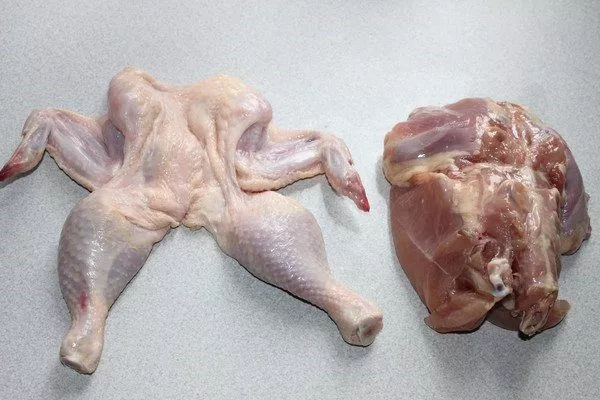
We take out the breast fillet
Chicken fillet is often used in salads or dietary meals – it is low in calories, rich in protein, and saturates the body.
But when buying a whole chicken, housewives sometimes face the challenge of removing the chicken breast from the carcass. This is a simple process that doesn't require much time:
- An incision is made along the rib cage, pressing the knife against the bone.
- Carefully cut the meat from the carcass.
- Separate the second half of the brisket from the back.
Cutting chicken for rolls and shashlik
To prepare a gourmet dish—a whole chicken roulade—you'll need to use the closed boneless method. Whether you want to boil the roulade in plastic wrap or bake it with vegetables, removing the bones from the carcass is a necessary step.
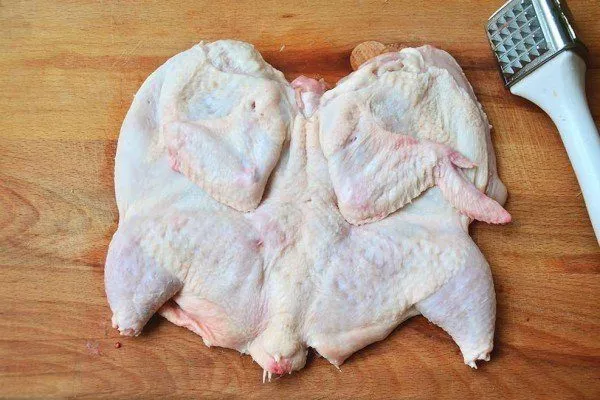
Chicken shashlik can be prepared using individual parts of the bird. This is done by dividing the bird into 8 or 9 portions, marinating them, and then grilling them.
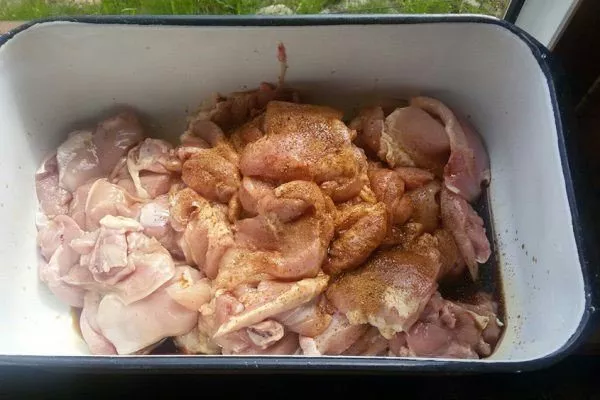
If you're using skewers or prefer boneless shashlik, the open method is a good choice. Simply cut the chicken breast into the desired size pieces.
Cutting up a chicken for a roulade is easy. Once done, you'll be able to prepare a delicious dish that the whole family will enjoy. Step-by-step instructions in the video:
Secrets of experienced chefs
Every chef has their own tricks for cutting poultry. Many world-renowned chefs recommend paying attention to the following details:
- Freshness. All processing must be performed on a fresh carcass. If using frozen poultry, it must be completely defrosted, rinsed thoroughly, and dried before cutting.
- The right tool. To cut the chicken into pieces, you'll need a large knife, but to separate the flesh from the carcass, it's best to use a smaller tool. Serrated kitchen scissors are also helpful.
- Maintaining hygiene. Before butchering, it's important to inspect the carcass for parasites and check the suppliers' health documentation. It's recommended to wear rubber gloves when handling poultry. Afterward, rinse the blades of the tools with hot, soapy water and clean them thoroughly. Wash your hands with soap.
- Aesthetics. By removing the outer phalanx of the wings, you can significantly increase the visual appeal of dishes prepared in any way.
- Removal of tendons. Poultry fillets contain tendons—one in the large muscle and one in the small muscle. These tendons need to be removed, which will help keep the meat tender and appealing after cooking. Using the tip of a sharp knife, cut both tendons alternately. Run the blade along the grain until the tendon comes out.
- Help with hands. A sharp tool isn't always helpful when removing skin, finding a joint, or moving meat off a bone. In these cases, you'll need to use your fingers to avoid damaging the carcass.
- Separate storage. Place carcass parts in the freezer separately from vegetables and fish. In the refrigerator, store portions away from foods suitable for raw consumption. This will help prevent flavor loss.
Properly cooking each cut of chicken is equally important. Improperly prepared chicken can result in dry flesh, loss of beneficial micronutrients, and a deterioration in flavor.
There are many ways to cut up a chicken, depending on how you plan to use the carcass or its parts. The first time, this process may seem complicated, but subsequent cuts will be quick and easy. It's much more economical to get several different parts from a single carcass than to buy them individually at exorbitant prices.