
Cage-based raising of laying hens is one of the most popular methods. But every poultry farmer needs to know how to properly create all the necessary conditions to maintain good health and high egg production.
Advantages and disadvantages
Keeping laying hens in cages has many advantages pros:
- the ability to keep more individuals in a limited area;
- maintaining a bird house is easier and more convenient;
- reducing feed costs by eliminating feed spillage outside the cages;
- the process of collecting eggs is significantly simplified;
- the safest way of keeping;
- reduction of lighting and heating costs due to reduction of area.
Another advantage is that birds in a confined space move less, which means they consume less food.
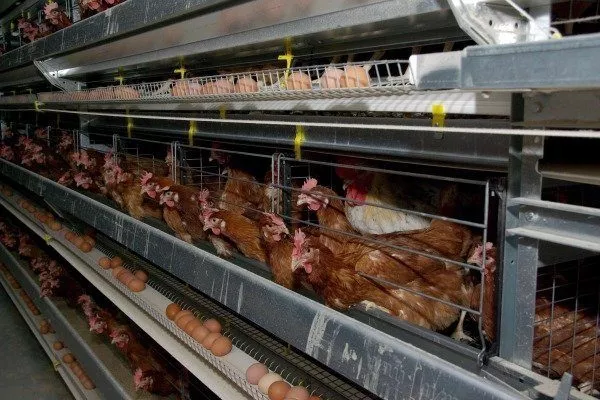
Keeping chickens in cages also has some disadvantages flaws:
- poor quality of life for birds;
- the need for additional nutrition with vitamins and microelements;
- rapid spread of infections and parasites between birds;
- lack of natural light in the room;
- Increased risk of heart disease due to restricted movement of birds and overfeeding.
Basic rules for keeping laying hens in cages
When keeping chickens in cages, it is necessary to adhere to certain rules that will help prevent various problems both with the health of the birds and with decreased egg production.
Bird stocking density
When keeping laying hens in cages, one of the most important factors is stocking density. Experts recommend only housing hens of the same breed and, preferably, of the same age in a cage. This approach will help prevent conflicts between the birds.
When housing layers in a single cage, allocate at least 0.1 square meters per individual (no more than 5-6 hens per standard cage). If housing each hen in a separate cage, allocate at least 0.5 square meters per individual.
Cell illumination
When arranging caged laying hens, it's also important to ensure proper lighting. This factor greatly influences the number of eggs produced, as longer daylight hours significantly increase egg production.
Vitamin D is essential for the health of birds, as its deficiency not only leads to illness but also to reduced egg quality.
To prevent mental health problems in chickens, experts recommend purchasing special lamps that operate automatically and provide smooth and even illumination throughout the entire cage.
Cleaning
Regular cleaning is essential in caged environments. This will help prevent the development and spread of various diseases in birds.
To maintain cleanliness in the cages, the following measures are taken:
- daily wet cleaning;
- uneaten food must be removed;
- the drinking bowl and feeder are washed after each feeding;
- water is changed daily;
- The droppings are removed several times a day with mandatory disinfection of the trays.
Feeding
When keeping chickens in cages, you need to carefully monitor their diet, since without free range, they cannot independently obtain additional elements that are necessary for the proper functioning of the body.
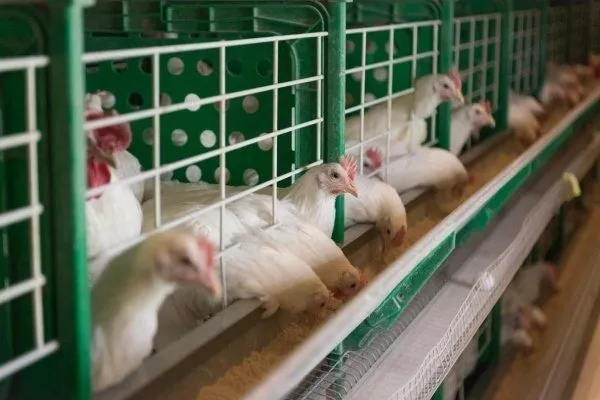
In this case, ready-made balanced feeds are used, which are selected depending on the breed and needs of the animals.
If you are preparing your own diet, use the following ingredients for the feed:
- wheat;
- sunflower cake;
- vegetable fats;
- calcium carbonate;
- salt;
- vitamin supplements.
Zdravur can be used as a supplement. This is a proven complex designed specifically for laying hens.
The birds' diet must be properly balanced, so every day chickens should receive 72% carbohydrates, 15% proteins, 6% fats, 3% fiber, 2% vitamins and minerals.
Read more about daily nutrition of laying hens.
Prevention of diseases and parasites
In cage conditions, birds are more susceptible to various diseases and parasites. Vaccination is often used for prevention. Pay special attention to young animals, as their immunity is weaker than that of adults.
To prevent feather parasites, experts recommend placing special containers filled with ash and sand in each cage. If birds regularly use the ash bath, the parasites will be unable to survive and reproduce.
If infected, isolate the infected bird from healthy individuals and thoroughly disinfect the cage it was in. Ash, sand, or dust are used.
Temperature conditions
The correct temperature in the chicken coop must be maintained depending on the season. During warmer months, a temperature of 23 to 25 degrees Celsius is recommended, while during colder months, a temperature of 15 degrees Celsius is recommended. In summer, open the windows to maintain the temperature, and in winter, insulate the coop and install heating devices.
Ventilation
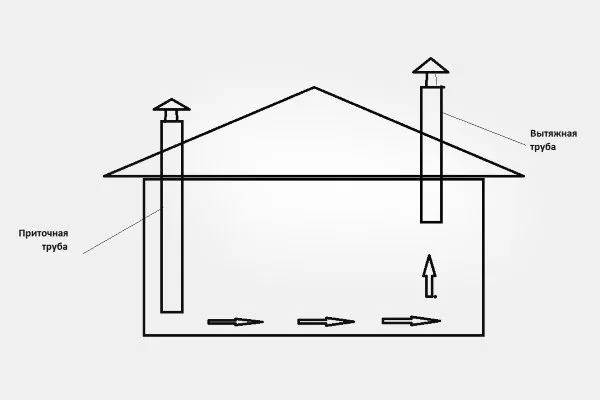
In addition to temperature, consider ventilation. For small coops, several vents can be installed. For larger coops, a dedicated ventilation system is recommended.
To create this, two holes are made in the roof, a pipe is placed in each, and the upper ends of the pipe are led outside. The air intake pipe should be positioned below the exhaust pipe to allow warm air from the coop to easily escape.
Experts recommend considering the ceiling height when building a chicken coop. 180 cm is optimal, as a ceiling height lower than 180 cm makes ventilation difficult, and a ceiling height higher than 180 cm makes it difficult to maintain the room's temperature in winter.
4 useful tips
To maintain high egg production and the health of chickens, the room in which the birds are kept must contain:
- Artificial lighting. For indoor lighting, use LED lamps, as they are more energy-efficient and safer for birds. Place lamps throughout the enclosure, spaced 2 meters apart. Birds should receive 14 to 16 hours of daylight.
- Ventilation system. Often, electric fans are installed for this purpose, which prevent moisture accumulation and ensure good air circulation in the chicken coop.
- Heating. In most cases, poultry farmers use steam or stove heating, infrared and oil heaters, as well as fan heaters.
- Automatic drinkers. For this purpose, a vacuum feed is used. A common, hermetically sealed tank is installed above the waterers, from which pipes are run to each waterer.
How to make a cage for laying hens?
For laying hens, you can buy ready-made cages or create them yourself at home.
Cell requirements
There are certain requirements for laying hens' cages. Adhering to them will significantly increase egg production and prevent health problems.
Experts have identified several recommendations for cell design:
- each cage must have a feeder and a drinker, which must be removable;
- all walls in the cages must be made of steel and lattice;
- the diameter of the cage bottom bars is at least 2.5 mm;
- the distance between the bars of the front wall should be 5 cm wide and 10 cm high;
- When designing an egg collector, make a protrusion of about 6-8 cm and a bend in the edge of 3 cm;
- the feeder and drinker should be securely fastened, but easily removable;
- the ceiling is made latticed to ensure good ventilation;
- the slope of the cage floor is 6-8 degrees, the diagonal of the hole is 1-1.5 cm.
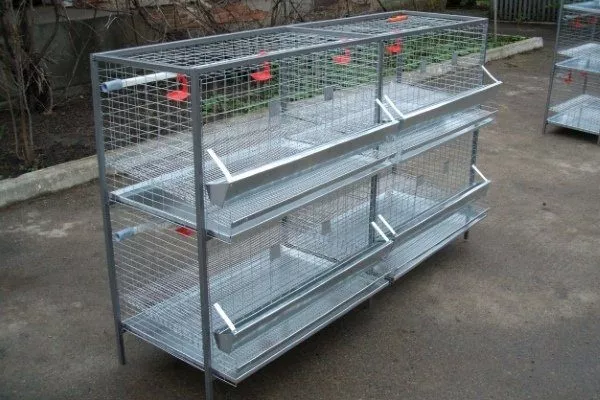
Below are the optimal parameters for cages depending on the number of chickens:
| Number of individuals in a cage | Depth, cm | Width, cm | Height of the rear wall, cm | Total height, cm | Area per individual, sq. m |
| 2-3 | 50-60 | 60-100 | 45 | 65 | 10:30 |
| 4-5 | 50-60 | 100-140 | 45 | 65 | 10-21 |
| 6-8 | 60-80 | 140-180 | 50 | 70 | 10-22 |
| 9-12 | 70-100 | 180-200 | 50 | 70 | 10-24 |
| Cell type | Area per individual, sq. m | Ease of cleaning | Manufacturing cost |
|---|---|---|---|
| With bedding | 0.1 | Low | Low |
| With a sloping floor | 0.1 | High | Average |
Types of cells
Laying hen cages vary depending on the breeder's requirements and capabilities. They can be broadly divided into two types:
- Cages with bedding. In this case, the floor is made solid and covered with straw or sawdust.
- Cages with sloping floors and egg collectors. This variation creates a double floor, with the upper section constructed from sloping lattice. The lower section, in turn, is solid and often equipped with a tray.
- ✓ Consider the number of chickens
- ✓ Rate the ease of cleaning
- ✓ Calculate your budget
This option ensures maximum cleanliness and dryness in the cages. The sloping floor allows the eggs to roll into a special egg collector. This type of cage is more popular among poultry farmers.
Layer specialists with large flocks often use a battery cage system, where rows of cages are stacked one on top of the other. Each row is positioned slightly behind the one below to prevent the hens from soiling their neighbors below.
Step-by-step instructions for making
The cages are made of metal mesh and can be attached to either a metal or wooden frame.
For a cage with a metal frame, the following materials are required:
- galvanized mesh, fine (cell diagonal – 1.5-2.5 mm, rod thickness – 2.5 mm);
- wide mesh for the front wall (mesh size – 5 cm);
- metal corners (thickness – about 3 mm);
- galvanized sheet metal for the tray (thickness – 1.5 mm);
- plywood sheets for the feeder (thickness – 1.5-2 mm);
- water pipe (diameter – 5-7 cm);
- steel loops and hooks;
- dowel nails or anchor bolts;
- Self-tapping screws for metal and wood.
The litter tray can be made of plastic.
The following tools are required:
- welding machine;
- screwdriver;
- tape measure with marker;
- building level.
Before you begin building the cages, you need to determine their size and quantity, and create a frame drawing. You can use a drawing of a metal cage designed for 4 birds:
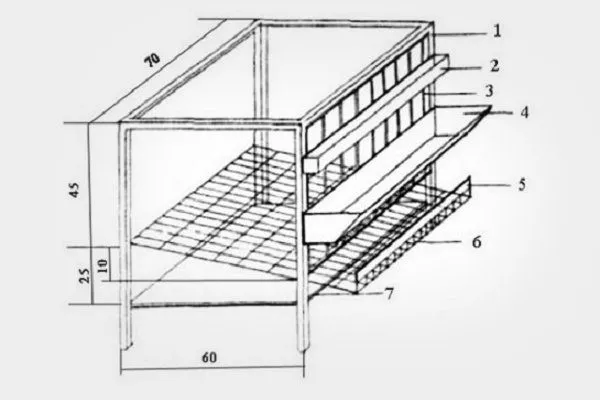
1 – cage frame; 2 – drinkers; 3 – door; 4 – feeder; 5 – egg collector; 6 – mesh floor; 7 – litter tray.
To install the cages and assemble the frame, you must perform the following steps:
- cutting a corner for the frame with a grinder;
- installation of vertical frame elements and welding them with horizontal ones;
- measuring the horizontal level of the crossbars and adjusting it;
- strengthening the frame by welding additional diagonal corners (length 3-4 cm);
- cutting an inclined egg collector from the mesh and folding its edge;
- cutting out the side walls and roof of the cage;
- processing the front wall (cutting horizontal cells at a height of 15-20 cm from the bottom to create an opening of 5 x 10 cm);
- assembly of the cage, welding of fixed parts;
- fastening the movable part to the hinges;
- bending the edges of a sheet of tin so that their height is 2-4 cm, and the internal dimensions are 60-70 cm;
- creation of the required number of trays;
- welding two metal plates (2 by 3 cm) to the front parts of the cages on the sides;
- installation of cells on the frame, fastening with self-tapping screws;
- making feeders from thin plywood sheets (height of vertical wall – 10 cm, bottom – 15 cm, height of back wall – 12.5 cm);
- attaching metal hooks to the feeders using self-tapping screws and installing them at a height of 15-20 cm from the bottom of the cages;
- longitudinal cutting of plastic pipes for drinking bowls using a hot knife, installation of sealed plugs on the sides and securing them 7-10 cm above the level of the feeders;
- supplying water to drinking bowls.
The frame can be mounted on wheels. This will make it easy to move the cages around the room or outdoors during warmer months. For easy transport, wheels are recommended for smaller frames that house up to six laying cages.
The cage lids can be made movable. This will make them easier to maintain.
If installing the cages on a wooden frame, the metal corners can be replaced with a 10 cm square beam for the vertical support and a 4 cm beam for the horizontal crossbar. Assemble the frame using screws, installing additional crossbars at a 45-degree angle to the supporting beams. To speed up installation, you can install a single, sloped floor, and then place the cages on top without the floor.
Litter trays should be installed one per maximum of two cages, this will make cleaning easier.
In this video, a poultry farmer explains the specifics of creating cage structures for keeping laying hens:
Keeping layers in cages can significantly reduce bird costs and simplify care. However, this method requires following basic rules regarding cages, cleaning, and room temperature.