
Few ordinary people think about how much a chicken egg weighs. People usually focus on its size. However, for breeders, this is important because the weight of a single egg depends on the chicken breed and the type of egg. Consequently, this also affects the cost. Therefore, keeping chickens that weigh too little becomes unprofitable.
The weight of a chicken egg
The weight of a chicken egg is influenced not only by the breed of chicken, but also by factors such as the conditions in which the birds are kept, the age of the chicken, and the breed's intended use (meat, eggs, etc.). However, it's still interesting to know the weight of eggs in a given state (white and yolk only, shell removed, boiled or raw).

Weight of protein and yolk
The weight of individual whites and yolks is affected by the variety, so it is customary to use average statistical data in percentage terms for determination:
- the amount of protein in one egg is 60-65%;
- yolk – 35-40%.
Accordingly, if an egg without a shell weighs 50 g, then it contains 20 g of yolk and 30 g of protein.
Weight of an egg without a shell
The weight of shell-less eggs is of interest to those following a special diet. It allows for precise calculation of the calorie content of the product, but for chicken breeders, it's not a critical indicator.
The shell accounts for approximately 9-11% of the total weight of an egg. Therefore, to calculate the weight of an egg without the shell, subtract 10% from the weight, on average.
How much do raw and boiled eggs weigh?
Any food that undergoes heat treatment inevitably changes its weight. But not a chicken egg. This is because the white and yolk are securely sealed in the shell, which is impermeable to water, steam, and air.
Therefore, the weight of a boiled egg is no different from the weight of a raw egg. However, if the eggs are poached or fried, the weight is reduced by 10-14%.
Does egg weight depend on the breed of the laying hen?
There are egg-laying and meat-laying chicken breeds. Therefore, the former lay larger eggs than the latter. Among egg-laying chickens, there is a huge variety of breeds, differing in weight, nutritional value, and other characteristics. Some chickens lay large eggs, others medium, and still others small.
- ✓ Egg production level: 250-300 eggs per year for egg breeds.
- ✓ Disease resistance: choose breeds with high immunity.
- ✓ Adaptation to climate: preference for local or acclimatized breeds.
For example, there are dietary eggs from Pavlovskaya chickensThey are small in weight (50 grams), but have high nutritional value. Therefore, they are classified in the second category (corresponding to weight). Many miniature breeds can also be mentioned here, whose eggs are very nutritious but weigh little. However, the largest eggs, with minimal nutritional value, lay Hy-Line chickens.
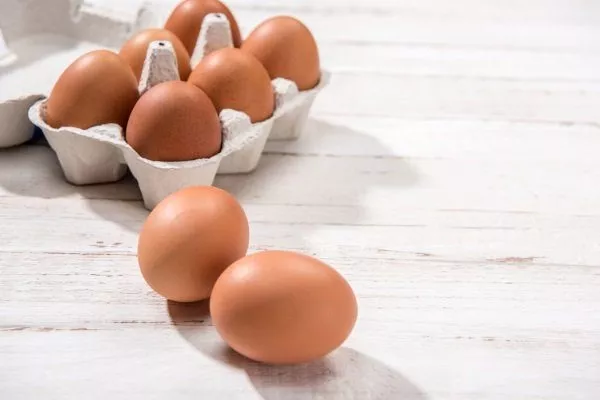
Egg weight in grams by category
The chicken egg's grade depends on its weight. There are standard standards that are strictly adhered to. The grading is as follows (in grams):
| Grade/category | Marking | Mass with shell | Average indicators | Weight without shell | Yolk weight | Protein weight |
| Higher | IN | 75 and above | 75 | 68 | 26 | 41 |
| Selected | ABOUT | from 65 to 74.9 | 70 | 55-65 | 25-30 | 35-40 |
| First | 1 | from 55 to 65 | 60 | 50 | 19-24 | 30-38 |
| Second | 2 | from 45 to 55 | 50 | 35-45 | 16-20 | 25-30 |
| Third | 3 | from 34 to 45 | 39-40 | 31-40 | 13-16 | 20-25 |
| Category | Proteins (g) | Fats (g) | Carbohydrates (g) |
|---|---|---|---|
| Higher | 6.5 | 5.0 | 0.6 |
| Selected | 6.3 | 4.8 | 0.6 |
| First | 6.0 | 4.5 | 0.5 |
It is quite easy to calculate the weight of ten eggs, but one kilogram of product can contain from 14 to 27 units.
Why are eggs sold individually and not by weight?
Many foods are sold by weight, not individually. So why isn't this the case with eggs? Here are the main reasons:
- Eggs are fragile foods that must be stored separately from each other. That's why they are packaged in specialized trays, which must be covered at the top.
Therefore, if eggs are weighed, they will inevitably break (when transferred to a plastic bag or other packaging, when placed on scales, etc.). Consequently, any retailer will suffer losses. And what's more, poultry farms, which ship hundreds of thousands of eggs daily, will suffer losses? - All eggs are susceptible to salmonella, as they are laid by hens in harsh conditions. For this reason, everyone should thoroughly wash eggs with soap and water or a special disinfectant after purchasing them. If eggs are left unpacked (for example, in bulk in a crate or on a counter), nearby food items will inevitably become contaminated.
This approach risks global transmission. Of course, one option is to set up a separate section in the sales area where eggs are primarily stored, but this will force store owners to significantly inflate prices, which is unprofitable for both consumers and retailers. - It turns out that moisture is lost through the shell (over a certain period). This evaporation doesn't affect a single unit, but if you buy, say, 10,000 kg, only 9,500 kg will remain. Therefore, the seller, to avoid losing money, must increase the markup.
The most unusual facts about chicken eggs
Chicken breeding has been practiced for centuries, so there's already an official list of interesting facts about eggs:
- We're used to seeing brown and white eggs, but there have been cases around the world of hens laying blue and green eggs (shells). It turns out that only certain breeds of chickens do this. The structure and chemical composition of the egg They're no different from the varieties we're used to. The only difference is that multicolored eggs are laid in smaller quantities.
- The smallest egg weighs just 10 grams, while the largest weighs 450 grams (its length was 32 cm, diameter 23 cm). These are official figures recorded in England.
- In the UK, a hen laid an egg that had 5 yolks at once.
In China, eggs are artificially produced. Calcium carbonate is used for the shell, and a gelatin base with coloring and flavorings is used for the yolk and white. Importing such products into Russia is strictly prohibited, and is therefore considered contraband.
Whatever type of eggs you buy, remember that the category has no correlation with the nutritional value of the product. The grade is determined solely by weight. There's a myth that people unquestioningly believe: small chicken eggs are much healthier than large ones. However, this hasn't been scientifically proven.
Listen, I never thought about things like this!!! Very interesting article! I just started raising chickens and now I know for sure that for large eggs you need a certain breed…