
Every chicken farmer needs to understand the principles of poultry fertility. This knowledge will help them estimate the approximate time of laying and the number of roosters and hens needed to successfully manage their operations.
Features of the reproductive system of chickens
Reproduction in chickens, like in other birds, occurs through a special avian organ called the cloaca. This is the enlarged end of the hindgut in some vertebrates, where both the excretory and reproductive ducts of the urogenital system empty.
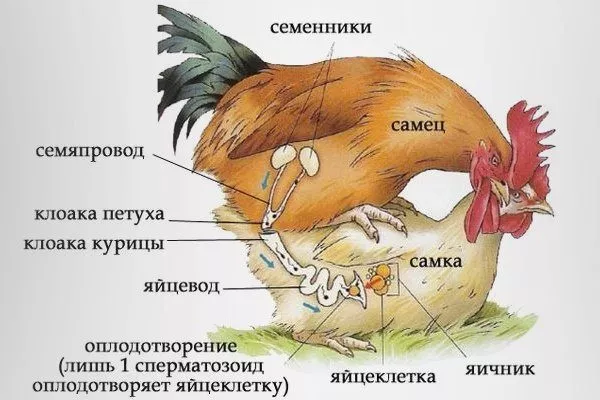
The rooster's reproductive organs are small testes, from which extend the vas deferens (thin tubes), ending in the cloaca. Sperm are expelled from the testes via a small papilla located on this specialized organ.
In hens, the reproductive system consists of the grape-shaped ovary, located on the right side, and the oviduct. Both elements of the system access the cloaca through ducts serving different functions. The ovary is where the process of formation and maturation of the oocytes, which will later become the yolk of the developing egg, begins.
During the mating process of hens, their cloacas touch: the male's cloaca is turned inside out, and his seminal fluid enters the female's cloaca.
A rooster's sperm can remain active in a hen's reproductive tract for up to twenty days.
How many hens and roosters should you have in a chicken coop?
For a small domestic chicken flock, one or two roosters are sufficient. A young, healthy, and sexually mature rooster can independently fertilize up to 15 hens on a regular basis. As a male ages, his strength decreases with the number of hens he can lay. A rooster over three years of age is considered incapable of mating and producing healthy, viable offspring.
For many poultry farmers, the formula for the hens-to-rooster ratio is quite simple: one rooster for every ten hens. Experience shows that this is a perfectly workable formula. However, the ratio may vary depending on the specific poultry breed.
Regardless of the chicken breed, the minimum ratio that should be maintained is one male to three to four females. If the ratio is less, the male may become aggressive not only toward competitors but also toward females.
- ✓ Activity and aggressiveness are within normal limits.
- ✓ Bright, healthy comb and earrings.
- ✓ No signs of respiratory disease.
Selecting a rooster and fertilization issues
Every chicken breeder sooner or later faces a situation where a rooster is unable to fertilize a sufficient number of hens or stops fertilizing altogether. This can have several causes:
- Age. A bird that is too young or too old cannot perform its “marital duty” at the required level or cannot do it at all.
- New environment. A newly-bred rooster may not trample the hens until he gets used to the new environment and group.
- Stress. Stress is harmful not only to humans but also to birds. Excessive noise, temperature fluctuations, insufficient food, excessive or insufficient lighting, and many other factors are detrimental to a rooster's reproductive performance.
- Genetics. Hermaphroditism is common in chickens. A hermaphrodite rooster will not perform its functions.
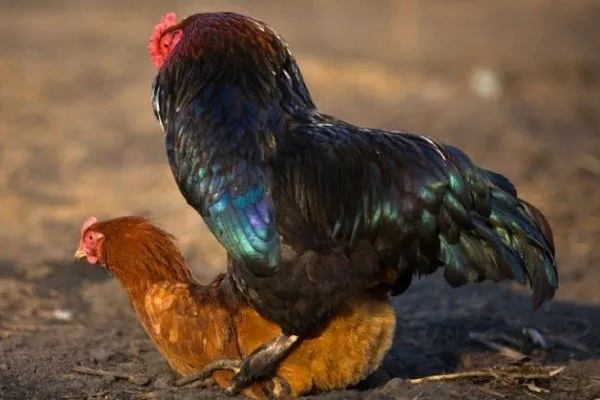
A male begins to fertilize hens at around three to four months of age. If the rooster is too young, the farmer simply waits for the birds to reach reproductive age. However, even a mature rooster may sometimes need additional time to gain experience and confidence in this delicate process.
For a spacious coop with many hens, it is recommended to keep two or more males: they will be able to demonstrate from their own experience how to behave with hens and will create healthy competition.
Taking the lead in a flock and finding common ground with all its inhabitants can be a challenge for a rooster. When the arrival of a new male in the coop results in aggression from the hens, it's best to remove the rooster from the flock and place him in a separate pen. Over time, gradually introduce hens to his fold. This will help the male establish himself as the new leader of the coop.
The solution to stress-related problems is time. The bird needs time to adjust to the changed living conditions. Sometimes it's necessary to eliminate factors that are stressing the bird: stabilize the temperature, normalize the daylight hours, change the feeding schedule, etc.
How does mating between a rooster and a hen occur?
At the beginning of the mating season, the rooster circles the hen and scratches her lowered wing with his paw. Males are often observed to be particularly generous: he shares food with the female and generally pays increased attention to the female he likes.
The molting period radically changes the behavior of both hens during this delicate process. During the seasonal change of plumage, the hens are left to their own devices, while the rooster strikes and drives his fellow hens away from his prey.
Once the molt is over, everything returns to normal: the rooster once again becomes charming towards the hens he likes.
The mating process begins with trampling—the rooster searching for an opening on the hen's back using his claws. Overall, the process of hens mating is a rather rough and unpleasant spectacle. During copulation, the male sits on top of the female, holding her by the nape of her neck with his beak.
Sexual intercourse in domestic hens is relatively brief, yet remarkably regular. Some healthy, young roosters can mate with hens up to 20 times in a single day.
Such consistency isn't always a good thing. The more often a rooster tramples his hens, the less semen he produces, and the less concentrated it is. As a result, such fertilizations produce eggs that won't hatch into chicks. Reducing the number of times a poultry farmer fertilizes his hens, on the contrary, increases the percentage of fertilized eggs and the production of viable offspring in the future.
You can see how the mating rituals and the mating process in chickens take place in this video:
Fertilization of eggs
The mature egg enters the oviduct, where fertilization occurs in the upper part via the acrosome reaction: the upper part of the sperm penetrates a special tubercle on the female gamete. Its tail is separated. During fertilization, several sperm penetrate the hen's egg, but only one fuses with it.
The egg then gradually becomes coated with protein produced by specialized glands located in the walls of the oviduct. As it moves forward, the future egg develops a membrane called the shell membrane, followed by a hard shell composed of calcium carbonate compounds. This substance is produced in the lower part of the oviduct.
How to determine if eggs are fertilized?
If a poultry farmer is breeding hens for the purpose of hatching chicks, it's crucial to know whether the resulting egg is fertile or not. Hens lay eggs regardless of the presence of a rooster, but hens reproduce only with the help of males. Unfertilized eggs do not hatch because they do not contain an embryo.
A fertilized egg can be identified by the presence of a small amount of blood clots in the yolk. To detect blood, a lumen is required. Three things can help identify fertilized eggs:
- natural bright lighting;
- artificial light source;
- An ovoscope is a special device for instant determination.
The egg in question should be placed in a dark place. Place it with the blunt end toward the light, then tilt it to allow a detailed examination of the contents. Brown eggs are particularly difficult to see through, so it's best to select light-colored eggs, ideally white, for placing under the hen. There's no need to spend a long time examining the contents: thanks to the intense light, even a novice poultry breeder will have no trouble identifying the embryo.
A fertilized egg will show several blood vessels in a small area when viewed through the lumen. If no blood clots or black spots are detected, the egg is not fertilized and is not suitable for hatching.
There are also cases where it's impossible to detect the presence of a clot or spots in the center of the yolk, but a clearly visible blood outline is visible around the edge. This indicates a fertilized egg in which, for one reason or another, the embryo has died. Such specimens are also of no use for hatching: none will hatch from them.
Injuries in chickens after mating
When observing the activity of poultry, a breeder may notice that roosters have "favorite" hens—hens with whom the males mate more often than others. Frequent mating can cause these hens to have sparse withers, broken feathers, and bald patches. Hens appear dirty and unkempt. Furthermore, hens in this situation may develop abrasions and scratches on their backs and sides.
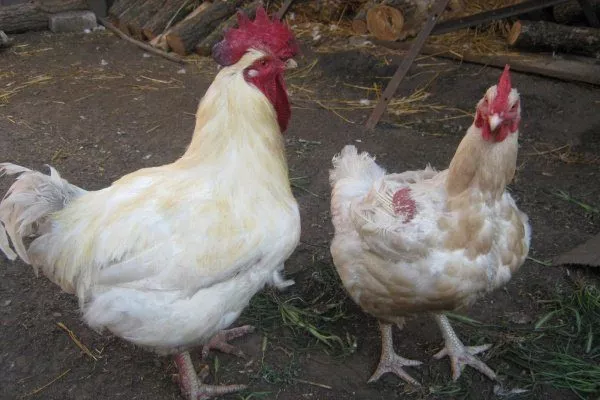
The cause of this phenomenon is the male's excessively long claws, so the excess must be constantly removed, otherwise the situation will repeat itself with the same regularity with which hens mate.
Chickens injured by amorous roosters need special care. Abrasions should be treated with any painless disinfectant, such as hydrogen peroxide or chlorhexidine. It's also a good idea to treat the wounds with ointments that accelerate regeneration:
- Vishnevsky ointment;
- zinc paste;
- ointment "Healer" and others.
- Clean the wound from dirt.
- Treat with a disinfectant solution.
- Apply healing ointment.
- Isolate the chicken until the wounds heal.
Until the abrasions and scratches on the hen's body heal, it's best to remove the hen to a location out of the rooster's reach. If multiple hens are injured, it's best to "exile" the rooster. This will not only give the wounds time to heal but also allow the rooster to accumulate enough semen for successful future fertilization.
Regular insemination of hens by a rooster is the key to a steadily increasing population of these poultry. A responsible breeder must not only provide the hens with a sufficient number of healthy roosters but also ensure the health and well-being of any affected hens.