
The Hungarian Giant breed is deservedly popular among poultry farmers. These chickens grow quickly, lay eggs well, produce plenty of tasty meat, and adapt easily to any climate. Let's find out what these beauties look like, how to breed them, and how to raise them—read on.
History of the breed
As its name suggests, the breed was developed by Hungarian breeders. The Giants were created through years of crossbreeding local Hungarian breeds with Orpingtons, an English meat and egg breed. The breeders' goal was to create fast-growing and frost-resistant chickens. In appearance, the Giants are very similar to the Master Grey and Magyars.
Hungarian giants are often called red broilers due to their characteristic red color.
Description and standards of the Hungarian Giant
The name of this breed contains key information—its origin and key productivity characteristics. The Hungarian Giant differs from ordinary layers in its impressive size and weight. To avoid buying ordinary hens instead of purebred ones, it's helpful to familiarize yourself with the breed's characteristic traits in advance.
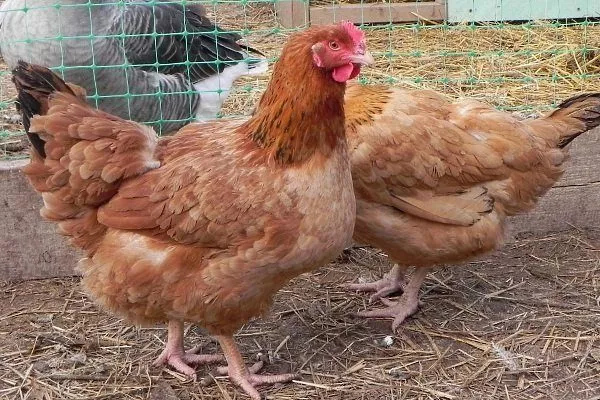
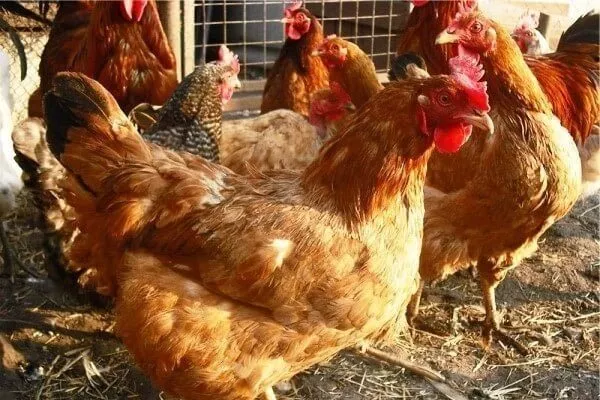
Exterior
The giants are indeed very large, with a massive body, as befits the descendants of Cochins and Orpingtons. Despite their small stature, the bird appears squat.
Characteristic exterior features:
- Carcass - square and barrel-shaped.
- Chest and abdomen - clearly defined.
- Legs - powerful, yellow, without fluff.
- Wings - powerful, tightly pressed to the body.
- Skeleton and musculature - well developed.
- Plumage - reddish-brown, especially lush on the thighs and keel.
- Feathers - hard, with a warm layer of down.
- Tail - in females it is small, but in roosters it is clearly visible and colored black.
- Head - neat, with a small beak rounded at the edge.
- Neck - elongated, powerful.
- Scallop - round, bright red.
The Hungarian giants got their thick plumage from the Orpingtons, and the Orpingtons from the Cochins.
Temperament
It's difficult to describe this breed's character in just a few words. Hungarian Giants are typical chickens, with all the nuances of a "chicken" character—they are cheerful, restless, and curious. However, they don't pose any particular problems for poultry farmers. Compared to many other breeds, Giants are quite well-behaved.
Only roosters are known for their quarrelsome and contentious nature. They actively defend their territory and "harem," so keeping several roosters in a small flock is undesirable. However, compared to many other breeds, giants are not aggressive and can coexist with a variety of other animals in a poultry yard.
During the mating season, the males are separated, leaving 6 hens per rooster.
The restless nature of this breed is taken into account when setting up the chicken coop. Everything is designed with maximum safety in mind, with high partitions, wide nests, and low perches (up to 0.5 m).
An overview of the Hungarian Giant chicken breed is presented in the following video:
Puberty and egg production
Like all meat-and-egg breeds, giants are balanced in terms of egg production—they're not record-breakers, but they're quite capable of performing well as layers. Hens begin laying eggs at 4-4.5 months. The first eggs are medium-sized, with light-brown, medium-thick shells.
While egg production is establishing, eggs may have defects, a result of calcium imbalances in the young organism. Later, hens lay larger eggs.
Although not an egg-laying breed, giants lay eggs every other day. However, their egg production is still higher than the average for dairy and meat breeds.
The instinct of incubation
Hens of this breed have a well-developed broody instinct. They sit responsibly and calmly on their clutches, never putting their future chicks through any hardships—they don't leave for long periods of time and vigilantly monitor the temperature of the eggs they're hatching.
The mother hen turns the eggs herself to ensure even heating. When the chicks hatch, the hen ensures their safety, accompanies them everywhere, and protects them when necessary.
A single broody hen can incubate 10 eggs at a time. The survival rate during natural hatching is almost 100%, demonstrating the high quality of incubation. The poultry farmer's job is to provide the broody hen with adequate nutrition. While sitting on a clutch, her body becomes exhausted.
Advantages and disadvantages
Advantages of Hungarian Giants:
- high weight and high meat yield;
- high productivity of meat and eggs;
- easily adapts to different climates;
- the instinct of brooding is well developed;
- healthy offspring;
- high survival rate;
- rapid weight gain;
- fairly large eggs;
- high - for meat and egg breeds, egg production;
- high immunity;
- resistance to temperature changes;
- precocity.
Compared to this list of advantages, the disadvantages of giants seem insignificant:
- short duration of egg production - a hen lays eggs for about a year, then it is used for meat;
- with irrational feeding, a tendency to obesity appears;
- demanding nature of food.
Overall, the breed has many more advantages, which is why it has maintained its popularity for so long. These chickens, without requiring any special care, reproduce quickly and easily, just as well as rabbits.
Productive qualities
Giants, being a meat and egg breed, gain weight quickly. In terms of meat production, they are second only to the renowned Hercules. However, the Hungarian Giant outperforms meat breeds in other important parameters – egg production and survival rate.
A distinctive feature of chickens of this breed is a clearly expressed relationship between nutrition and weight gain.
Productivity indicators
The breed is distinguished by its balanced meat and egg production. This is very advantageous for small private farms focused on achieving the dual benefits of meat and eggs. Meat yield is 60%.
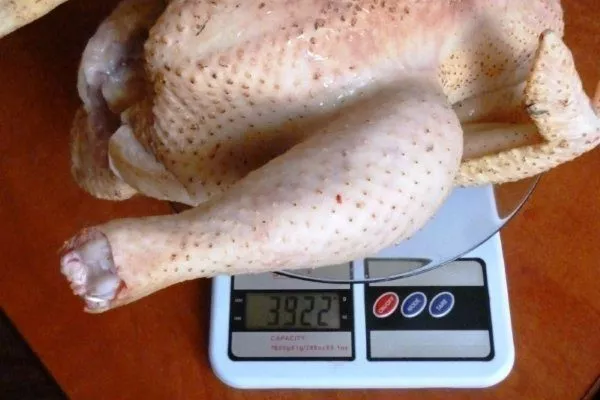
Hungarian Giant. Rooster, 7 months old.
The Hungarian Giant's weight gain dynamics:
| Age, months | Weight, kg |
| 2 | 2 |
| 3-4 | 2.5-3 |
| 12 | 4 – hens, 5 – roosters |
Egg production:
| Characteristics | Meaning |
| Egg weight, g | 55-70 |
| Number of eggs per year, pcs. | 170-200 |
Early maturity and taste of meat
Chickens grow quickly. At two months, they weigh about 2 kg. They are slaughtered at three to four months, by which time they weigh 2.5 to 3 kg. However, Hungarian Giants' meat remains tasty even after a year of life, producing delicious broths.
Velikan meat is tender and juicy, lean, and dietary. It contains no more than 10% fat and is high in protein. It is easily digestible and contains a rich array of vitamins—PP, B2, B6—as well as amino acids and trace elements.
The most nutritious part of the carcass is the breast. The legs and skin are considered the least nutritious, as this is where the most harmful substances accumulate.
The breed is distinguished by its meaty wings, which are very tasty when fried.
How to care for chickens?
Buying a productive breed is half the battle. To maximize profits from poultry, create favorable conditions:
- a properly equipped chicken coop with a run;
- full feeding in accordance with the regime;
- maintaining normal temperature and climate conditions.
Climate and walking
The breed is distinguished by its increased resistance to temperature fluctuations and cold. What you need to know:
- can easily withstand frosts down to minus 20 °C;
- chickens are let outside if the temperature is not below minus 10 °C;
- On frosty days, walking is short-term.
To maintain good physical condition, Hungarian Shepherds are walked outside in a special fenced yard. Features of the yard:
- the walking area is approximately twice the size of the chicken coop;
- the fence is made of wooden beams and metal mesh;
- fence height – 1.5-2 m;
- In the spring, the walking area is sown with wheat, oats or grass so that the birds have green food.
Thanks to their thick, dense plumage and excellent adaptability, this breed tolerates all natural disasters—heat, frost, and high humidity—well. Their high-quality plumage, like an Uzbek robe, protects these giants from the cold in winter and from the heat in summer.
Setting up a chicken coop
Red broilers have dense feathers, so they can live in unheated coops—provided the region's winter temperatures are suitable for the breed's frost resistance. These giants are kept in insulated coops protected from drafts. Heated boxes are essential for young birds up to one month old.
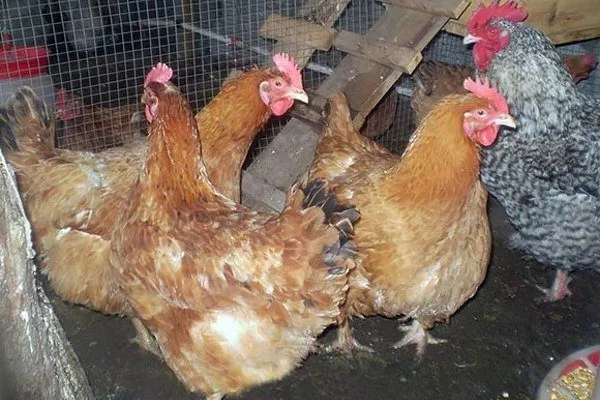
Rules and features of setting up a chicken coop for Hungarian giants:
- Giants are a large breed, so no more than two individuals should live per square meter.
- To avoid fighting, there shouldn't be too many roosters in one room. A maximum of 1-3 per coop is recommended. Males being fattened for slaughter can be kept in cages, without access to the outdoors.
- The floor is earthen or concrete.
- Bedding—straw, hay, or sawdust—is essential on the floor. The bedding is turned periodically, and fresh bedding is added as needed.
- Perches are recommended. These perches should be designed to accommodate the birds' heavy weight—it will be difficult for them to fly higher than half a meter. Keeping the birds without perches is also possible.
- Water bowls should be available and always filled with clean water. You can learn how to make your own water bowl from this article.
- In winter, lighting is required for 10-12 hours a day.
- ✓ Optimal stocking density: no more than 2 individuals per 1 sq. m.
- ✓ Temperature conditions for young animals: the first 7 days +26…+30 °C, with a gradual decrease.
Before introducing a new flock into the coop, it must be disinfected. The litter is changed, and the floor is sprinkled with slaked lime. Chickens must wear clean shoes when entering the coop to avoid spreading germs.
Read the article about How to build a chicken coop yourself.
Molting and break in egg laying
All laying hens experience a period of rest from the constant production of eggs. This break is associated with seasonal molting, which begins in the fall, when the hens' hormonal levels change due to shorter daylight hours. Feather loss is also associated with vitamin deficiency, stress, and metabolic imbalances.
The seasonal molt lasts about two months. After this period, the molt is complete, and the clutch returns. Often, the hens lay even more eggs than before the molt.
During molting, chickens are given vitamin premixes, grated fodder beetroot and lots of greens.
Feather loss may indicate a parasite infestation. The poultry house should be regularly disinfected, and the hens should be treated with insecticides and acaricides.
Planned replacement of the herd
One of the disadvantages of Hungarian Giants is their short laying period. Once peak egg production has passed, the hens are sent to slaughter. The most productive period is one year after puberty. The following year, the number of eggs laid decreases by about a quarter. By this time, replacement hens must be prepared.
When raised for meat, poultry are slaughtered at 3-4 months of age. After this age, their weight remains virtually constant, and their meat quality only deteriorates over time. The cost of production increases, and profits fall. Consequently, the meat herd must be replaced every three months.
If chickens are raised for meat, the first batch of eggs is laid in February. In March, the chickens are raised in a crèche, and in April, in a coop with a run. The next batch is planned to ensure a continuous cycle of meat production.
How and what to feed?
Giants are large and substantial, but have a moderate appetite. Proper, balanced, and nutritious feeding will not only ensure high productivity but also prevent disease.
Feeding principles:
- Most of the proteins, fats and carbohydrates come from combined grain mixtures – they are purchased or prepared at home.
- Chickens are fed a variety of grains, but wheat is the staple. Barley, oats, millet, rye, peas, and corn are also given.
- To prevent hens from having a deficiency of vitamins, amino acids and minerals, their diet is supplemented with chalk, vegetables, grass and vitamin supplements.
- In winter, mixed porridges made with broth or skim milk are beneficial. Warm porridge in winter is not only a source of energy but also warmth.
- Birds are given clean, cool water in summer and heated water in winter.
- The feeding schedule for adult birds is 2-3 times a day. Feedings should be regular, and the birds should be accustomed to the schedule.
To ensure Hungarian Giants gain weight quickly and produce plenty of eggs, they are fed special compound feed—they need a certain amount of protein. This is the approach taken by large commercial producers, while summer residents and small farm owners often feed these birds kitchen scraps and garden produce. On such a diet, giants grow slowly, and egg production declines.
To ensure that the bird receives the full range of nutrients, you will have to either buy compound feed, or prepare it yourself - from grains and other ingredients.
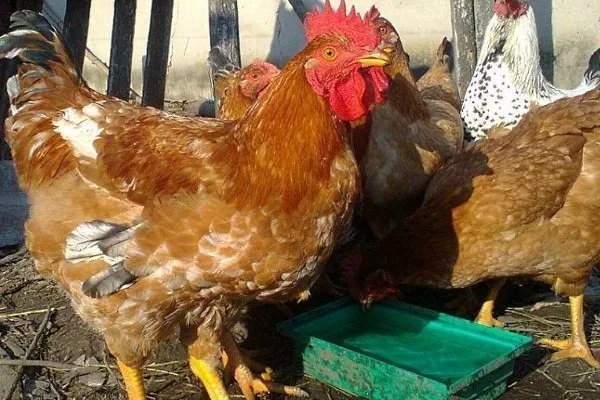
Recommended diet for adult birds:
| Ingredient | Quantity, % |
| Crushed corn | 40 |
| Wheat | 22 |
| Barley | 18 |
| Split peas | 12 |
| Animal protein | 8 |
To prevent livestock from suffering from a calcium deficiency, crushed chalk, shells or eggshells are added to the feed.
Breeding Hungarian Giant chickens
When breeding giant chickens at home, hatching is not a problem; these hens are excellent brooders. The second generation becomes more meat- or egg-producing, depending on the crossbreeding.
Incubation
Chickens are bred using any method—incubation or with a broody hen. The eggs are checked for fertility using an ovoscope. This device allows for the early detection of defects.
Defects that cause eggs to be rejected:
- the air chamber is displaced;
- the shell is thin or has defects;
- age over 7 days.
Features of hatching eggs using different methods:
- In the incubator. Eggs for laying are selected to be of the same weight, then the chicks hatch almost simultaneously. Rules laying eggs in an incubator:
- the eggs being laid should be at room temperature;
- turn the eggs at least 4 times a day;
- incubation period – 21 days;
- On the 5th-1st day, the eggs are checked with an ovoscope to identify defective ones, those without signs of an embryo.
- A hen. Hens begin to hatch eggs in the spring and summer. They cluck, sit in the nest for a long time, and then pluck down from their breasts and line the nest with it. Before laying eggs, wooden decoys are placed in the nest.
If a hen is serious about hatching chicks, she doesn't leave the nest—she trades the decoy eggs for real ones. The nest is built in a quiet, semi-dark place—the hen needs to feel safe. This method of hatching is only suitable for private farms; in industrial breeding of giants, incubation is used.
| Method | Advantages | Flaws |
|---|---|---|
| Incubator | Temperature and humidity control, the ability to hatch large numbers of chicks at once | Requires constant attention and turning of eggs |
| Hen | A natural process that does not require human intervention | Limited number of eggs, depending on the hen's mood |
Caring for young animals
The chicks peck their shells themselves. Once they are completely dry, they are removed from the incubator. With natural hatching, the hen controls the pipping and drying process herself. The chicks are placed in a crate—a small box. At the bottom is a heating pad to maintain a temperature of 30°C. A clean blanket is placed on top of the heating pad to keep the chicks cool.
Requirements and care features:
- Temperature during chicken growth:
- 1st week – from +26 to +30 °C;
- 2nd week – from +23 to +27 °C;
- then the temperature is maintained at +19 °C.
- Lighting is provided 24/7. The nursery is equipped with a lamp with adjustable intensity, which must be reduced over time.
- Regular diaper changes – chickens need to be clean, otherwise the risk of developing diseases increases.
Feeding chickens
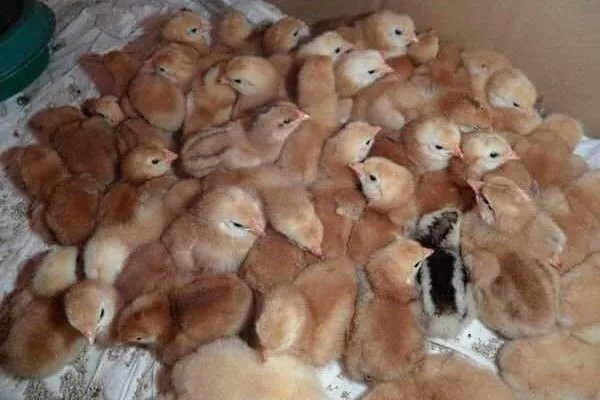
The chicks' first food is chopped egg with millet. The water bowl is filled with rosehip or chamomile infusion.
When feeding, the following feeds are used:
- for chickens - "Start";
- for young animals – “Fattening”;
- at 3 months and until slaughter – “Finish”.
Throughout the entire feeding period, the chicks are provided with fresh and clean water (+20 °C).
Frequency of feeding chickens:
| Age, weeks | Number of feedings, times per day |
| 1 | 8 |
| 2 | 6 |
| 3 | 4 |
| 4 and further | 2 |
Chickens are fed compound feed according to the standard tables provided on the feed packaging. The feeding schedule is as follows:
- During the first 5 days, the chick eats approximately 15-20 g of food.
- On the 20th day, the chick already eats 90 g of starter feed.
- Next, he is transferred to fattening compound feed. At two months, he eats 150 g.
- From the third month, the chicks are transferred to finishing feed - 160-170 g.
Diet for chickens using natural feed:
| Age | What do they feed you? |
| 1-2 weeks | millet, crushed oats and barley, cottage cheese, yogurt, herbs, chopped egg, grated pumpkin and carrots |
| 3-4 weeks | Less millet is given, eggs are not given, the grain diet is supplemented with boiled potatoes, yeast, fish meal, crushed corn and wheat |
| from 5 weeks | They are fed whole grains, mash, vegetables and greens. |
The chickens' diet also necessarily includes vitamin and mineral supplements.
Diseases
The Hungarian Giant has a strong immune system, which allows the breed to have a high survival rate among young animals and a low incidence of disease. With proper care and nutrition, health problems are usually uncommon.
To protect the herd from diseases, preventative measures are recommended:
- regular examination for the presence of blood-sucking parasites;
- vaccinations against salmonellosis and infectious bronchitis.
Chickens of this breed can be affected by skin parasites and infectious diseases:
- tuberculosis;
- salmonellosis;
- pasteurellosis;
- colibacillosis.
Any infection is accompanied by lethargy, decreased appetite, and diarrhea. Chickens are treated with antibiotics. In some cases, it's more cost-effective to slaughter sick birds and treat the rest as a preventative measure.
An important preventative measure to prevent infections and parasites is regular disinfection of the chicken coop and all equipment.
Where and at what cost can I buy it?
It's recommended to buy Hungarian giants from poultry farms—it's more reliable. For example, they're sold by the private farm "Veselaya Ryaba" (Kurgan) and the farm "Komov Dvor" (near St. Petersburg). They sell day-old chicks, hatching eggs, and adult birds.
One egg costs about 80-100 rubles. Prices for poultry depend on its age:
- day-old chicks — 80-100 rubles;
- ten-day-old young animals — 600 rubles;
- rooster for breeding – 1,000 rubles;
- laying hen – 1,200 rubles.
Pitfalls when buying a breed
The most reliable way to obtain purebred Red Giants is to purchase them in Hungary, either independently or through reputable intermediaries. If you buy this breed through an ad, you risk acquiring birds that have lost their parental traits. When bred independently, these hens retain neither the qualities of the Hungarian Giant nor those of the parent breeds of the cross.
When buying from a private seller, you may end up with giants with the following problems:
- underdevelopment of the genitals;
- significantly lower weight – chickens grow half as big as they should;
- After switching from starter feed to a regular diet, development stops.
To obtain hatching eggs at home, Hungarian Giant hens are bred by Orpington roosters or Rhode IslandsIt is natural to observe a splitting of traits that disappear over time, which is why crossbreeds are sold in markets and private farms that do not achieve the stated productivity.
Breed analogues
The Hercules breed is most similar to the Hungarian Giant. These hens are distinguished by their large body weight. Roosters grow up to 4.8 kg. Hercules hens produce more eggs, up to 300 eggs per year. However, this breed is sensitive to housing and feeding conditions. If care is not taken, the stated productivity cannot be achieved.
Reviews of the breed
The Hungarian Giant will become the crown jewel of your poultry yard or farm if you purchase the first generation of this cross. Choose reputable breed suppliers and remember: you can only get the desired results from these giants with proper feeding.