
The Russian White chicken breed was developed specifically for farming in Russia. It is undemanding in terms of living conditions, hardy, and has a well-developed immune system. Even a novice farmer can manage this breed, but it is necessary to follow a few simple rules, which will be discussed later in the article.
Description of the breed
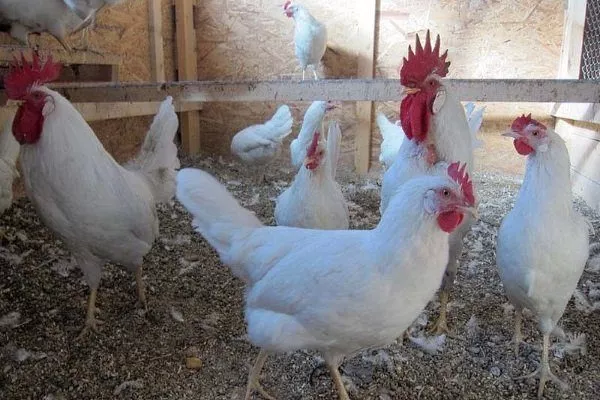
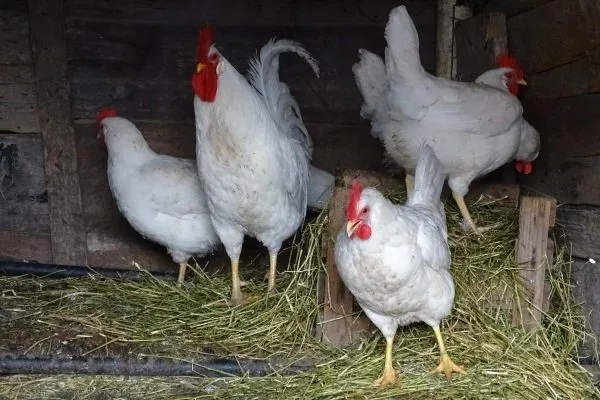
Russian White chickens are egg-laying breeds. They get their name from their pure white plumage.
The breed is undemanding in terms of maintenance conditions, tolerates the cold climate of the North well, has a strong immune system, and adapts well to new conditions.
A restless nature is one of the breed's special qualities, but they get used to their owners and become calmer.
Origin
This breed was developed in the 1830s. It is based on local chickens of uncertain origin and noble Leghorns.
The breed immediately became a favorite in backyards, and during the country's industrial development, on poultry farms. Its absolute popularity lasted until the 1990s. During this time, Leghorns and crosses with superior egg production began to enter the Russian poultry market, causing the Russian White to lose ground.
Nevertheless, breeders are working to improve the characteristics of hens, achieving competitive qualities. While in the past, hens produced up to 190 eggs per year, now they produce 200 and even 244, but this comes at the cost of a loss of up to 56 g in egg weight, as well as a loss in the hen's own weight.
Characteristics and standards of Russian White chickens
Representatives of the breed are distinguished by their strong build. Their body structure can be described as follows:
- a slender bird with a slightly elongated body;
- the head is of medium size, developed proportionally, proudly carried;
- strong neck;
- broad chest and belly;
- legs and beak are always only yellow;
- legs without feathers, strong;
- white earlobes;
- chickens have a small, well-developed tail;
- roosters have beautiful, fluffy tails;
- the comb of the chicken is not vertical, but leans to the side;
- Roosters have a leaf-shaped comb with five teeth and red wattles.
Adult Russian White roosters weigh up to 2.5 kg, and hens – up to 1.8 kg.
The breeder presents an overview of the Russian White chicken breed in the video below:
Puberty, productivity
The Russian White breed is considered an early maturing breed. Hens reach maturity at 5 months and begin laying eggs, and roosters do so even earlier.
These hens are high egg producers, producing up to 240 eggs per year. They lay for a long time, with virtually no decline in production in their second and third years, which is rare even among egg-laying breeds.
Ten hens lay 8-9 eggs per week, each laying 2-3 eggs and then taking a 24-hour break. The eggs are yellowish or white, elongated, and weigh between 50 and 75 grams, making them tastier than those of many breeds.
Cockerels gain weight by six months, reaching 1.7 to 2 kg, and by seven months, their weight reaches 2.2 kg. Their meat is of average taste and is considered bland.
Advantages and disadvantages
The main advantages of the Russian White breed include:
- strong immunity;
- stress resistance;
- premature puberty;
- high productivity;
- unpretentiousness and adaptation to living conditions;
- good cold tolerance;
- The small weight of the chicken allows you to save on food.
The disadvantages of the breed include:
- white feather color requires cleanliness in the chicken coop and aviaries;
- eggs are not large in size;
- not high enough taste qualities of meat;
- timidity and excitability.
Breeding chickens without a range
Chickens of this breed can be kept in battery cages.
If chickens are bred on an industrial scale, it is permissible to install cages in several tiers.
Conditions
The area of the cages is calculated using the formula: 1 sq. m of cage per 8 adult chickens.
- ✓ Optimal stocking density: no more than 4 hens per 1 sq. m in the coop to ensure sufficient space.
- ✓ Temperature conditions: maintaining the temperature in the chicken coop at least 12°C in winter to prevent a decrease in egg production.
In this case, you should adhere to the following rules:
- Purity. Cages should always be kept clean. Clean and disinfect them regularly.
- Ventilation. A closed chicken coop must have sufficient fresh air. Consider installing vents or transoms.
- Access to food. Each individual must have unimpeded access to food. Install feeders of appropriate length.
- Drinking bowls. Water bowls should always be stocked with clean water and easily accessible. Keep them regularly refilled and clean.
- Temperature. The recommended room temperature is 12-19°C in winter and up to 24°C in summer. If necessary, install additional heat sources during cold periods.
- Humidity. It shouldn't exceed 70%. A deviation of 1-2% is acceptable. Monitor this indicator, otherwise the bird will start to get sick.
- Illumination. Adjust the lighting – extending daylight hours has a positive effect on egg production.
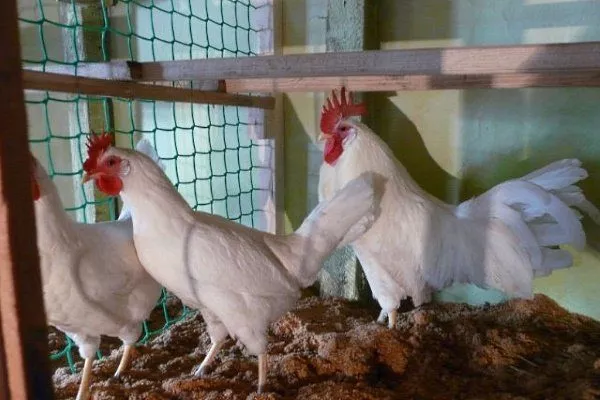
If the rules of keeping chickens are violated, they lose productivity and start to get sick.
Cells
You can buy ready-made cages or build them yourself by following the basic rules.
When making cells, please note:
- Frame. Make it from metal or wood.
- Walls. Construct the back and side walls of the cage from fine-mesh wire, chain-link fencing, or plywood. It's best to make the front wall from metal rods so the bird can reach the feeder.
- Bottom. Make the bottom two-tiered to make it easier to keep clean. Make the surface where the chickens will be kept (the floor) out of fine-mesh wire mesh so the birds can stand on it.
- Pallet. Attach a tray made of slate, plywood, or polycarbonate to the bottom, under the mesh floor. This will collect the bird's waste.
The tray should be kept clean and thoroughly cleaned every 15-20 days.
- Egg collector. Attach the bottom base at an angle for rolling eggs. At its lowest point, install a mesh egg collector 22-24 cm away from the bottom with open access for removing eggs.
- Feeder. Attach to the front wall of the cage. It should extend the entire length of the cage.
- Light sources. If there are no windows, install spotlights near each cage.
Breeding chickens with free-range access
Breeding Russian White chickens with a range requires dividing the territory into 2 zones:
- chicken coop, where the bird will lay eggs and spend the night;
- poultry yard, where the chickens can roam freely and forage.
In this case, the ratio of areas is observed: 1-2 parts is the area of the chicken coop, 3 is the area of the walking yard.
Raising hens in a free-range environment is the preferred option. This provides the hens with greater comfort, which positively impacts egg production.
Poultry house
The construction of a poultry house includes the following structures:
- Walls. You can use chipboard, 5-12 mm plywood or boards for construction.
- Insulation. The chicken coop is insulated from external weather conditions, wild birds, and animals using walls, one of which should have a door. Seal all cracks and holes in the walls to prevent drafts.
- Canopy and roof. Install a roof over the bird's habitat and a canopy over the exit to provide shelter during adverse weather conditions.
- Nests. The number of nests depends on the number of hens. Place them along the walls and line them with straw.
- Ladder. To make it easy for the hens to climb into the nest, install a small ladder or board at least 15 cm wide near each of them.
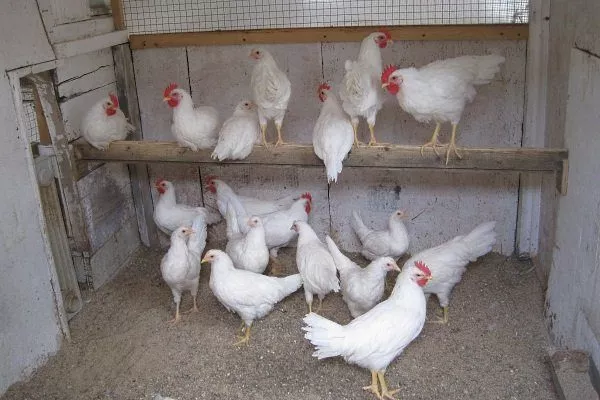
- Perches. They should be installed about 0.5-0.7 m above the floor, either level or gradually rising, to prevent hens in the upper perches from soiling those in the lower perches with their droppings. Construct them from sturdy wooden poles, 2-3 cm in diameter, to prevent the hens' feet from freezing and to provide easy access.
Fix the poles firmly so they cannot rotate.
- Bedding. Choose a large one and lay it out in a thick layer. It should be changed frequently, as the white feathers can stain.
- Feeders and drinkers. Bring feeders and waterers into the poultry house in winter to prevent water and feed from freezing.
Poultry yard
Surround the poultry yard with a high fence - Russian whites fly well.
When constructing, consider:
- Fencing frame. Build a frame around the walking area from wooden beams or solid welded pipe.
- Fencing. Stretch the mesh along the outer sides. The mesh openings should be less than 5 cm.
- Laz. Leave a special opening from the chicken coop to the walking yard for the chickens to move freely.
- Development of the territory. Make sure there are no stagnant puddles in the yard and that there are no objects or plants that could be dangerous to chickens. Also, make sure your chickens don't roam in dusty areas.
- Feeders and drinkers. During warmer months, install feeders and waterers in the exercise yard. Cover them with a shelter to prevent rainwater from contaminating the feed.
Bird nutrition
Russian White chickens need to be well fed, especially from six months to a year, when they begin laying eggs and productivity is established.
The diet should include sufficient amounts of:
- Fats. They provide energy and can be obtained from corn and oats.
- Squirrels. "Building" material for full growth. Found in high concentrations in legumes, meat and bone meal.
- Carbohydrates. They ensure the smooth functioning of internal organs and metabolic processes. Contained in whole grains.
- Vitamins. Vitamins A, B, and D are essential. They are found in abundance in fresh vegetables and greens.
- Minerals. For eggshell formation. Contained in additives such as ash and eggshells.
It is desirable to provide the opportunity for foraging in open spaces.
There are two possible feeding schemes for Russian White chickens:
- With ready-made commercial feeds:
- compound feed;
- mash;
- vegetables.
- Self-prepared food:
- wet mash of potatoes and vegetables;
- corn;
- fresh vegetables and herbs.
To improve digestion, the bird should have access to containers with sand, pebbles or shell rock.
A laying hen should eat 120-140 g of dry feed or 170 g of liquid feed per day, divided into 3-4 meals. This regimen will prevent the hen from becoming overweight and will allow her to produce enough eggs.
Distribution of feed per day:
- Morning. It is best to feed whole grains.
- Day. Wet mash, include more mineral and vitamin supplements in the feed.
- Evening. Succulent feed, greens.
Table of optimal diet per individual per day:
| Ingredient | Weight, g |
| Corn | 50 |
| Protein feed, mash | 10 |
| Succulent feed, greens | 30 |
| Vitamin and mineral supplements | 15 |
| Bone meal | 2 |
Breeding chickens
The breed has a poor brooding instinct, so they are hatched in incubators or their eggs are placed under hens of other breeds.
For incubation, it is customary to select elongated white eggs of at least 60 g. They are stored for no more than 2 weeks in a cool room.
Hatching Russian White chickens in an incubator is no different from hatching other breeds. Read more about incubating chicken eggs. Here.
Russian White Chicken chicks are distinguished by their survival rate (94-99%) and health.
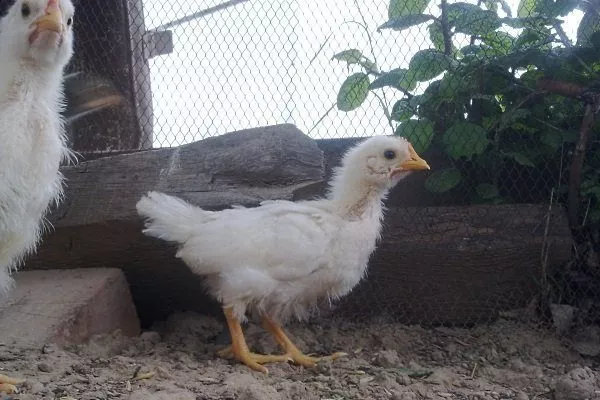
They are characterized by the following indicators:
- a day after birth, the chick’s weight reaches 44-46 g;
- the downy covering is yellow, sometimes white, without inclusions;
- at 2-3 weeks the sex of the chicks becomes distinguishable - the combs of the cockerels become larger and redder, and the combs of the hens become yellowish-pink;
- During this period, the down is gradually replaced by white feathers;
- 30-day-old chicks weigh 650 g;
- maximum growth force is observed at 6 months;
- very active from the first days, but timid.
- ✓ Yellow fluff without inclusions indicates good health of the chicken.
- ✓ Activity and absence of lethargy in the first days of life is an important indicator of vitality.
Care
After hatching in the incubator, the chicks are transferred to a cardboard box at a rate of 13-14 chicks per 1 square meter.
Proper care:
- Heating. Place a heat lamp above the box and maintain a temperature of 30°C underneath it.
Different breeders have different opinions on this matter. Some prefer to keep the brooder temperature at 28 or 29°C, while others believe this is too low.It is important to heat the box space unevenly so that each chick can be in a place with an optimal temperature for it.
- Bedding. Line the bottom of the box with paper and replace it as needed.
After two weeks of growth, replace the paper with a highly absorbent cloth bedding. Cotton or wool fabric is suitable, but it should be disinfected before use and changed as it becomes soiled. - First walk. After a month, when their bodies have strengthened and become less sensitive to cold, take the chicks outside in good weather. Set up a separate enclosure for this purpose.
Feeding
Feed your chickens according to the following rules:
- Feed newly hatched chicks with boiled, mashed eggs with semolina or starter feed.
Gradually add greens and cottage cheese. After one month, introduce vegetables into the diet.Chicks are not restricted in their food intake until they are 8 weeks old. After that, the feed amount is reduced by 20%.
- After two months, feed the grown chicks along with the adults. To prepare young hens for egg production, increase their daily protein intake.
- The box where the chicks are initially kept should be filled with warm water. Provide a waterer and maintain the water temperature at the chick's body temperature.
- The dishes used by the chicks for feeding should always be clean and sterile. To do this, wash them in a baking soda solution once a day, then treat them with a 1% potassium permanganate solution.
The water temperature for chickens should be 30-40 °C.
Diseases
This breed has good health and is particularly immune to internal organ carcinoma, leukemia and neoplastic diseases such as Marek's disease.
However, the Russian White is susceptible to a number of infectious diseases:
- Salmonellosis. Symptoms include increased thirst, decreased appetite, and physical inactivity, with hens falling over. Their stools are loose and foamy. Affected individuals are isolated and given a furazolidone solution (1 tablet per 3 liters of water) for 21 days.
- Colibacillosis. Body temperature rises, accompanied by thirst. Wheezing may be heard. Treatment involves the use of Biomycin at a dose of 0.01 g per 1 kg of bird weight.
- Pasteurellosis. Symptoms include a lack of movement, fever, thirst, and severe nasal discharge. Stools are loose. Patients are isolated and given tetracycline (1-3% solution) at 500 mg/day for 3 weeks.
- Newcastle disease. Chickens refuse to eat, have difficulty breathing, and noticeably discharge foul-smelling mucus from their beaks. A few days after symptoms appear, the chickens' combs turn blue and the bird dies. There is no cure for this disease.
- Tuberculosis. Affects any organ of chickens. Symptoms include lethargy and paleness of the comb and wattles. There is no cure.
After identifying and treating infectious diseases, the chicken coop is disinfected.
In addition to infectious diseases, chickens can suffer from a number of illnesses associated with poor nutrition and sanitary conditions:
- Atony of the goiter. Over time, the goiter hardens and sags. Death is possible.
- Gastroenteritis. Appetite decreases, the bird becomes lethargic, and the stool becomes loose.
- Cloacite. Inflammation in the cloacal area.
- Avitaminosis. It manifests itself in pecking of eggs and lethargic behavior.
Non-infectious diseases are treated by improving sanitary conditions and a balanced diet with increased vitamin content.
Molting and break in egg production
Shedding is manifested by the following signs:
- loss of appetite;
- motor lethargy;
- deterioration of appearance;
- break in egg production.
Molting in chickens is not a disease.
During the molting period, provide your hens with a balanced diet and a warm environment. After two months, they will begin laying again.
Planned replacement of the herd
A Russian White family consists of 10 hens and one male with a spare rooster.
Features of breed reproduction and frequency of replacement:
- On an industrial scale, laying hens are kept for no more than 2 years, in private farms – up to 3-4 years;
- Due to the high activity of roosters, they are kept separately until families are formed;
- by crossing the Russian White with the Livenskaya Chintz, Welsumer, and Kuchinskaya, highly productive crosses are obtained;
- The breed requires serious breeding selection; for example, it is not recommended to breed chickens that are very similar to Leghorns.
You can replenish or renew your flock by purchasing hatching eggs or chicks.
Breeding of Russian Whites is carried out by:
- Maryinskaya poultry farm, Stavropol Krai;
- Mashuk poultry farm in Yessentuki;
- JSC Adler Poultry Farm, Sochi.
Reviews
The farmer has no problems raising Russian White chickens. These eggs are egg-laying birds, and their productivity remains high for about three years. They are undemanding in terms of feed and living conditions, and they survive the winter well. The only drawbacks noted by poultry farmers are a loss of broodiness and the poor taste of their meat.