
Pervomayskiye chickens are very popular with our farmers. Pervomayskiye chickens gain weight quickly and lay eggs well year-round. This highly productive breed is popular with both small and large farmers. Let's find out what else makes Pervomayskiye chickens so special, and how to breed and raise them.
History of the breed
The Pervomaysky chicken breed was developed in Kharkiv before World War II. The breed is nearly 80 years old, but remains popular due to its exceptional productivity. It was developed from Yurlov Vocal chickens and two American breeds: White Wyandottes and Rhode Island Hens.
The breed's development began in 1935 and was completed in 1941. During the war, the population was virtually wiped out. Only a few dozen individuals remained. But our poultry farmers not only managed to restore the breed but also increased its numbers so much that Pervomayskiye chickens spread to all poultry farms across the country.
Characteristics and standards of the Pervomayskaya breed
Over the course of selection, Pervomayskiye chickens acquired the appearance inherited from their parent breeds. These powerful, short-legged chickens have a modest yet impressive appearance.
Color and plumage
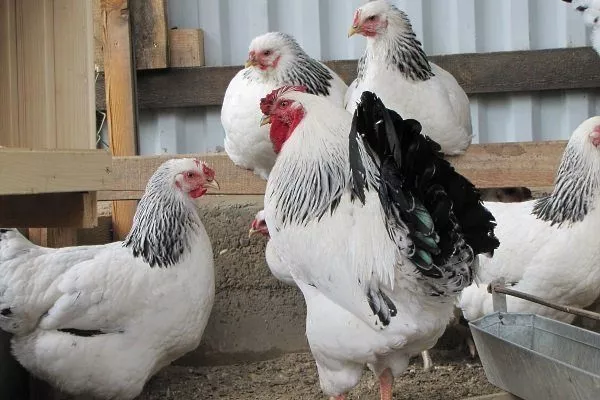
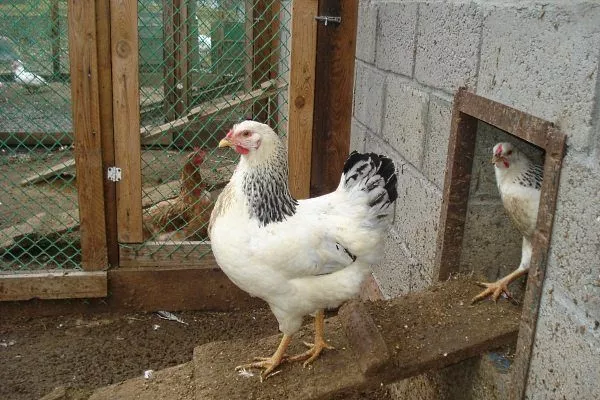
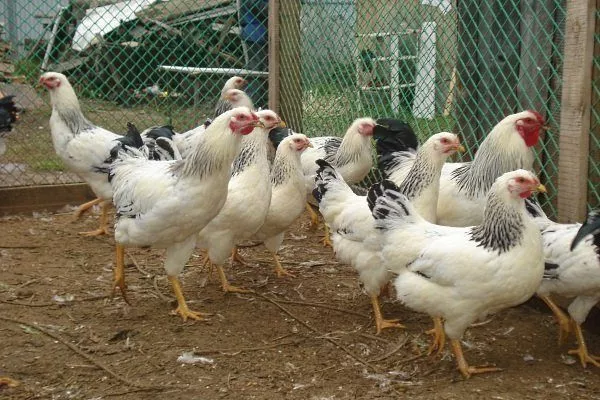
The Columbian color is the breed's main distinguishing feature. This coloration features white feathers with a black edging around the neck. Dark feathers also appear at the tips of the tail and flight feathers. Silvery-white chickens with a lush black and white "ruff" around the neck have a prim yet elegant appearance.
Color of Pervomaysky chickens:
- frame - white;
- head - white;
- feathers on the neck – black, feather shafts – white;
- wings - white on the outside, with black feathers on the inside;
- tail - black, black feathers often have a white edge.
The feathers of the Pervomaysk chickens are stiff and tightly packed. Due to the increased density of their plumage, these chickens are reliably protected from adverse environmental factors such as wind, cold, and precipitation.
Torso
Both Pervomayskaya hens and roosters are quite large—they have a powerful frame, a strong build, and well-muscled muscles. The chest is rounded and protruding. The legs are short in comparison to the body. The tail is small and slightly bushy. The bones and muscles are well developed. The body is wide and slightly elongated. Small wings are held tightly to the sides.
Neck and head
The head of Pervomayskiye chickens is small but wide, with a short neck. Features and characteristic signs of the head:
- Crest - rose-shaped. Combs of this type are typical of frost-resistant breeds—they are less susceptible to frost damage.
- Earrings and earlobes - red, elongated, oval.
- Beak – black and yellow in color. The edges of the beak have a yellow edging.
Character
The main character trait of Pervomayskaya chickens is their calm demeanor. This breed is not known for being quarrelsome or quarrelsome; they are unafraid of people and easily get along with other chicken breeds. They are only known for their liveliness and stubbornness during the growing season, when they experience an excess of energy.
An overview of the Pervomayskie chicken breed is presented in the video below:
Character traits of Pervomayskaya hens and roosters:
- phlegmatic;
- stress-resistant;
- docile;
- recognize the authority of the leader.
Puberty and egg production
This old, proven breed, unlike newer crosses that lay eggs at four months of age, matures significantly later. The first clutch appears around seven months. Although late maturing, these hens are characterized by long and high egg production.
A distinctive feature of the breed is the close relationship between egg production and the quality and quantity of feed during the cold season. If the hens aren't provided with favorable conditions, they may stop laying altogether. However, once a normal diet is restored, egg production returns to its previous level.
After 1.5 to 2 years, hens experience a natural decline in productivity. Therefore, it is during this period that young laying hens should be introduced into the house.
When is the break in egg laying?
In the fall, to avoid artificially stimulating molting, poultry farmers gradually reduce daylight hours. At the onset of molting, hens' appearance deteriorates as they lose some feathers. New feathers then grow in their place. During molting, laying ceases. After 2-2.5 months, laying resumes and continues throughout the winter.
The instinct of incubation
Pervomaika hens are distinguished by a well-developed brooding instinct. This breed is ideal for those who don't have time to care for chicks—the hens will hatch them and care for them themselves.
Mature hens sit on their own eggs to hatch their young. During incubation, they demonstrate patience and self-sacrifice, resulting in strong and healthy offspring. First-time hens make calm and responsible mothers.
Productivity
The breed is distinguished by high productivity in all parameters:
- 98-100% of eggs are fertile and suitable for hatching healthy chicks.
- The average annual egg production of one laying hen is 160-200 eggs. The eggs are tasty, small (weighing about 58-60 g), and have a brown shell.
- The weight of a hen is 2.5-3 kg, the weight of a rooster is 3.8-4 kg.
Although this breed of hens has a well-developed maternal instinct, egg collection is not a problem—people can easily collect them. The hens lay regularly, in one place, without trying to hide the eggs.
Advantages and disadvantages
Advantages of the Pervomayskaya breed:
- high productivity;
- good health, resistance to diseases;
- cold resistance;
- well-developed maternal instinct;
- balanced disposition;
- high survival rate of chickens;
- good adaptive abilities;
- rapid weight gain with normal feeding.
The May Day owls have almost no disadvantages, except that the young ones have a somewhat quarrelsome and timid nature.
Conditions of detention
Pervomaysky are medium-heavy birds and tolerate crowded conditions well. However, fighting over territory is possible. To achieve high egg production, it is necessary to provide the birds with good living conditions—a warm barn and a spacious run.
The Pervomayskaya breed is productive in any climate and is bred throughout Russia, from the southern regions to the Far East.
Poultry house
A barn or coop for Pervomayskaya chickens is built from wood—beams, railroad ties, or planks will all work. Requirements for the coop:
- insulated building;
- the room is dry, warm, well ventilated;
- no drafts;
- the presence of a window to allow sunlight in;
- dry bedding on the floor - hay, straw, sawdust;
- in an unheated poultry house, the thickness of the litter in winter is up to 40 cm, then the temperature in the room will always be above zero;
- If there is no heating in the poultry houses, you can turn on a safe electric heater.
The litter needs to be changed as it gets dirty, otherwise the quality of the hens' egg production will decrease.
Poultry house equipment
The barn in which the Pervomayskiye chickens are kept is equipped with:
- Perches. They are made from 40x40 mm beams or poles. They are placed 60-100 cm above the floor. They are secured to the walls or supported by a beam of similar cross-section.
- Feeders. They're made from planks angled like the letter V. Two beams are nailed to the bottom to create the legs. To prevent the chickens from climbing into the feeder, a free-swinging perch is attached along the entire length, in the center. It's secured to metal pins that are attached to beams nailed to the end boards. The perch prevents the chickens from climbing into the feeder. Read on to learn how to make your own chicken feeder. here.
- Nests. They are made of plywood or planks. The "houses" measure 30 x 30 x 25 cm. The entrance to the nest is 20 cm wide. A small threshold is made at the entrance to prevent eggs from rolling out. The bottom of the nest is lined with straw. The nests are placed at the same level as the perches.
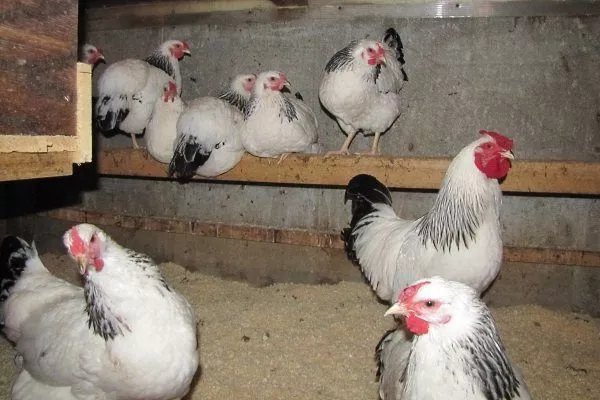
You will also need space for feed and a table for preparing mash.
Walking
Pervomaysky chickens are sedentary, but they need time outdoors to maintain a strong immune system. They should be allowed outside even in winter. A fenced-off area on the young side of the barn is used for this run. Given the chickens' mobility, the run should be spacious enough. When determining its size, the standard is 2-3 square meters per bird. The run is enclosed with wire mesh.
If the run is built separately from the chicken coop, it is necessary to build a canopy so that the birds can shelter under it from the scorching sun and precipitation.
Feeding Features
The Pervomayskaya breed is not picky about food—they'll eat whatever they're given. However, if the diet isn't carefully planned, health and egg production problems are inevitable.
Principles of feeding adult birds:
- The basis of the diet is whole grains.
- The daily grain intake is 40-50 g.
- In winter, the grain rate is slightly increased, and in summer, it is reduced.
- Crushed grain is added to the mash.
- Mashed milk is given in the morning or at lunchtime.
- In summer, greens are produced at 40-50 g per individual.
- In winter, instead of greens, give 10-15 g of dry concentrate.
- Every day – mineral supplements (bone and meat and bone meal, chalk – 3-4 g, salt – up to 1 g).
- During active laying, the chalk rate is increased.
- Chickens are periodically given animal proteins. Three to four times a week, they are fed skim milk, broths, and meat scraps.
- In winter, give 30-50 g of root vegetables per day.
- Use supplements in moderation. Give up to 10 g of yeast and 3-4 drops of fish oil.
The diet of Pervomayskaya chickens is influenced by the purpose for which they are raised – for eggs, meat or for breeding.
On the tribe
Breeding chickens are fed 120-180 g of feed per chicken, depending on the season and nutritional value. Feeding guidelines:
- they are always fed vegetables;
- fatty and starchy foods are given in limited quantities - up to 20% of the total diet;
- access to greenery must be provided.
For meat
Birds fattened for meat are given a lot compound feed and mash. They are fed protein products—fishmeal, meat scraps, milk products, vitamins, and minerals. Young animals up to 1.5 months old are fed compound feed.
Layers
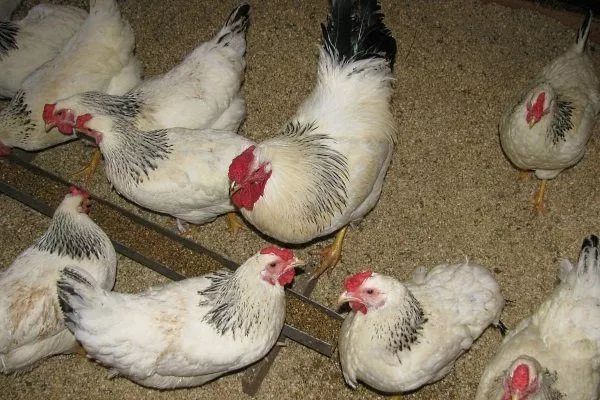
Laying hens are given vitaminsFeed is rationed. If the hens' feet turn pale during laying season, it means they need carotene. A carotene premix or foods containing this vitamin, such as pumpkin and carrots, are immediately added to the diet.
Reproduction
To start your first flock, it's recommended to purchase hatching eggs from poultry farms that breed purebred birds. Hens, who readily sit on eggs, will be able to reproduce the flock. An incubator can also be used.
Breeding options
There are several methods of breeding:
- Hatching eggs are purchased from different poultry farms to create two unrelated families. Each family has two roosters—a foundation rooster and a backup. These roosters produce the first generation of young. The males are slaughtered, and the young hens are retained. The following year, the second generation is produced. Subsequent family ties are undesirable, and a replacement rooster is taken from another family. The pullets are mixed—half the family's own and half the other family's. This method allows hens to be bred for up to 10 years without purchasing birds.
- If you have a large coop, you can form five chicken groups. Four groups of chickens are bred into two lines, with roosters placed with neighboring chickens. The fifth group is bred independently and used as a backup.
- This method is convenient for those who cannot afford to purchase and incubate purebred eggs but have access to purebred roosters. Non-pedigree hens are crossed with the first purebred rooster. The offspring are crossed with the second rooster, and the third generation is crossed with the third rooster. This selection process results in nearly purebred hens.
Incubation of eggs
Incubation is a complex process in which the immunity of future chicks is influenced by the parameters in the chamber, the frequency of turning, and ventilation.
- ✓ The optimal temperature in the incubator should be maintained at 37.5°C with fluctuations of no more than ±0.5°C.
- ✓ Humidity in the incubator should be 50-55% in the first 18 days and increased to 65-70% in the last 3 days before hatching.
Incubation includes the following stages:
- inspection and culling of eggs;
- disinfection of selected eggs in potassium permanganate;
- laying eggs in an incubator;
- incubation;
- on the 20-21st day – hatching.
We recommend that you familiarize yourself with all the nuances in more detail.incubation of chicken eggs.
Selection of chicks
Hatched chicks are sorted for signs of deformity. Roughly equal numbers of chicks with desirable and undesirable traits are born. If a farmer hopes to improve the breed, chick selection must be rigorous and repeated.
The first sorting takes place immediately after hatching. The second is done 2-3 months later. Potential breeders are removed from the pool of individuals with:
- not rose-shaped combs, too large or too red;
- white metatarsus.
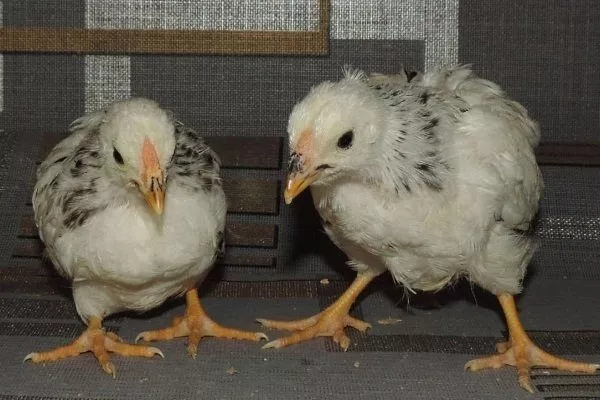
The final cull takes place after the first molt, when the birds' true colors become visible. From the remaining hens, ten hens and a rooster are selected for breeding. Fewer hens are not allowed, as roosters are particularly active.
Caring for chickens
Hens not only brood the chicks themselves but also provide excellent care for them, protecting them from birds, cats, and inclement weather, helping them find food in the pasture, and keeping them warm. If the chicks are under the hen's care, the temperature in the coop is maintained between 22°C and 24°C. The chicks grow very quickly, weighing about 1 kg by the end of the month.
It's important to provide proper care for day-old chicks. During the first day, they need a temperature of at least 33°C and a light on. The chicks are placed in a box covered with a cloth, with plastic bottles filled with hot water inside. Holes are made in the box for ventilation.
Feeding
Principles of feeding chickens:
- During the first few days, chicks are fed 5-6 times a day. After about 5 days, they are transitioned to 3-4 meals a day. They are given boiled eggs, greens, ground chicken, and vitamins.
- On the 10th day, the chicks are fed porridge, mash, dry grain mixtures, boiled vegetables, herbs and chalk.
- At 1.5 months, chicks are fully transitioned to an adult diet, with protein, chalk, lime, and shell rock. Glucose and vitamin C are given weekly.
Health
The breed is generally disease-resistant. Here's what you should know about the health of Pervomaikas:
- Infections attack them when hygiene in the poultry house and feeders is poor.
- Incorrect feeding, the predominance of dry food, often leads to crop blockage.
- Close inbreeding should not be allowed, as the offspring may be weak and unproductive.
- The rooster's voice may seem hoarse to inexperienced poultry farmers, but silence and quiet sounds are a characteristic of the Pervomayskaya breed.
- Young and adult chickens may suffer from digestive disorders, which are treated with black tea or St. John's wort infusion.
- Disinfect the poultry house and equipment every 2 months.
- Provide your chickens with vitamin supplements during molting to support their immune system.
- Check birds regularly for parasites and treat if necessary.
Planned replacement of the herd
The lifespan of Pervomayskaya hens is 10-12 years. Poultry farmers keep them for no more than four years, as long as they are productive layers. Peak egg production occurs at two years. If kept for meat, they are ready for slaughter at one year of age—that's when the meat is at its tastiest, juiciest, and most tender.
A hen can produce 2-3 broods per year, so replacing the flock with new stock is easy. All hatched chicks exactly resemble their parents.
How much do May Days cost?
The price of a single Pervomayskaya squirrel depends on its age, region, season, and other factors. However, on average, an adult costs between 600 and 2,000 rubles.
Breed analogues
There are breeds that share one or more characteristics with the Pervomayskiye chicken. Similar breeds are listed in the table:
| Signs and characteristics | Breeds similar to the Pervomaysky chickens |
| Egg production and carcass weight |
|
| Color and weight |
|
Helpful tips
Some useful tips for beginners:
- If you house birds with as similar plumage colors as possible, there will be fewer conflicts. Birds that look alike have no desire to compete for dominance.
- It's best to keep active and passive birds separately. Older, more assertive birds will always steal food from weaker chickens, pecking them at the same time.
- If you pour a little less feed into the feeder than required, the hens will not scatter it.
- If the chickens are fed a wet mash—with milk or another starter—they are given only as much as they can eat at a time. Any uneaten mash has to be thrown away, as it quickly turns sour.
Poultry farmers' reviews of the Pervomayskaya chicken breed
This old Soviet chicken breed has stood the test of time. Its popularity remains undiminished, thanks to its high productivity, hardiness, and good temperament. This breed is a useful addition to any farm or private household.