
Brown Nick chickens are known for their longevity, high productivity, and strong eggshells. They require little feed and are not picky eaters, making them a pleasure to raise and breed. Proper care and feeding are key.
History of the breed's origin
For several years, the German company International has been raising and breeding birds that lay large eggs and produce tasty meat, allowing people to make a good profit. In the 1960s, they selectively bred laying hens when dark eggshells became popular.
This chicken breed was listed in the book in 1965 as a high-productivity layer, resistant to dangerous chicken diseases, and with a high chick survival rate. Today, Braun chickens are bred not only in Germany, but hatching eggs and young birds are distributed to several dozen European and American countries.
Chickens of this breed can also be found in industrial farms in Russia. Many of them cooperate with the German corporation International.
External signs and character
The external characteristics of hens are determined by their gender. Roosters can be distinguished by the following characteristics:
- The feathers are white, and the body is large and massive. Compared to other egg-laying hybrids, the body build of this breed is atypical.
- The body is dense, trapezoidal in shape with a clearly defined sternum.
- The head and neck are of medium size, the comb with earrings is rich red.
- The beak is not straight, but slightly curved and is yellow in color with a slightly grayish tint.
- The keel is of medium length, the skin itself is light.
- The main leader can weigh 2.5 kg.
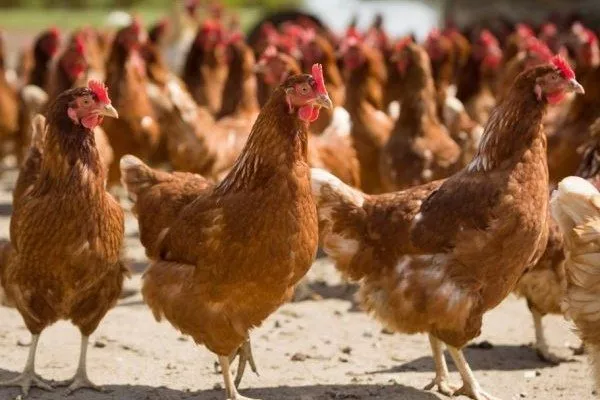
Laying hens have a completely different appearance, named for their smooth, rich, brownish-red feathers. The tip of their tail has white streaks, similar to those on the wingtips. Their bodies are smaller than those of males, trapezoidal in shape, with a short tail and wings held tightly to their bodies. Their comb is smaller than that of roosters (but also erect) and is also red. Hens can reach up to 2 kg (4.4 lbs) in live weight, but they are not raised for meat; Browns have one goal: year-round egg production.
Chickens have a docile, calm, and modest nature, making them easy to raise even for inexperienced owners. They are resilient and easily tolerate sudden changes in temperature and living conditions. They are not frightened by loud noises, and roosters get along well with people and other male birds, and are not aggressive.
On poultry farms, these birds are kept in small cages, and this is enough for them to live a wonderful life. If at home they have enough space to roam freely, that's great, as they'll be active. However, in this case, timely vaccination is essential, as there's a high risk of contracting diseases.
Poultry productivity
According to specialists at the German company, Brown Nick chickens have excellent characteristics. Chick survival rates are high, sexual maturity occurs at 21 weeks, and egg weight increases over time.
Meat
Brown Nick chickens are not kept for meat production, as they weigh less than 2 kg live and produce very little meat. Of course, if the bird must be slaughtered, its meat can be consumed, but it's best served whole, baked in the oven.
Eggs
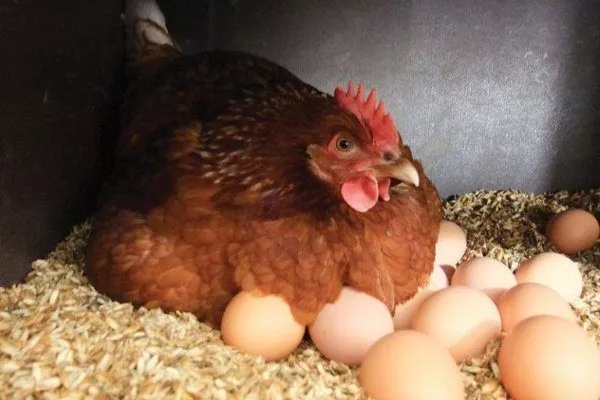
Incredibly, a Brown Nick hen can lay approximately 400 large, brown-shelled eggs in 12 months. Young birds under eight months old lay half that amount annually, or 200-250 eggs.
Young hens lay eggs weighing 60 grams, while an adult hen can lay eggs weighing up to 70 grams. Many poultry farmers report that chickens can be profitable not only for large companies but also for home-based farms, provided they are properly cared for, fed, and maintained.
Egg productivity in relation to the years of the bird is presented in the table:
| Age of the laying hen | Chicken weight | Number of eggs in 12 months | The weight of one egg |
| up to 13 months | 1.5-1.7 kg | 250 | 60 g |
| up to 18 months | 1.7-2 kg | 365 | 60 g |
| 1.5 years | 2-2.5 | about 400 | 70 g |
Brown eggs do not have the fishy odor found in eggs of other breeds.
Puberty and egg production
German farmers and ordinary people highly value the Brown Nick chicken because of its early egg production and high annual egg production. The breeders who developed this breed can be proud of the early maturity and good egg production of these hens. The hen first lays an egg at five months of age, and egg production continues year-round, even in extreme heat and severe frost.
Maternal intuition
Unfortunately, these hens have almost no maternal instinct. For a Brown Nick to be a good mother, she needs to incubate her eggs for many days. But they don't have the time for this, as they often lay eggs twice a day. For this reason, the chicks hatch by egg incubation.
Maintenance and care
Proper care and maintenance are the foundation of good productivity. Expert advice will help maintain fertility and boost the immune system.
- ✓ The temperature in the chicken coop should be maintained between 21-26°C for optimal productivity.
- ✓ Humidity in the room should not exceed 70% to prevent diseases.
These birds can thrive in any environment; even a small cage will suffice. If it's possible to relocate them to a larger space, that's even better. The key is a dry, warm, and comfortable environment. The air temperature should be no less than 21°C (70°F) and no more than 26°C (80°F). Cold temperatures can negatively impact the birds' productivity; even in winter, it's important to monitor the temperature, which should not fall below 5°C (41°F). During frosts, chickens should not be allowed outside, as they may develop frostbite on their combs and catch a cold.
As for chicks, they require a different temperature range – 35 degrees Celsius. For three days after hatching, they need 24-hour light. Before hatching, the coop where the chicks will live should be heated – a day is enough in summer, and two in winter. The area should be separated with a cardboard partition, and at six weeks old, they can be moved in with the adult hens.
For every 17 hens, adding one male is sufficient to ensure proper laying and order. Hens can lay eggs without a rooster, but one is necessary for the hens' peace of mind and for selecting high-quality reproductive material.
Providing light in the chicken coop is essential for keeping laying hens. Both in winter and summer, birds require 16-18 hours of light per day. The table below shows the lighting hours depending on the age of the birds:
| Age of the laying hen | Light intensity in Watts | Lighting duration |
| The first 2 days | 10 | 24/7 |
| From 3 to 21 days | 10 | 15-17 hours |
| Before the first egg laying | 5-8 | 8-9 hours |
| Grown-up individuals | 5-8 | 15 hours |
When hens are actively laying eggs, the light level is increased for a couple of hours. The room humidity should be no more than 70%. Drafts are unacceptable, but a stuffy room also makes the birds feel unwell.
It's important to keep the chickens out of reach of rodents and other pests, which can carry infections. Sawdust can be used as bedding, and it should be regularly replaced with fresh wood.
Nick Brown, the owner of Brown's chickens, shows off his offspring, their appearance, explains where they live, and how to insulate the poultry house:
Feeding the breed
Although chickens aren't picky eaters, it's still best to provide them with a proper, balanced diet. Feeding chicks and grown chickens differs, and experts have provided examples of proper feeding for young and adult chickens.
Adult chickens
The advantage of these birds is that they are omnivorous, so you can offer them any kind of food, scraps, grass, etc., and they'll eat it all. They happily eat mash, vegetable mixes, meat scraps, and grass.
Wet mashes
The mash can be prepared using boiled water, skim milk, or broth, adding foods rich in minerals and vitamins (vegetables, grass meal, fruits). The next morning, it is recommended to offer the wet mash with compound feed, carrots, or beets. Vitamin supplements are also essential.
Vegetables
Since birds are active, vegetables and greens should be added to their diet, as they contain a large amount of minerals and vitamins. Nettles, beets, carrots, and the tops of any plant can be offered. Various mineral supplements should be added to the diet. vitamin complexes, because a deficiency can lead to diseases and decreased egg production.
Waste
Chickens need both vitamins and micronutrients, especially calcium and protein. A deficiency in these nutrients can lead to illness and poor product quality. Calcium can be obtained from fish and meat scraps, dairy products, and fermented milk products. You can also treat your birds to worms and maggots. Feed 100 g of feed per adult bird per day.
Approximate daily diet for a home-raised Brown Nick chicken:
- dry or sprouted wheat, oats, barley;
- vegetable mash or based on compound feed;
- sunflower seeds;
- greenery and grass;
- vitamin complexes.
Read about the correct feeding of laying hens in our next article.
Chickens
Week-old chicks are allowed to eat small grains cooked into porridge:
- semolina;
- corn;
- barley.
It's best to buy special compound feed for young chicks. Day-old chicks should be offered food every couple of hours. After the third week, they can be given cottage cheese as a dietary supplement, as it contains a lot of calcium and should be mixed with cereals. Feedings should be five times a day.
When the babies are a month old, they can be given solid food, including crushed grain. At six weeks, the birds are gradually transitioned to the same diet as adult birds. They should be fed three times a day.
For breakfast, chicks can be offered a mash based on carrots, beets, compound feed, bone meal and vitamin additives.
Breeding and raising poultry
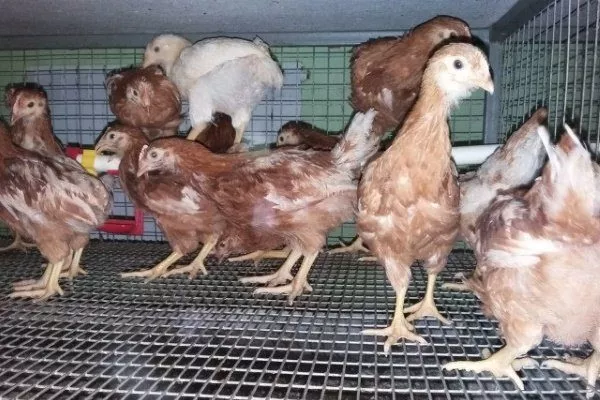
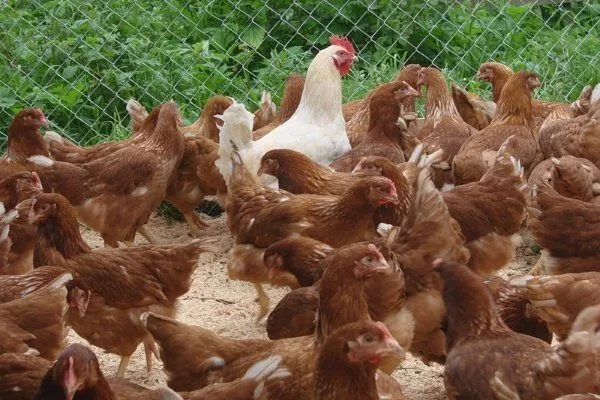
These hens can be raised using any method, including floor or cage rearing. To ensure high survival rates, the new habitat must be thoroughly disinfected. If you decide to buy the hens during the cold season, turn on the heating in the coop three days beforehand. However, if you buy them in the summer, you should heat the coop for 24 hours.
It's also important to maintain the correct number of birds per square meter. If the chickens are kept on the floor, 13 birds per square meter will be sufficient; later, the ratio should be reduced to 7 birds per square meter.
As for cage housing, 1.40 square meters is sufficient for one bird, and 2.90 square meters for an adult. If space is limited, the hens will overheat, which can lead to illness.
Advantages and disadvantages
As is already known, Brown Nick chickens are a highly productive breed, in which experts note a number of advantages:
- calm and peaceful character;
- high egg production – 400 eggs in 12 months;
- high survival rate of chickens – almost 100%;
- can be kept both in small cages and in spacious floor sheds;
- there is no unpleasant fishy smell of eggs;
- strong brown shell;
- unpretentiousness in feeding.
Molting and break in egg production
A huge advantage of this breed is that even during the most difficult period of their lives, they continue to lay eggs. During the winter months, molting occurs, a long period. To speed up this process, reduce daylight hours, and, if necessary, stimulate molting with medication.
Replacement of livestock
The ideal lifespan for a single flock of chickens is three years, which is when productivity is at its highest. After three years, productivity drops significantly, and hens lay few eggs or stop laying altogether. Therefore, it's best to replace the flock at three years of age.
Diseases and vaccinations
Birds must be vaccinated to prevent infection from other animals. Your veterinarian will advise you on which vaccines to administer and when during your consultation. Below is a rough vaccination schedule for birds:
| Age of the bird | Names of diseases for which vaccinations are given |
| Newborn | Marek's disease |
| From 2 to 4 weeks | Infectious bursitis, Newcastle disease, infectious bronchitis |
| 2-3 months | Smallpox, avian encephalomyelitis, infectious bronchitis, Newcastle disease |
- In the first days of life: vaccination against Marek's disease.
- At 2-4 weeks: vaccination against infectious bursitis, Newcastle disease, infectious bronchitis.
- At 2-3 months: vaccination against smallpox, avian encephalomyelitis, repeated vaccination against infectious bronchitis and Newcastle disease.
Brown Nick chickens are very resilient, with a 96-97% survival rate. However, common diseases can affect laying hens:
- avitaminosis;
- rickets;
- bird flu;
- pathology of the oviduct.
To prevent these pathologies, it's enough to maintain a proper lighting regime, provide a balanced diet, and vaccinate your chickens on time. Keeping the coop itself clean is also crucial.
The health of the flock must be constantly monitored; a healthy bird will look active, its feathers and down will be shiny, its feathers will be clean, its nose will be dry, and its nostrils and eyes will be free of pus and crusts.
For more information on chicken diseases and treatment options, look forHere.
Reviews
Below are reviews from private farmers.
Brown Nick chickens are highly productive, laying around 400 eggs annually. They produce continuously, even in winter. The chick survival rate is almost 100%, and they consume little feed, making this breed a profitable choice for both large poultry farms and home-based farms.