
The Kuchinskaya Yubileinaya is one of the most common chicken breeds in Russia, dating back to Soviet times when it was developed by poultry farmers at the state-owned Kuchinsky Poultry Farm. It is easy to care for, disease-resistant, and the hens retain their brooding instinct. More details on the breeding of the Kuchinskaya Yubileinaya can be found later in the article.
Characteristic
For breeding, poultry farmers used the best of the gene pool, combining the desired qualities from meat, egg, and combined breeds:
- Plymouth Rocks, Australorps, Rock Islands, and New Hampshires. These breeds gave Kuchinskaya excellent qualities: rapid weight gain, strong immunity, and excellent meat and eggs.
- Livenskaya. This breed imparted to Kuchinskaya Yubileinaya its adaptability to local conditions, its reproductive instinct, and its low mortality rate among young.
From a very young age, the Kuchinsky Jubilee have a strong physique, which is typical of the best meat breeds.
At 5 months, a cockerel weighs up to 2.4 kilograms, while a henches weigh 2 kilograms. At one year, cockerels gain another kilogram, while hens gain another 700 grams. An adult cockerel weighs 4 kg, while a henches weigh 3 kg.
Their temperament is described as calm: the birds are not prone to stress, are not shy, and are active throughout the day. They enjoy chatting but do not create a fuss in the coop.
Roosters can become aggressive when the house is disturbed. Controlling the situation is an important trait.
Exterior
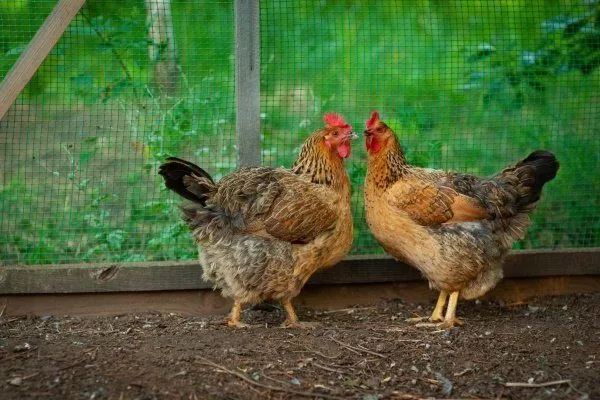
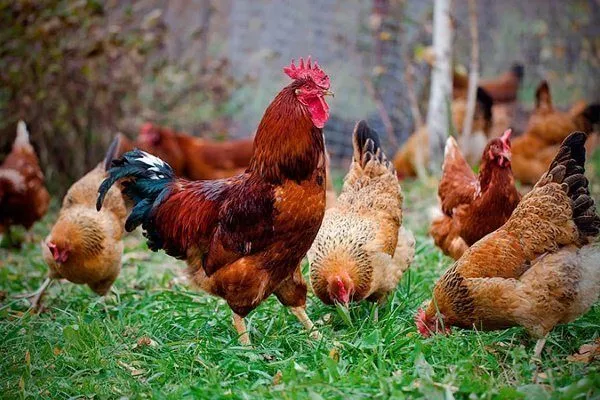
The Kuchinok's color is light brown or reddish-brown with a pink tint, with black and red feathers on the chest creating a pattern, but each individual is individual.
Chicken exterior:
- the body shape is trapezoidal, curvy;
- the breast is clearly defined;
- the belly is round;
- small head;
- comb and earrings - small, red;
- a small tail with black feathers at the end;
- The birds have yellowish-brown beaks and legs of the same color.
Rooster exterior:
- large and stately birds, the body has a triangular shape;
- chest, back and stomach - voluminous, powerful;
- paws and thighs are strong;
- often wear red feathers, a black chest and a fluffy black tail;
- on the belly and chest the plumage has a black, green and reddish tint;
- the head is set proudly, larger than that of a chicken;
- the comb is leaf-shaped, bright red in color;
- the earrings are well defined and the same color as the comb;
- The ears are beige, but white ones also occur.
Chickens:
- all chicks are dark fawn to black in color;
- gray fluff;
- breasts yellowish-gray;
- there are spots on the head and wings, and several stripes on the back;
- at the age of one day, the wing feathers of males are lighter than the body, while those of females are darker;
- the spot on the wing of “boys” is closer to the center of the wing, in hens it is on the tip or absent;
- The cockerels have black outlines around their eyes.
Egg production
Egg production is average to good:
- per year, a laying hen lays from 190 to 240 eggs weighing from 55 to 60 g with a brown shell;
- They start laying eggs at 5.5 months, but the eggs are not suitable for incubation until 6 months, as the chicks from these eggs are not very healthy;
- With a balanced diet and good care, the molting period lasts no more than 2-3 weeks, and egg production returns to its previous level.
Pros and cons
The following advantages of the breed are highlighted:
- feathers with a light shaft are valuable because when the carcass is processed, no black feather stumps remain in the skin;
- the ability to distinguish hens from cockerels at a very early age;
- Kuchinsky chickens have very warm down, which allows them to withstand low temperatures;
- laying hens lay eggs even in 15-degree frost;
- Birds can be let out for a walk even in winter;
- quick adaptation to a new place and conditions;
- vitality;
- early puberty;
- rapid weight gain – by 3-4 months, chickens gain enough weight for slaughter;
- Meat and eggs have excellent taste characteristics.
Maintenance and care
Kuchinsky Yubileiny do not tolerate enclosed spaces and love to explore the territory of the walking yard, so they are not kept in cages.
When setting up a chicken coop, enclosure, and walking yard, pay attention to the following details:
- Chickens tolerate frost well, but the coop should not be colder than 1°C. To maintain the temperature during the winter, the floor is covered with deep litter, which is not changed until spring. Microorganisms that inhabit it generate natural heat.
- The bird is quite large, so it doesn't feel secure on perches (it could fall and injure itself). It's best to build wide shelves as perches.
- The perch shelves are not installed high - from 60 to 100 cm above the floor.
- Another option for overnight accommodation is to place the chickens directly on the floor. Cages can be used for this.
- The enclosure should be fairly free and illuminated for up to 12 hours a day.
- The walking yard can be made without high fences (or without nets instead of a roof) - Kuchinsky jubilee ones cannot fly.
- Sand and ash baths are installed in the poultry house and in the walking yard.
- Do not allow other animals and birds to enter the poultry house.
- Keep it clean – regularly whitewash the walls and change the bedding.
Diet
The productivity and viability of Kuchinsky Yubileiny chickens depend on their diet. Therefore, the following recommendations should be followed:
- feeding – 3 times a day;
- since chickens can eat even after they are full, it is necessary to dose the amount of feed supplied;
- In the summer, you can skip the daytime feeding and let the chickens roam freely instead – fresh grass is an excellent replacement for lunch;
- If the chickens have gained excess weight and become obese, high-carbohydrate and protein foods are removed from the diet, and the birds are fed vegetables, root vegetables, and greens;
- During the egg-laying period, laying hens need additional calcium;
- In winter, you can increase the amount of feed slightly.
Kuchinsky Yubileiny's diet should include a mixture of high-quality compound feed with crushed or whole grains, and a wet mash once a day.
The following ingredients need to be added to the diet:
- fine gravel or sand, crushed shell rock;
- bone meal;
- vitamins and greens even in winter;
- Protein sources: dairy products, fish, meat.
Clean water is essential. In cold weather, it should be heated and changed more frequently.
The approximate daily ration for one individual is as follows:
- grain mash – 80-90 g;
- wheat bran – 10-15 g;
- sunflower cake – 10-12 g.
Breeding chickens
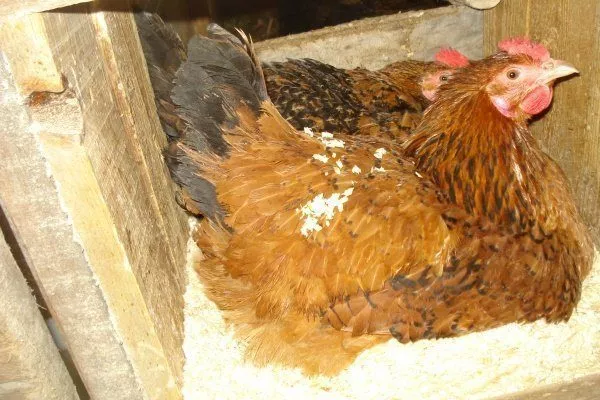
About half of the laying hens begin to hatch eggs at six months of age. Each Kuchinskaya hen can easily hatch and raise 13-15 chicks, but you can try laying up to 27 eggs.
If a hen is neglected during the laying period, she may die of starvation or dehydration due to her strong instinct to brood. A poultry farmer must remember this and remove her from the nest to feed her at least once a day.
Nimble, active chicks are born with virtually no physiological abnormalities.
The following problems may be observed in incubator chicks:
- the embryo may freeze in the egg and not hatch;
- a chick can hatch with the umbilical cord wrapped around its leg, which prevents it from digesting the remaining yolk and deprives it of the strength for further growth;
- Farmers notice that hatching eggs are beginning to hatch, which leads to the death of the embryo.
A hen raises 100% of chicks, while in an incubator about 5-15% die.
Material selection and incubation
Eggs are selected according to the following parameters:
- carefully select eggs - of the correct shape, medium size, without cracks or growths;
- carefully clean them, but do not wash them (if you wash off the shell membrane, the eggs will be unsuitable for incubation or brooding);
- store eggs in a cool place and clean container;
- Incubation material can be collected for no more than 2 weeks.
You will find more information about placing eggs in an incubator, as well as their care during this period. Here.
The organization of incubation includes the following steps:
- The nest is placed in a cool, secluded place, away from other nests.
- The nest should be 40x40 cm in size and lined with straw or hay.
- The eggs are placed in a nest in one row in a horizontal position.
- The eggs are turned over to prevent the embryo from sticking every 2-3 days.
- After a week, the eggs are checked for the presence of an embryo; if none are present, they are removed.
- The hen is fed daily, mainly with dry food, and is also given free access to water.
Incubator hatching involves the following sequence:
- The device is disinfected and turned on one day before laying the eggs.
- The eggs are brought into a room where an incubator is installed to gradually warm up to room temperature.
- The eggs are placed in an incubator, the temperature is set to 37.9 °C, the humidity is 66%.
- The eggs are turned over 4 times a day until the 12th day.
- From the 13th day, reduce the temperature to 37.3 °C, humidity to 53%.
- The eggs are turned over again as often as before. The incubator is ventilated twice for 5 minutes.
- From the 18th day, humidity is reduced to 47%.
- Turn the eggs over 4 times and ventilate 2 times for 20 minutes.
- 20-21 days – reduce the temperature to 37°C, increase the humidity to 66%, stop turning the eggs, ventilate for 5 minutes 2 times.
- After 21 days, the chicks hatch, a process that takes several hours.
After birth
The following steps should be taken when hatching chicks in an incubator:
- the chicks are transferred to a warm place (box), where the temperature is maintained at 25-28 °C at the edges, 34 °C under the lamp; Critical parameters for successful breeding
- ✓ The optimal temperature in the chicken coop for chicks in the first days of life should be no lower than 34°C under the lamp and 25-28°C at the edges of the box.
- ✓ To prevent obesity in chickens, it is necessary to strictly dose the feed, taking into account their tendency to overeat.
The chicks' nesting area should be heated unevenly. Each chick should be able to independently choose a location with an optimal temperature.
- after the first feathers appear, the temperature is reduced by 3 degrees every week;
- At the end of the first month, the chicks' temperature is reduced to 20 °C.
The hen takes care of the care and warming of naturally hatched chicks.
At 5-6 days of age, the chicks are let out into the open air in warm weather. Initially, the time should be 5 minutes and gradually increased. For this purpose, it's best to set up a special run for young chicks.
Diet
From the first days of life, chickens are offered chopped boiled eggs with semolina at the rate of 1 egg per 25 chickens.
Next, enter:
- vegetables (boiled potatoes, carrots);
- green;
- cottage cheese;
- additives (bone meal, fish, coal, chalk, coarse sand).
From 2-3 weeks of age, chicks are introduced to grains and cereals. At first, they are ground.
After a month, the chicks can be kept together with adults.
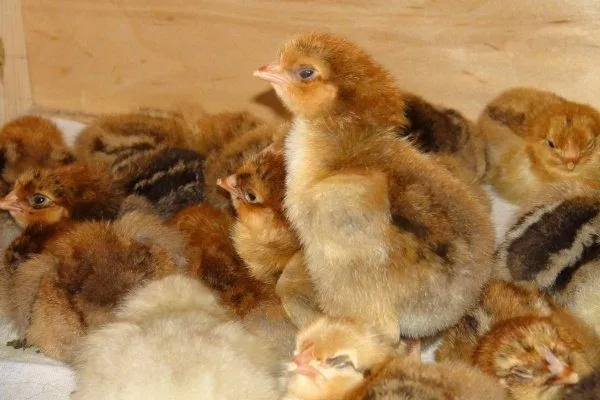
Kuchinskaya Yubileinaya chickens grow much faster than other breeds.
Susceptibility to diseases
Kuchinsky chickens are generally healthy. Diseases can result from improper husbandry, particularly overfeeding. When the birds become overweight, they become ill.
Other common diseases include:
- Avitaminosis. If vitamin intake is insufficient, chickens stop growing and egg production declines. Other symptoms include poor appetite, seizures, conjunctivitis, and gastrointestinal upset.
The solution to this problem is simple: add vitamin supplements to your diet.Read more about what vitamins chickens need for egg production. here.
- Gastroenteritis. Occurs as a result of feeding poor quality food.
Symptoms include loss of appetite, fever, and green, loose stools.
Gastroenteritis can be cured by changing the food to a high-quality one.
- At the first signs of vitamin deficiency, immediately introduce vitamin complexes into your diet.
- If symptoms of gastroenteritis appear, replace the food with high-quality food and provide access to clean water.
- If cannibalism occurs, increase the amount of protein in the diet.
- Cannibalism. In other words, it's called chicken pecking. This behavior is caused by insufficient protein intake in the diet.
Treatment: add more protein foods to your diet.
Where to buy?
The main distributor of breeding material has been and remains the Kuchinskaya Poultry Farm, located 13 kilometers from the Moscow Ring Road. Hatching eggs, day-old chicks, and grown-up chicks are available for purchase. In addition, in the spring and summer, birds are available at a 30% discount.
Breeding Kuchinskaya Yubileinaya chickens is usually hassle-free. Along with superior meat and egg quality, they inherit good health, are easy to care for, and are easy to handle in harsh climates. Hens make good and responsible mothers. The main rule is not to overfeed them.