
Australorp chickens are in high demand among many poultry farmers. Their low maintenance, high productivity, and distinctive appearance allow breeders to achieve significant profitability.
History of the breed
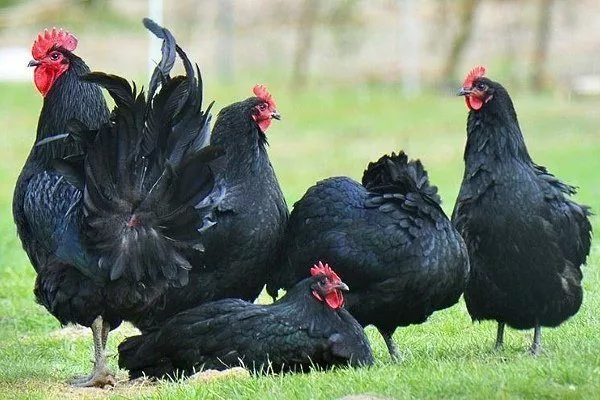
Origin: Australia, 1890. Chief breeder: William Cook. Their ancestors are White Leghorns, English Orpingtons, and Langshanns. Thanks to the crossbreeding of strong breeds, Australorps boast high egg production, considerable weight, and early sexual maturity.
The newly developed Black Australorp was extremely popular among poultry farmers in its homeland and in America, but elsewhere interest was much less. The situation changed dramatically in 1922, the year a world record for egg production was set. Six Australorp hens laid 1,857 eggs in one year, or approximately 309 eggs per hen. Some poultry farmers believe this record was achieved without additional lighting or special feed.
Birds of this breed were brought to the territory of the Russian Federation in 1946.
Description of Australorp chickens
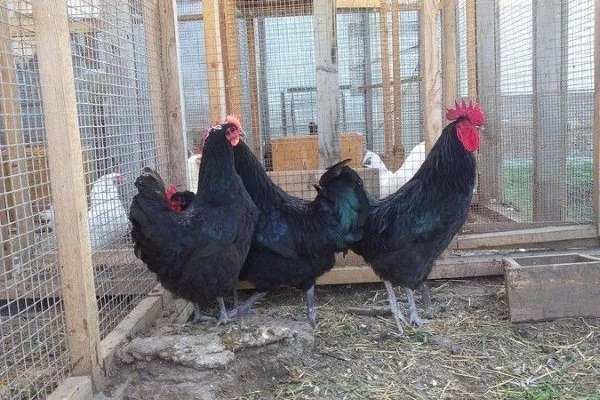
The standard is very strict; any slight deviation in appearance classifies the hens as non-purebred. The hens are not particularly large, but they are well-built and considered excellent brood hens.
Characteristic features of a rooster:
- small head;
- straight comb with straight teeth;
- massive chest;
- flat abdomen;
- large-scale wings;
- legs are black, not long;
- wide tail;
- black eyes;
- the skin is white.
Based on the birds' characteristic features, it's possible to determine the pedigree of the young. When hatched, the chicks have gray spots on their bellies and wings. This is one of the main indicators of purity, but not the only one. Birds develop their external characteristics over time. The chicks should have white down, light-colored tarsi, and irises. Over time, all light colors turn black.
- ✓ The presence of gray spots on the belly and wings of chicks at birth.
- ✓ White fluff and light-colored tarsi in newborn chicks.
Astralorp Character
Representatives of this breed are peaceful, friendly, and quiet. They don't fight and avoid confrontations. Australorp hens won't "talk" without reason. They don't fly off at random, behave appropriately, and don't misbehave.
Males are calm and phlegmatic, maintain order, and can interact with each other. If you keep these hens on your property, they will not cause harm; they will obey their caregiver and remain quiet.
The instinct of incubation
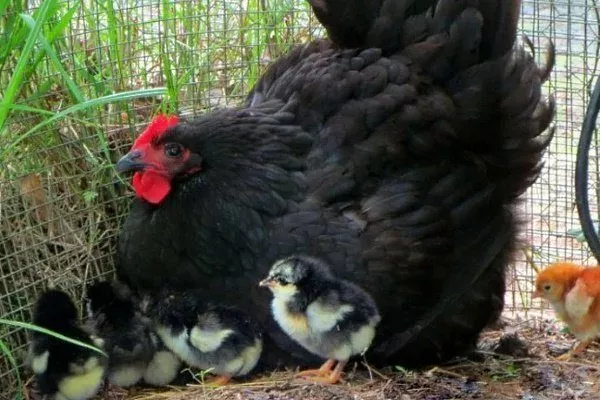
Experienced breeders claim that Australorp hens are the best mothers of all chicken varieties. For this reason, nature has rewarded these birds with high egg production. Almost every female becomes a mother twice in a single season and hatches approximately 15 chicks.
The hatchability rate is over 95%, but if the percentage drops significantly, the problem is most often with the rooster. The "father" of the young should be a male no older than 5 years old, not too large or heavy.
Heat and cold temperatures also affect hatchability. Breeders believe that birds in nests require additional heating, which will increase survival, but the offspring won't be the healthiest.
Types
Initially, breeders worked on creating a black Australorp breed. Then, scientists decided to expand the chicken's color range, and other Australorp colors were developed.
| Name | Weight of an adult (kg) | Egg production (pieces/year) | Plumage color |
|---|---|---|---|
| Black | 4 | 250 | Black |
| Marble | 2.5 | 200 | Black with white spots |
Black
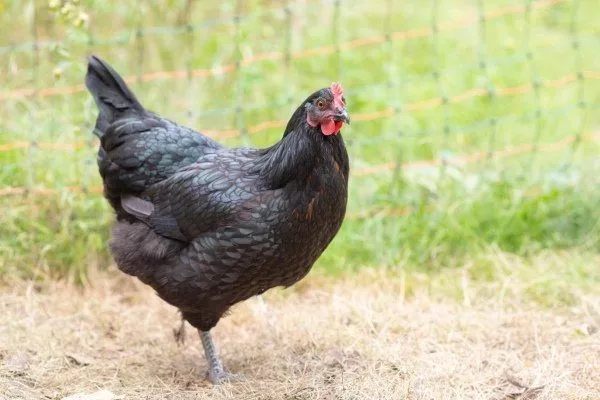
The most popular in the world, black Australorp hens are favored because they are the largest of all Australorp varieties. In addition to their excellent production rates, they are also chosen for their strong immune system. With proper preventative care, they are generally disease-free. A hen can lay around 250 eggs per year, and at six months, she weighs approximately 3 kg. Adult males can reach 4 kg.
Marble
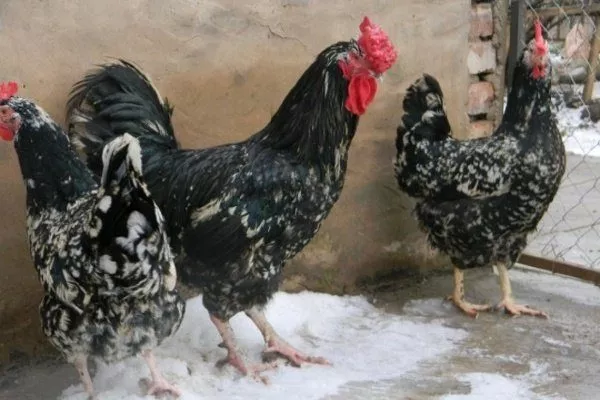
Breeders also favor this Australorp variety, but the reason lies not in its excellent production performance, but in its unusual feather coloring. Marbled hens are distinguished by light spots on their black feathers. A single hen weighs approximately 2.5 kg. Marbled hens don't boast a strong immune system, and their egg production is significantly lower than that of black hens.
At first, the eggs of marbled hens were very small, weighing about 30 g, but breeders did not stop working on increasing them, and today the egg weight is 55 g.
Other colors
In their homeland, poultry breeders recognize only three main colors: black, blue, and white. In South Africa, the main varieties are wheaten, gold, silver, and red. In Russia, another color variant, black-and-white, was developed. However, in terms of production traits, this breed has little in common with purebred Australorps.
Productivity
Purebred Australorps are birds bred primarily for meat and eggs. Like other breeds, this one also has a smaller counterpart—the Dwarf Australorp. They are identical in appearance, differing only in egg production and egg size.
Egg production
The main characteristic of Australorp layers is that no external factors (lighting, bad weather, etc.) reduce their productivity. Some poultry farmers claim that with proper care, a single hen can produce over 300 eggs per year. However, actual data shows that a single hen produces around 200-240 eggs.
The eggs have light-brown shells, and each weighs approximately 60 g. Laying hens reach sexual maturity early, producing eggs at four months. Egg production declines after two years. For this reason, poultry farmers recommend regularly replacing their flocks.
The survival rate of young animals is more than 95%, but about 10% of them die later.
Australorp meat
The breed was developed specifically to produce layers that would reach their peak weight by six months of age. Males sometimes reach 4.5 kg, but more often, 4 kg, while females weigh 1 kg less. With a complete and proper diet, the meat is tender and juicy.
Poultry farmers claim that molting leaves black spots on the birds' skin, so it's best to slaughter the hen immediately after this occurs.
Features of maintenance and care
Even a novice poultry farmer can handle this breed. These birds don't require any special care, nor are they extremely expensive. They are ideal for commercial chicken farming. They are undemanding, friendly, and quiet. Australorps always thrive in the environments provided to them. However, some simple guidelines should be followed.
Chicken coop
Australorps don't require a specially constructed coop; they can live anywhere. The main requirement is a warm coop, so the walls are insulated if necessary. In winter, the room temperature should not drop below 12 degrees Celsius.
Of course, even if the temperature drops below freezing, the birds won't die, but their productivity will decrease significantly. If insulating the room isn't possible, install infrared lamps.
Nests, perches, and food and water containers are essential inside the coop. Ideally, these should be made of wood. As for its size, four hens are allowed per square meter. If there are more birds, the birds will become uncomfortable, which will impact productivity.
The floor is covered with straw, peat, or hay. Dried grass can also be used, as long as the covering is warm. In winter, it's best to use peat moss with crushed wood chips—this mixture is considered an excellent insulator.
In this video, the breeder shows how he keeps Australorp chickens:
Walking area
Outdoor exercise is key to the birds' good health. Australorps are not particularly active or curious, but they can escape from their outdoor yard, so it should be fenced in with mesh on all sides. A canopy should be installed overhead to protect the birds from heavy rain, scorching sun, and birds of prey.
The size of the yard is calculated so that the birds feel comfortable and are not restricted in their movements.
It's best to set up a run on open ground so the birds can find grass to browse on. Clover, grass, barley, or knotweed should be sown on the ground beforehand.
Birds need a basking area. To clean themselves, you can mix wood ash, sand, and granite screenings. By bathing in this mixture, birds clean their feathers of insects and pests.
The birds have thick plumage, so they tolerate frost and snow well. In winter, laying hens love fresh air, so they can be let out of the coop for a couple of hours. Naturally, this does not apply on days when the temperature is very low.
If possible, it is better to install the chicken coop and walking yard on a small hill, otherwise it will be constantly flooded by rainwater.
If you need advice on how to build a chicken coop yourself, then this article is located here.
Nutrition
Australorp chickens require little food. However, this isn't a clear advantage, as if the birds don't get enough nutrients, their eggs will not shell. Without proper nutrition, egg production will decrease significantly. It's important to be mindful of your birds' diet.
Basic recommendations for feeding chickens:
- Main dishes: grains, dairy products, meat and bone meal, bran, and boiled vegetables. They can be given separately or combined.
- Add yeast to food, it will help increase egg production.
- Use shells, clams, chalk, etc. as fertilizer. They help improve gastrointestinal function.
- In the summer, fresh herbs and vegetables are the mainstay. In the winter, add dried herbs to your diet.
Breeding of the breed
You can place the eggs under a broody hen or use a special incubator. Both methods produce healthy and strong chicks.
Incubation
Don't place just any eggs in the incubator; they must be carefully selected and the most reliable ones chosen. For example, eggs with cracks, dents, or spots are unsuitable. They will produce unhealthy and restless chicks. Selected eggs should be treated. A weak solution of potassium permanganate can be used.
- ✓ The optimal temperature in the incubator should be maintained at 37.5-37.8°C for the first 18 days, then reduced to 37.2°C.
- ✓ Air humidity should be 50-55% for the first 18 days, then increase to 65-70% in the last days before hatching.
Experienced poultry farmers recommend checking the temperature in the incubator. If it's too high, the chicks will hatch early and be small. It's also important to monitor the humidity (60-63%). Before placing the eggs in the incubator, be sure to warm them up. This will ensure the chicks hatch at the same time.
It is not possible to manipulate various parameters in the incubator; the chicks must be born healthy without any additional intervention.
Incubation stages
Incubation of young animals consists of 4 periods:
- Active ripening – first 7 days.
- Need for dry air – 8-11 days.
- The chick's first peep begins at 12 days. Metabolic processes begin in the young bird's body.
- Birth of chicks – all chicks should be born by day 22.
We recommend that you additionally read the article about the peculiarities of incubating chicken eggs at home.
Caring for chickens
During the first 10 days, chicks require special attention. Consider their living space, feeding, and care. The coop for the chicks should be bright and ventilated. A small area should be provided for the chicks to roam freely with the mother hen.
There are 20 chickens per 1 sq. m.
For the first few days, keep the chicks in a wooden box with a wire rack on top and paper on the bottom. You can also add millet; the chicks will happily dig in it and play.
For the first 60-90 days, chicks need warmth, so special heaters are essential. In the first few days after birth, chicks live at a temperature of 32 degrees Celsius, then decrease the temperature by 2 degrees every 7 days. At 1 month old, chicks thrive at 19 degrees Celsius.
At night, turn on the lamps, and during the day, take the box with the chicks outside.
Nutrition of chicks
Australorp chickens grow stronger and stronger every day, growing very quickly. If the diet is carefully chosen, they will weigh about 1.5 kg by day 45. For the first 10 days, the chicks are fed boiled eggs, grain, and greens. These ingredients are mixed and fed to the chicks. After this, eggs are eliminated from the diet, as they contain too much protein.
During the growing stages, the young animals' main diet consists of grains mixed with fish oil. Clean, settled water is added to their water bowl daily.
Advantages and disadvantages
Representatives of the Australorp breed, like other birds, have both advantages and disadvantages.
Advantages of the breed:
- undemanding in care;
- strong immunity;
- the ability to adapt to any conditions;
- high egg production;
- tender and tasty meat;
- calm disposition.
Many poultry farmers who keep chickens are sure that they have no shortcomings, but some sources indicate the opposite.
Disadvantages of the breed:
- The young animals born from crossing Australorps with other breeds are not very productive;
- After molting, individuals must be slaughtered;
- Breeders are developing breeds that are better than the Australorp not only in appearance, but also in production characteristics.
Shedding and susceptibility to diseases
Australorp chickens are one of the few breeds that are extremely negatively affected by molting, although it's not considered unnatural. During molting, the birds lay eggs, and their productivity remains unaffected. However, the remaining feathers after molting significantly spoil the hen's appearance. After this, the birds are slaughtered for meat.
As for diseases, birds react calmly to any sources of disease; they are considered ideal among birds for the strength of their immunity.
Reviews
The birds started laying eggs at six months, some later, some earlier. They lay about 20-25 eggs a day. They are peaceful and good-natured. This is the only breed of chicken that I can introduce chicks to at 3-4 weeks of age; they don't harm them, but rather care for the babies.
The Australorp chicken breed helps many poultry farmers profit from selling eggs and poultry meat. These hens don't require meticulous care, can lay eggs in sub-zero temperatures, and are generally friendly with other poultry in the yard.