
The Adler Silver chicken breed, bred for both meat and egg production, was developed for southern regions. These birds have a calm disposition, strong immunity to most diseases, and are easy to care for. Read on to learn about the rules to follow to ensure your hens produce high egg production rates and your roosters gain weight well.
Description of the breed
This is a popular meat and egg breed. Developed for the south of Russia, it is known for its low maintenance.
Owners praise the immunity, the large number of chicks hatched, and the lack of reaction to hot climates.
Origin
| Name | Weight of an adult, kg | Egg production, pcs/year | Color |
|---|---|---|---|
| Russian white | 2.5 | 200 | White |
| Pervomayskaya | 3.0 | 180 | Colombian |
| New Hampshire | 3.5 | 220 | Red |
| White Plymouth Rock | 3.2 | 190 | White |
| Yurlovskaya | 4.0 | 150 | Black |
The breed was created in 1951-65 at the Adler Poultry Farm with the participation of specialists from the Kuban State Agrarian University.
Breeders used the sequential addition method and used the following breeds as a basis:
- Russian white;
- Pervomayskaya;
- New Hampshire;
- White Plymouth Rock;
- Yurlovskaya.
In the 1960s, Adlers were bred industrially, but modern crosses proved far more effective, and Adlers were relegated to private farms. Attempts were made to improve the breed by crossing it with White Leghorns, but this was unsuccessful.
Characteristics
By the age of 1 year, chickens reach a weight of 2.8-3.5 kg, roosters – up to 4 kg.
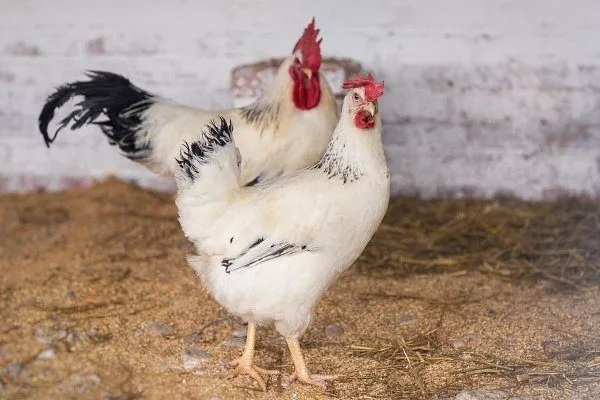
These powerful, beautiful birds can be described:
- the back is broad, the chest and belly are well developed;
- the wings fit tightly to the body;
- feather color – Colombian (white feathers with black speckles on the neck, wings and tail);
- legs are powerful, shins are massive, metatarsus is widely spaced;
- the head is beautifully set, the neck is wide;
- eyes are round, red-orange;
- red leaf-shaped comb, red earlobes and earrings;
- paws and beak are yellow.
Occasionally pure white birds with white legs are found, but these are subject to culling.
The Adler Silver is similar to the Sussex, but this is only a superficial resemblance. Columbian-colored Sussexes are often sold as Adlers, but this only detracts from the breed's authenticity. The birds can be distinguished by the color of their legs: Sussexes have white and pink legs, while Adlers have only yellow.
The birds of this breed have a peaceful nature; they rarely fight among themselves, get along well with other inhabitants, quickly get used to people, respond to calls, and love communication.
Productive qualities
Adler hens produce quite a lot of eggs, averaging 200 eggs per year, weighing 40-60 grams. Hens begin laying at 5-6 months and continue laying for several years (their egg production remains high for up to 4 years). The eggs are very tasty, with a strong, tasty white.
Good layers have a distinctive leg color: they are paler than those of other birds, as the pigment goes into the eggs.
Adler Silver chickens can be raised like broilers. By increasing the feed dosage or purchasing broiler feed, they can gain weight.
Features of egg laying
A laying hen lays an egg daily, without interruption, for three weeks to a month, followed by a one- or two-week break. This schedule is maintained year-round, regardless of the season.
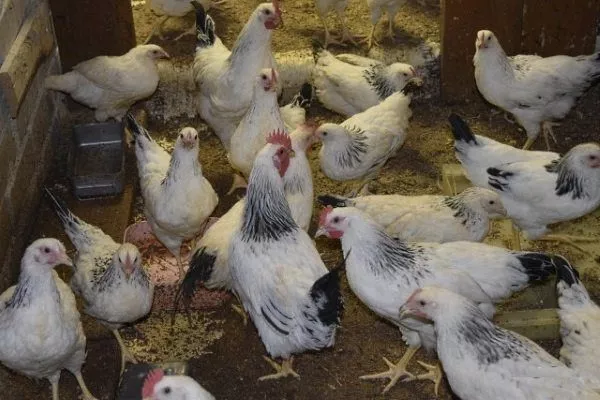
If productivity is declining, consider the following factors:
- Nutrition. A common cause is a lack of vitamins, calcium, and other minerals. Increase your intake of greens, root vegetables, eggshells, and chalk.
Another common cause is overfeeding. When birds become overweight, or when poultry farmers decide to raise them as broilers, they stop laying eggs.The less a chicken weighs, the more eggs it produces.
- Stress. Changes in territory, diet, daily routine, and the addition of new birds to the flock can cause hens to stop laying eggs. Densely crowded hens in one area can also negatively impact egg production.
Adler chickens do not tolerate cramped cages and neighbors being too close.
- Daylight hours. Birds perceive short days and long nights as winter, a time when hens in the wild don't lay eggs. To remedy this:
- maintain the temperature in the chicken coop above 0 °C;
- lay down loose, dry, warm bedding;
- add mineral components to the feed;
- arrange additional lighting.
- Molting. The molting period occurs in autumn and lasts 2-4 weeks. After this period, egg production resumes.
- Diseases. Monitor the condition of your livestock closely to avoid missing a problem.
For hens, early egg production is very dangerous, as it can lead to oviduct prolapse. Therefore, it's important to monitor sexual development. This can be done in the following ways:
- keep males and females separate until they are 6 months old;
- hatch chicks in June so that by the time they reach adulthood, daylight hours begin to decrease;
- For early hatchlings, starting from 4-5 months, the amount of food is reduced and daylight hours are artificially limited.
Content Features
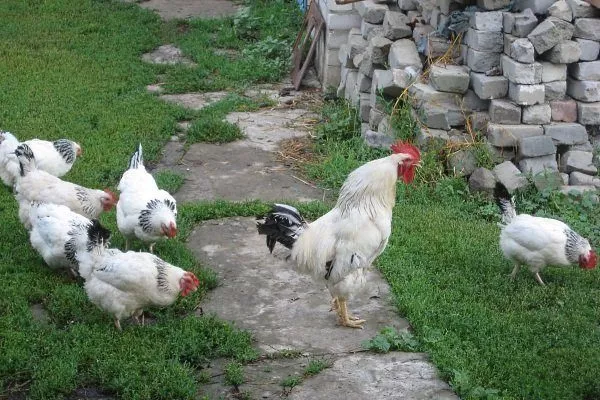
Adler silverbacks are not picky about living conditions; they can be bred in enclosures or spacious cages; they feel very comfortable in the open air, where they successfully find food by foraging.
Summer maintenance
In summer, free-range chickens will lay eggs better and gain weight. At night, they can be kept:
- in a poultry house, closed on all sides by walls;
- in an enclosure where 1 or 2 walls are replaced by a net.
When setting up a poultry house or aviary, adhere to the following guidelines:
- Place for a chicken coopIf possible, choose an elevated area to ensure it stays dry.
- Square. Calculate using the formula: 1 sq. m of area per 2 individuals or the total number of chickens, divided by 3.
- Bedding. Cover the floor with dry bedding.
- Feeders and drinkers. Place it so that all the chickens can approach it together. Otherwise, the stronger and more dominant ones will chase away the smaller and weaker ones. Read on to learn how to make your own chicken feeder. Here.
- Perches. Install the perch 0.6-1 m above the floor in a remote, shaded, and warm area of the building. There should be at least 30 cm of perch per bird. Its thickness should allow the bird to grip it securely with its feet. Material: wood.
If there is a large number of birds, they can be kept on the floor without installing perches.
- Nests. The optimal nest size is 30 x 40 x 45 cm. Place them in the driest areas and away from the exit. Line the nest with straw or sawdust. Ideally, the sides should extend 5-10 cm above the ground.
- Baths. Place ash or sand baths in bird habitats to clean feathers.
- Cleaning. During the summer, clean and change the bedding once every 14 days.
Arrangement of the walking yard:
- FencingEnsure that the dog's walking area is fenced. The fence should be 2 m or more high. Make it from metal or nylon mesh with mesh openings up to 5 cm wide.
- Low humidity. Choose an area where water will not stagnate after rain.
- Coating. For Adler chickens, sown grass or meadow flowers underfoot are well suited.
- Feeders, drinkers, baths. In summer, you can take them outside to the exercise yard. Make sure to build a rain shelter to prevent water from spilling onto the food and baths.
From this article You will learn how to make a drinking bowl yourself.
- Laz. Connect the coop to the run area using a hatch so that the chickens can move around freely.
Care Features
A special feature of care is that Adlers require high, dry and soft bedding that absorbs moisture well.
The following are suitable as bedding:
- sawdust;
- peat moss;
- coconut fiber;
- straw;
- fine gravel;
- A small amount of lime can be added to the bedding.
Regardless of the conditions of keeping, you should take care of soft, loose and dry bedding on the floor.
Feeding
Adler chickens require adequate nutrition to thrive. The daily diet is as follows:
- Corn. Chickens swallow both crushed and whole grains, even corn, easily. This doesn't affect digestion or absorption.
- Vegetables. They can make up to 50% of the total diet. Feed fresh zucchini, cucumbers, pumpkin with seeds, and fodder beets. You can also grate them first and add them to mash.
- Green. Birds need it every day. Chickens happily eat dandelions, nettles, chickweed, clover, and leafy greens. Feed them freshly picked grass or add chopped grass to their mash.
Greens, as a staple food, are given to birds that have grown too fat.
- Compound feed. Buy for meat and egg breeds. Feed it in the morning, sometimes steamed and mixed into the mash.
- Protein supplementsTo increase egg size, you need to add protein to your bird's diet. Feed your bird 10 g per day. Porridge made with meat or fish broth works well. bone meal or meat and bone meal, dairy products.
- Vitamins and minerals. It's better to buy ready-made complexes and mix them into the food. Important elements include phosphorus and calcium, as well as vitamins A, B, E, and D.
- Water. It should always be fresh. Top it up twice a day and clean the waterers daily.
Feed
The chickens are fed 3 times a day. In the morning and in the evening compound feed and grain, during the day - mash.
The diet depends on the age of the laying hen.
Table of approximate list of feeds for 1 chicken per day:
| Feed per 1 chicken | Age 22-47 weeks | Age over 47 weeks |
| Boiled potatoes, g/day | 50 | 50 |
| Corn, g/day | 40 | — |
| Greens, g/day | 30 | 30 |
| Wheat, g/day | 20 | 40 |
| Meal, g/day | 11 | 14 |
| Carrots, g/day | 10 | — |
| Meat and fish waste, g/day | 5 | 10 |
| Shell rock, g/day | 5 | 5 |
| Fishmeal, g/day | 4 | — |
| Chalk, g/day | 3 | 3 |
| Yeast, g/day | 1 | 14 |
| Bone meal, g/day | 1 | 1 |
| Barley, g/day | — | 30 |
| Pumpkin, g/day | — | 20 |
If you eat fish regularly, the meat of slaughtered poultry will have a fishy smell.
Egg production can be increased by increasing or decreasing the consumption of certain foods.
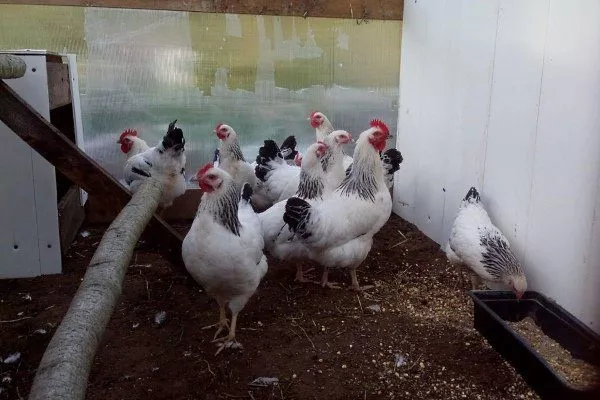
Feeding chart for chickens to increase egg production:
| Feed for 1 chicken | Egg production 50% | Egg production 60% | Egg production 70% |
| Wheat, g/day | 25 | 30 | 35 |
| Oats, g/day | 15 | 15 | 15 |
| Millet, g/day | 10 | 10 | 10 |
| Sunflower cake, g/day | 20 | 20 | 20 |
| Wheat bran, g/day | 40 | 20 | 20 |
| Flour, g/day | 5 | 5 | 5 |
| Bone meal, chalk, g/day | 5 | 10 | 10 |
Maintenance during the winter period
When preparing for winter, carry out the following work:
- InsulationSeal all cracks and holes to prevent drafts in the coop. Make sure the door is insulated so it closes tightly without any gaps. Lay a thick layer of bedding on the floor. Once it's compacted, loosen the top layer with a rake or replace it with new bedding if it's soiled.
- Walking. Chickens need to go outside every day. A run is best for this. Insulate the floor with a layer of bedding. Provide protection from wind and precipitation.
- Lighting. Install fluorescent lamps in the chicken coop to extend the illumination to 13-15 hours a day.
- Feed. In winter, ensure wet food doesn't cool down while being eaten, and especially doesn't remain in the feeder to freeze. Increase vegetable and green food intake in the form of hay.
- Water. Make sure that the water does not freeze in the drinking bowls.
- Hygiene. Clean the poultry house every week.
- Insulate the chicken coop, paying particular attention to the absence of drafts.
- Provide sufficient bedding to keep the animal dry and warm.
- Install additional lighting to extend daylight hours to 13-15 hours.
Breeding
Adler chickens have lost their brooding instinct through selective breeding, so to breed them you will need an incubator or you can place the eggs under a hen of a different breed.
Adler crosses well with other breeds:
- Egg production increases when crossing an Adler rooster with a Kuchin chicken;
- the immunity of the offspring of Adler chickens with Kuchin roosters is strengthened, and they also improve their meat production;
- the color and productivity characteristics are improved in the chicks of the Local chicken and the Adler rooster;
- Autosexing chickens are bred from Rhode Island roosters and Adler hens, and their hens hatch with dark down.
Buying an Adler Silvery shouldn't be a disappointment if you purchase a bird from the Genofond and VNITIP. A week-old chick can cost from 250 rubles.
How to choose eggs?
Although Adler eggs have a high fertilization rate, not all are suitable for incubation. Please note the following:
- Laying hen. Do not collect eggs from sick, very old, or young hens, or from hens with abnormal egg-laying patterns.
- Term. Select eggs immediately from the nest and no older than 5 days. Storage temperatures below 12°C will kill the embryo.
- Shape and size. Choose medium-sized, standard-shaped eggs. Avoid eggs that are too long or rounded, or those with external shell defects.
- Cleaning. Never wash eggs for incubation. Also, do not rub them with force.
- Examination using an ovoscope. When examining an egg, the yolk should be in the center, the air cell should be at the blunt end, its size should not be larger than a teaspoon.
Incubation
The best time to hatch chicks is in late May-June.
Before placing eggs in an incubator They are brought into the room where the device is located for several hours. The incubator is turned on to warm up. Once the starting temperature is reached, the eggs are placed in it.
Table of incubation periods and parameter changes:
| Period, days | Temperature, °C | Humidity, % | Turning, once a day | Ventilation, once a day | Ventilation, min/time |
| 1-11 | 37.9 | 66 | 4 | — | — |
| 12-17 | 37.3 | 53 | 4 | 2 | 5 |
| 18-19 | 37.3 | 47 | 4 | 2 | 20 |
| 20-21 | 37.0 | 66 | — | 2 | 5 |
- ✓ The optimal temperature in the incubator should be maintained at 37.5°C with fluctuations of no more than ±0.5°C.
- ✓ Humidity during the first 18 days of incubation should be 50-55%, increasing to 65-70% in the last 3 days.
The chicks have an 86% survival rate, grow quickly, and the brood consists of about 20% cockerels.
Raising chickens
As soon as the egg hatching process begins, it should be constantly monitored and the hatched chicks should be immediately removed from the incubator.
To dry, place the chicks in a box with a heating pad or hot water bottles wrapped in cloth at the bottom. Place a 100-watt lamp on top.
A healthy day-old chick weighs 35-40 g, is vigorous, has clean down, and eats and drinks on its own.
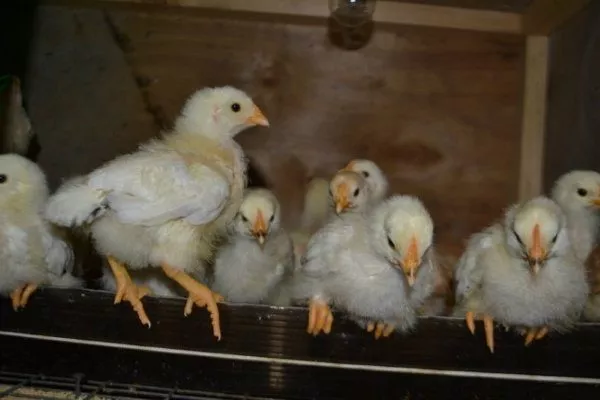
Next, maintain the temperature regime in the box according to the table.
Temperature table by day:
| Days | Temperature, °C |
| 1-5 | 30-35 |
| 6-10 | 26-28 |
| 11-20 | 22-25 |
| 9:30 PM | 20-22 |
| 31-40 | 16-22 |
Normally, chicks move evenly around the box. If they're crowded under the lamp, they're too cold. If they're sitting in the corners, they're too hot. Adjust the temperature accordingly.
Rules for care and feeding in the first 10 days of life:
- Daily routine. Get the chicks accustomed to a daily routine right away by turning on the lamp at 6 a.m. and turning it off at 8 p.m. Place a heating pad in the box at night.
- Diet. Feed the chickens every two hours, including at night. Prepare fresh food each time. Only hard-boiled eggs in their shells can be refrigerated. It's best to feed fresh greens; if not, they can be kept in the lower drawer of the refrigerator for up to 24 hours.
- Noma korma. Calculate the amount of feed so that the chicks eat it within 30 minutes. Throw away any leftovers.
- Bedding. Line the bottom of the box with clean, ink-free paper. Change it whenever it gets dirty. When feeding from the floor, replace the top layer of paper after each feeding.
Chicks need adequate amounts of all nutrients, especially protein, to thrive. Feed them according to the chart and their age.
Table of daily feed norms for chickens:
| Feed for 1 chicken | 1-3 days | 4-10 days | 11-20 days | 21-30 days | 31-40 days | 41-50 days | 51-60 days |
| Hard-boiled egg, g/day | 2 | 2 | — | — | — | — | — |
| Skimmed milk, g/day | 5 | 8 | 15 | 20 | 35 | 25 | 25 |
| Low-fat cottage cheese, g/day | 1 | 1.5 | 2 | 3 | 4 | 4 | 5 |
| Millet, barley, corn, g/day | 5 | 9 | 13 | 22 | 32 | 39 | 48 |
| Bone, fish meal, g/day | — | — | 1 | 0.4 | 2.8 | 3.5 | 4 |
| Meal, cake, g/day | — | 0.2 | 0.5 | 0.6 | 1.2 | 1.5 | 2 |
| Greens, carrots, g/day | 1 | 3 | 7 | 10 | 13 | 15 | 18 |
| Boiled potatoes, root vegetables, g/day | — | — | 4 | 10 | 20 | 30 | 40 |
| Mineral supplements, g/day | — | 0.4 | 0.7 | 1 | 2 | 2 | 2 |
| Salt, g/day | — | — | — | — | — | 0.1 | 0.2 |
After 2 months, the chicks are fed together with the adult birds.
Advantages and disadvantages of the breed
The main advantages of the breed include:
- widespread, easy to acquire hatching eggs and young;
- docile nature;
- good immunity;
- undemanding to maintenance conditions;
- stable egg production throughout the year;
- maintaining egg production for 3-4 years;
- preservation of taste and quality characteristics of meat for up to 4 years.
The following can be highlighted as disadvantages:
- lack of brooding instinct;
- the need for additional lighting in winter;
- the need to regulate puberty.
Watch a review of the Adler Silver chicken breed in the video below:
What diseases do chickens get?
Adler breed chickens often suffer leg diseases(especially joints), so keeping them in damp conditions is unacceptable; litter should always be provided on the floor of the coop. Perches are essential in humid climates.
Otherwise, the bird enjoys robust health and strong immunity. However, under unfavorable living conditions and poor feeding, infectious and non-infectious diseases may develop.
Farmer reviews of the Adler Silver chicken breed
My impressions: a calm bird that flies very high—the roosters can even fly up to the roof to crow. They lay eggs reliably, even in winter, though they require additional lighting in the coop.
The Adler Silver breed thrives and lays eggs when provided with adequate nutrition and free-range conditions, and does not tolerate cramped cages. Hens lay eggs for up to four years and have average productivity. They can be raised as broilers. This breed is suitable for beginning farmers.