
Extremely low temperatures require insulation for chicken coops, which can be costly. Therefore, many breeders are interested in what a polycarbonate greenhouse chicken coop is, how to build one themselves, and whether it will provide reliable protection for the birds.
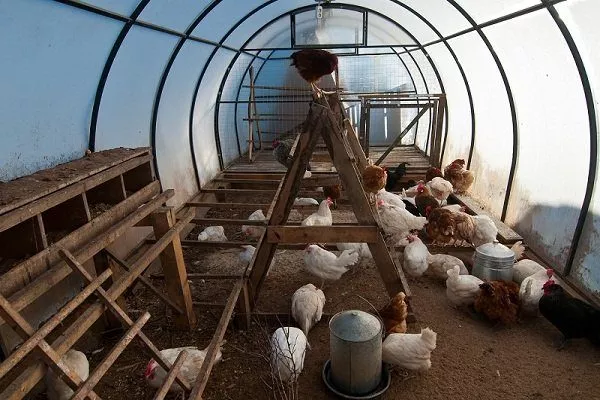
Pros and cons of a polycarbonate chicken coop
Before you begin work and look for all the necessary materials and a place to build a polycarbonate chicken coop, you should familiarize yourself with its pros and cons.
Advantages buildings:
- Occupies a small area of land.
- Building separate rooms for chickens does not require a lot of money.
- Chickens are provided with excellent protection not only from low temperatures, rain and other natural surprises, but also from small predators who want to feast on poultry meat.
- A competent approach allows for the full preservation of adult livestock and facilitates the emergence of our own young animals.
- Polycarbonate is easy to clean. Light stains can be easily washed away with a hose. For more serious stains, apply any dishwashing detergent to a cloth, wipe, and rinse.
Flaws:
- Insulation of a polycarbonate greenhouse, including all structures (from the foundation to the walls), is mandatory. All this requires investment and time.
- Providing additional equipment that is usually not available in a greenhouse (perches, nesting boxes, water containers, feeders, etc.).
- As soon as spring arrives and the chickens can now walk outdoors, all the items from the second point will have to be moved into the summer room.
Be careful not to use ammonia-based mixtures on polycarbonate, as it will damage the surface of the sheets. These thermoplastics are resistant to most other common chemicals.
Step-by-step instructions for making
Before placing chickens indoors, it is necessary to make a schematic plan of the greenhouse and mark:
- place for perches;
- nests;
- area for walking.
Necessary materials and tools
When constructing a chicken coop from polycarbonate, you cannot do without:
- sand;
- cement;
- crushed stone;
- plasticizer;
- formwork boards;
- twine;
- straw and sawdust;
- plywood sheets;
- polycarbonate itself;
- self-tapping screws;
- drills;
- deep vibrator;
- knives;
- electric jigsaw;
- an awl or a thin, sharp screwdriver;
- building level;
- hammer.
It is best to take slightly more materials than necessary, since during construction, defects may be discovered or some mistake may be made.
Preparatory work
Preparatory work includes developing a chicken coop design, which will allow you to calculate the required amount of building materials.
Selecting a location plays an important role in planning. The site for the building should be on a flat surface. Building a chicken coop on a hill carries a high risk of collapse of the walls and/or roof due to strong winds, while a greenhouse in a low-lying area will flood after heavy rains and melting snow.
Now decide how many chickens you plan to keep there. Marking out the area based on the number of birds:
- Rest area – about 1 sq. m. is required for 5 chickens.
- One nest requires 0.09 square meters and can accommodate up to 4 individuals.
- To ensure simultaneous access to feed for the entire flock, feeders should be set up with the feeding space per head: 10-12 cm for an adult hen, 2-5 cm for pullets up to 2 weeks old, and 8-10 cm for pullets (up to 140 days old). Don't forget about waterers, which can be made using the same principle as in a standard chicken coop.
The remaining area is occupied by a walking area. In some cases, this area is separate from the building and is not considered when planning the chicken coop.
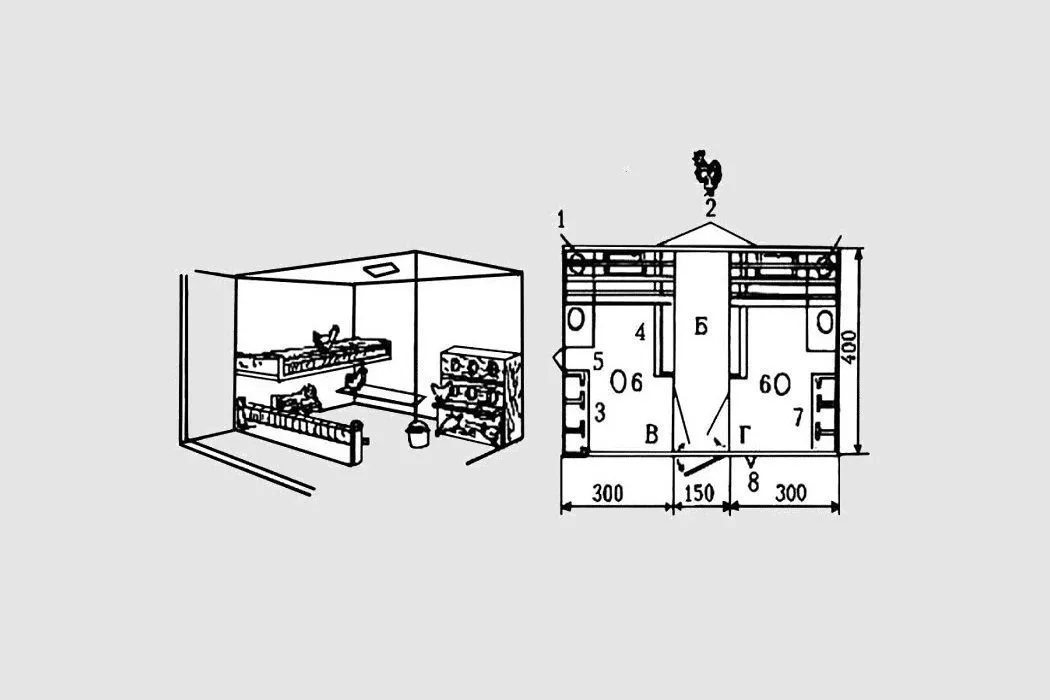
Make a drawing of the greenhouse with all the necessary dimensions and only then start work, for example:
Laying the foundation
A chicken coop greenhouse can be built without a foundation, but one is necessary to provide reliable protection from strong winds. It also provides an excellent foundation for a sturdy frame, which can then be insulated.
Foundation construction plan:
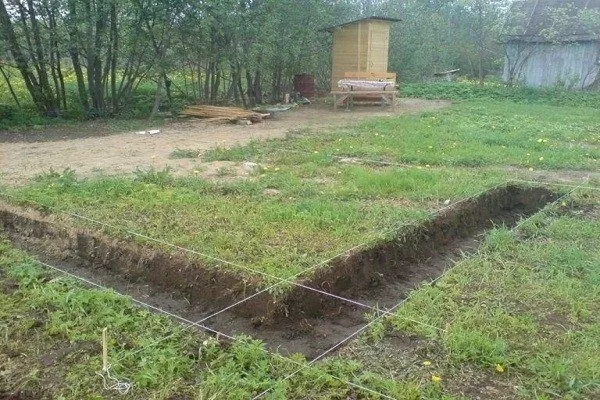
- Remove the sod from the area where the chicken coop will be located. Drive four wooden stakes into the outer corners of the greenhouse, extending above the ground to the height of the foundation. Drive four more stakes into the inner corners of the coop. The distance between the outer and outer stakes should be equal to the width of the foundation. Stretch twine along both edges.

- We measure the diagonals or use the Pythagorean theorem to compare the dimensions of the triangle's sides to check if the angles are correct. We begin digging a trench, digging it to a depth slightly deeper than the frost line. We compact the bottom and add a layer of sand. We wait for it to settle, repeat the compaction process, and fill it with water. Once the sand has set and is completely dry, we fill it with crushed stone.
The thickness of the sand and crushed stone layer should be 7-10 cm for each.
- We set the formwork at a height 5 cm higher than the outermost point to facilitate leveling the mortar. We reinforce the foundation with a row of reinforcement every 30 cm. We nail planks between the formwork walls to ensure the formwork remains in place and does not shift due to the weight of the mortar. For added stability, we install braces. We pour the mortar and compact it using a deep vibrator. We level the surface with a trowel.
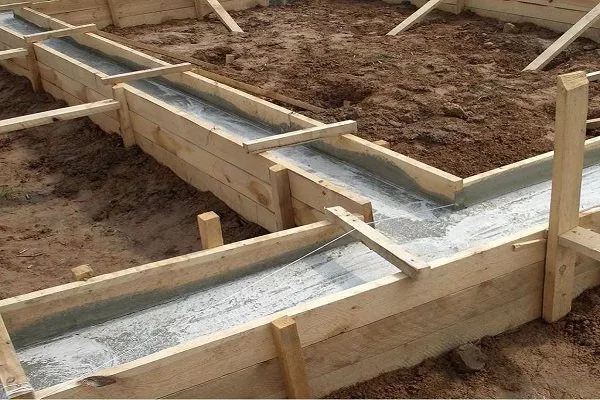
When building in spring or summer, after a few days we can dismantle the formwork and cover the base with high-density polyethylene film (or roofing felt) to prevent rapid evaporation of moisture.
There is also a less expensive (both financially and time-wise) way to build a foundation:
- We lay beams of durable, moisture-resistant wood in the trench.
- We tighten them together with metal pins or join them using the tongue and groove method.
Don't forget to treat all beams with an antiseptic before installing them.
Making the frame
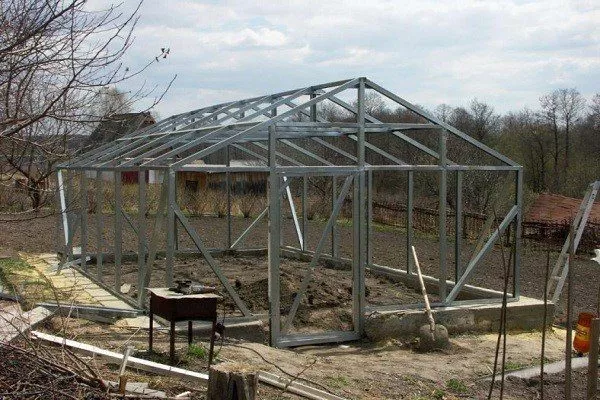
The polycarbonate greenhouse frame is made up of profile pipes treated with an anti-corrosion compound. Painted materials are best, as the paint protects the metal from rust. The pipes can be connected in two ways:
- By welding.
- Using bolts.
It is recommended to resort to the first method, since the protective layer of metal at the bolt attachment point is damaged, which negatively affects its reliability.
We assemble the frame according to the previously prepared drawing. In places corresponding to the door and window locations, we need to install lintels to reinforce the frame. Door hinges and window opening mechanisms are installed as desired.
Bending of profile pipes
When constructing such a structure, it's often necessary to bend a profile pipe. Several methods are available for this:
- Using the Turbobender tool. This tool allows for smooth and precise bends, saving the user time and effort. Its main drawback is its high cost and its use only in professional construction.
- Cutting and welding. This method is recommended for skilled and experienced users of welding machines, as in the hands of a novice, the appearance of the future greenhouse will deteriorate significantly.
- Sand packing and heating. This method is time-consuming and inexpensive. To implement, you fill the profile pipe with sand and heat it with a gas torch or an open flame. The disadvantage is the high risk of uneven bends and the enormous time required.
Installation of end frames
This section of the chicken coop frame accommodates ventilation openings, doorways, and windows. The frame can be manufactured as a separate module (providing greater strength) or attached to an existing frame.
A door recess can be made to resemble a standard door. A 40 x 20 mm profile is suitable for its frame, while even thinner pipe frames—20 x 20 mm—are suitable for windows or vents.
It is necessary to begin installing the tubular frame by securing the end frames.
The frames are secured with a welding machine, bolts, or self-tapping screws (tools are selected depending on the materials from which the frame is made).
Installation of polycarbonate sheets
Rules for laying polycarbonate sheets:
- the canvases are arranged so that the moisture accumulating in the “honeycombs” can escape;
- if the sheets are installed vertically, then the stiffening ribs must also be located in the same direction;
- in pitched construction, the webs are positioned so that their stiffening ribs are directed parallel to the slope line;
- Arched frames are covered with "honeycombs" of polymer material so that they ("honeycombs") are located parallel to the lines of the arches.
Sequence of installation of polycarbonate sheets:
- We try on the polymer sheets on the area to be mounted and cut them with a sharp knife.
- We drill holes using a drill and a drill (screwdriver).
- We seal the ends of the panels with aluminum tape and a self-adhesive base.
- We insert the cut sheets into the frame.
- Using an awl or screwdriver, make several holes in each side of the plate and thread twine through them, thus first securing the sheets to the frame.
You can also fasten elements in other ways:
- We apply the polycarbonate directly to the pipe and drill a hole through it with a drill, the diameter of which should be 0.1 mm smaller than the diameter of the screw;
- by purchasing special thermal washers or connecting profiles.
Insulation of a greenhouse
A winter chicken coop made from a greenhouse should be draft-free, so seal all joints. It's recommended to install rubber gaskets between the foundation and the frame. Seal the gaps between the polymer sheets with a sealant that forms a flexible surface after curing. Thiokol or polysulfide mastics can also be used for this purpose.
- ✓ The minimum thickness of polycarbonate for winter housing of chickens should be at least 8 mm.
- ✓ It is mandatory to have an air gap between the layers of insulation to prevent condensation.
Wall insulation should be calculated based on snowfall and frost in your area. A properly reinforced metal frame and thick polycarbonate sheets allow the walls to be insulated by precipitation itself.
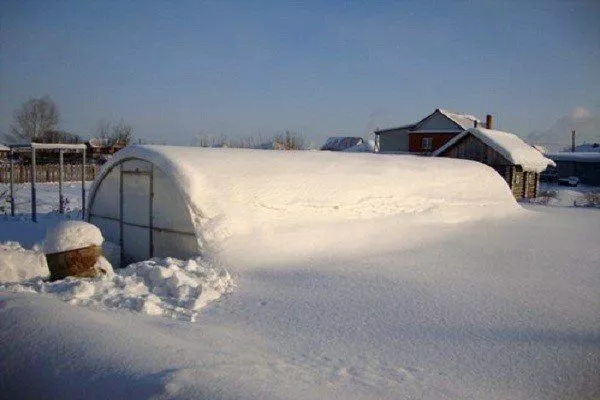
Be careful and take all these factors into account, otherwise the structure may collapse.
If you live in a region with harsh winters, the optimal solution to insulating your walls is to install an additional layer of insulation. For this, you can use:
- polycarbonate of smaller thickness (4 mm);
- lining;
- plywood;
- bubble wrap.
Line the space between the two layers with mineral wool, wood shavings, or polystyrene foam. To prevent moisture accumulation, seal the new wall from the inside with lutrasil.
Heating
To ensure your chickens stay healthy and feel comfortable in their new coop, it's important to ensure an optimal temperature. For layers, it should be no less than 15°C, and for other birds, no less than 10°C. To heat the coop, use:
- Heat guns.
- Heaters.
- Special heaters.
- Infrared lamps.
The first three methods are quite expensive and are more suitable for keeping elite chicken breeds. Infrared lamps are less expensive and offer several advantages:
- heat the surface, not the air;
- allow the bedding to dry;
- have a subdued, non-irritating light that has a calming effect on birds.
One 500-watt lamp is sufficient for 10-12 square meters of space. It's best to place them a short distance from the floor so that the fixture can be lowered or raised as needed.
If you live in a region with harsh climates and have more than enough money to build a greenhouse like this, you can install underfloor heating. To do this, pour 50-100 mm of sand onto the leveled soil, cover it with protective mesh, and lay the electric heating cable. Top it with another layer of mesh, 50 mm of sand, and twice as much soil. If you connect a relay and thermostat to the circuit, the system will operate automatically.
Ventilation device
A simple polycarbonate vegetable greenhouse is equipped with at least two vents per 10 square meters of area. In winter, these vents should only be opened when temperatures are not too low and there is no wind.
- ✓ The air speed in the chicken coop should not exceed 0.2 m/s in winter.
- ✓ Adjustable ventilation openings for humidity control are mandatory.
In this case, exhaust fans (for chicken coops, quiet models with an air velocity of less than 2 m/s) are installed to circulate and exhaust air outside the room. Try to choose a device with a power regulator and thermostat with a temperature range of 10-25°C and a capacity of at least 300 cubic meters per hour.
The devices are installed on the greenhouse frame: one above the door, the other opposite. To protect the fan from adverse environmental factors, an inertial grille is required, the flaps of which open with the air flow and close automatically once the device stops operating.
Lighting
Chickens should have 12-14 hours of daylight per day, but no more. In summer, this amount is met automatically, and supplemental lighting is not necessary, which is not the case in winter.
Energy-saving 20-watt bulbs are a reliable source of energy. One such bulb is sufficient for a 12-square-meter chicken coop. In areas where the hens rest and lay eggs, it's best to use minimal lighting to create a cozy atmosphere. Place more powerful bulbs in the run area.
An energy-efficient way to light a greenhouse is to install two time relays in a circuit. During evening feeding, the first energy-saving 20-watt lamp turns on, burns for 2-3 hours, then automatically turns off, and the second, lower-wattage (9-watt) lamp turns on for 1 hour.
Optimal time for additional light sources to operate:
- from 6 to 9 am;
- from 6 pm to 9 pm.
Bedding
Fermented litter can be purchased at specialty stores. To effectively use it, mix it with wood shavings, oat hulls, and straw. This mixture collects the droppings and reacts with them chemically, generating additional heat. The unpleasant odor is also almost completely eliminated.
The litter is changed twice a month, removing the old layer or adding a new layer on top of the old one (the “non-replaceable litter” method).
Hay is also a common bedding material, but it needs to be changed frequently.
How to make a feeder and waterer?
We will introduce you to several methods for setting up feeders and waterers:
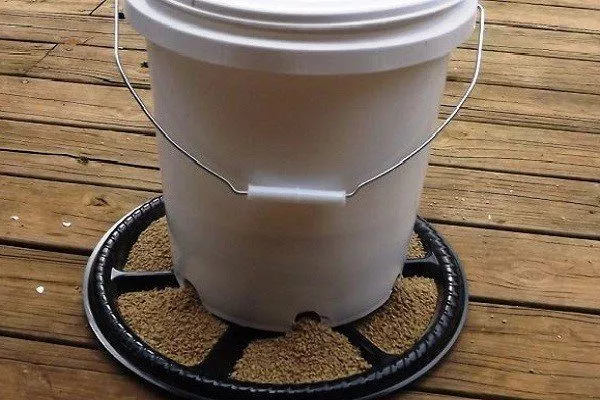
- Bunker feeder. The grain is automatically added as it runs low. To make the feeder, you'll need a plastic bucket and a portion tray. First, cut holes in the bottom of the bucket to accommodate the feed.
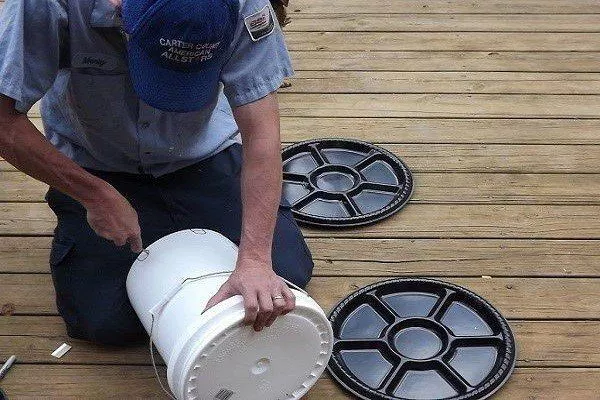
We fix the tray to the bottom of the bucket using wire or bolts.
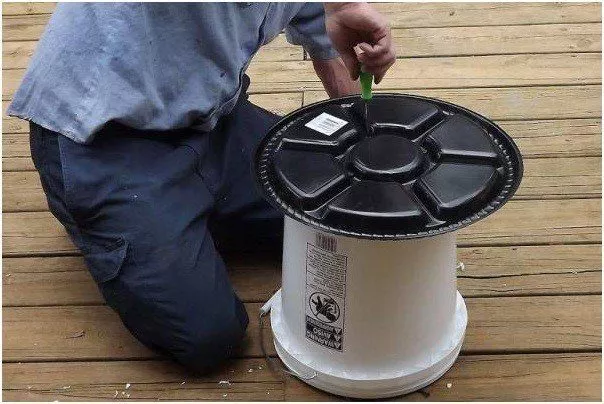
We place the finished feeder on the floor or hang it in a convenient place.
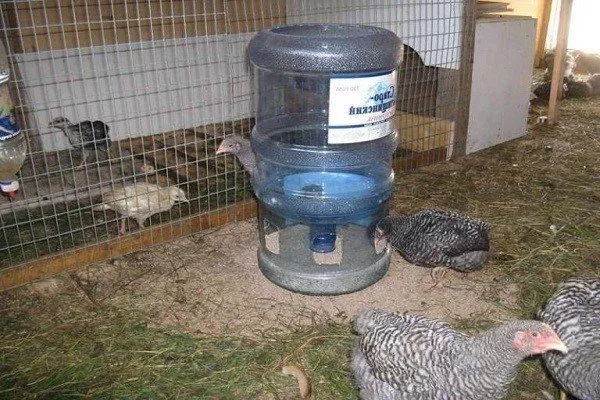
- A feeder made of 2 bottles. Take the first container and cut it down by 2/3. Poke holes in the sides large enough to comfortably fit a chicken head. Fill the entire bottle with grain, turn it upside down, and place it in the second container. To ensure automatic grain feeding as it drains, the neck of the second container should be 1 cm from the bottom of the first.
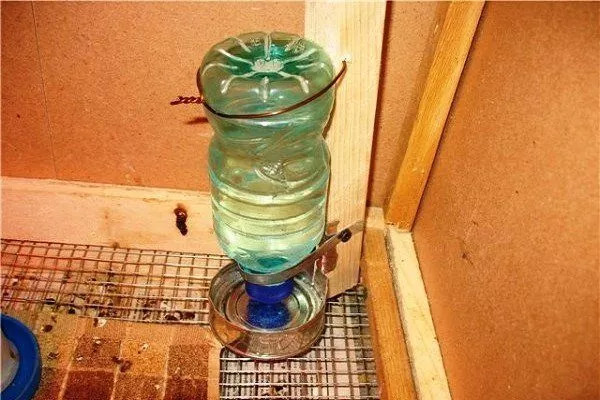
- Saucer-type drinking bowl. The base of the container is designed to support an inverted jar or bottle. A small gap is left between the neck and the bottom, allowing water to flow as the birds consume it.
To build this structure yourself, you'll need a tin can and a plastic bottle. Cut the can down to a height of 7 cm and file it down (to ensure the chickens remain safe and sound). Place the bottle over the can, ensuring the neck doesn't touch the bottom.
Features of keeping birds in a chicken coop in a polycarbonate greenhouse
If you're keeping your birds in the coop for the winter, be prepared to provide them with regular care and good, nutritious nutrition. A varied diet is essential:
- dry grain mixtures;
- specialized combined feeds;
- wet mashes of vegetables, greens, cereals and feed;
- bran steamed in water.
You can also treat them with food scraps, chopped fish, cottage cheese, dried grass and boiled vegetables.
To ensure that your chickens' egg production remains at the same level as during warmer seasons, provide the birds with optimal temperature and lighting conditions.
A chicken coop in a polycarbonate greenhouse is a great solution if your chickens have nowhere to overwinter. The key is not only to construct the structure correctly but also to consider its internal design.