
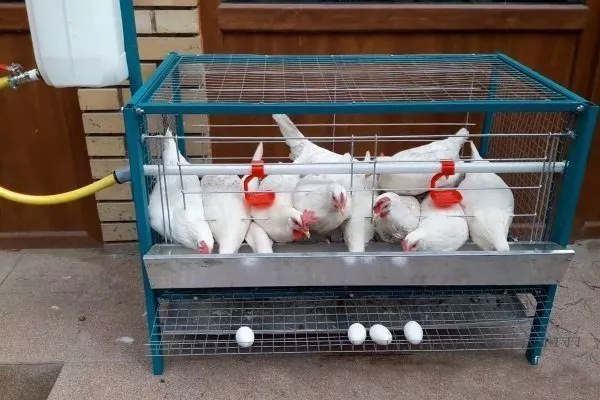
Cages are often used to house laying hens when space is limited. In this case, specially designed cages, rather than standard ones, are necessary, otherwise the hens' productivity will suffer. Suitable cages can be purchased at the store or built at home using ready-made plans and instructions.
Cage requirements
To ensure a cage suitable for laying hens, it's important to first determine the key requirements it must meet. Pay attention to the parameters described below.
- ✓ The size of the floor mesh should be no more than 25x25 mm to prevent injury to the chickens' paws.
- ✓ For the front wall, use a mesh with 50x100 mm cells so that the chickens can freely stick their heads through to feed.
Dimensions
| Name | Cage dimensions (sq. cm per individual) | Floor type | Availability of an egg collector |
|---|---|---|---|
| Egg | 20-50 | Reticulate | Yes |
| Meat and egg | 80-90 | Reticulate | Yes |
To ensure accurate calculations, you need to consider the size of the birds you plan to keep. This depends on the breed of chicken:
- Egg-laying. In this case, the cage shouldn't be too high, as the chickens are small. It's generally recommended that each individual needs between 20 and 50 square centimeters of space.
- Meat and egg breeds. Meat and egg breeds are larger in size, so more space is required per individual – approximately 80-90 sq. cm.
When calculating cage size, the number of animals must also be taken into account, as it's crucial to maintain a balance in space and prevent overcrowding. Thus, based on the number of animals, a cage can be:
- single – 500x500x650 cm;
- for 2-3 laying hens – 600x1000x450 cm;
- for 4-5 laying hens – 600x1200x500 cm;
- for 5-7 laying hens – 700x1500x650 cm.
If space is limited, several cages can be installed in tiers.
Strength
The structure must be sturdy enough to support the weight of not only the birds but also the necessary equipment. For example, each individual section is often equipped with waterers, feeders, and an egg collector. To prevent the cage from sagging over time under the weight of the birds, solid walls should be avoided. The cage's mesh should be strong and have small openings to prevent small predators like weasels and ferrets from getting through. The largest openings should be in the front wall, allowing the hens to poke their heads through to eat. The ideal size is 5 x 10 cm.
If you make the floor of the cage mesh and install a tray underneath to collect droppings, this will greatly simplify the cleaning process.
Lighting
The amount of daylight directly affects egg-laying rates. As daylight hours decrease in the fall and winter, egg production declines, while as daylight hours increase in the spring and summer, egg production increases. To ensure that hens in their cages receive the required amount of light, proper supplemental lighting is necessary. It's important to keep in mind that the optimal daylight duration during warm weather is 14-16 hours with an average room illumination of 20-50 lux.
When installing lighting, it's important to use a dimmer, as it allows for smooth switching of the lights, creating the illusion of day and night. This will protect the hens' mental state, which is crucial for good egg production. Furthermore, this device extends the life of the lamps.
Centralized lighting (one lamp per chicken coop) is unacceptable, since the light flux must evenly illuminate the cage systems.
Availability of an egg collector
This device will allow you to easily remove eggs without disturbing the hens. Furthermore, without it, almost half of the eggs will be consumed by the hens themselves.
Types of cells
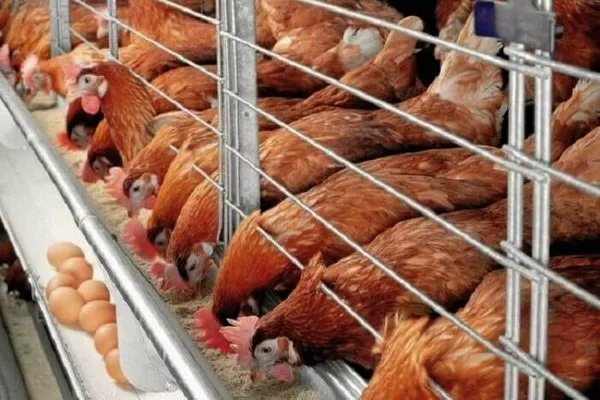
There are various types of chicken cages, selected depending on the breeder's capabilities and breeding goals. They can be broadly divided into two types:
- With beddingThese structures have a solid floor covered with a layer of straw or sawdust. Wood is the best material for this, as the bedding will not slip on a wooden floor. When raising hens on bedding, the cage height should be increased by 15-20 cm. Furthermore, a maximum of six hens can be housed in a single cage.
- With a sloping floor and an egg collectorIn this case, a double floor is used. The upper part is slatted and sloped, while the lower part is solid and often equipped with a pull-out tray. This type of cage makes it easy to keep dry and clean. The sloping floor automatically slides the eggs down and into a special chute, minimizing contact with the hens.
Any type of cage can be built by hand, provided you prepare the necessary drawings. Typically, cages for laying hens are built in groups, each of which can hold 7 to 10 hens. For very large flocks, you can build a battery cage—a single structure consisting of several rows and tiers of cages.
Selection of materials
Chicken cages can be made from the following materials:
- Wooden beamsThe simplest structure that can be built at home is a wooden one. Cut a frame from a suitable-sized piece of lumber, then attach a wire mesh to its front wall with large mesh openings. The cage can be covered with a sheet of plywood or sheet metal. The rear wall is best made of plywood, but preferably mesh for good air circulation. Such structures are best kept small, otherwise they won't be strong enough. Therefore, this option is not suitable for tiered cages.
- Metal profileStructures made of this material are considered more reliable. Their frame must be welded, and then the mesh must be attached. Galvanized iron is recommended for the mesh. The finished cage will be durable and hygienic, as the metal is rot- and mold-resistant. It's important to note that these structures are not disassemblable, so the frame must be prefabricated to accommodate several sections.
To make the cage, mesh with a metal or wooden frame is used, since these materials are more practical in terms of hygiene and service life.
How to make a metal cage?
Before constructing a cellular structure, you need to prepare the following materials:
- metal corner for the frame;
- bolts;
- galvanized welded mesh with cells measuring 25x50 and 50x50 mm;
- tin for tray and door;
- door spring and hinges.
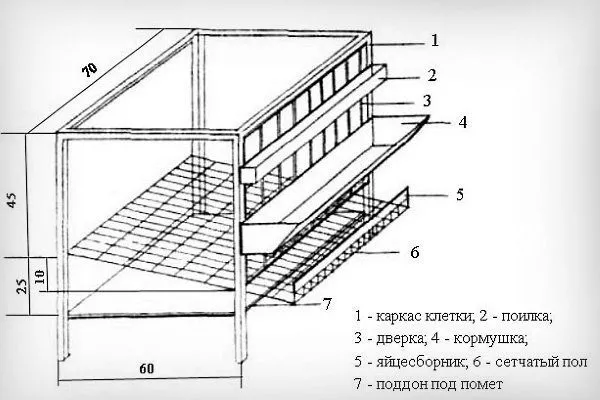
Using these materials, a cage is assembled according to the following drawing:
Once you've gathered the necessary materials, you need to prepare the parts for your future cage. They are presented in the table:
| Name | Quantity (pieces) | Dimensions |
| Made of galvanized welded mesh measuring 25x50 mm | ||
| Back wall | 1 | 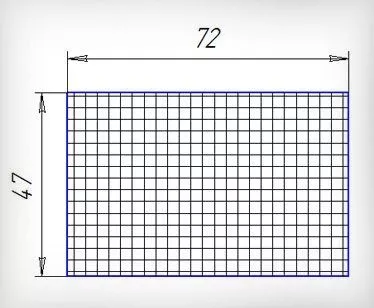 |
| Side wall | 2 | 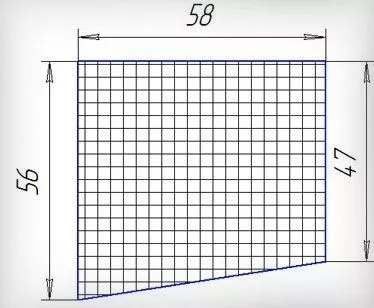 |
| Ceiling | 1 | 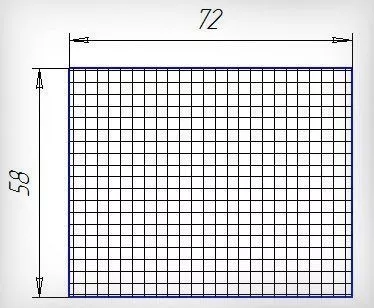 |
| Mesh floor | 1 | 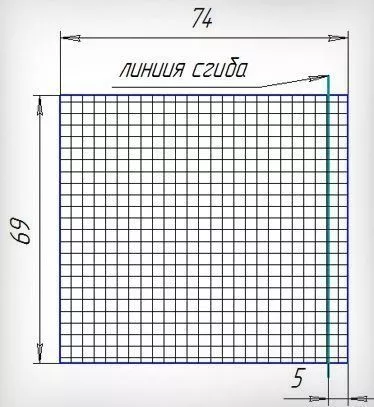 |
| Made of galvanized welded mesh measuring 50x50 mm | ||
| Front wall | 1 | 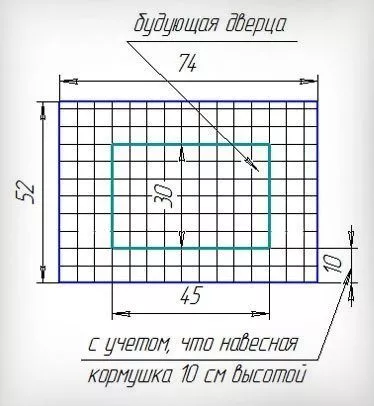 |
| A door cut out of the front wall | 1 | 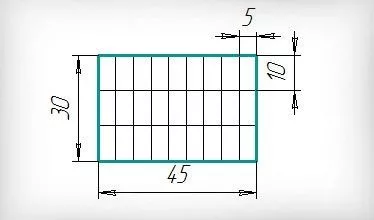 |
| From a 2x2 cm corner | ||
| Legs | 4 | Length – 80 cm |
| Ceiling frame | 4 | 2 frames, 70 and 60 cm long |
| Mesh bottom frame | 4 | Length – 70 cm |
| Frame for a litter tray | 3 | 2 frames 65 cm long and 1 frame 70 cm long |
| From a steel strip 2 cm wide | ||
| For the front wall | 1 | Length – 74 cm |
| Under the mesh bottom | 1 | Length – 70 cm |
| Made of tin | ||
| Pallet | 1 | 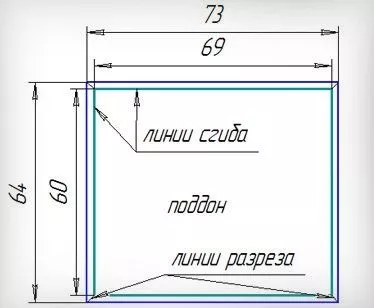 |
Once you have prepared all the parts, you can begin making the cage:
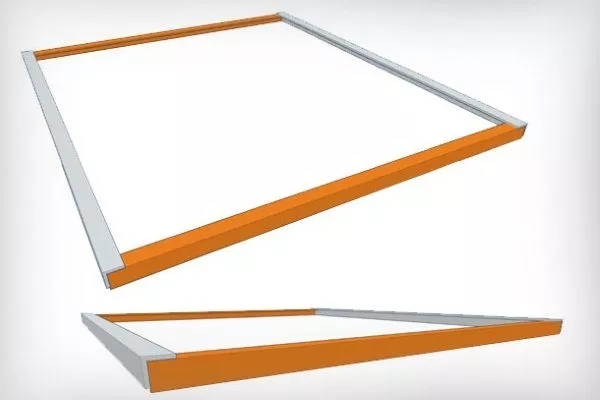
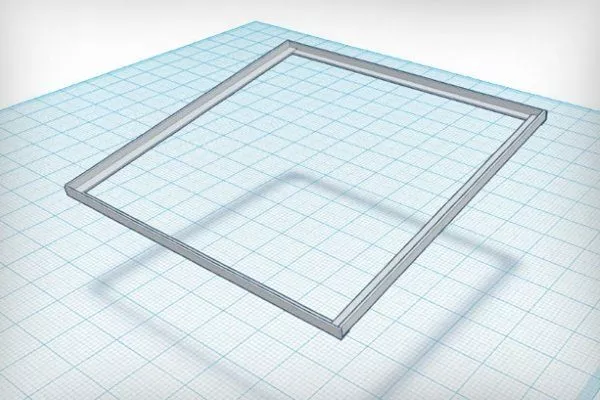
- Assemble the frame. To do this, take the prepared ceiling frame pieces and bolt them together so that the 70 cm long corner (gray) is positioned above the 60 cm long corner (orange):

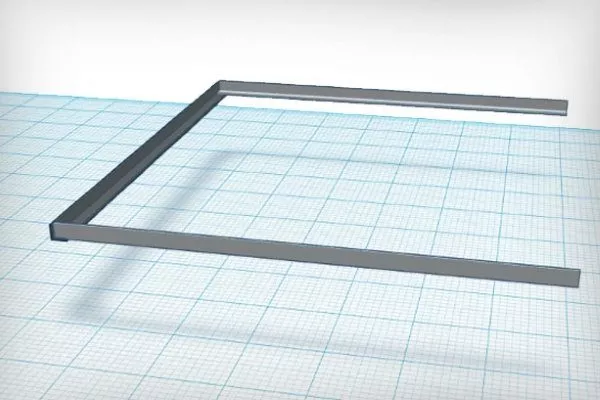
- Assemble a frame for a tray in which bird droppings will be collected:
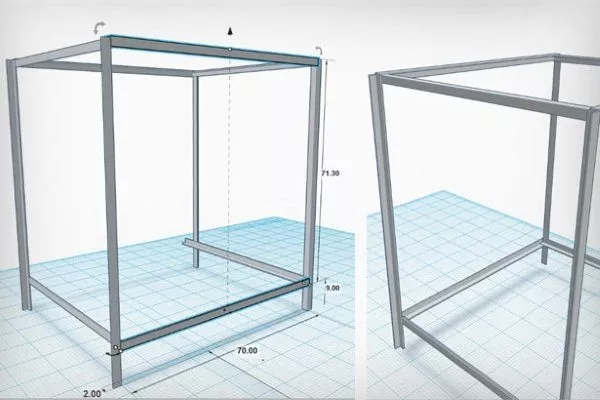
- Assemble the mesh bottom frame using the same principles as when assembling the ceiling frame:
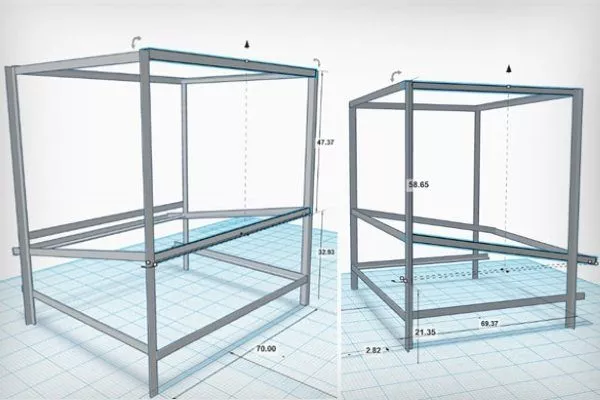
- Connect the legs to the ceiling and the tray so that the distance between the elements of the back wall is approximately 71 cm:
- Install the mesh bottom frame in its place as shown in the drawing:
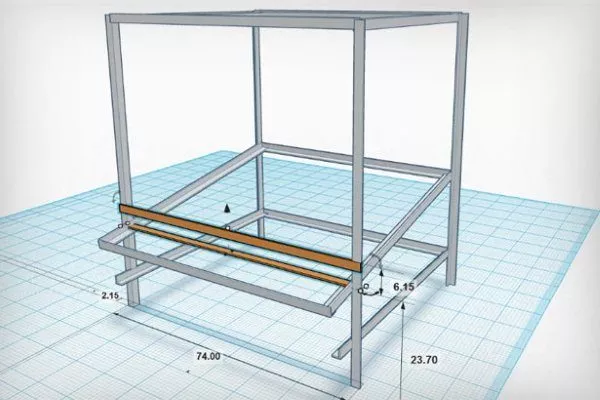
- Fix the steel strip parts in the appropriate places:
- Secure the mesh, cut into rectangles, to the frame using strong wire. To ensure eggs can easily fall into the egg collector, the distance between them should be slightly more than 6 cm.
- Make a tin frame around the door, then attach it to the cage using hinges so it opens freely downwards. Install a spring.
- Check and clean the litter tray daily.
- Disinfect waterers and feeders once a week.
- Inspect the cage monthly for damage to the mesh or frame.
If you equip the cage with a waterer and a feeder on the outside, it will look like this:
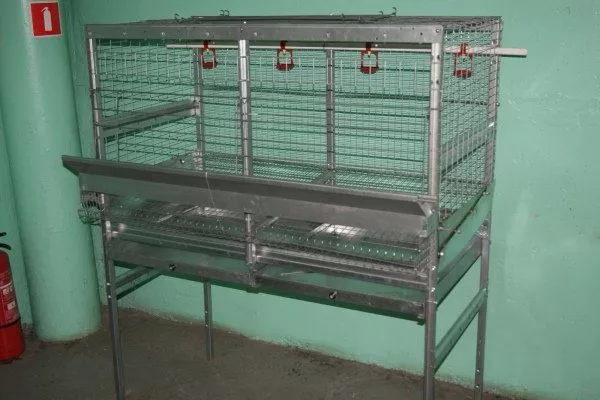
If desired, the cage can be made in 2-3 tiers, increasing its height and using the ceiling of the lower structure as a tray for droppings.
Making a cage from a wooden block and metal mesh
If the farm is small, you can make a cage measuring 0.5 x 1 m and 45-46 cm high. To do this, you will need to prepare the following materials:
- planed wooden beam measuring 40x40 or 40x50 mm and 3 m long – 5 pieces;
- planed wooden beam measuring 20x40 and 3 m long – 2 pieces;
- metal mesh for the floor, ceiling and side walls, 1 m wide and with cell sizes from 15x15 to 25x25 mm - 2 cards measuring 0.5x2 m or 3 linear meters of rolled mesh;
- metal mesh for the front wall, 1 m wide and with a cell size of 50x100 mm – one card measuring 0.5x2 mm or 1 linear meter of rolled mesh;
- metal corners for frame assembly;
- galvanized wood screws and large-headed "bug" screws for fastening the mesh;
- a sheet of galvanized iron with a thickness of 1-1.5 mm for making a pallet or a plastic tray.
To complete all work you will need the following tools:
- hacksaw or jigsaw;
- screwdriver;
- grinder for cutting mesh and tin;
- roulette;
- level;
- square;
- sander or sandpaper;
- marker.
Once you have everything you need, you can begin assembling the cage according to the following instructions:
- Place and cut the frame material. To do this, cut the prepared beams according to the sketch using a hacksaw or jigsaw. Sand the ends to avoid injury.
- Assemble the frame using angle brackets and galvanized screws. To ensure maximum stability, reinforce the side walls with plywood gussets.
- Make a door frame from 20x40 lumber. To make the cage mobile, you can attach furniture wheels to the legs.
If a metal profile is used to make the frame, then the prepared parts must be welded together using metal screws, a corner, or a profile pipe.
- Create a lattice floor by cutting it out of fine-mesh metal mesh according to the design. Bend the front edge to form a tray. To strengthen the floor, create additional cross supports from 20x40 cm lumber. The distance between them should be at least 20 cm. It's recommended to treat the lumber with an antiseptic (drying oil, lime), and then attach the mesh to it using self-tapping screws.
- Cover the side and back walls with wire mesh, also using screws. To avoid unnecessary cutting, you can bend the side walls from a single piece of mesh. A standard 0.5 x 2 m sheet is enough for two side walls and the back of the cage.
- Cover the front door with 50x50 mm mesh using screws. It's preferable to make the door hinged, as a 1 m wide opening door is inconvenient. To ensure it locks, attach bolts.
- The cage cover should be made from lattice or moisture-resistant plywood.
- Make a tray out of galvanized sheet metal, the size of which should match the bottom of the cage. Bend the front edge to form a tray. Place it on a block of wood flooring. Bend the sides of the tray inward to minimize feed loss.
The nuances of making an inclined egg collector
Cages with egg collectors are considered among the most convenient for laying hens, but their secret lies in the slanted floor. When a hen lays an egg, it doesn't roll across the floor, but rather gently into a special tray located outside the wall.
An additional benefit of this design is that the mesh floor does not need to be removed or covered with bedding, as the droppings will fall through the mesh cells directly into the tray, which only needs to be cleaned regularly.
To make a cage with a similar mechanism, several nuances should be taken into account:
- the floor must be rigid, so it should be made of wire at least 3-5 mm thick, otherwise it will sag under the weight of the hens;
- the ceiling and side walls do not need to be made blank, so they can be made from a mesh with cells measuring 25x50 mm;
- The front wall should be made of a mesh with larger cells - 50x50 or 50x100 mm (to obtain the front wall, you can simply fix the rods at a distance of 50 mm).
Here is a diagram of a cage with a slanted egg collector:
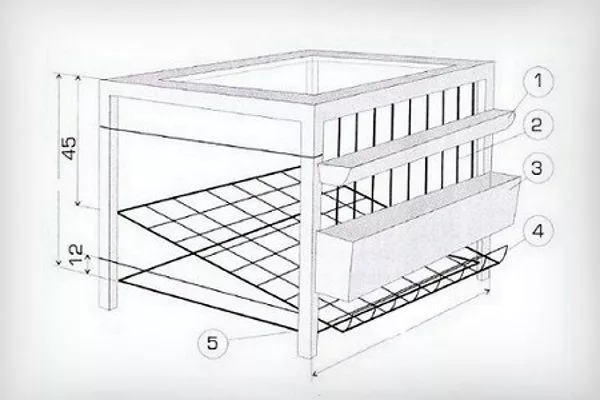
1 — drinking bowl; 2 — door; 3 — feeder; 4 — egg collection tray; 5 — litter tray.
Having prepared the appropriate frame, you can make the chicken cage itself:
- Attach mesh to the frame to form the first floor (#5 in the diagram). This will be used to hold the litter tray.
- Make a second slanted floor from fine-mesh wire and attach it to the frame at an 8-9 degree angle (#4 in the diagram). When installing the slanted floor, keep in mind that its wire mesh should extend 15 cm beyond the front wall. Bend its edges to create a container for collecting eggs.
- There must be a gap of at least 12 cm between the first and second floors to allow for the insertion of a pallet later.
- Install the side walls and ceiling, and then use hinges to attach the front wall made of rods or large-mesh wire to use as a door (No. 2 in the diagram).
- The structure is almost ready, you just need to attach a drinker (No. 1 in the diagram) to the front wall, and a feeder (No. 3 in the diagram) below.
Cage lighting
To ensure that hens' egg production does not decline, they need to be provided with an optimal daylight period of at least 14-17 hours. In winter, this duration can be achieved with the help of lighting.
To save energy, it's best to use energy-saving lamps or LED lights. They should be positioned so that the cages are evenly illuminated. To automate the lighting, you can install lights equipped with a timer or photocell.
When installing any lighting fixtures, maintain a safe distance from the chickens or use durable lampshades that will prevent the lamps from breaking.
Video instructions for assembling a laying hen cage
This video provides an overview of a homemade cage for laying hens with a sloping floor:
Helpful tips
When making your own laying hen cages, consider some simple recommendations:
- The tilt and elevation of the egg collector must be correct, otherwise it will not be possible to prevent the eggs from being pecked, as the birds will reach them with their beaks.
- Metal rivets can be used to join metal profile and galvanized sheet metal components together. This allows the structure to be provided with a minimal anti-corrosion coating, extending its service life.
- To simplify the installation process, you can use a special device - a riveter.
- It's best to use PVC pipes for water supply. Nipple drinker heads can be installed directly into them.
There are various options for constructing laying hen cages, all using readily available materials and tools. Once you've prepared all the necessary drawings, taking into account the number of hens on your farm, you can begin assembling the structure. Keeping the hens indoors will reduce feed costs by 15% and increase hens' productivity.