
Chickens don't require much attention, are undemanding eaters, adapt to their surroundings, and so on. However, there's an important point that many beginners overlook: grass is essential for chickens. But picking it by hand and putting it in their cage is completely wrong. So today we'll talk about grass shredders for chickens.
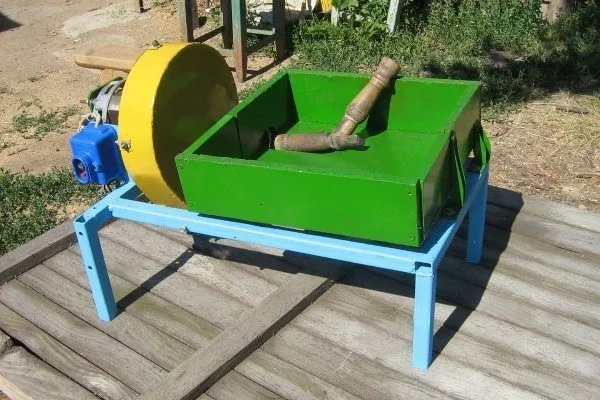
Do you need a shredder?
Undoubtedly, because grass is the basis of a chicken's diet, as strange as it may sound. Owls, for example, need to eat rodents whole, although they will regurgitate fur and bones. That's how their digestive system works. The same goes for chickens: they can be fed special feed, grain, and so on, but nothing can replace the nutrients found in fresh, living grass.
However, compared to owls, chickens need to eat the grass they need every day. How much energy is humanly possible to manually chop plants every day? Hardly much. That's why a grass chopper is needed. Moreover, chopped plants are much more palatable to chicks: it's easier to peck at the prepared food than to try to pluck leaves from long stems.
A chicken herb chopper is also useful if you have a large flock of chickens. Daily cutting of plants can be tedious, and if you need to do this in particularly large quantities (chickens eat a fair amount), you'll need the right tool.
Design and operating principle
Any herb chopper works like a food processor: it cuts everything into small pieces using sharp blades. While there are variations among herb chopper models, the basic idea is always the same: the herb is placed in a container, rotating blades chop the contents, and the finished product is ejected (due to centrifugal force) through a special opening on the side.
- ✓ The particle size should be large enough for chickens to easily peck at the feed.
- ✓ The device must minimize dust formation so as not to cause respiratory diseases in birds.
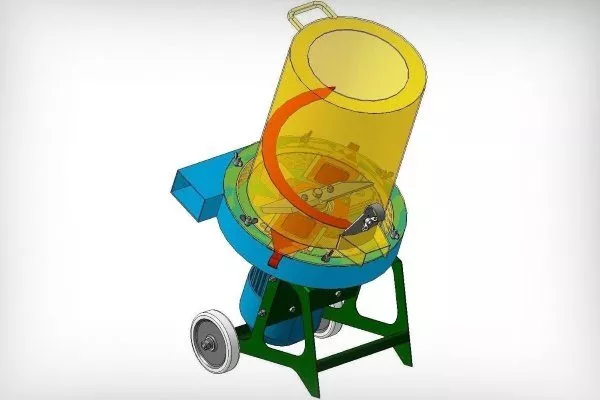
Any chicken grass chopper consists of several parts key details:
1Container for storing raw materials
This is where the unprocessed plants the chickens need are stored. The amount of raw material allowed in the container depends on the technical specifications of each individual model.
However, oftentimes, skilled poultry farmers create such devices themselves to feed a small number of chickens. In this case, a standard 12-15 liter bucket is used as a container for storing grass. It can also be replaced with a plastic barrel or other more suitable containers.
2Knives
The bottom of the feed container is fitted with knives. Some models can use cords (trimmer lines). This method of cutting grass is even preferable for feeding chickens: the pieces will be larger, making them easier for the birds to peck at.
And when using models with sharp blades, there's a high risk of producing mulch (for gardening) or even grass mush. Neither is suitable for feeding chickens—they'll refuse to eat it.
3Engine
Grass cutters can be either automatic (most common) or manual. Commercial models have a wide range of motors depending on the intended purpose. This also affects the power of the device. High-performance shredders, in addition to cutting grass too finely, can also create a lot of dust.
To prevent this, manufacturers install various filters on grass cutters, but what if the grass is cut to feed chickens? A high-performance, powerful motor isn't required, meaning it won't create much dust.
Homemade models can even use drills or angle grinders, with blades attached to the end for shredding the grass. In some special cases, chicken grass shredders are even made from old, discarded washing machines.
Their basic operating principle perfectly matches the requirements of grass cutters: blades are installed in the drum, an additional hole is created for the removal of cut grass, after which the device begins to operate for its intended purpose.
4Other details
In addition to the raw material container, blades and motor, a wide variety of additional accessories can be installed:
- protective cover;
- wheels (allow you to freely move the shredder around the area);
- cable for connecting the unit to the power grid;
- sieve;
- filters;
- blowing out the finished product, etc.
DIY grass shredders
To create your own unit, you can use any tools and parts that will effectively perform the function of chopping grass.
For assembly you will need the following materials:
- a cultivator device that will act as a drive for chopping grass;
- sharpened steel knife(s);
- self-tapping screws;
- crushing container;
- table top and legs.
Depending on the desired assembly, other materials may be required. However, this is a purely individual process.
This video shows a very simple homemade shredder. It's made from a metal bucket, a motor with blades, and a plastic container (for collecting the finished material):
A shredder made from a bucket and old construction tools
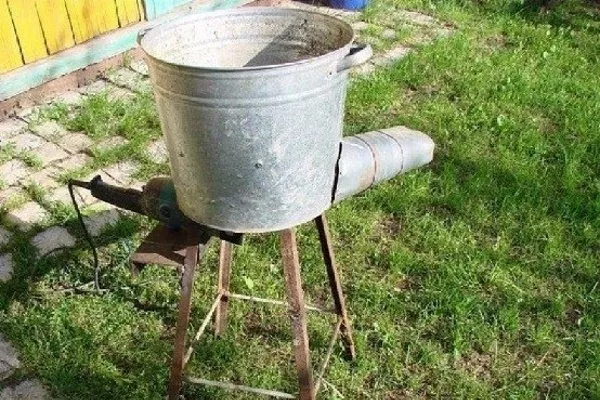
To create such a device, simply take a countertop, attach a bucket to it, and drill a hole in the bottom. A knife is attached to the drill shaft and placed on the bottom of the bucket, just under the countertop.
A hole needs to be made in the side of the bucket and covered with metal plates (centrifugal force will allow the chopped grass to pass through). After final assembly, the resulting unit will look something like this:
If you wish (or don't wish to), you don't have to install the drill in place; you can simply attach the blades to the rod and lower the drill into a bucket that already contains grass.
For the especially lazy, you can avoid making any holes in the bucket and just empty the chopped grass from the container manually each time, while simultaneously using an improvised drill-grass cutter yourself.
The video below shows how to make a shredder from a bucket and an angle grinder:
A shredder made from an old vacuum cleaner
The most commonly recommended device for this homemade device is the Soviet-era "Typhoon" vacuum cleaner. It has a perfectly shaped top opening for grass clippings, as well as an identically sized outlet (where the suction hose used to be). This ensures that the shredded grass doesn't remain inside, but is ejected from the housing during operation.
The diagram for creating such a unit can be seen in these images:
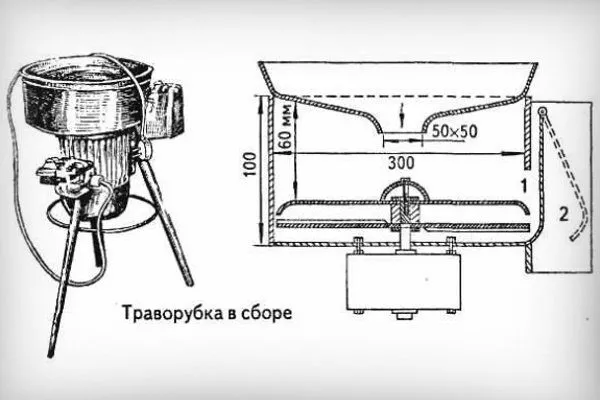
1 – the damper is closed; 2 – the damper is open.
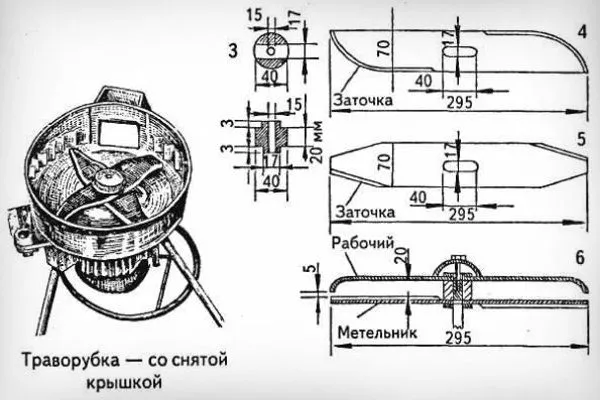
3 – bushing; 4 – working knife; 5 – sweeper knife; 6 – knives with bushing assembled.
A grinder from a washing machine
This type of unit is almost identical to one made from a vacuum cleaner. The only difference is the size. The washing machine body (which can be cut to size, if desired) will be used as the container, and the sleeve should be more than 5 cm long.
It's best to use a top-loading washing machine. This will make loading the material easier. A standard-loading machine will have to be placed on its side, although this isn't a drawback. Rather, it's a slight complication when installing the pre-made shredder.
You can watch the video to see how to make a weed grinder from a washing machine. Here, the craftsman explains in detail the process of creating his own unit and tests it:
Types of shredders and popular models
Exists 3 main classes, into which grass cutters are divided:
1Amateur
This category includes units with a power consumption of up to 2,200 W. These devices easily handle small quantities of processed material (150 kg/h for grass), shred the grass perfectly, and can even handle grains, vegetables, fallen fruit, rotten wood, and small branches.
A remarkable example of a high-quality grass chopper of this type is the IKB-002, which is both a grass chopper and a grain crusher.
As for the technical characteristics of the device:
- power – 1,150 W;
- grass chopping – 150 kg/h;
- blade rotation speed – 1,200 rpm;
- can work without breaks for up to 6 hours;
- compact size;
- easy transportation;
- saving on electricity consumption.
This device costs 4,500 rubles. Its only drawback is its flimsy appearance, but with careful handling and maintenance, it will last a very long time. For its price, it does an excellent job of shredding grass.
2Semi-professional
The power of these devices is equal to or slightly higher than that of hobby models (up to 2,800 W). Their key difference lies in their higher performance: the cutting elements rotate faster, as does the quality of the material they are made from. They also have more blade types, meaning they can not only cut grass but also mulch it.
The Kubanets-300T3M is rightfully considered a good example of a semi-professional shredder:
- power – 2,200 W;
- grass chopping – 300 kg/h;
- blade rotation speed – 2,850 rpm;
- operating mode – continuous (without breaks, as long as the cooling system is functioning properly);
- high availability of spare parts and consumables.
One of the unit's drawbacks is its size. It may not be particularly large, but it comes fully assembled, so transporting it will require more effort and expense than similar units. Another drawback is its high dust production: the unit doesn't come with special filters, resulting in significant dust generation during operation.
Nevertheless, this model has proven itself to be excellent among customers, and can be purchased for 19,000 rubles.
3Professional
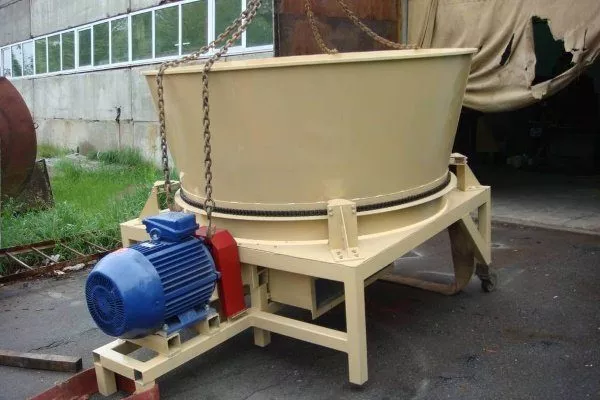
Shredders of this type are designed not only for grass but also for branches, even quite large ones (up to 80 mm). Moreover, they are ideal for shredding pine needles, cones, and other items. These models operate at 5-7 kW and are not electric—only gasoline-powered. Professional-grade devices are superior to their predecessors, in every way.
An excellent example and high-quality model among similar units is the VIKING GB 460:
- 4-stroke engine with 5.8 kW power;
- blade rotation – 3,000 rpm;
- the operating mode is constant, but it is recommended to take breaks of 10-15 minutes every hour;
- service life – 20 thousand hours;
- 12 crushing and 3 grinding knives;
- automatic feeding of raw materials;
- maximum performance.
The disadvantages include the unit's weight (72 kg), noise level (around 100 dB), and price – 140,000-145,000 rubles. However, when considering its characteristics, which allow it to easily supply a small poultry farm with chopped grass, its incomparable benefits become clear.
It's best to keep children away from shredders, and adults should also exercise extreme caution. A grass cutter may seem harmless, but the blades inside are so sharp they can cause serious injury. When used properly, the device will last for many years, providing high-quality food for your chickens.
I've also seen a version of a shredder made from a garden lawn mower. You flip it upside down, place a bottomless bucket on top, and throw in the grass. It's not as efficient as the methods described above, of course, but sometimes this option can be useful for the really lazy.