
Alben is a common preventative and antiparasitic medication given to chickens. It does not require laxatives before deworming or a pre-treatment diet, which is necessary before many other antiparasitic medications. More information about the medication, its use, and side effects can be found below.
What kind of drug is this?
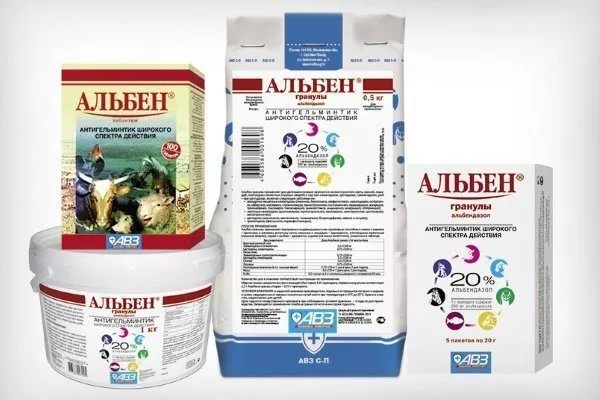
Alben is a new-generation, universal, complex anthelmintic for animals, also known as Albendazole. This Russian-made product is primarily manufactured by the Scientific and Implementation Center Agrovetzashita Saint Petersburg, located in Sergiev Posad, Moscow Region.
The anthelmintic has a broad spectrum of action and destroys various parasites when administered orally. Indicated for infestation of chickens with helminthsThese can be sexually mature and immature individuals:
- cestodes;
- nematodes;
- trematodes.
Alben is effective for all types of poultry, not only for treatment but also for prevention, as it is classified as a moderately toxic medication and is completely safe for poultry. However, before administering it to birds, it is essential to consult a veterinarian. Only they can determine the correct dosage.
Alben should be stored in a dark place at a temperature of 0 to 22°C. The shelf life is 3 years from the date of manufacture.
Composition and release forms
The main active ingredient of the drug is albendazole, the concentration of which is approximately 20%. In addition, there are auxiliary additives in the form of:
- polyvinylpyrrolidone;
- calcium stearate;
- potato starch;
- lactose.
Alben is available in tablets, which are sold in polymer jars of 25-100 pieces each, or in foil blisters of 25 pieces, packed in cardboard boxes (one package can contain 25-100 tablets).
The drug is also available in granular form. The granules are placed in sealed laminated bags. The bulk weight is 0.5 kg or 1 kg.
Alben is also available in suspension and capsule form.
Effect of the drug
Alben is administered orally to the bird, then enters the gastrointestinal tract and is rapidly absorbed, penetrating other tissues and organs. Its active ingredient disrupts carbohydrate metabolism and microtubule function in worms. As a result, they die and are eliminated from the bird's body. Alben is also capable of killing helminths that have not yet hatched from eggs.
- ✓ Rapid absorption in the gastrointestinal tract and penetration into tissues.
- ✓ Destruction of helminths at all stages of development, including eggs.
The drug is excreted from the bird's body along with the feces, without changing its form. A single dose is sufficient. The convenience of administration is that there is no need to starve the bird to empty its intestines or administer laxatives before deworming.
The product has hazard class 4 and is well tolerated by birds when the required dosages are observed.
Instructions for use
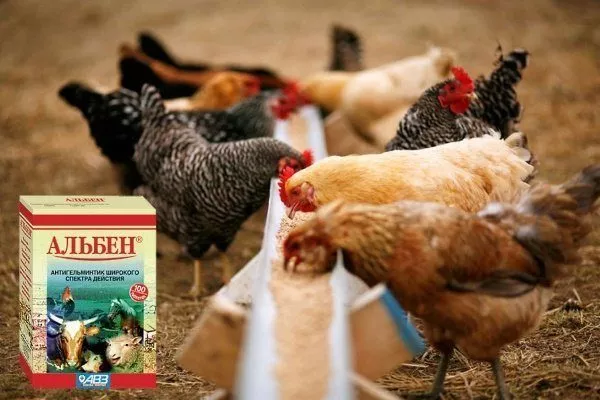
This medication, in tablet form, is used to treat and prevent helminthiasis in chickens. It is administered to birds according to the following instructions:
- The optimal dose is determined based on 20 mg of the drug per 2 kg of live weight of the bird. Thus, 1 tablet is calculated for 35 kg of weight, 1 capsule for 40 kg, and 1 granule for 20 kg. The optimal amount of the drug is ground into powder in a mortar.
- Take the food, preferably a mash, and add the powder to it, mixing thoroughly.
- Feed the birds in the morning. For best results, deworm them two days in a row.
- Never overdose the medication, as this will cause diarrhea and vomiting in the chickens. On this day, the birds may refuse to eat at all.
Many farmers prefer to administer the medication by dissolving it in water. This method is preferable for small farms, as each bird will need to be given the medication individually.
Alben is given to broiler chickens in solution!
Special instructions have been developed for taking the drug dissolved in water:
- The medication dosage is calculated based on the number of chickens. To do this, the weight of all the birds is added up.
- Calculate how much water each chicken drinks at a time (usually 1.5 parts of their feed intake) and add it up based on the number of birds. One tablet is calculated for 35 kg of live weight. Since one chicken weighs about 2 kg on average, this tablet can be fed to approximately 17-18 chickens.
- The drug is crushed to a powder state and dissolved in warm boiled water.
- The prepared mixture is given to the bird using a regular medical syringe, after removing the needle.
Another method of administering Alben involves adding the medication to the chickens' daily drinking water. However, this is not as effective as individual infusions, as chickens consume water at different rates. Furthermore, some chickens may not even approach the drinking bowl. Therefore, this method is used only in extreme cases.
Features of application
To ensure that Alben is used with maximum effectiveness, the following information should be taken into account when using it:
- age of the bird;
- purposes of using chicken eggs and meat;
- time of seasonal molting.
Based on these nuances, there are the following features of the use of Alben:
- The medication is given to chicks after they begin going outside, which is around one month old. This is because helminths can be everywhere outdoors, and chicks will carry them on their feathers and feet. Therefore, preventative measures are taken to prevent infection. Alben is usually mixed into the mash, but it should not be hot. Feeding is given after the chicks have been outside for two hours, allowing them to become hungry and actively consume the mash.
- If laying hens are being treated, their eggs are considered unfit for consumption for 4-5 days after administering Alben. However, eggs laid during this period can be boiled and fed to other birds or animals (but not to humans!). If broilers are being treated, they should not be slaughtered for one week after deworming, as their meat is unfit for consumption during this period. In extreme cases, the meat can be boiled and fed to animals.
- Alben is contraindicated in the fall or spring, when birds begin molting, even if helminths are detected. It's necessary to wait until this time has passed and then replace the medication with pumpkin seeds and herbal infusions.
- Preventative maintenance is carried out annually. The best time is considered to be spring, approximately 7-8 days before releasing the birds outdoors, and in the fall, with the onset of cold weather, approximately 5 days before moving them into the barn.
In the video below, the breeder provides an overview of the medicinal product "Alben" and demonstrates how chickens take the drug:
Quite often, when submitting a stool sample for analysis, the result is negative, but it is worth remembering that helminths can affect the lungs and oviducts, so it is still worth carrying out preventative measures using Alben.
Recommendations and special instructions
When using Alben, the following recommendations should be taken into account:
- On large farms, it's not recommended to deworm all the chickens at once. It's better to select 50 birds from the flock and administer the medication only to them. Then, monitor their condition for 3-4 days. If everything goes well, the procedure can be repeated with the remaining birds.
- When working with Alben, precautions must be taken as it is moderately toxic. Avoid eating, drinking, and smoking while in contact with the medication. Wear rubber gloves when handling it. Wash your hands with detergent after use.
- To ensure the birds consume all the medicated food, they should be underfed in the evening and more palatable ingredients added to the Alben mash. These could include, for example, boiled potatoes and carrots. It's important that the birds consume all the food in one sitting.
- Along with deworming, the chicken coop should be cleaned with antiseptics. This will require thoroughly cleaning the chicken coop of droppings for one week, and much more frequently than previously.
Side effects and contraindications
If the dosage of Alben is followed, no side effects are observed, but in case of overdose the following phenomena are possible:
- allergic rash;
- decreased appetite;
- diarrhea;
- vomit;
- depressed state;
- drowsiness.
Typically, this reaction can be observed within 24 hours of administering the medication. If these symptoms occur or if the chickens' condition worsens, consult a veterinarian. They can prescribe medications to relieve these unpleasant symptoms and another anthelmintic to eliminate the worms.
As for contraindications, one is the molting period in chickens. Furthermore, Alben should not be given to weakened or sick chickens. It's important to note that other anthelmintic medications should not be given to chickens simultaneously.
Which is better - Alben or Tetramisole?
To compare the two anthelmintic drugs, it is necessary to consider the properties and therapeutic capabilities of Tetramisole:
- This is a broad-spectrum anthelmintic. It is active against nematodes found in the gastrointestinal tract and lungs. It paralyzes the nervous system of nematodes, causing their death. It is used for both prophylaxis and treatment of helminthiasis.
- It is considered moderately toxic. After oral administration, it is rapidly absorbed through the gastrointestinal tract and begins to act within 60 minutes, with the effect lasting for about 24 hours. The drug is excreted through bird feces.
- It is available in small, milky-white granules (up to 3 mm in diameter), as well as in powder form (10% and 20%). It is sold in plastic jars, polyethylene, and paper bags. The quantity varies from 50 to 5,000 grams.
It's clear that Alben and Tetramisole are very similar in their properties, even in their toxicity levels. They are suitable for the prevention and treatment of various types of helminths in chickens. Neither has any advantages over the other. The only differences are their shelf life (Alben has a 3-year shelf life, while Tetramisole has a 5-year shelf life) and hazard class (Tetramizole has a 3-year hazard class, while Alben has a 4-year hazard class).
The price of 100 Alben tablets is 374 rubles, and 150 grams of granules is 180 rubles. Tetramisole 20% granules are slightly more expensive at 195 rubles.
Analogues
Alben has a number of analogs that are also prescribed as anthelmintics. These include:
- AlvetA broad-spectrum anthelmintic drug that is effective against adult and larval nematodes, trematodes, and adult cestodes. The main active ingredient is albendazole. It also contains vitamin E and lactose. The drug is administered to birds in the morning, mixed with compound feedThe ratio is 0.5 g per 10 kg of bird weight..
- BioferminIt has a broad-spectrum anthelmintic effect. It is used to treat ascariasis, heterakiasis, capillariasis, syngamosis, and rayetinosis. The active ingredient is flubendazole (5%). The drug is administered to birds with feed for 7 days at a rate of 60 g per 100 kg of food.
- Piperazine. An effective anthelmintic drug whose main active ingredient is piperazine adipate. It has a toxic effect on helminths. The recommended dose is 2.5 g per 1 kg of bird weight. The treatment course is 2 days.
- Promectin. An antiparasitic agent containing ivermectin as its active ingredient. It is used to treat and prevent internal and external parasites. It is effective against all types of roundworms, acaroses, entomoses, lice, and nematodes. The dosage and rate of use are prescribed by a doctor.
- Tetramisole. A water-soluble anthelmintic. Its active ingredient is tetramisole chloride. It has a broad spectrum of action, active in the lungs and digestive organs. It is used once during the birds' morning feeding.
- Fenbazen. Another anthelmintic, the active ingredient of which is fenbendazole. It has a lethal effect on nematodes and some cestodes. It is administered with feed at a rate of 0.0045 g per 1 kg of bird weight for 4 days.
- Febtal. The active ingredient is 5-phenyl-thio-2-benzimidazole carbamate. It is active against nematodes and cestodes. The drug is administered to chickens in groups, mixed with feed at a rate of 1 crushed tablet per 15 kg of body weight or 1 g of granules per 22 kg of body weight.
- Fenbendazole. A broad-spectrum medication that is active against giardia, nematodes, cestodes, and some trematodes. It is characterized by low toxicity. It is used for group treatment, mixed with morning feed at a rate of 7.5 mg per 1 kg of body weight.
Alben is one of the most widely used anthelmintics, which not only combats the disease itself but also serves as an excellent preventative measure. It is effective against cestodes and nematodes, and also copes well with adult trematodes.