
Coccidiosis in chickens is quite common, especially on large poultry farms. The disease affects young birds, with mortality rates reaching up to 80% of the total flock. Such losses are extremely unprofitable from an economic perspective. For complete instructions on how to prevent the disease and protect your farm, see this article.
Etiology
The causative agent of this disease is a single-celled protozoan called coccidia. In chickens, the disease is caused by more than 10 parasite species, the most pathogenic of which are:
- Eimeria tenella – affects the caecum of the intestine;
- E. Necatrix, E. Brunette, E. Maxima – affect the small intestine, as well as the rectum and cloaca;
- When weakly virulent eimeria such as E. Mitis and E. Praecox enter the body, the disease becomes chronic.
One bird can be infected with different types of coccidia at the same time.
Young birds up to one and a half months old, and less commonly, up to six months old, are most susceptible to the disease. The disease is acute and severe, with mortality rates in chicks reaching 80-100%.
Although adult birds may become infected with coccidiosis, they show no clinical symptoms. A decrease in productivity and egg production may be observed. In broiler chickens, weight gain decreases.
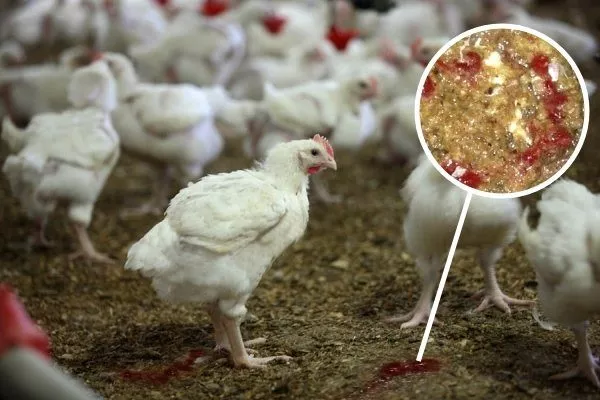
All chicken breeds are susceptible to coccidiosis.
Causes of infection
Coccidiosis often occurs in farms where sanitary and hygienic standards are severely violated, and during the spring and summer. Coccidia enter the birds' bodies through feed or water.
Factors for infection include:
- sick chickens, recently recovered young chickens, adult carrier chickens;
- meager diet;
- elevated temperatures in the chicken coop;
- high air humidity, dampness;
- grass used as feed contaminated with coccidia oocysts;
- contaminated soil in outdoor enclosures;
- contaminated litter in the chicken coop that has not been removed in a timely manner;
- contaminated equipment, staff change clothes and dishes;
- Oocysts can be spread by rodents and insects.
Coccidia are very resistant in the external environment and can retain their invasive properties for up to 1 year.
With different methods of keeping chickens
Newborn chicks Floor-dwelling animals become infected through contact with surfaces contaminated with coccidia or through food. The disease is diagnosed within 10-14 days, or less commonly within 3-4 weeks after infection, depending on the following factors:
- the state of the immune system at the time of infection;
- age;
- varieties of parasite and the degree of its virulence.
The course of the disease is characterized as severe, with a high mortality rate among chickens.
At 2 months of ageIf the bird was previously kept in cages and then released onto the floor, coccidiosis infection begins within 5-10 days, peaking within 3 weeks. This indicates that the bird has not previously encountered the pathogen and has not had time to develop immunity. The course of the disease is mild.
It follows that cage housing, with proper care and proper sanitary conditions in the poultry house, is more appropriate than floor housing.
Stages and symptoms of coccidiosis in chickens
Coccidia have a complex life cycle. Clinical manifestations of the disease vary depending on the stage of their development in the bird:
First stage
It is characterized by the penetration of Eimeria into the intestinal submucosa, where they begin to multiply. This period lasts approximately 5 days, during which the parasite destroys intestinal tissue, causing bleeding and an inflammatory reaction.
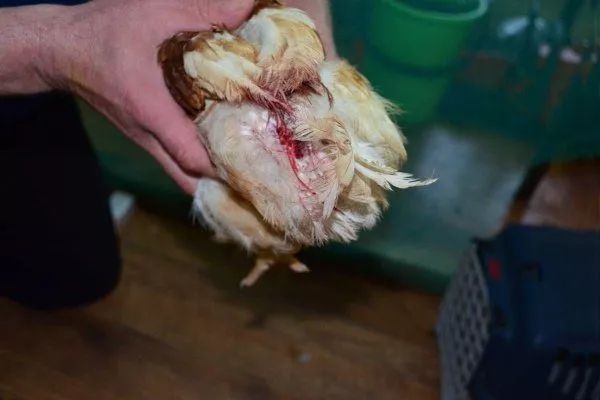
The initial stage can end in different scenarios:
- If the body's immune system is functioning properly, the bird experiences a mild form of the disease with few pronounced symptoms (abortive form). Suppression of coccidia activity and complete recovery are observed.
- When immunity levels are low, Eimeria actively reproduces, with the parasite subsequently spreading to other organs. Then, it progresses to the next stage.
The second stage
During the second stage, clinical symptoms appear. This stage lasts approximately 7 days. Intestinal function is disrupted, and nutrients are no longer absorbed and enter the bloodstream. This is caused by damage to the mucous membrane over large areas.
The body's energy expenditure for vital functions increases, bleeding increases, and anemia begins to develop.
The above changes serve as a favorable environment for the development of opportunistic microorganisms - E. coli, cocci.
Chickens infected with coccidiosis, due to reduced immunity, may simultaneously suffer from various bacterial infections.
Next, a complete disruption of metabolism occurs, and the supply of nutrients to the body stops.
The nervous system is involved in the pathological process. Chicks exhibit neurological abnormalities, including gait disturbances accompanied by loss of balance, limb paresis, and disorientation.
The toxic products of Eimeria activity rapidly enter the bloodstream, causing severe intoxication – the bird’s condition deteriorates sharply, and the following symptoms are observed:
- general weakness - the young animals are disheveled and spend most of their time sitting;
- complete refusal to eat, rapid weight loss;
- paleness of the visible mucous membranes is noted;
- diarrhea, stool color of various shades;
- depressed state.
In severe cases, the disease ends with the death of the bird; in less severe cases, the next stage begins.
The third stage
The third stage is characterized by a weakening of the negative impact of coccidia on the body, suppression of their vital functions, and gradual recovery. At this stage, intestinal bleeding ceases, and hematopoiesis returns to normal.
There is a risk of death of the bird due to dystrophic changes.
The fourth stage
In the fourth stage, complete restoration of immunity and metabolic processes is observed. Bowel and organ function improves, and appetite and digestion return to normal.
We also recommend reading the article, which will tell you about others chicken diseases.
For those who prefer to learn by ear, we recommend the following video, in which a specialist explains coccidiosis in chickens in detail:
Diagnostics
For a complete diagnosis of coccidiosis, comprehensive studies are used, which include:
- epizootological picture;
- clinical manifestations;
- pathological changes;
- laboratory data that show the presence of eimeria at different stages of its development in feces.
Coccidiosis is differentiated from borreliosis, histomoniasis, pullorum and trichomoniasis (birds of all age groups die in infectious diseases, which is not observed in coccidiosis).
Drugs for the treatment and prevention of coccidiosis
The medications described below are for use exclusively on replacement chicks and broiler chickens. Use in adult egg-laying birds is prohibited, as the medications are deposited in the eggs.
The variety of drugs with anticoccidial properties are divided into 2 types.
Funds used directly for the treatment of coccidiosis:
- Baycox is a veterinary drug with a pronounced effect against the pathogens that cause coccidiosis in chickens. It is used at the first signs of coccidiosis by mixing the drug with water at a dose of 1 ml of 2.5% Baycox per 1 ml of liquid (28 ml of the drug per 100 kg of live weight). The bird is given the drug for two days. In severe cases, the dose is repeated after five days.
- Amprolium 30%. Administered starting at 3 days of age, mixed with feed or water. The daily dose is 400 g of the product per 500 liters of water (250 mg per liter), used for 7 days to treat coccidiosis.
It is important to prepare a fresh solution daily.
A preventative dose of 400 g/ton is used for mixing with feed. A therapeutic dose of 850 g/ton is used for 10 days.
Medicines that are used as a preventive measureThe bird receives the drug daily (the drug is discontinued 5 days before the expected slaughter). These include:
- Granulated powder preparations with a broad spectrum of activity against coccidia, suppressing the parasite's activity at any stage of its development and protecting livestock from mass infestation. The following are used: Avatec 15%, Kokcisan 12%, Cigro 1% at a rate of 0.5 kg per 1 ton of finished feed, and Cikostat 66 at a dosage of 33 g per 1 ton of feed.
- Liquid medications that have a similar effect to those described above, such as Medicox, are available. 8 ml of the medication is diluted in 100 ml of water.
A breeder shares his method for combating coccidiosis in chickens in the video below:
To prevent addiction to one active substance in large farms, it is recommended to alternate the preparations monthly.
Prevention methods
The difficulty in carrying out prevention is that:
- Coccidia oocysts have a high survival rate in changing environmental conditions;
- Disinfectants used in veterinary medicine are often ineffective - oocysts exhibit strong resistance to them;
- Eimeria reproduce very quickly.
The main measures for successful prevention:
- Before introducing birds, prepare the room and equipment. To do this, treat surfaces with boiling water or steam. A 7% ammonia solution is also suitable. (After using ammonia, ventilate the room for 3 hours, and rinse waterers and dishes.)
- It is recommended to keep young animals up to 2 months of age isolated from adult livestock.
- Cage keeping of chickens under 8 weeks of age.
- Keep the litter in the chicken coop clean and dry.
- Young animals kept on bedding should receive chemoprophylactic drugs in their feed starting from the age of 10 days.
- ✓ Using a 7% ammonia solution requires subsequent ventilation of the room for 3 hours.
- ✓ Surfaces should be treated with boiling water or steam at a temperature of at least 70°C to ensure the destruction of oocysts.
Of course, these recommendations will not completely solve the problem of coccidiosis on the farm, but they will significantly reduce the risk of global spread of parasites.
Due to the risk of addiction to coccidiostatics, vaccines against coccidia have been developed—Koktsivak, Immukoks, and Livakoks. Their high cost makes them difficult to administer, so they are primarily used for laying hens and replacement hens.
Coccidiosis is a common problem. While it's impossible to completely eliminate the parasite, maintaining proper sanitary and hygienic conditions is within the capabilities of any farm. Following veterinarian recommendations and timely disinfection of the premises are the key to high productivity and healthy poultry.