
Owners of both large poultry farms and private farms are faced with worms in their chickens. The worms multiply rapidly, affecting individual organs and the entire body, both young and adult birds. This article provides information on how to prevent infection in birds and what to do if an infestation occurs.
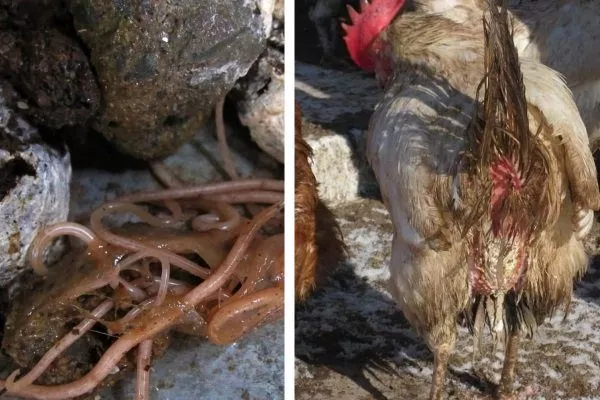
Causes and routes of infection
Helminth infestation in chickens directly depends on the state of the bird's immune system. The following factors, in turn, influence the development of a strong immune system:
- feeding regime and quality;
- conditions of detention;
During free-range conditions, the risk of infection with worms increases.
- sanitary and hygienic conditions on the farm.
Life cycle of a helminth
Worm eggs enter the chicken's body through the alimentary route - through infection with larvae:
- food products;
- earth surfaces;
- insects, worms, and snails living in the soil that carry helminths;
- household items.
Depending on the type of helminth, to reach the sexually mature stage, the larvae can be localized in:
- lungs;
- heart muscle;
- liver;
- in the bird's brain.
After reaching a certain stage of development, parasites of many species migrate to the intestines, where they undergo intensive reproduction.
The larvae are released into the environment with the droppings, completing the developmental cycle.
Worm larvae may be present on the eggshells of infected chickens.
Types and symptoms
The invasion manifests itself in several ways:
- a healthy bird with a strong immune system can be a long-term carrier of various types of worms, clinical symptoms may be absent;
- in case of moderate severity of the lesion, clinical manifestations of the invasion may be observed;
- When infected with several types of helminths and with weak immunity, the invasion ends with the death of the host.
In laboratory studies of problem farms, chickens are usually found to have a mixed type of infestation – the simultaneous parasitism of different types of helminths.
Most often, infection with 3 types of helminths is diagnosed.
| Name | Length of an adult | Localization in the body | Life expectancy |
|---|---|---|---|
| Heterakis gallinarum | 10 mm | Cecum | 4 weeks to sexual maturity |
| C. Contorta | Not specified | The mucous membrane of the esophagus, goiter, oral cavity | 7 weeks |
| Ascaridia dalli | Up to 12 cm | Intestines | From several months to a year |
Heterakidosis (Parasitocenosis)
Heterakiasis is caused by a small nematode, Heterakis gallinarum, which averages 10 mm in length. It parasitizes the cecum of birds. The parasite develops from the larval stage to sexual maturity in four weeks.
Helminth eggs are resistant to changing environmental conditions and retain their infectious properties for a long time. When hygiene conditions are poor, the parasite multiplies rapidly in the litter, leading to widespread infestation of chickens.
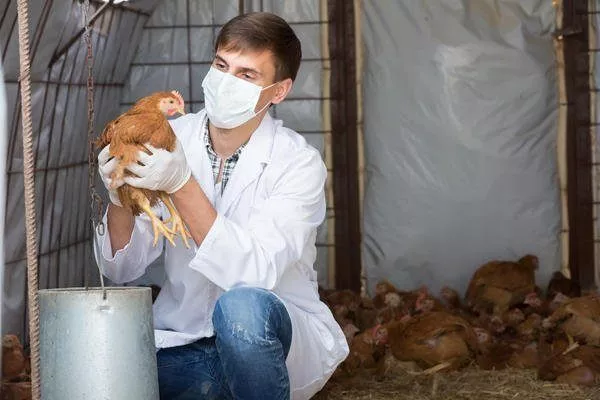
Heterakiasis is a chronic condition with the following symptoms:
- unstable appetite;
- lethargy;
- decrease in egg production;
- growth retardation in young animals;
- diarrhea.
Diagnosing this pathology during life is difficult; the helminth is identified posthumously.
Capillariasis
The disease is caused by the nematode C. contorta. The helminths reside in the mucous membranes of the esophagus, crop, and oral cavity of chickens. Sexual maturity is reached in 4 weeks, and the parasite's lifespan is approximately 7 weeks.
Mostly chickens under 4 months of age are affected, with the peak incidence observed in the summer.
The main symptoms in this case are:
- digestive disorders – worms localize on the mucous membranes of the digestive tract in large clusters, causing swelling, hemorrhages and inflammatory reactions;
- lethargy is noted;
- loss of appetite and, as a consequence, decreased weight gain;
- mortality is often observed.
Capillariasis is diagnosed based on clinical signs, laboratory tests and pathological changes.
Ascariasis
The disease is caused by the largest nematode, the chicken roundworm Ascaridia dalli. Females can reach 12 cm in length. The parasitic period in the chicken's intestines ranges from several months to a year.
Ascariasis is most dangerous for egg-laying chickens (productivity decreases by 30%) and young animals up to 6 months of age.
Signs of infestation are observed a week after infection:
- appetite is reduced or absent;
- lethargy;
- diarrhea;
- exhaustion;
- slowing of growth and weight gain;
- There may be nervous disorders.
Pathological changes indicate inflammatory processes in the intestines with hemorrhages. Ruptures of the intestinal wall and intestinal obstruction by parasites are often detected.
Treatment
For deworming chickens of all ages:
- use veterinary drugs that are dosed and mixed with dry food or water;
- droppings containing dead parasites are carefully cleaned and burned;
- During treatment, the bird is transferred to clean rooms;
- adhere to the diet recommended by the veterinarian.
- ✓ The storage temperature of drugs must be strictly observed to maintain their effectiveness.
- ✓ The time of day at which medications are added to feed or water affects their digestibility by the bird.
For ascariasis the following drugs are used:
- Piperazine is used for 2 days in a row in the following doses:
- up to 3 months of age – 0.1 g per day;
- for older young animals and adults - 0.25 g per day.
- It is possible to use Piperazine in combination with Phenothiazine:
- for young animals up to 3 months – 0.2 g/kg;
- adult - 0.5 g/kg.
- Piperazine dithiocarbamate – 0.2 g/kg.
- Nilverm – 0.04 g/kg, for mixed infestations the dose is increased to 0.08 g/kg.
- Tetramizole – 0.2 g/kg.
- Hygrovetin – 1.5 kg of the drug per 1 ton of compound feed.
For heterokidosis The same medications are used as for ascariasis. In small farms, carbon tetrachloride can be used at a dose of 2-4 ml per head.
For capillariasis apply once:
- Ivomec microgranulated – 200 mcg/kg with feed.
- Levamisole – 30 mg/kg with water or feed.
You can also use benzimidazole preparations (used with feed):
- Febentel – 15 mg/kg for 2 days in a row.
- Fenbendazole – 10 mg/kg 1 time per day for 4 days.
- Mebendazole – 6 mg/kg for 7 days.
The use of antihelminthic drugs, from the name of the drug to the determination of the dosage, is appropriate only after consultation with a veterinarian.
Folk remedies
Traditional treatments are not as effective as chemical medications. They can be used as a preventative or adjunctive measure:
- Poultry farmers add finely chopped garlic or onion to prepared feed;
- Instead of water, use decoctions of wormwood, sorrel, and chamomile.
Preventive measures
To prevent helminthiasis, there are some rules for keeping chickens:
- cage keeping of birds is recommended;
- young and adult chickens must be kept separate;
- newly acquired birds should be quarantined;
- compliance with sanitary and hygienic standards (thorough cleaning of premises and adjacent areas, use of clean dishes for water and food);
- timely preventive deworming of the entire livestock.
Helminth infestation is a serious disease affecting chickens. Once infected, the bird itself becomes a carrier, posing a danger not only to other birds but also to humans. You can protect your farm from widespread infestation by following your veterinarian's recommendations and using preventative medications.