
Turkey meat is popular not only in America, the bird's native land, but also far beyond its borders, including Russia and the CIS countries. This is due to its heavy weight, exceptional nutritional value, and nutritional value. This is why farmers are increasing their turkey production.
Description and taste of turkey meat
Turkey meat is considered dietary because it is lean and has a very tender texture. It is characterized by the following:
- color – depending on the part of the carcass – light and dark (from creamy pink to deep red);
- taste - like game;
- structure - juicy, soft;
- dark meat - more fatty;
- light parts (pile) - a little drier.
Two main factors influence taste: diet and frequency of outdoor exercise. If turkeys are fed only compound feed and not given daily fresh air exercise, their meat will become very dry, flavorless, and tasteless.
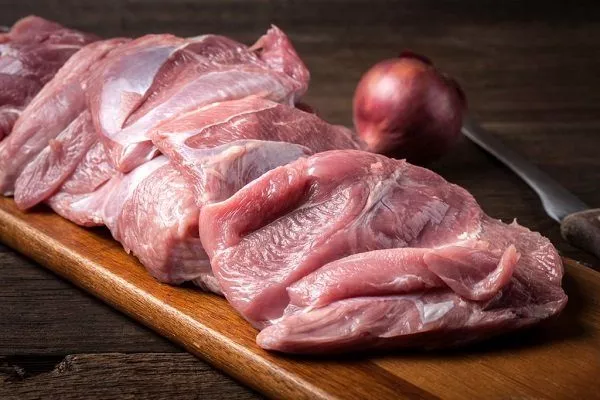
The chemical composition of turkey
Turkey meat is highly nutritious, containing a wide range of beneficial substances, including zinc, selenium, sodium, magnesium, iron, phosphorus, potassium, vitamins B, PP, and E, amino acids, and more.
Caloric content and nutritional value per 100 g of product:
| Indicators | White parts | Dark parts |
| Caloric content | 160-161 kcal. | 190-192 kcal. |
| Carbohydrates | 0 g | 0 g |
| Squirrels | 30 g | 28 g |
| Fats | 4 g | 8 g |
| Selenium | 32.1 mcg. | 40.9 mcg. |
| Vitamin B2 | 13 mg. | 24 mg. |
| Vitamin B1 | 0.40 mg. | 0.50 mg. |
| Zinc | 2.08 mg. | 4.30 mg. |
| Iron | 1.57 mg. | 2.40 mg. |
| Vitamin B9 | 1 mcg. | 10 mcg. |
Benefits and harms
Thanks to its rich chemical composition, turkey meat has a comprehensive effect – it heals, heals, and strengthens. Its main effects:
- General benefit. Potassium, selenium, and protein strengthen the immune system and speed up metabolism, making this product recommended for maintaining overall health and during dieting. But the benefits of meat don't end there.
Other properties:- serotonin production – improves mood;
- eliminating insomnia and preventing the development of cancer cells – thanks to tryptophan;
- reducing platelet aggregation – important for the heart and blood vessels;
- restoration of hair, nails, skin structure;
- strengthening bones, in which phosphorus is especially helpful;
- getting rid of anemia, as it contains a lot of iron;
- wound healing, regeneration of damaged cells and tissues – zinc contributes to this;
- energy production – due to the content of pantothenic acid.
- For women and men. Free radicals and cholesterol are eliminated from the female body, plasma is replenished, metabolism is stabilized, and the reproductive system is improved. In men, potency is restored as additional testosterone is produced.
- During pregnancy and breastfeeding. A pregnant woman's body needs nutrients such as protein, amino acids, vitamins, and minerals. Turkey meat contains all of these. During lactation, it's important to consume hypoallergenic foods.
In addition, this meat contains a full range of microelements necessary for the development of fetal bone tissue and the brain. - For children. The product is approved and recommended for first feeding. It is given in the form of puree or broth.
- For weight loss. Low calorie content allows you to eat meat while on a diet.
- The benefits and harms of broth. When turkey broth is boiled, collagen, chondroitin, and glucosamine are released—essential nutrients for joints, bones, nails, and hair. When dieting, broth quickly satisfies hunger.
Additionally, fluids have a positive effect on inflammation. However, protein negatively impacts gout and kidney problems. - What are the benefits of turkey fat? It contains many vitamins, including choline, selenium, and other minerals, so it can reduce inflammation. It's even recommended for weight loss.
- Which is healthier - chicken or turkey? Unlike chicken, turkey meat has a more balanced fatty acid profile. Therefore, it doesn't cause allergic reactions or raise cholesterol levels.
The harm from turkey meat is relative: if you buy store-bought turkeys, that is, birds raised on an industrial scale, there is a risk of saturating the body with harmful chemicals, since turkeys are fed with growth-enhancing agents.
Turkey in medicine
Turkey meat is recognized by official medicine and is therefore prescribed by doctors for certain ailments. It is particularly beneficial in the following cases:
- For diabetes mellitus. It is easily digestible, promotes wound healing, stabilizes the functioning of the pancreas and central nervous system, and removes toxins.
The most important thing is that the glycemic index of boiled meat is 0 units. - For pancreatitis. It alleviates the condition in acute cases, but it must be cooked in small pieces, as the extractive elements are destroyed.
- For gastritis. Meat restores the functionality of the gastrointestinal tract and normalizes acidity.
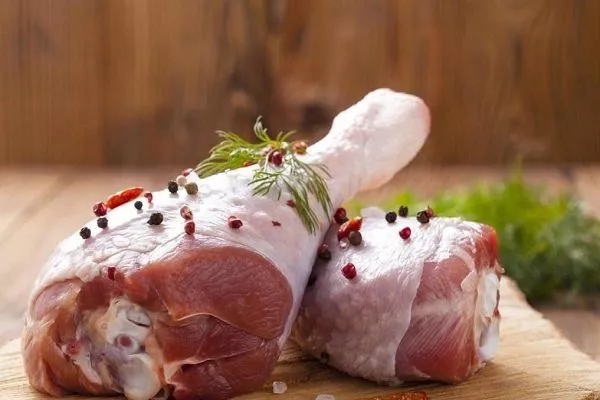
Contraindications
Turkey meat should not be consumed in any form if you have gout or kidney disease, as it contains sodium, which negatively impacts the affected organs.
How to store turkey?
For short-term storage (no more than 24 hours), meat can be kept on the refrigerator shelf. Otherwise, it should be kept in the freezer only.
Profitability of farming
Turkey farming is considered a profitable business because the costs are low and the profits are high. Furthermore, the farming period is short, and consumer demand is high. This latter factor is due to the following reasons:
- relatively low cost (about the same as pork);
- nutritional value;
- usefulness in different cases;
- use during dietary nutrition;
- Presentable dishes for big holidays and celebrations.
Selling turkey meat is straightforward. It's purchased by ordinary people in stores and markets, as well as by the following organizations:
- preschool and school institutions;
- restaurant establishments, cafes;
- grill bars;
- meat processing plants, etc.
How to cut up a turkey?
The first thing you need to do is select a turkey for slaughter. There are certain requirements for this:
- weight – about 12 kg;
- age – 8 months, but broiler breeds are slaughtered starting at 4-5 months, and breeding turkeys – at 3 years.
- ✓ Pay attention to the color of the skin: it should be light cream without spots.
- ✓ Check the elasticity of the meat: when pressed with your finger, the indentation should quickly disappear.
- ✓ The smell should be fresh, without signs of sourness or decay.
Next, the bird is slaughtered and plucked. This process involves the following steps:
- Scald the carcass with boiling water, but do not keep it in the water, otherwise the skin will cook.
- Pluck out large and small feathers and remove down.
- Wash and wipe dry.
Now comes the most crucial moment: cutting. This involves the following steps:
- Using a sharp knife, make a cut along the belly.
- Remove the entrails from the inside (heart, liver, stomach and definitely the crop).
- Cut off the head at the second vertebra.
- Remove the skin from the neck.
- Separate the legs down to the knee joint.
When cutting a turkey carcass into portions, the procedure is slightly different:
- Place the plucked bird on the table with the belly facing up.
- Cut off the paws.
- Make an incision in the anus area and between the legs.
- Open the peritoneum, but do not remove the internal organs.
- Make a triangular incision around the anus with a knife, which will make it easy to remove the gland.
- Through this opening, remove the entrails along with the trachea and esophagus.
- Cut the ligament located between the thighs and the carcass.
- Remove the legs and wings.
- Make an incision under the breast up to the ribs.
- Using kitchen scissors, cut off small bones.
As a result, you should get several main parts, as shown in the photo:
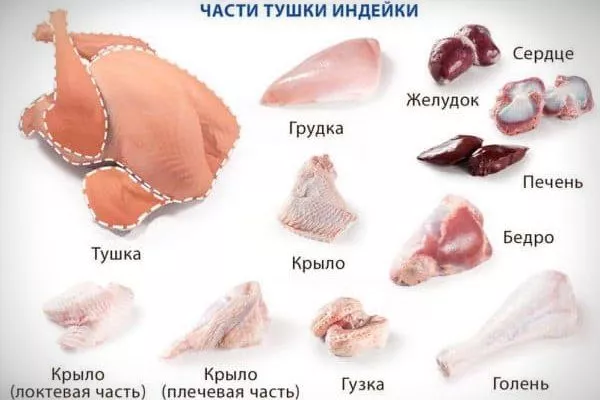
Important nuances to pay attention to:
- It is better to separate the ligaments with your fingers;
- there is no need to cut the bones - this is only permissible in relation to the ribs;
- Be sure to cut through the areas where ligaments accumulate, otherwise the meat will be tough.
Watch our video to see how experienced farmers slaughter, pluck, and dress a turkey:
How to cook turkey meat?
Before preparing any dish, thoroughly rinse the turkey inside and out. Be sure to pat dry with a paper or cloth towel. Follow the instructions for your specific recipe.
Be sure to pay attention to the cooking rules:
- Cooking. If you put a whole carcass in the pan, it will take 2-4 hours to cook thoroughly; if you put it in pieces, it will take 30 to 50 minutes.
- In a multicooker. Cook for at least 20 minutes, maximum 45 minutes.
- For infants. The turkey meat is boiled for 30 minutes, after which the broth is drained and the meat is cooked in new water for another 60 minutes.
- To soften old poultry. Add milk to the water while cooking (ratio 1:1).
- To improve taste. Be sure to add onions (whole or chopped) to the pot when boiling or to the frying pan when frying/baking.
- For richness. Cook without a lid for the first 30 minutes, then cover the container.
- For first courses. Place the turkey in cold water only.
- For second courses. Place meat only in boiling water.
- To preserve nutrients in maximum quantity. Be sure to add a little salt to the water before cooking.
- For juiciness. After turning off the stove, leave the meat to steep under a closed lid for another 15-20 minutes.
- For frying. Roasting time depends on the dish, part of the turkey and degree of doneness:
- steaks – 20 minutes;
- drumstick – 35 minutes;
- wings – 45 minutes;
- fillet – 15 minutes.
- For baking. The optimal temperature is 180 degrees Celsius. It's best to bake it covered in foil; 2.5-3.5 hours is enough for it to be ready. After turning off the oven, let it rest for another 30 minutes (so to speak, to "finish").
- For the marinade. Use wine or wine vinegar, perhaps cognac or champagne, but it's best to avoid beer. Be sure to add garlic, honey, lemon, and spices.
Marinate for at least 12 hours and at most 18 hours.
To ensure juicy, nutritious, and delicious turkey meat, follow proper farming practices. This directly impacts a farmer's profitability – the better the meat, the more repeat customers and clients. This is especially true for wholesale sales.