
The taste, quality, and appearance of a turkey depend on proper slaughter and butchering, which is crucial when selling and preparing the bird at home. We'll describe several methods for quickly butchering a turkey.
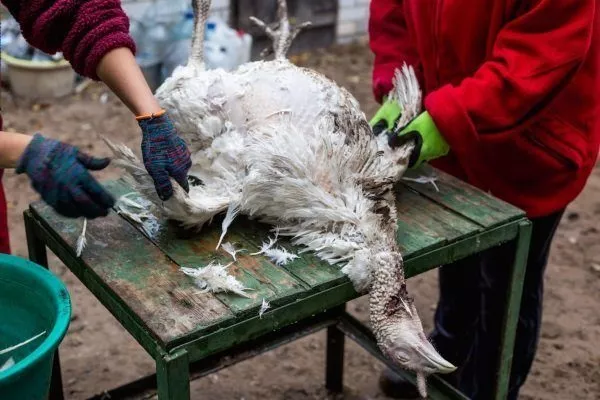
Preparing poultry for slaughter
First, fast the turkey for 12-15 hours. This is necessary to flush out all the food the bird has consumed. The food will begin to decompose if this is not done, and certain substances during decomposition can cause the bird's carcass to turn blue or green in certain areas.
Water can and should be given in unlimited quantities. It will help flush the food out of the bird's system faster. You can use a 2% solution of Glauber's salt or regular table salt. This will have a laxative effect, and the system will be cleansed very quickly and thoroughly.
Turkeys should be kept in a clean pen. Be sure to remove any food scraps and droppings. Otherwise, the bird will eat whatever it can find, which will reduce the taste and quality of the food. Turkeys can also be kept in any dark area; this will help them remain calm.
Turkeys must be slaughtered quickly and completely to ensure they are bled. Otherwise, bacteria can spread through the bloodstream, leading to meat contamination.
Blood residue also contributes to carcass decomposition and decay. Another reason to bleed the carcass quickly is that the sight of blood is very unpleasant for humans, which will reduce the turkey's appeal if it's intended for sale.
- ✓ The room temperature should be between 10-15°C to slow down the decomposition process.
- ✓ Air humidity should not exceed 70% to prevent bacterial growth.
Make sure all tools you use are disinfected or thoroughly scalded with boiling water. This will prevent contamination of the meat.
What are the methods of slaughtering turkeys?
There are various methods for slaughtering turkeys. The most common is the external slaughter method, which is simpler and easier to perform.
External slaughter
This is the most common slaughter method. It is divided into the left-handed method and the opposite, the two-handed method. This method involves making a small incision in the turkey to expose the jugular vein.
Left-hand:
- Take the turkey by the beak.
- Cut through the skin, veins, and arteries. The cut should be 2-2.5 cm long for a large turkey and 1-1.5 cm long for a small turkey.
Double-sided:
- Pierce the skin under the ear and open all the veins by moving the blade to the right.
- On the other side you should have a hole up to 1.5 cm.
Below is a video of a turkey being slaughtered and eviscerated:
Internal slaughter
This is the cleanest method of slaughtering a turkey among all existing methods. It is also the most gentle. It is also known as the "split" method:
- Stun the turkey by hitting it on the head.
- Insert the knife as deep into the throat as possible, then cut the vessels in the posterior palate. The cut should be made on the left side, above the tongue. Choose this particular spot because it is where the jugular and pontine veins meet.
- Inject the turkey into the cerebellum. Aim for the lower right side of the head through the palatine foramen. This injection helps relax the turkey's muscles. This allows blood to flow more easily, making the bird easier to pluck.
- Drain the turkey. To do this, hang it by its feet with its wings spread. Place a basin underneath the turkey to catch the blood.
- After this, plug the incision with a swab to avoid staining the carcass with any remaining drops of blood.
- After slaughter, the bird must be plucked.
How to remove feathers from a carcass?
There are several ways to pluck a turkey. The first and simplest method is to pluck after scalding the bird. The key to this method is to scald the bird before plucking. Handle the carcass carefully, as turkey is very tender and soft meat.
Step-by-step instructions:
- Scald the bird. One minute will be enough. The temperature must be below 60 degrees Celsius (140 degrees Fahrenheit) to avoid scalds. This method is used to effectively remove wing and tail feathers. Then remove the bird from the water and begin plucking immediately. If the bird is too cold, plucking will be quite difficult.
- Begin plucking the down and feathers. Pluck the feathers in the direction of their growth to prevent the bird's skin from tearing.
- After removing all the feathers, carefully remove the stumps; they're more difficult to remove. If you're having trouble, use regular tweezers, which will grip the stumps well. This will take a little more time, but will clean the bird better. After that, you can remove any remaining small feathers.
- To ensure the turkey is completely plucked, pluck the bird with a flame. This can be done on a gas stove. To do this, turn on the heat and slowly and carefully pluck the bird. Be careful not to hold the bird too close to the flame, as this can burn the turkey's skin. This will cause the meat to spoil faster and become unmarketable if you're preparing the bird for sale.
The sequence of plucking a turkey is shown in the following video:
The next method is plucking a turkey with an iron. This method is most convenient if you're dealing with a domestic turkey, not a wild one.
You'll need an iron with different heat settings. It's best to use an iron you no longer use.
You will need to take:
- a pump that inflates regular balls or mattresses;
- strong rope;
- any fabric, but preferably natural;
- a container with water at room temperature (the container can be any, deep or shallow, in this case it doesn’t matter);
- iron with different heating modes.
Instructions:
- Place the pump bell between the duck's neck and skin.
- Gently and slowly pump in air, being careful not to burst or crack the skin.
- Pump air until the feathers lift. If this doesn't happen, try repeating the previous steps, as the pump may be positioned incorrectly.
- After raising the feathers, pull out the funnel. Tie the turkey's throat with string. This will prevent air from escaping. The knot should be secure, but keep in mind that you'll need to untie it, so be careful how you tie the throat.
- Take a cloth and soak it thoroughly in water.
- Place the fabric on the carcass and iron it over it. Choose a power setting that doesn't scorch the skin. This is usually setting 2 or 3 on an iron. If you're using cheesecloth instead of fabric, fold it several times, as it's thinner and can burn the skin.
The process of plucking a turkey is simple, but be careful not to damage the skin of the carcass (the meat will lose its marketable appearance).
How to gut a turkey?
Prepare a knife with a thin blade to easily cut the ligaments. Use it to cut the bird's belly and then remove the internal organs: the stomach, heart, and liver.
Instructions for gutting the carcass:
- Before gutting the turkey, you'll need to remove the legs and both wings down to the elbow joints. The head should be cut off at the second joint of the spine.
- After this, make an incision across the entire neck. Remove the neck bones to create an opening. Feel for the crop there and cut it out without opening it.
- Now make an incision in the abdominal cavity. It should extend from the edge of the last rib to the urinary tract. Cut very carefully, avoiding the gallbladder. Remove all the internal organs and cut out the cloaca.
If the gall bladder is damaged and its contents spill onto the carcass, rinse the bird thoroughly in salt water. This will remove any germs and eliminate any unpleasant odor that may develop.
Action plan for gallbladder injury- Immediately rinse the affected area of the carcass with cold running water for at least 5 minutes.
- Prepare a solution of 1 liter of water and 50 g of salt, soak the carcass in this solution for 30 minutes.
- Rinse the carcass thoroughly under running water again before further processing.
- From the entrails, leave the liver, heart, and stomach. The rest is not edible. Cut the stomach lengthwise and clean it under running water, removing the inner membrane.
- Rinse the carcass inside and out to remove any remaining blood. If you notice any stumps remaining from the initial plucking, remove them with tweezers.
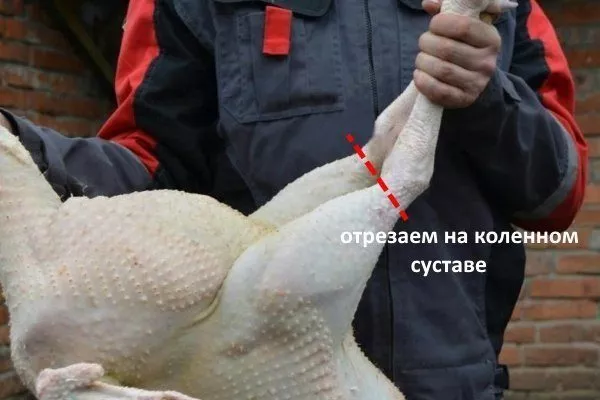
we cut off the limbs at the knee joint
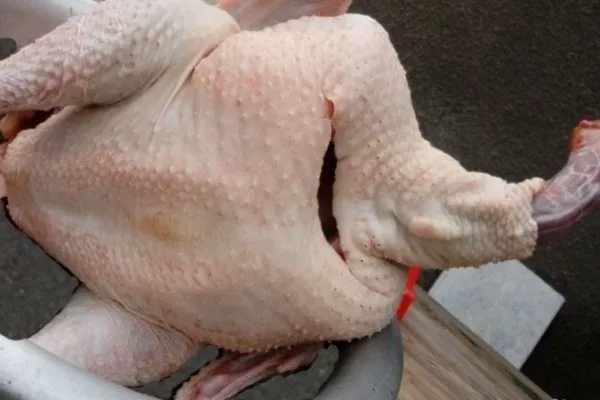
we make an incision across the entire neck
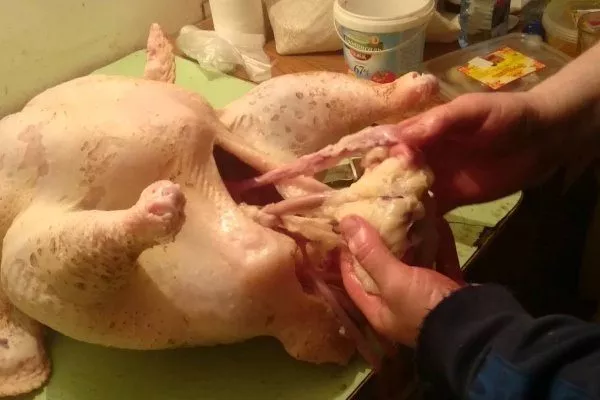
We make an incision in the abdominal cavity and take out all the insides
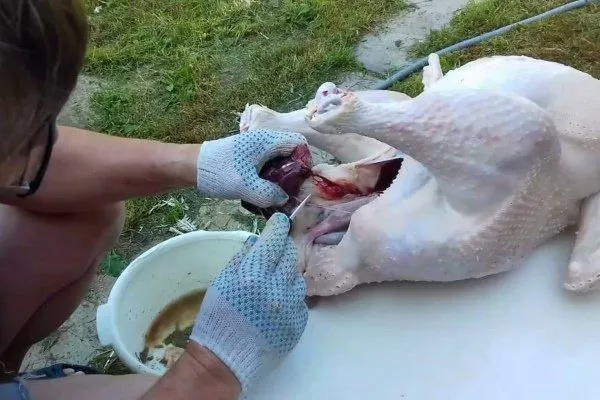
we cut out the internal organs along with the cloaca
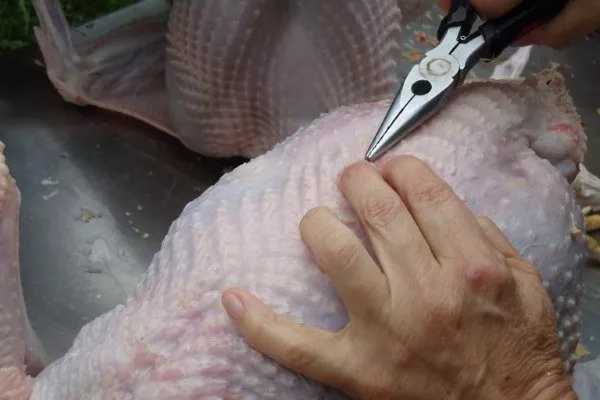
If there are any stumps left after plucking, remove them with tweezers
Full section
If you decide to use this method, cut off the neck section down to the second vertebral joint. Then, chop off the bird's limbs at the joints and remove all the internal organs.
Partial section
The neck should be left intact; the internal organs are removed, washed, and then returned to the carcass. The heart, stomach, and liver can be kept; they can be used for giblet gravy and other dishes using these organs. The other organs, however, are discarded; they are not suitable for consumption.
Step-by-step instructions for cutting up a turkey
The basic cutting process looks like this:
- First, place the carcass on a hard surface. A regular cutting board, found in every kitchen, is ideal for this.
- Cut through the skin and ligaments where the thighs meet the turkey's body. Separate the legs from the drumsticks, then remove the wings from the carcass.
- Make an incision under the breastbone where the internal organs were. Make this incision through the skin. Once you reach the ribs, use poultry shears. Regular shears won't work here because their blades are duller and the pressure required to cut through the bones is less, making it nearly impossible to cut through them.
- As a result, the turkey is divided into the following parts: wings, thighs, breast, back and legs.
If you are going to cook the bird whole, there is no need to cut it up.
The process of butchering a turkey is quite simple. The main thing is to follow the instructions to ensure proper preparation and avoid damaging the bird.