
Turkeys are considered the unofficial leader among poultry breeds used for meat production. To achieve maximum body weight, it's important to provide high-quality feeding before slaughtering. Keeping a turkey feeder full is essential. You can make one yourself using readily available materials.
General requirements for feeder equipment
The recommended height of a feeder is approximately 15 cm, and it can be easily secured to a post or any wall. To prevent food spills, it's best to fill standard feeders to a third of their capacity.
- ✓ Consider the aggressiveness of the poultry house environment: metal feeders are preferable for wet feed due to their resistance to corrosion.
- ✓ For dry food, wooden feeders can be more environmentally friendly, but require regular anti-fungal treatment.
The best option for turkeys is to install two types of feeders: one solid one for daily feeding and one divided into sections for supplementary feeding. You can create one long turkey feeder or place several in different parts of the coop, depending on its size.
Hopper structures are prone to being knocked over by turkeys, so it's recommended to secure them additionally to increase stability. After installing the feeders, it's important to closely monitor the flock for several days to ensure the structures are comfortable for the birds.
- ✓ Feeders for turkeys should be higher than for chickens due to the larger size of the birds.
- ✓ Consider the need for stronger materials due to the greater strength of turkeys.
Types of feeders
| Name | Material | Type of feed | Resistance to tipping over |
|---|---|---|---|
| Made of wood | Tree | Dry food | Low |
| Made of metal | Metal | Wet food | High |
| Made of plastic | Plastic | All types of feed | Average |
| Made of mesh or metal rods | Mesh/metal rods | Fresh herbs | High |
| Regular (trays with sides) | Various | Various | Average |
| Sectional | Various | Top dressing | Depends on the material |
| Bunker (automatic) | Various | Dry food | Depends on the design |
| With automatic lid lifter | Various | Various | High |
There are several types of turkey feeders. Among them are the following:
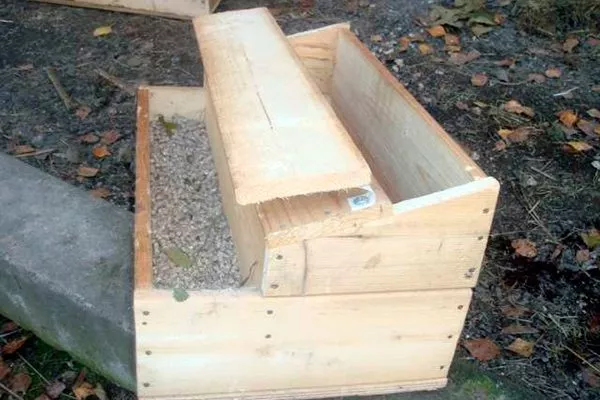
- Made of wood. These feeders are durable, but they are difficult to clean and disinfect. They are recommended for use with dry food.

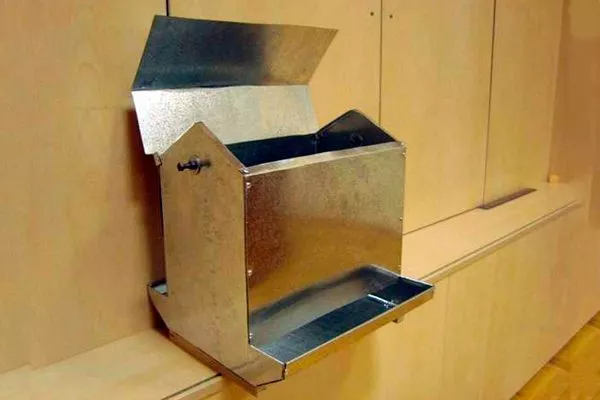
- Made of metal. The material is durable and reliable, easy to clean and disinfect. When constructing the feeder, it's important to avoid sharp corners and edges. This can be solved by bending the metal sheet inward. This option is suitable for use with wet food.
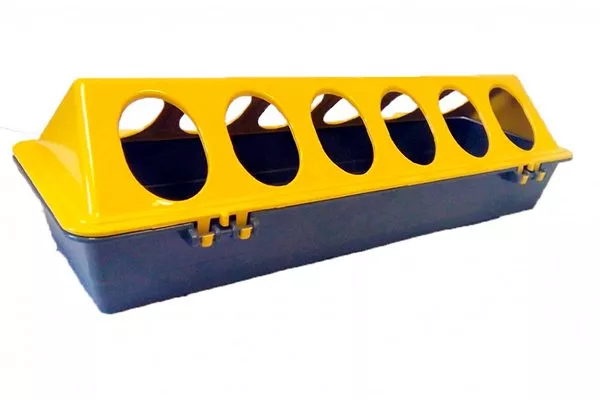
- Made of plastic. When constructing the feeder, we recommend using only high-strength plastic to prevent damage from large turkeys. This type of feeder is suitable for all types of feed.
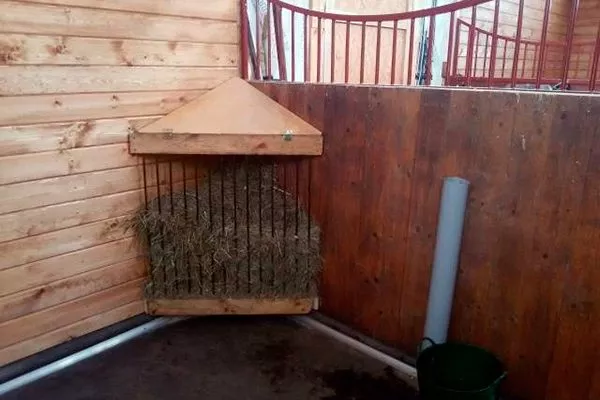
- Made of mesh or metal rods. Ideal for fresh herbs, as turkeys can safely reach the herbs through the mesh or bars.
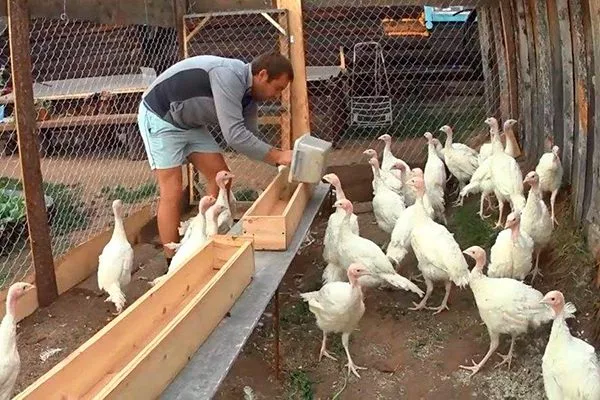
- Regular (trays with sides). These trays are a simple and effective solution for turkey feeding. They feature a robust design and provide easy access to the birds' food.
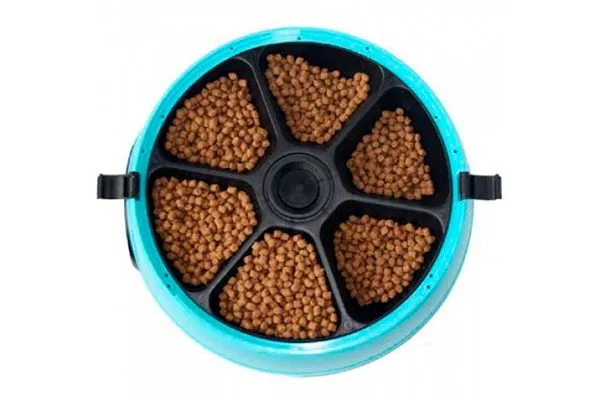
- Sectional. Divided into several sections, these feeders are ideal for supplementary feeding, as gravel, lime or shells can be placed in different compartments.
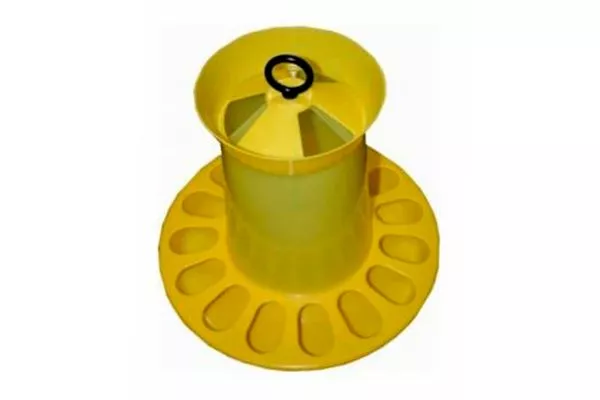
- Bunker (automatic). These feeders, which don't require constant monitoring of the amount of food in the tray, automatically refill the feed as the turkeys eat. They are ideal for dry feed.
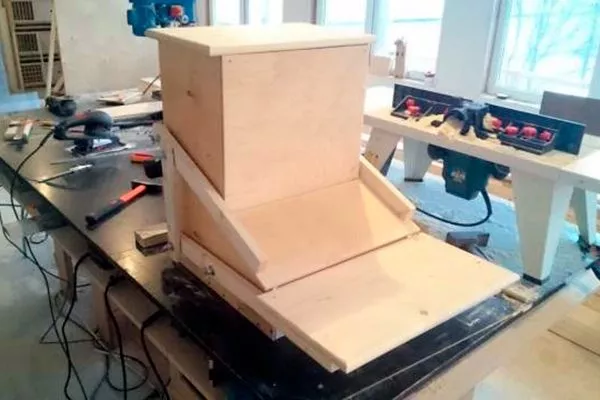
- With automatic lid lifter. The lid automatically opens when a turkey steps onto a special platform in front of the feeder. This mechanism has a significant advantage: when the birds are not feeding, the feeder always remains closed.
Bird feeders that are easy to make yourself
Since building a turkey feeder yourself isn't difficult, it allows you to avoid additional financial costs when setting up a poultry house. Many designs are easy to assemble at home.
A feeder made from plastic plumbing pipes
One of the easiest turkey feeders to make. This option is distinguished by its ability to prevent feed from spilling on the floor and is easy to clean. The feeder is designed to serve 10 birds.
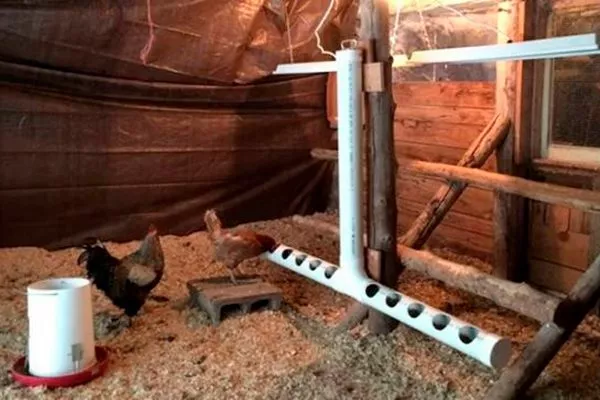
For work you will need the following materials:
- plastic plumbing pipe, at least 10 cm in diameter and at least 1 m in length;
- plugs corresponding to the pipe sizes – 2 pcs.;
- plastic cutting tool;
- tee fitting to the pipe dimensions.
Manufacturing process:
- Cut the plastic pipe into three pieces: one 10 cm long, the second 20 cm long, and the third 70 cm long.
- Leave the longest section unchanged, and cut round holes in the other two sections through which the turkeys will reach the food in the pipe.
- Install a cap on one end of the 20cm pipe and a tee on the other.
- Attach the shortest piece to the tee so that it appears to be an extension of the 20cm piece.
- Attach the remaining section of pipe to the last inlet of the tee. Install a second plug at the end. This will create a T-shaped structure.
- Secure the structure to any vertical surface with the longest section so that the pipes with holes are 15 cm from the floor. The holes should be directed toward the ceiling.
To prevent debris from getting inside, close the holes at night. Instead of several round holes, you can cut one long one.
Hopper feeder made from a bottle
A hopper feeder is an excellent option for feeding turkey poults. It serves as a personal container for each bird.
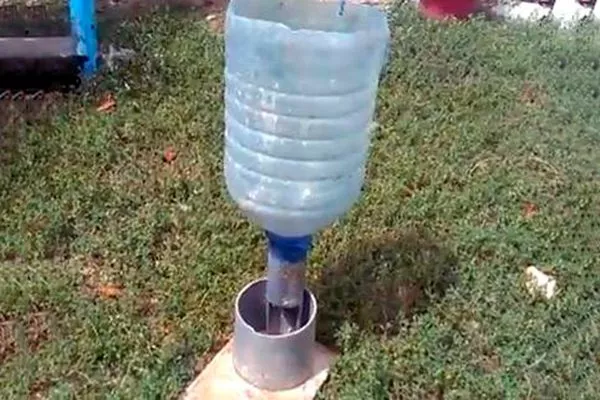
For work you will need the following materials:
- plastic bottle with a capacity of 5 liters or more;
- board or plywood for the base of the feeder;
- hacksaw or other tool for cutting plastic;
- hammer or screwdriver;
- rope;
- insulating tape (fastening or plumbing);
- mounting corners.
- fastening materials (screws, nails, etc.);
- plastic pipes (one with a diameter of at least 30 cm, the second with a diameter large enough to fit the neck of the bottle).
Manufacturing principle:
- Cut a piece of large-diameter plastic pipe to serve as the turkeys' feeding perch. The pipe should be at a comfortable height for feeding (lower for babies, higher for adults).
- From the second pipe, cut a piece twice as long as the first. Cut this piece lengthwise, starting at one edge and leaving about 10 cm (4 inches) short of the middle. Cut off one of the cut pieces completely, creating a scoop-like structure.
- Using brackets and screws, attach a 30 cm diameter plastic plumbing pipe to the base board, facing upward. The brackets should be positioned inside the pipe, and the fasteners should not protrude to prevent possible damage from turkeys.
- Remove the bottom of the plastic bottle and insert the neck into the smaller diameter pipe from the end you didn't cut. Wrap the joint between the neck and the pipe with electrical tape.
- Attach the other (cut) part of the inner side of the pipe to the wide pipe so that the end points into the base board.
- Install the structure in the coop. For added stability, secure it to a vertical surface with a rope tied to the top of the bottle.
The final step is to fill the bottle with feed to test how the turkeys react to the new feeder.
Wooden bunker feeder
This structure is more stable than, for example, a plastic feeder. The simplest method involves constructing a structure and a "bunker" out of planks or plywood: a container where the turkeys will feed, and a feeder filled with feed.
- ✓ Require treatment with moisture-protective compounds to increase service life.
- ✓ Not suitable for wet food without additional internal protection.
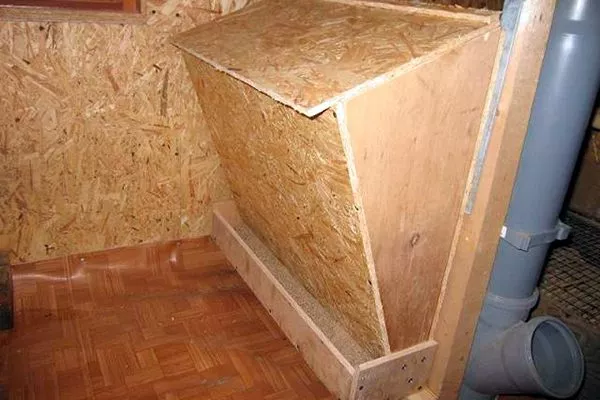
For work you will need the following materials:
- wooden boards;
- nails or screws;
- saw;
- hammer or screwdriver;
- insulation tape;
- insulating tape (fastening or plumbing).
Manufacturing principle:
- Determine the size and shape of the feeder based on the needs of your turkeys and the size of your poultry house.
- Using a saw, cut the wooden boards to the pre-selected size.
- Assemble the base of the feeder, joining the boards with nails or screws. Make sure the structure is stable and sturdy.
- Create a roof for the feeder by attaching appropriate wooden pieces to the top of the base. This can be a sloped roof to prevent precipitation from accumulating.
- If the feeder is to be used outdoors, it is recommended to use insulation tape or other protective materials to prevent prolonged exposure to moisture and external conditions.
- Attach the roof to the base using nails or screws, ensuring a stable connection.
- Add tape or other protective materials around the perimeter of the feeder to prevent turkeys from being injured by sharp edges.
- Place the hopper feeder in the house so that it is convenient for the turkeys and provides them with easy access to feed.
After installation, monitor the turkeys' behavior and make adjustments to the design if necessary.
Universal bucket feeder for young birds
Feeders for turkeys and chickens are often made from readily available materials. This type of design is specifically designed for young birds, given their lower grain requirements compared to adult birds.
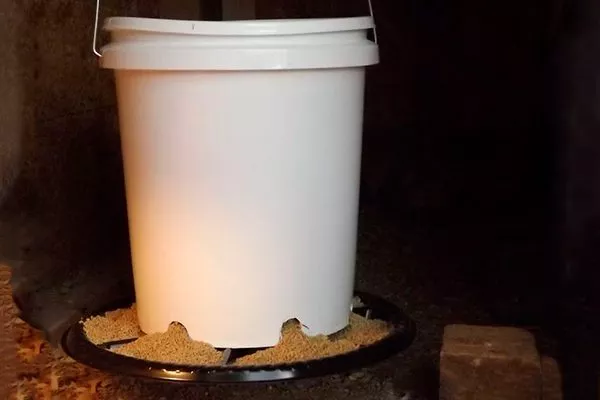
To build such a feeder you will need the following materials and tools:
- a bucket with a capacity of 7-10 liters;
- bowl with sections;
- cutting tools.
Step-by-step instructions:
- Attach the bottom of the bucket to the bowl using screws.
- Make small holes in the top of the bucket corresponding to the number of sections in the bowl.
- Pour the grain into the open bucket, then secure the lid securely. The weight of the feed will distribute it among the sections.
- An airtight plastic bucket effectively protects the grain from moisture. Be sure to poke a few small holes under the lid to allow the feed to "breathe."
Thanks to the sides and the small amount of grain, turkeys and chickens rarely steal the feed. Sometimes the feeder is attached to a vertical surface slightly above ground level. In this case, the excess base sections are removed. This position prevents dirt from getting into the feed, and the grain stays fresh.
Choosing the right turkey feeder is crucial to ensuring optimal feeding conditions. A variety of designs and materials allows you to find the best option to suit your birds' needs and living conditions.