
All poultry get sick from time to time, and turkeys are no exception. They often share common illnesses with chickens, affecting them with both infectious and non-infectious diseases. Read more about turkey diseases, symptoms, and treatment below.
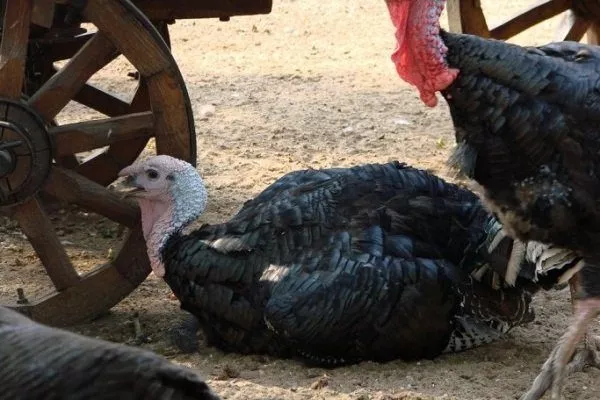
Infectious diseases
These types of diseases are easier to prevent than to treat, as most of them result in the death of the bird. Experts recommend following a number of preventative measures:
- buy turkey poults or eggs for incubation from reputable farms;
- disinfect the premises regularly;
- change the litter in a timely manner - some pathogenic microorganisms remain active in its deep layer, getting there with the excrement of sick birds or contaminated feed;
- engage in the prevention of helminths and coccidiosis.
| Name | Incubation period | Form of the disease | Treatment |
|---|---|---|---|
| Smallpox | 7-20 days | Cutaneous, Catarrhal, Diphtheritic, Mixed | Antibiotics, disinfection |
| Tuberculosis | Not specified | It is not treatable | Destruction of sick birds |
| Worms | Not specified | Gastrointestinal tract, respiratory organs | Anthelmintic drugs |
| Newcastle disease | 3-4 days | Acute | Not found |
| Synovitis | Not specified | Inflammation of the joints and ligaments | Antibiotics |
| Respiratory mycoplasmosis | Not specified | Chronic | Broad-spectrum antibiotics |
| Coccidiosis | Not specified | Gastrointestinal tract | Coccidiostatics |
Smallpox
Turkeys become infected from chickens through drinking water, feeding, and direct contact with an infected turkey. Flies and mosquitoes also transmit the disease. The pathogen can live in turkey feathers, so any infected animal should be quarantined immediately.
The pathogen is very resilient and survives temperatures from -15°C to +36°C. It is one of the most common and dangerous diseases.
The incubation period for the disease ranges from 7 to 20 days; birds can become ill at any time of year, but infection most often occurs in the autumn, when their immunity is weakened.
The main symptoms are:
- dry bumps and dark spots (crusts) appear on the skin;
- deterioration in appearance - wings are drooping, plumage is ruffled, feathers are dull;
- a sharp decrease in activity - the bird becomes apathetic to everything happening around it;
- poor appetite.
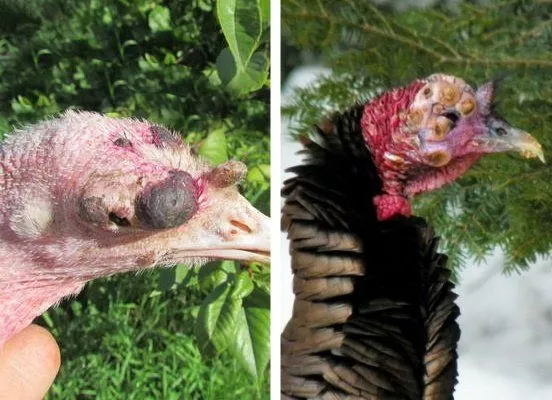
There are 4 forms of the disease:
- SkinTurkeys are most often affected by this form. Lymphatic lesions appear as brown spots on the head and comb.
- Catarrhal or atypicalThe most severe form. The virus affects not only the internal organs but also the eyes. Even if the bird is cured, it will remain blind for life.
- DiphtheriaThis form affects the respiratory system. The rash is localized on the mucous membranes of the respiratory tract, and diphtheritic films form. The bird cannot breathe normally. Its beak is constantly open and it makes a whistling sound.
- MixedIt is diagnosed when symptoms of the two above-mentioned forms are observed.
All of these species have different symptoms and treatment methods, so it is essential to consult a veterinarian to determine the exact form of the disease.
The sick bird is placed in a separate disinfected room, and the entire poultry house is also disinfected. The affected skin is wiped with glycerin to soften the pox lesions, and then iodine is applied. This prevents the recurrence of pox. If the nasopharynx is affected, it is rinsed with a warm 2-3% boric acid solution. The sick bird is given one tablet of an antibiotic (erythromycin, penicillin, terramycin, tetracycline, or oxytetracycline) and an antimicrobial agent (such as furazolidone) at night, and during the day, Lozeval is added to the bird's drinking water according to the instructions.
If the disease has spread throughout the farm and become epidemic, the entire flock is culled. The bodies of the dead birds are incinerated, and the premises are disinfected again. Smallpox prevention involves vaccination. Turkey poults are vaccinated with embryonic vaccine at 1.5 months.
Tuberculosis
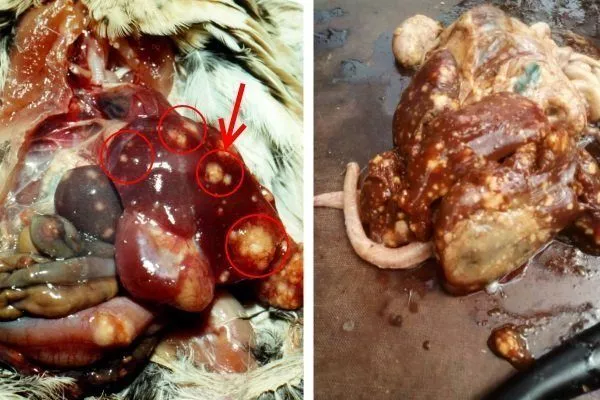
Another dangerous disease, but unlike the previous one, it is incurable. It is caused by the tuberculosis bacterium. It enters the farm through dirty water, eggs, and litter. It affects both the upper respiratory tract and the lungs, impairing their function. Then, all vital organs rapidly deteriorate. When an autopsy is performed on a sick bird, its liver contains small (sometimes large) yellow-white nodules, as shown in the photo.
Symptoms:
- the bird moves slowly, its legs give way and it falls, so it is more often in a sitting position;
- she refuses food and as a result quickly loses weight;
- the stool is loose, which contributes to dehydration;
- the bird goes bald;
- characteristic nodular formations are visible on the skin.
Treating sick birds is pointless; they are immediately destroyed. All efforts are directed toward preserving the remaining flock. All birds are brought outside or transferred to another barn. The poultry house is completely disinfected.
The pathogen is inactivated by exposure to caustic alkali and a 3% formaldehyde solution. Dishes are thoroughly washed and sanitized, all bedding is removed, and manure is scraped from the floor. All windows and doors in the barn are opened and kept open for two summer months to allow the room to "bath," ventilate, and dry. Only sunlight can completely eliminate the pathogen; direct exposure to sunlight kills it within 40-50 minutes. Birds are not allowed to live in the barn until it has been treated.
The meat of well-fed birds infected with tuberculosis can only be consumed after prolonged boiling. The entrails are burned. Under no circumstances should they be fed to pets or livestock. Emaciated bird carcasses are burned. Burying their carcasses is not recommended, as the tuberculosis bacteria can survive for up to a year, risking reinfection of new flocks.
Worms
Parasites are found in the bodies of all living things, including humans. It's impossible to detect parasites in poultry at the initial stage, as they don't show any symptoms. As the infection progresses, the bird becomes weaker, its immunity weakens, and it becomes susceptible to other diseases.
Worm eggs and larvae are found in water, soil, and litter. Worms typically inhabit the gastrointestinal tract, but can also parasitize the respiratory system.
In case of parasite infestation:
- turkeys are losing weight despite having a good appetite;
- the immune system is destroyed;
- the stool is usually liquid.
A variety of deworming medications are available at veterinary pharmacies. Phenothiazine and piperazine sulfate are the most popular. Some poultry farmers rely more on folk remedies, but herbs are ineffective against parasites that live in the respiratory system, and they don't work against all intestinal helminths.
We invite you to watch a video in which a farmer explains how and with what he deworms his turkeys:
For prevention, birds are regularly given anthelmintic drugs once every 1-2 months.
Newcastle disease
Known as pseudoplague or Asiatic swine fever, this viral disease spreads rapidly and affects the entire herd, especially young animals. Most die. The source of infection is a sick animal or a carrier of the pathogen, but the animal remains healthy. From these animals, the virus is released into the environment through their excrements.
In turkeys, the disease occurs in an acute form and lasts for 3-4 days, rarely continuing for up to 2 weeks.
The main symptom of the disease is grayish or greenish diarrhea with an extremely unpleasant, pungent odor. Mucus is also secreted from the nasal passages and mouth. Paralysis then sets in. The bird cannot move its wings or legs. It often develops into pneumonia (inflammation of the lungs), encephalitis (inflammation of the brain), or damage to other internal organs with hemorrhage.
A cure for the disease remains elusive, so at the first sign of infection, birds are culled to prevent infection among their fellow birds. The premises are sanitized. As a preventative measure, they are treated with ultraviolet light, which instantly kills the virus. Birds are also vaccinated with La-sota starting at 15 days of age (then revaccinated after one month, then after three months, and then every six months until immunity is established).
Synovitis
This disease affects adult birds and young birds over 7 weeks old. It is caused by a pathogenic microorganism. Synovitis is characterized by inflammation of the joints and ligaments. This immediately affects the turkeys' behavior:
- the skin of the comb turns pale;
- limps (the bird moves slowly around the area), and then falls to its feet;
- If you touch the joint, you will feel an increased temperature and dense swelling.
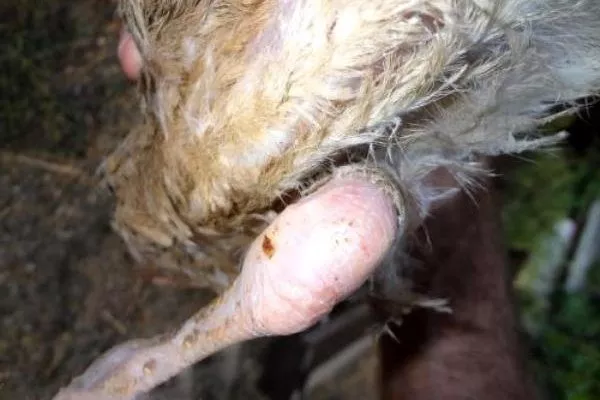
In severe cases, diarrhea occurs. The infection is transmitted by other eggs that have recovered from the disease. In very rare cases, infection occurs in the egg during the incubation period.
Treatment involves the use of antibiotics—Terramycin, Streptomycin, and Biomycin. The most effective is considered to be Tilan, which is injected into the chest muscle, and Biomycin, which is added to the feed. Vaccination is administered to prevent the disease.
Respiratory mycoplasmosis
The disease is caused by poor husbandry practices, such as low room temperature or humidity, especially if the bird has a weakened immune system or is deficient in vitamins B and A.
It is a chronic disease characterized by:
- damage to the respiratory system;
- runny nose;
- exhaustion.
The disease is transmitted by airborne droplets.
Veterinarians claim there is no cure for this disease. Broad-spectrum antibiotics are used for other apparently healthy birds to prevent an epidemic. Sick birds are immediately culled. Farms where mycoplasmosis has been reported do not collect hatching eggs; they are used exclusively for human consumption. However, many breeders report that any coccidiostatic agent (Baytril, Intarcox, or Torucox) helps their birds.
The barn is disinfected, and the droppings are calcined at a high temperature. Quarantine is imposed. It is lifted only after the last apparently healthy bird has been slaughtered, and there are no cases of disease among the breeding stock and poults raised up to eight months.
Coccidiosis
The disease is caused by single-celled microorganisms called coccidians. They enter the body through poor-quality water and feed, as well as through dirt from drinking bowls, bedding, and feeders, and destroy the entire gastrointestinal tract. Young birds up to 3 months of age are susceptible to the disease, but it most often affects poults aged 2-3 weeks.
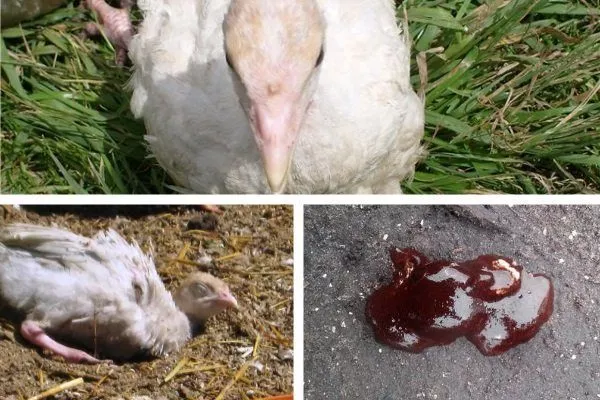
Sick chicks:
- liquid stool mixed with blood (from light brown to black);
- refuse food;
- drink a lot;
- they are lethargic, inactive;
- their eyes are half-closed;
- the wings are drooping, the plumage is dirty and ruffled.
At the first sign of illness, call a veterinarian. They will prescribe the appropriate treatment. Baycox or Stop-Coccid are commonly prescribed. After recovery, turkey poults require a rehabilitation period—they are given vitamin supplements and receive treatment for all body systems.
Please note! Koktsisan should not be given to turkeys.
Birds that die from this disease should not be eaten; all carcasses are burned. The premises are treated and repopulated after a few weeks. Prevention consists of their correct contentVaccination of newborn chicks is only performed as prescribed by a veterinarian. Sick birds are immediately separated from the rest of the flock.
Non-communicable diseases
The main causes of this category of diseases are errors in care and maintenance.
| Name | Cause | Symptoms | Treatment |
|---|---|---|---|
| Pendulous goiter | Unbalanced diet, large amounts of water | The goiter stretches and sags | Diet, rest |
| Hard goiter | Excess of roughage, lack of fine gravel, chalk | The crop becomes filled with food and hard. | Absent |
| Wrong appetite | Nutritional deficiencies | Eating feathers, bedding, and sawdust | Vitamin and mineral complexes |
| Hypovitaminosis | Unbalanced diet | Deterioration of immunity, runny nose, watery eyes | Vitamin injections |
| Mechanical injuries | Inbreeding, calcium or vitamin deficiencies, illness, overcrowding | Leg problems, bone fractures | Paw splint, plaster cast |
Pendulous goiter
This is a milder form of hardened crop and is treatable. The crop stretches and sags due to an unbalanced diet and excessive water consumption when the bird is kept in stuffy rooms or exposed to the sun in the summer.
A veterinarian handles treatment. They develop a customized diet based on the bird's diet. The bird also needs rest.
Hard goiter
The disease is easily diagnosed but is untreatable. Its main causes are:
- improper nutrition - excess of roughage and lack of fine gravel and chalk;
- failure to comply with portion sizes.
As a result, the crop becomes overloaded with food, leading to inflammation. It becomes very hard to the touch and may ooze pus. The turkey loses its appetite, leading to rapid weight loss. The bird becomes passive and sits with its head hunched.
There is no treatment, the bird is unable to consume food and dies of starvation. To prevent the disease from developing, it is necessary to feed the bird properly from the moment it is purchased. What the proper diet for turkeys should be is described.here.
We recommend watching this video where an experienced poultry farmer explains how you can help a turkey cope with crop dysfunction:
Incorrect (perverted) appetite
The turkey's diet begins to include strange items, uncharacteristic of his diet. He eats feathers, bedding, and wood shavings. His appetite increases, he feels constantly hungry, and spends the entire day searching for food.
Changes in eating habits occur due to nutrient deficiencies in the diet. If left untreated, the bird's crop hardens, and the bird dies. Treatment involves supplementing the bird's diet with vitamin and mineral supplements to replenish the deficiencies.
Hypovitaminosis
If avitaminosis is caused by a lack of just one vitamin, then hypovitaminosis is a vitamin deficiency, meaning there's an imbalance between vitamin consumption and vitamin intake. The main cause of this deficiency is an unbalanced diet. Vitamin deficiency leads to a weakened immune system, weakening the bird, and a runny nose and watery eyes.
In this case, revising your diet will not help; vitamin injections are necessary.
Mechanical injuries
Turkey poults often experience leg problems. Their feet become dislocated, twisted, or crooked. This can be caused by:
- inbreeding;
- lack of calcium or vitamins;
- diseases;
- cramped space.
An adult bird sometimes injures a chick by stepping on it or pecking at its leg. Bone fractures are common, and in these cases, a splint and a plaster cast are required.
Diseases of young individuals
There are also diseases that affect only young individuals.
| Name | Age | Symptoms | Treatment |
|---|---|---|---|
| Infectious sinusitis | Young individuals | Inflammation of the nasal and ophthalmic sinuses, pus | Antibiotics |
| Hemophilia | Up to 5 months | Inflammation of the mucous membranes in the nasopharynx, eyes, shortness of breath, wheezing | Inhalations with iodine and chlorine turpentine |
| Paratyphoid | Up to 1 month | The chicks hardly move, they sit in a hunched position | The drugs are Mepatar, Trimerazine and Lautecin. |
| Pullorosis (typhus) | Day 1 | White diarrhea with clumps of foam and an unpleasant odor | Antibiotics |
| Histomoniasis | 3-21 weeks | The stool is yellow-orange in color, and the scalp takes on a blue-black tint. | Medicines: Trichopolum, Furazolidone, Metronidazole and Osarsol |
Infectious sinusitis
Causes of the disease include overcrowding, hypothermia, and vitamin A and D deficiencies. Sinusitis causes inflammation of the nasal and ocular cavities, which accumulate pus. The bird's head swells and turns red. Treatment involves antibiotics such as Furazolidone, Oxytetracycline, Streptomycin, Tilana, or Pharmazin.
Experienced breeders also recommend using a syringe with a thicker needle (a thin needle will make it difficult for the pus to drain), laying the turkey on its back with its head to one side (it's best to do this with two people), and draining the pus from the sinuses by puncturing the swelling. The needle should be inserted away from the eye to avoid damaging it. The needle should be inserted at an angle, not at a right angle. Stop draining the contents when the swelling subsides (the skin sags in the area).
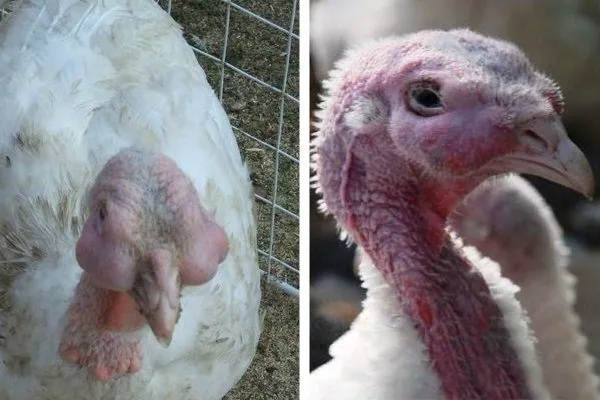
Hemophilia
An infectious, incurable disease that typically affects turkey poults up to 5 months of age. It is transmitted from sick to healthy turkeys, as well as through water and feed. The chicks develop inflammation of the mucous membranes in the nasopharynx and eyes, shortness of breath and wheezing, loss of appetite, and consequent weight loss. In the later stages, the bird's head resembles an owl's due to severely inflamed suborbital sinuses.
Sick birds are slaughtered. The remaining birds are given inhalations of iodine and chlorine turpentine. The room is disinfected with a solution of 2% formaldehyde, 2% caustic soda, and 20% freshly slaked lime added to water. The mixture is heated to 80°C, and the entire house is disinfected.
Paratyphoid
A dangerous disease that affects chicks up to one month old. Mortality rates exceed 70%, as their immune system is not yet fully developed.
The chicks are practically motionless, sitting hunched over with their feathers hunched over. They have no appetite, but they have an increased need for water. The medications used for treatment are Mepatar, Trimerazin, and Lautecin.
Pullorosis (typhus)
This is a contagious disease that spreads quickly throughout the flock. The main symptom is white diarrhea with clumps of foam and an unpleasant odor. The chicks squawk constantly and breathe heavily. They become blood-poisoned, and their gastrointestinal and respiratory systems are damaged.
Typhus is transmitted through food, water, utensils, and from sick birds. If eggs are initially infected, the turkey poults hatch already infected. One-day-old chicks are most susceptible, with a mortality rate of up to 70%. Treatment is prescribed by a veterinarian, who selects the appropriate antibiotic after establishing an accurate diagnosis. Clearly sick birds are destroyed. For prevention, chicks are given furazolidone from the first day.
Histomoniasis
Turkeys kept with chickens, ducks, and geese are most susceptible to the disease. Poults aged 3 to 21 weeks are at risk. Affected chicks stand passively in a corner, do not eat, and have yellow-orange stools with a blue-black tint on their scalps. The intestines and liver are affected (the photo shows spots on the liver of a bird with histomoniasis).
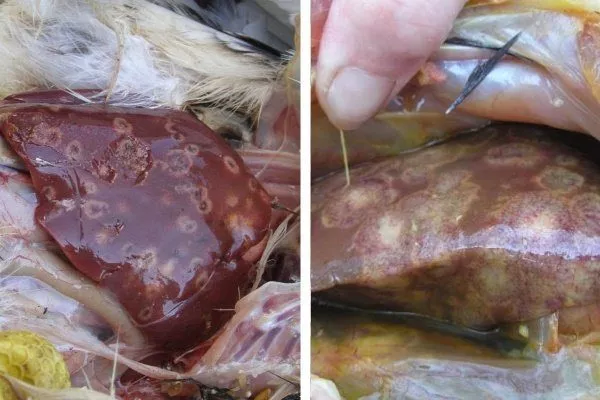
For treatment, the following medications are used: Trichopolum, Furazolidone, Metronidazole and Osarsol, following the manufacturer's instructions.
Diseases of small turkey poults
Turkey poults are susceptible to serious pathologies; even from an early age they can suffer from some serious diseases.
| Name | Cause | Symptoms | Treatment |
|---|---|---|---|
| Cannibalism (pecking) | Overcrowding, poor nutrition | Pecking at their fellows, constant fights | Isolation, menu change |
| Rickets | Lack of calcium, vitamin D3 | Bone problems | Adding vitamins and minerals to food, walking |
| Avitaminosis | Lack of any vitamin | Poor weight gain, eye problems | Brewer's yeast and vitamin supplements |
| Enteritis | Poor quality food or dirty water | Refusal to eat, loose stools | Balanced quality food and clean water |
Cannibalism (pecking)
This phenomenon often occurs when chicks are kept in close quarters, where they are unable to exercise and are constantly stressed. This leads to pecking among their fellows and constant fighting for a place in the sun. Another common cause is poor nutrition, a lack of protein, vitamins, and minerals.
The affected bird must be isolated from other birds, otherwise it will be slaughtered. The birds' diet is adjusted, increasing protein and supplementing with vitamins and minerals. The individual space for each bird is increased, and their numbers are adjusted according to the size of the coop.
Rickets
The disease is caused by a lack of calcium and vitamin D3, which is essential for calcium absorption. This vitamin is synthesized in the skin under the influence of ultraviolet rays and is ingested through food. The disease is most often seen in cross-breed chicks, as they require significantly more protein and calcium, but it also occurs in egg-laying turkeys.
Treatment involves adding vitamins and minerals to their food and allowing them to walk outdoors, but not in direct sunlight. The chicks should be given ample exercise. They should also be kept indoors where they can comfortably occupy space.
Avitaminosis
This is a deficiency of a certain vitamin in the diet. A lack of vitamin A causes chicks to gain weight poorly and develop eye problems—they become cloudy and watery. A severe deficiency of B vitamins leads to paralysis of the legs, making the chicks unable to stand. They also become bald and their skin condition worsens.
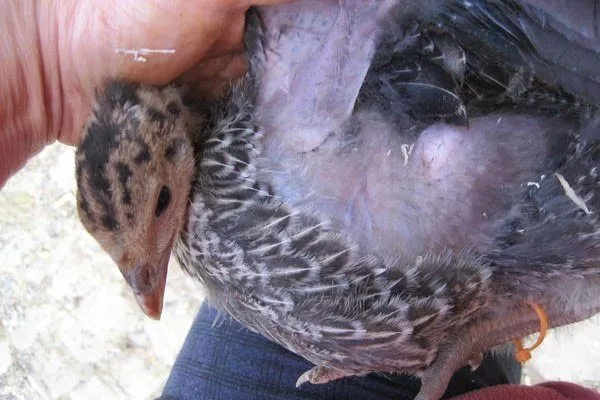
Brewer's yeast and vitamin supplements can help replenish these vitamins. Vitamin D deficiency slows the growth of young birds, and their bones become soft and easily broken, making them susceptible to fractures. If left untreated, rickets can develop.
Egg pecking is often attributed to vitamin deficiency, but this is incorrect. If a bird pecks eggs, it's either lacking calcium, sulfur, or protein, or it's lacking nutrition.
Enteritis
It most often affects chicks aged 1.5 to 3 months. The symptoms resemble dysentery. Chicks refuse food, become lethargic, have loose stools containing lumps of indigestible food, and have matted feathers near the vent.
Enteritis is caused by feeding birds expired, poor-quality food or dirty water. Sick birds are separated from healthy flocks. They should be fed a balanced, high-quality diet and clean water. Recovered birds are released into the general pen after they have fully recovered.
The list of turkey diseases is quite extensive. Young birds are most susceptible to illness, as their immune system is not yet fully developed. Proper nutrition, care, and comfortable conditions significantly reduce the risk of non-infectious diseases. Vaccination is effective against contagious diseases. Therefore, to protect your birds from disease, it's best to resort to preventative measures and vaccines.
Thank you very much. This is the best collection of articles about turkeys I've ever read.