
Plucking a domestic goose requires a certain amount of manual dexterity. Those who have been keeping poultry for a long time have likely already mastered this skill. However, for those just beginning to master this craft, it's advisable to familiarize yourself with each of the available DIY methods for plucking poultry.
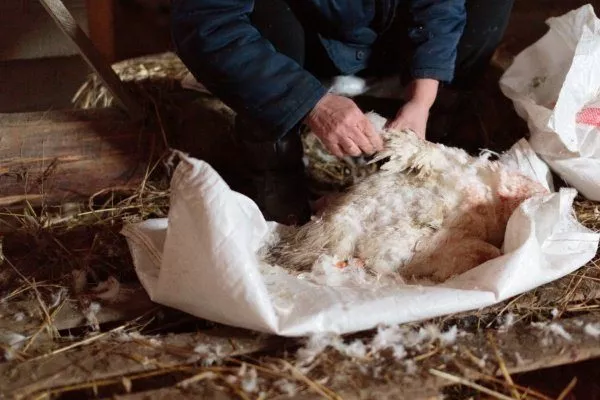
Preparing a goose for plucking
The plucking process must be approached with care. Several simple preparatory steps are required beforehand.
First, it's important to choose the right location—the humidity level should be within the recommended range, and the lighting should be dim, so the goose won't peck at its own droppings and its feathers will stay clean. If a natural body of water is available, it's recommended to let the bird bathe. For ten hours before plucking, the geese should not be fed; only warm water should be left for them.
- ✓ Store the pen in a dry, well-ventilated place.
- ✓ Avoid direct sunlight to maintain the quality of the pen.
A solution of table salt has a laxative effect on geese, helping to clean out their stomachs and intestines. This is necessary for the bleeding procedure, which is performed before plucking.
Before slaughtering and plucking the goose's feathers and down, some time is required for the carcass fat, located under the skin, to solidify. Bleeding is performed by hanging the bird upside down.
Methods of plucking a goose
When cold weather sets in, goose owners often wonder how to pluck their geese. Several methods exist, each with its own advantages and disadvantages.
Regardless of the chosen method for removing feathers from a carcass, it's important to remember that goose feathers and down are extremely valuable raw materials. They're sure to find a use in any textile store. Some of the methods below don't allow for future use of this material, while others allow you to preserve it in its original form.
Goose meat is considered a delicacy and is used to prepare some of the most delicious dishes. And the feathers and down are perfect for stuffing duvets and pillows.
| Name | Plucking method | Possibility of using a pen | Processing speed |
|---|---|---|---|
| Dry method | Manual | Yes | Slow |
| Scalding | Using boiling water | No | Fast |
| Cold method | Manual after cooling | Yes | Average |
| Application of the pump | Using a pump | Yes | Fast |
| Using an iron | Using an iron | Yes | Average |
| Drill attachments | Mechanized | Yes | Very fast |
| Easy feather removal technique | Using a drum | Yes | Fast |
Dry method
Dry plucking of this bird is used exclusively after slaughtering the goose. No special attachment or device is required. When dry plucking, the bird's legs and wings must be tied. While holding the carcass on your feet, remove the feathers manually. The process begins with the large feathers and ends with the small ones.
Large feathers are much more difficult to pluck because they are attached to the skin much more tightly. Therefore, it is recommended to begin the dry plucking process with the wings and tail, and finish with the breast, neck, and legs.
The feathers removed from the bird's armpits are discarded. If the bird is to be cooked whole, without cutting it into individual pieces, do not pluck it all at once. Dry, vigorous plucking seriously damages the outer skin of poultry, making it appear less aesthetically pleasing.
Scalding
Before plucking the feathers, many goose owners prefer to scald the carcass. This procedure helps soften the skin, allowing the feathers to come out more easily. The temperature of the boiling water in which the carcass is placed should be at least 80 degrees Celsius.
The disadvantage of this plucking method is that the feathers and down cannot be used further. The meat must be sold as quickly as possible, as scalded carcasses cannot be stored for long.
The method of plucking a goose by scalding is shown in the video below:
This method is only good if you do not plan to use the down and goose feathers for sale or other purposes, since it is simply impossible to dry goose feathers.
Cold method
Cold feather removal of goose feathers involves sorting the feathers by size, separating them into small and large ones. This saves a significant amount of time in the future. To prevent contamination of the feathers, a piece of cotton wool is placed in the bird's beak.
There's no need to use special attachments for processing poultry. Simply place the carcass in a cool place for 3-4 hours. This will allow the carcass to cool after slaughter and the subcutaneous fat to solidify. This will make feather removal much easier.
The cold method of plucking geese is most often used by hunting enthusiasts, as it allows the carcass to remain intact and undamaged.
To avoid visual damage to the carcass, it is advisable to remove feathers and down in the direction of their growth.
Application of the pump
Not everyone is familiar with the method of plucking a domestic goose using a pump. A standard bicycle tire inflator is all you need. This method of feather removal is often combined with a steam iron. This reduces the overall time spent on a single bird.
The plucking procedure is carried out as follows:
- Place the pump hose in the space between the goose bumps and the cervical vertebra.
- Pump the carcass with air until the feathers rise slightly at the roots.
- Tie the bird's throat with twine to prevent air from being sucked out.
- Starting from the bird's back, remove the larger feathers by hand, then the smaller ones.
Using an iron
Not everyone knows that plucking a domestic goose can be done using a regular iron. To do this, you'll need a few essential items:
- pump (it is acceptable to use one designed for air mattresses);
- a container with cold liquid;
- a piece of natural fabric;
- with twine;
- with an iron.
The procedure for plucking a goose carcass using an iron is carried out as follows:
- Before plucking the carcass, insert the pump tube between the skin and the neck of the goose. Pinch to prevent air from escaping and pump until the feathers stand upright.
- Try not to over-pump, as there is a risk of the carcass' skin bursting.
- Remove the tube and tie the bird's neck with twine to prevent air from escaping.
- Lightly dampen the fabric with cool water and place it on top of the feathers. Iron. You can also use a gauze napkin wrapped in two or three layers.
- Turn on the steam function on your iron.
- Once the fabric is dry, remove the iron and pluck the feathers. If plucking is difficult, steam the area again.
You can watch a goose being plucked with an iron in the following video:
Drill attachments
Removing feathers with a drill is one of the most labor-intensive, yet fastest, methods. It's most likely necessary for those keeping large flocks of geese. After slaughter, the cleaning process must be carried out quickly, before the meat begins to spoil.
In addition to a drill, you can use a screwdriver. You'll need to purchase special plucking attachments. These can also be used for processing other game. The drill (or screwdriver) clamp is securely attached to the table, then the tool is turned on and the goose carcass is brought in.
Goose wings are cleaned on both sides. For ease of removal, straighten them by gently pulling the bird's legs. Removing feathers from one bird at a time requires a little experience, and in the future, the process will take no more than 2-3 minutes per goose.
Easy feather removal technique
Today, there are several different methods for plucking a goose at home: by hand and using a special drum. The latter involves placing the carcass in a rotating container of water.
When the drum is turned on, the feathers are removed from the bird. Although this plucking technique is relatively simple, it does not completely remove feathers from the bird. Therefore, the bird must still be plucked manually. The advantage of this method is that it reduces the time spent on each bird.
A rotating drum is available at any specialty store, but you can make one yourself if you prefer. Washing machine drums are also ideal.
To make such a tool yourself, you will need to acquire a suitable cylinder and perform the following steps:
- Make holes in the cylinder at a distance of 2 cm.
- Attach a bottom made of durable material and a lid that is the appropriate size for the diameter of the cylinder.
- Make a hole in the lid for a hose that will allow you to spray the carcass while removing the feathers.
Singing the hairs of a goose carcass after plucking
The method used to remove feathers from a domestic goose isn't particularly important. Depending on the desired result, plucking can be done cold, dry, or with boiling water. Singing is an essential and necessary step in feather removal. You'll need a gas torch (stove) or a soldering iron.
It's important to ensure the poultry skin doesn't roll up, so stretch it slightly when searing. To prevent soot from forming on the carcass, it's best not to bring the bird too close to the fire. If this is unavoidable, it's recommended to coat the meat in wheat flour or bran, which will remove the characteristic smoky odor and impart a more pleasant flavor.
You can watch how a goose is singed after plucking in the video below:
How to collect feathers from a live bird?
Keeping domestic geese is a waste-free operation. Feather harvesting while the birds are growing provides additional income. This is achieved by combining plucking and the natural molt that occurs after the geese lay eggs. This occurs only twice: in early June and July.
When a goose molts, its feathers are replaced by new ones. This makes feather removal much easier. It's recommended to start with geese that are already undergoing the natural feather renewal process. To ensure the purity of the raw material, allow the birds to bathe in a pond.
The whole process goes like this:
- Before plucking, carefully tie the bird's feet.
- Place the goose on your lap with its back facing you and pluck it, starting from the breast.
- Do not take a large amount of feathers in one procedure, otherwise you may expose the goose's skin.
- Plucking should be done using your index finger and thumb, gradually moving to the back of the bird.
- Do not remove feathers from the shoulders, hips, tail, wings or neck under any circumstances.
If you live in a warm region, you can pluck feathers twice more during the fall, in early September and October. If blood appears during plucking, stop immediately, as this process must be carried out without harming the bird's health.
Plucking a goose isn't as complicated as it might seem at first glance. Simply follow these simple guidelines, and you'll end up with clean feathers and perfect goose meat.
I didn't even know there was a special drum for removing feathers!!! We usually slaughter 30-40 geese at a time, so I started looking for new and easier ways to pluck them. A drum is certainly not cheap, but you came to the rescue here too – you showed me how to make one myself. My husband made one, we've already tried it – everything is just perfect and superb. Thank you so much!!!