
Geese's thick downy coat reliably protects them from the harshest cold. However, this doesn't guarantee the birds a completely comfortable winter. They will require special housing, a special feeding regimen, and certain other maintenance requirements.
Requirements for keeping geese in winter
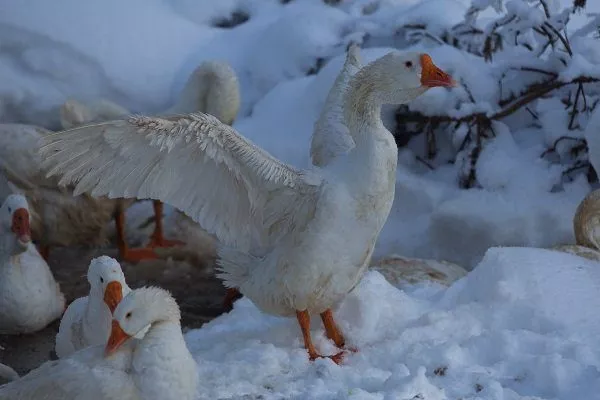
Dense plumage and down truly make the bird cold-resistant, even down to -40°C. Naturally, proper husbandry is essential for this. Otherwise, constant dampness can cause the feathers to become dirty and lose their density, and the bedding can become damp, causing the geese's feet to freeze.
This may lead to diseases and loss of bird populations. Even a small shelter where the geese can spend the night or wait out bad weather will help. It can be constructed from anything, and large cracks can be sealed with straw or rags during cold weather.
To prevent moisture from seeping in from the ground, it's best to build a plank floor and insulate it with underlayment. The underlayment should be 50 cm high, and the following materials are suitable:
- hay;
- straw;
- sawdust;
- shavings;
- peat.
- ✓ The bedding thickness should be at least 50 cm for effective thermal insulation.
- ✓ The bedding must be dry and clean to prevent diseases.
When the top layer of litter gets dirty, you can replace it or simply add some fresh material.
You can eliminate the ammonia smell in your goose house by sprinkling the bedding with superphosphate weekly. Apply 400 g per square meter. If you use double superphosphate, you'll need half as much. This product will not only eliminate the unpleasant odor but also thoroughly dry the bedding surface.
Keeping geese indoors all the time isn't recommended. In mild weather, it's enough for them to spend the night in a shelter, and during the day, it's best to let them roam outside. Even if the temperature drops significantly, geese should be let out for at least an hour.
Birds' feet are not as resistant to frost as their bodies. Therefore, it is recommended to regularly clear snow from the bird's run.
Features of winter keeping of geese
You can arrange a wintering area for your birds in any empty outbuilding. For example, a barn, chicken coop, or greenhouse will do. The main thing is to properly equip the space to create the most comfortable conditions for the birds.
In the barn
Any wooden shed that's temporarily empty of storage can be a reliable shelter. You can even quickly construct one from old boards.
Preparing the shed:
- Check for any cracks in the walls. Seal them thoroughly with fresh straw or dry rags. Sealant works well.
- If the gaps are very wide, place a third board at the joint between the two and nail it in place.
- When building a shed from scratch, be sure to install windows. This will allow sunlight to enter, allowing you to turn off the electricity during the day.
Geese will overwinter well in a stone or brick building. However, even here, a wooden floor and bedding are essential.
In the chicken coop
A simple barn is often insufficiently equipped for wintering, ensuring rapid weight gain and egg production. It's better to build a chicken coop equipped with:
- drinking bowls;
- feeders;
- nests.
Wooden troughs or shallow buckets are used as drinking bowls. It is recommended to line them with galvanized iron. Unlike wood, it does not rust or rot.
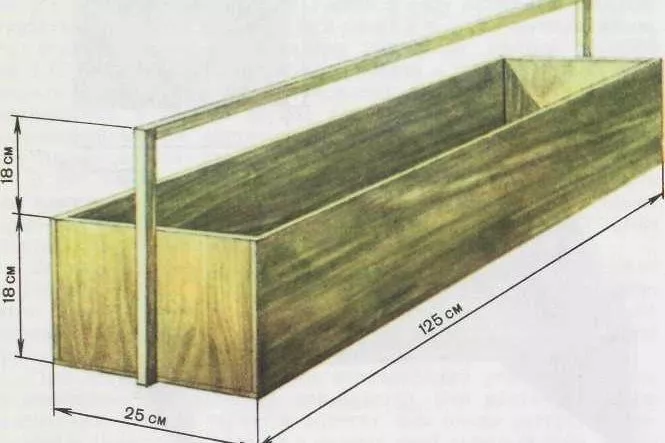
The feeder is made from two boards and several screws:
- Calculate the length of the boards based on the number of birds. The more birds there are, the longer the feeding space will be. Otherwise, some of the flock will go hungry.
- The feeder should be level with the goose's back. Attach the two boards together at a 45-60 degree angle. If the feeder is wider, the birds will simply rake the food out.
- Attach 2-3 crossbars to the top of the feeder. These will serve as handles for carrying the feeder and will prevent the geese from scooping out the feed.
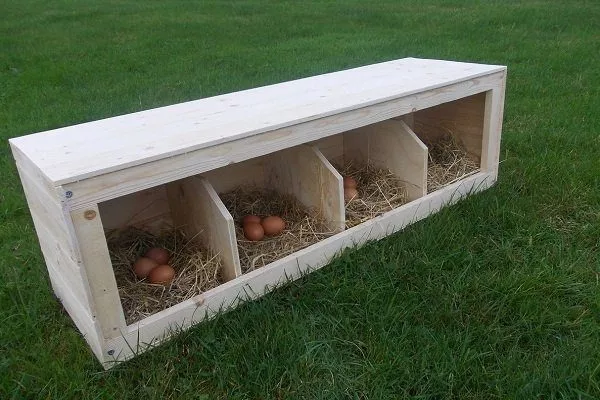
To provide the geese with a place to lay eggs, the coop needs to be equipped with nest boxes. These are made in the form of open-topped boxes made of plywood sheets or planks:
- Connect the boards to form a rectangle 60 cm long and 50 cm wide and high. Treat the walls with lime mortar.
- Install nest boxes along the walls. It's best to do this around mid-February so the birds get used to the nesting area.
- Make steps up to 10 cm high on the front panel of each nest. These steps will prevent bedding from spilling out and eggs from rolling out.
- Line the inside of each nest with straw or hay. Fill the box almost to the top.
Calculate the number of nests according to the norm: 1 nest for every 2-3 geese.
The chicken coop should be maintained at an optimal temperature comfortable for the birds—no lower than +3°C. Typically, the coop is equipped with everything necessary, so no additional equipment is required.
In the greenhouse
The optimal, low-cost option is a greenhouse, with all plants removed for the winter. The space is furnished, protected from wind and drafts, and the glass walls allow for good light transmission.
Greenhouse preparation:
- Strengthen the greenhouse by sealing any cracks.
- If winters are harsh, install heating in the greenhouse. This is especially important for plastic greenhouses, which will require additional heat during severe frosts.
- Carefully remove plant debris from the soil and level the surface.
- Provide bedding of straw.
Diet of geese in winter
Unlike in summer, in winter, geese cannot be provided with regular grass and insects, which are essential components of a healthy diet. Their winter diet is very different and must be prepared according to specific guidelines.
Nutrition
In November and throughout December, the chicks should be fed twice a day. The morning feeding should be a mash, and the evening should consist entirely of whole grains. January should be spent on three meals a day, and then through March (the egg-laying season) on four meals a day, according to the following schedule:
- day - wet mash;
- morning and evening - whole grain.
Forage grasses are essential for winter feeding. Feed 0.3 kg per bird daily. Nettle, alfalfa, and meadow grass hay are recommended. This type of coarse feed can be added dry, but it is more digestible when steamed.
- Chop large hay and pour boiling water over it.
- After 5-10 minutes, mix with chopped vegetables - beets, carrots, rutabaga or potatoes.
- Oat chaff is good to use instead of hay.
Geese love oats, which are added to their diet whole. However, wheat and barley cause obesity in captivity, significantly reducing egg production. Dried herbs and leaves, acorns, and vegetables are an important part of their diet during the winter months.
Rules for feeding geese in winter:
- Hay for geese is prepared in quantities of 15 kg per bird. This can be dried or ensiled meadow grass.
- A useful addition would be brooms made from dried linden, birch, willow, and oak branches. These dried branches should be steamed and hung along the walls of the coop.
- Oak acorns are a must. The standard is 6 kg per bird. Dried acorns are shelled before adding to the mash and boiled for 1 hour.
- The lack of grain is replenished with potatoes, both raw and boiled. To acclimate the goose to this food, grated potatoes are introduced into the chicks' diet from puppyhood.
- The mash with added potatoes and other vegetables should be prepared only once, otherwise it may turn sour within a few hours. This will cause gastrointestinal upset in the birds.
- When replacing grains with potatoes, maintain a 3:1 ratio. For example, 3 kg of potato mash with herbs fully replaces 1 kg of whole grains.
When geese begin mating, it's recommended to leave oats in the feeder overnight. This is especially important for males, as frequent mating causes them to lose weight, which affects the quality of fertilization.
It's best to feed the ganders indoors while the geese are outside. The following foods are used for feeding:
- whole wheat, barley, oats – 80 g;
- grated carrots – 20 g;
- baker's yeast - 4 g.
The quantity is given per individual.
Vitamin supplements
Even good feed in the right quantities won't provide domestic geese with the necessary micronutrients. This is due to insufficient sunlight, cold, a lack of fresh grass and insects, and low mobility. Therefore, it's necessary to supplement their diet with vitamins.
Nutritional supplements are easy to make yourself. For example, to provide vitamins A and D, fish oil and sprouted wheat are added to the feed. Sprouted wheat is prepared as follows:
- Pour water at room temperature over the barley and leave it indoors for 2 days.
- Spread the swollen grains on a flat surface so that they barely touch and the layer is uniform.
- On the third day, sprouts will appear. After a couple more days, they will strengthen, each grain will sprout, and you can add the resulting product to the wet mash.
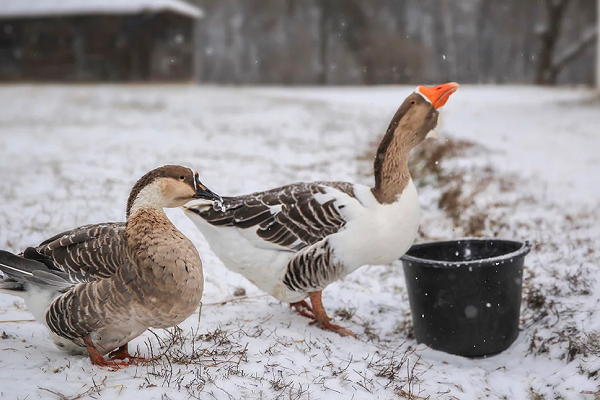
In winter, birds will also need substances containing calcium and minerals. Suitable options include:
- shell rock;
- nut shells, egg shells;
- chalk.
These ingredients can be fed together or separately. The key is to grind them well to make them easier for the geese to eat. Adding fine gravel is recommended: it helps the birds' stomachs digest the food.
Drink
It's a mistake to assume that snow will replace water for poultry in winter. In fact, geese's drinking regimen is more important and complex during the cold season than in the summer.
A lack of fresh water will cause circulatory problems in the birds, leading to nervous system disorders. This condition will progress to constant aggression or, conversely, lethargy. In either case, the geese will experience a decrease in egg production.
The required amount of water is 2 liters per day per bird. The waterer should be kept clean, so avoid stagnant water. The water must be changed daily.
Caring for geese in winter
Due to worsening weather conditions, winter care is more thorough than summer care. The rules are simple, but adherence is essential:
- Keep your birds' feathers clean. Dry, clean feathers will protect them from hypothermia and illness. Therefore, regularly replace their bedding with dry material.
- The minimum suitable temperature in a poultry house in winter is +3…+5°C. Below this level, geese will have to eat more to maintain energy and stop laying eggs.
- During the entire breeding season, goosebirds require long daylight hours, approximately 14 hours. While this is the natural length in summer, in winter, equip the goose house with lighting fixtures rated at 5 watts per square meter. Turn on the lights at around 5 a.m. and turn them off after sunrise. Turn off the lights in the evening from sunset until 7 p.m.
- Provide the males with additional food. They care for the females and often go hungry because they wait for the females to eat. Males need to be fed 20% more.
Organizing a dog walk
The area where the geese roam must be prepared. Here's what to do:
- Remove snow from the area to prevent the down and feathers from getting wet.
- Cover the surface with straw - this will protect the paws from freezing.
Each walk should last at least an hour. Geese can be allowed to swim in a nearby body of water. During a thaw, prepare an ice hole in advance for this purpose. During freezing temperatures, swimming is not recommended, as water that is too cold will cause hypothermia in the paws.
Disease prevention
The main problems that can cause illness in birds during the cold period are the following:
- a sudden change in diet, resulting in a decrease in immunity;
- lack of physical activity as a cause of metabolic disorders and obesity;
- dampness and drafts causing hypothermia and colds.
Proper feeding and exercise are often the most effective way to avoid these problems. Keeping the entire herd's habitat clean is essential. However, it's also a good idea to follow health and safety precautions, including:
- Before introducing the birds, thoroughly clean the goose house and disinfect the surface and equipment using caustic soda (2% solution).
- Change the litter no later than when it is a quarter soiled.
- Follow the vaccination schedule for birds established by your veterinarian.
- Monitor for helminth and other parasite infestations and take action if a problem is detected.
- When new birds appear in the flock, quarantine them.
- Completely eliminate contact between domestic geese and wild birds.
- If you notice a sick goose, immediately isolate it from the rest of the flock and contact a veterinarian.
Do geese lay eggs in winter?
As early as early February, domestic geese begin laying eggs. It's important to notice this early to monitor the process. Eggs are laid at night or early in the morning. They are collected while still warm to prevent freezing or other damage.
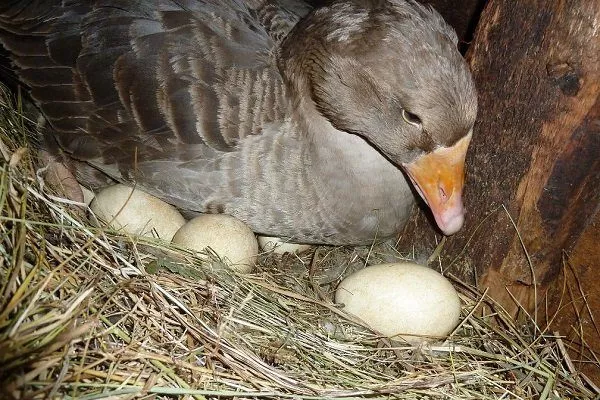
The collected eggs are transferred to a dark, dry place with a temperature of 5 to 12°C and laid out horizontally. They can be stored in this manner for 10 days before being placed under the female for further incubation.
If the geese do not start laying eggs at the appointed time, it means that the conditions of their keeping were violated, namely:
- it's dark in the room;
- the duration of daylight hours is not ensured;
- the goose house is too cold, damp or there are constant drafts;
- the birds do not have enough food or water;
- Geese have vitamin deficiency.
A goose's readiness to lay eggs is evident by signs of outward restlessness. The bird shifts in place, sways to one side as it walks, and lowers and tucks its tail. Most often, it stays near the nest, carrying straw into it and insulating it with its feathers and down.
Geese have long been domesticated by humans precisely because their care and upkeep require little effort, time, or special skills. Simply following simple guidelines can help you achieve a large, healthy flock.