
If you're raising geese, you absolutely must know the difference between a gander and a goose. After all, the sexual differences between them aren't as noticeable as, say, between hens and roosters. Let's look at the key differences between baby goslings and adult goslings.
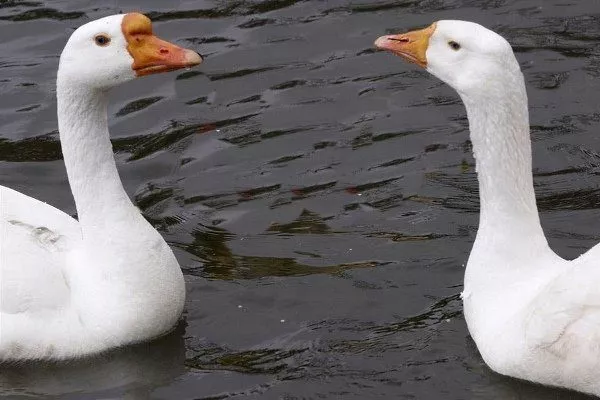
The Importance of Sex Determination in Geese
Determining the sex of geese is important if you plan to breed them or sell their meat, for example. In this case, you'll need to carefully select geese based on their gender.
- ✓ Pay attention to the activity and aggressiveness of ganders, as these qualities are important for protecting the flock.
- ✓ Check the condition of the goose's genitals using the scientific sexing method to avoid culling due to possible anomalies.
Why do this:
- understanding who is who, it is enough to simply select the best representatives of both sexes for reproduction, and send the rest to slaughter;
- the process of forming pairs for producing healthy offspring is facilitated, eliminating the mixing of related bloodlines;
- Separating the young according to their gender will help avoid violent conflicts and showdowns within the flock, and will also allow you to save on feed - geese expend less energy, and their weight increases faster with the same amount of food consumed;
- The correct ratio of ganders to geese will result in good offspring, allowing you to breed birds in the required quantity.
Some poultry farmers breed geese based on their own selection criteria. For example, some believe that ganders are less likely to get sick and are larger than geese. Others, on the contrary, prefer females because they are calmer, more docile, and less likely to run away at the first opportunity.
The Importance of Sex Selection
A properly formed herd allows for achieving optimal performance according to the following criteria:
- obtaining and subsequent sale of meat - for this, form a herd mainly of ganders, since they are larger;
- egg laying - in this case, focus on breeding females; an excess of males will lead to a drop in this indicator;
- birth of strong and healthy offspring - leave only the strongest and most resilient males;
- Breeding chicks for sale – provide accurate information about the sex of the birds to gain repeat customers and accurately meet the buyer's needs without errors.
The optimal flock ratio is considered to be four geese to one gander. Experts say this ratio allows for excellent egg production while also providing sufficient meat for sale.
Methods for determining the sex of young geese
In a flock of geese, the "boys" mature faster. They become adults and are ready to reproduce at around 7 months. Meanwhile, the females lag behind them in development by approximately 1-2 months.
Moreover, they can be distinguished from each other much earlier (even just a day after hatching). The main methods for determining sex are scientific (anatomical), by the size of the goslings, their activity, and their reaction to fear.
| Name | Weight of an adult (kg) | Egg production (pieces/year) | Neck length (cm) |
|---|---|---|---|
| Gander | 5-6 | 0 | 45-50 |
| Goose | 4-5 | 30-50 | 35-40 |
Scientific method
This method allows you to determine the sex of a gosling by examining its anatomical structure:
- Place the gosling on its back so that its head is directed slightly downwards (support it with your little finger) and its tail is slightly raised;
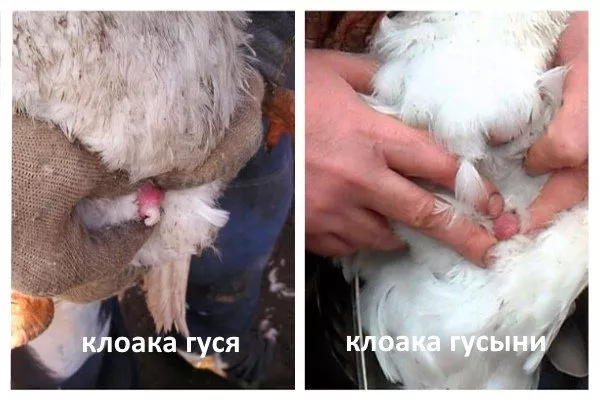
- examine the chick's anus (cloaca), where its genitals are located - to do this, pull the tail slightly and slightly spread the cloaca with your fingers;
- If there is a small curved process there, then the chick is a gander, if there is none, then it is a goose (they usually have evenly spaced folds, between which there is a small tubercle).
This method is considered the most reliable, as it's based on the bird's anatomy. You only need good eyesight to accurately examine the gosling's organs or use additional magnifying devices, such as a magnifying glass.
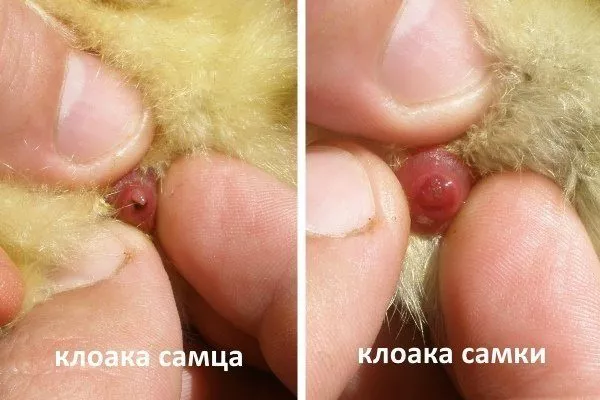
It's most difficult to detect anatomical discrepancies between 4 and 5 months of age. This is because goslings instinctively clamp their hindquarters during this period. If the chick actively resists this procedure, it's best to avoid damaging its psyche and postpone the experiment for a couple of days.
Gosling activity
If you look at the behavior and activity of the chicks, you'll notice that the "boys" are the noisiest and most active. They're the first to explore their territory and run to the feeding area. Furthermore, even as chicks, they already engage in small "wars" among themselves for the right to be the leader.
As for females, they are completely non-aggressive. They only show signs of anxiety when they are stressed or hungry.
Gosling sizes
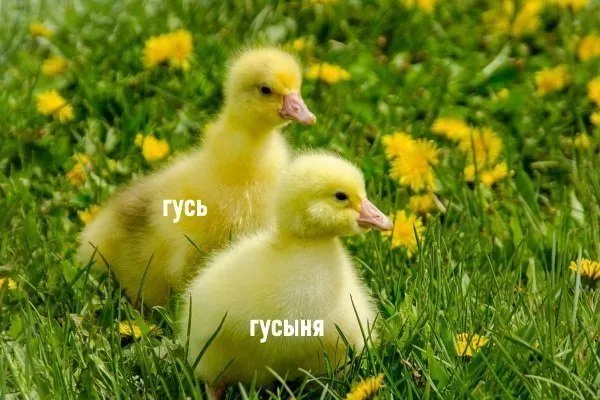
You can determine the sex of a gosling by its size. Gander are usually larger than geese, and this is noticeable even in the incubator. They also have a distinctive gait. Males walk with their heads held high and chests puffed out; they like to groom their territory and are quite curious by nature. Females, on the other hand, lower their beaks to the ground as they walk.
Frightened goslings
You can determine the sex of goslings by how they behave in an emergency. Startle them with a sharp, unexpected sound and observe their reaction. Males will stretch their necks and raise their heads, assessing the situation. Females, on the other hand, will huddle low and remain quiet.
Don't use this method too often, as it will have a negative impact on the young birds. They may develop a negative conditioned reflex, making them excessively fearful and nervous.
Bungee jumping
This method of sex determination is quite popular among poultry farmers and is carried out as follows:
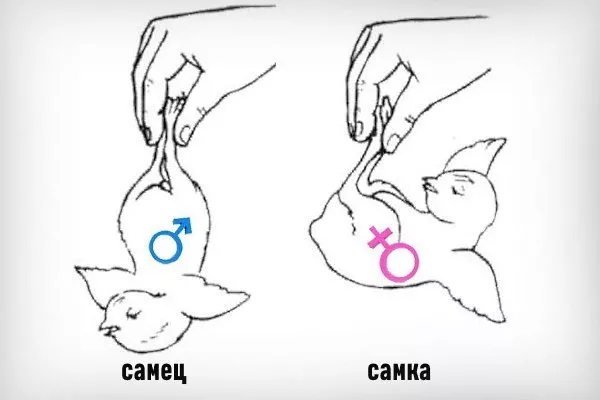
- carefully, so as not to damage the gosling's feet, take the chick by the legs;
- turn him upside down;
- lower the chick sharply, simulating a fall;
- Watch the reaction - the goose will try to reach his body or the hand of the person holding it with his beak, and the female will simply start turning her head in different directions.
This method isn't as reliable as all the previous ones. It's based on statistical data on the typical behavior of ganders and geese. However, each individual chick can react completely unexpectedly in an unfamiliar situation. Therefore, relying solely on the "Bungee" method isn't recommended.
| Method | Accuracy (%) | Difficulty of execution |
|---|---|---|
| Scientific | 100 | High |
| By color | 60-70 | Low |
| By size | 50-60 | Low |
Methods for determining sex in adults
Adult geese are just as easy to distinguish as baby goslings. In some ways, it's even easier, as some characteristics become more pronounced. Let's look at the main methods for sexing adult birds.
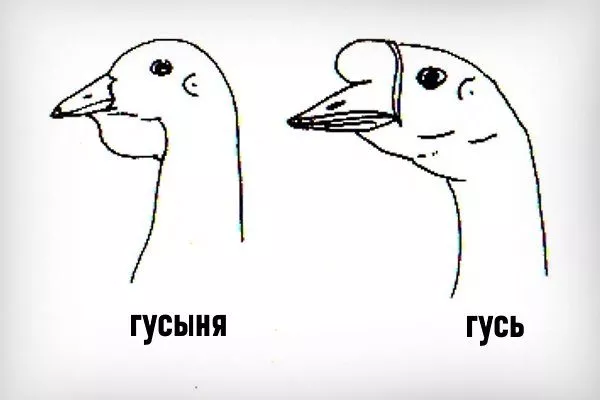
There are some geese in the world whose sexes are quite distinct. For example, Kholmogory ganders have a distinctive bump on their beak, which is reddish or pinkish with a yellowish tint. This breed of goose does not have this bump.
Scientific method
The technique for performing this method is the same as in the case of goslings:
- place the bird on its back;
- wrap your legs around the goose's body;
- lift the tail with one hand and spread the cloaca with the other;
- If the bird has a curled genital organ, then you have a male in front of you;
- if you see seals in the form of small bubbles, it is a female (by the way, the female has a slightly flattened nipple in the cloaca, but it is very difficult to mistake it for a male genital organ).
Using this method, you can determine the sex of a bird with 100% certainty. However, keep in mind that adult geese may resist such attempts. Males are especially aggressive, and may hiss and bite. To avoid injury in this case, gently squeeze the bird between your knees.
Another way to hold a bird is to sit on a chair with it and support its wing, leaning lightly on it with your body (keeping your neck under your armpit). Support the other wing with your elbow. This position makes it easier to examine the bird, as it frees up your hands.
Ideally, of course, you could use a special probe. Insert it into the bird's vent and get a result that's up to 98% accurate. True, such a device is expensive, but if you're specifically breeding geese, it will make your life much easier.
Coloring of geese
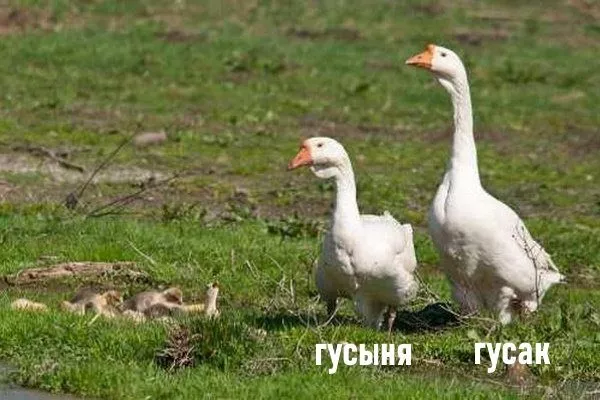
It's commonly believed that geese generally have white feathers. This is true, but the down of male ganders has a slight yellowish tint, while the plumage of female geese is more gray than white.
True, keep in mind that there are such breeds of geese, in which the coloring of males and females is virtually indistinguishable. For example, Linda – in this breed of bird, both the ganders and geese have white plumage.
Geese sizes
As the birds mature, the differences in size become more pronounced. Males are heavier than females, weighing on average about 10% more. This is because the goose, as a protector, requires greater strength and, therefore, weight.
In addition, they have large, long necks that are constantly under tension. Geese are smaller than ganders, and their necks are short and thin. Males also have larger feet, and the webbing between their toes is wider than that of females.
However, the bird's size doesn't guarantee a precise sex determination. In the Linda breed of geese (the one most often kept by Russian farmers), both males and females are approximately the same size. Therefore, distinguishing them by this characteristic is quite difficult.
Sounds of geese
You can also determine the sex of geese by the sounds they make:
- geese cry loudly, abruptly, with some hissing in their voice;
- The geese cry loudly, as if prolonging the sound.
Humans find the calls of geese more pleasant. The sounds produced by ganders are often irritating to humans. Keep in mind the breed differences. For example, male Chinese geese have a high-pitched, sharp call, while females, on the other hand, have a low, shrill sound.
Head of geese
As for the head, ganders have a large, massive head. The bill is usually coarse and also large, most often black. Females' heads are smaller than those of males and have softer, more delicate features. Their bills, however, are usually elegant and thin, brightly colored.
Geese behavior
It's fascinating to observe geese during their mating season. Males are typically quite aggressive and restless during this time. They compete with each other for leadership of the flock and for the females they prefer, who are typically quiet and reserved. Geese can only become aggressive during the incubation period, if there is any danger to the future chicks.
The pack leader is fairly easy to spot. He always walks ahead of everyone else, proudly puffing out his chest and holding his head high, showing everyone who's boss. Leaders also often patrol their territories to maintain control.
The geese's behavior in the water can also help you distinguish between them. Gander swim slowly and majestically, holding their heads parallel to the water. After swimming, they stand in place, vigorously flapping their wings. Geese, while swimming, tilt their heads, as if bowing.
When it comes to stressful situations, geese behave the same as they did as pups. Females cower when frightened, while males are prepared to ward off danger by displaying aggression. They hiss, stretch their necks, and attack.
In the video below, a breeder shares his experience of distinguishing a gander from a goose based on their behavior and appearance:
Determining the age of geese
Knowing the exact age of geese isn't necessary, but it's important to understand whether the bird in front of you is young. After all, the number of years a bird lives affects the quality of its meat (it loses its juiciness and flavor), older ganders can't feed the required number of hens, and geese, in turn, lay few eggs or stop producing altogether.
To determine the age of a bird, pay attention to the following signs:
- a young gander or goose weighs up to 4 kg, while an old bird weighs more than 4.5 kg;
- the belly of young individuals is round, while in older individuals it has transverse stretch marks with fat deposits;
- The paws of young females and males are usually shiny, smooth, with thin webs, but the paws of old birds are covered with scales, and their webs are already quite rough;
- The beak of young birds is usually yellow, without cracks or other damage, while that of older birds is dark with a characteristic plumb line underneath, often with cracks;
- The plumage of young ganders and geese is quite dense, shiny, and of a rich shade, but in older birds the color is dull, dark in shades, the feathers are quite disheveled, and there are bald spots on the body;
- The young bird looks healthy and moves a lot, while the old one stays in one place and sleeps a lot.
However, keep in mind that if your goose's symptoms include coughing, severe feather loss, loss of appetite, frequent loose stools, or mange, the bird isn't old, but rather sick. In this case, take your goose to a specialist—they'll be able to advise you on what to do next and whether treatment is warranted.
Start forming a family when the goslings are already six months old (approximately 6-8 months). Start bringing the birds together in mid-October. Chicks that hatched in late spring are best for this purpose.
You can start collecting eggs as early as when a goose is 10 months old. Egg production will continue to increase until she reaches 3 years of age. After that, it begins to decline. Therefore, if this is your primary concern, don't keep a hen in your flock for more than 5 years. Gander, however, peak productivity occurs between 2 and 4 years of age. Therefore, they are rarely kept beyond 6 years of age.
It's best to slaughter geese when they're young, when they weigh approximately 4 kg. Extended fattening (more than six months) is not recommended. This is because the older the bird gets, the more fat it develops. This affects the quality of the meat and its price.
To maintain proper breeding performance, maintain an optimal ratio of young to older birds. Ideally, a flock should consist of 35% young birds, 30% two-year-olds, 25% three-year-olds, and 10% four-year-olds.
Tips and recommendations
To accurately determine the sex of a bird, use these tips:
- Use the most reliable method - the scientific one. Since it's based on the bird's anatomy, you can determine its sex with maximum accuracy. There are no hermaphroditic breeds of geese.
- For accurate results, use all methods in combination. This is the most reliable way to determine the sex of an individual. Because the more methods that indicate a specific sex, the greater the likelihood that it is true. Any signs are important. Keep in mind that there are breeds in which males and females are visually almost indistinguishable.
- If in doubt, consult a professional. If you still have any doubts after using all the methods for determining the bird's sex, consult a specialist who can help resolve the issue. Keep in mind that this procedure may require a fee.
At breeding geese Observe their behavior. One of the ganders may turn out to be monogamous and try to mate with a specific female. In this case, it will be very difficult to steer him astray, as he is guided by instincts based on the behavior of his wild ancestors. Replace such males with their more polygamous counterparts.
Choose only strong and resilient males, as they lay the genetic foundation for healthy offspring. The female doesn't play a significant role in this regard.
Ensure a normal, friendly atmosphere prevails among the geese. Sometimes, geese will organize a campaign of persecution against a specific individual. This negatively impacts its productivity. If it's a female, her egg production will decrease, and the goslings may not hatch at all.
There are many ways to determine the sex of geese. Use them all in combination to achieve the most accurate result. If in doubt, consult a professional who can guarantee a reliable sex determination.
The article is good, but "separate brothers and sisters promptly, preventing them from coming into contact" isn't something they say in Russian.
(We need to say "contact", don't let the Yankees destroy our language)