
Depending on the breed, geese begin laying eggs at 6-9 months or early in their second year. This depends on their husbandry—with comfortable conditions and adequate nutrition, this process can begin as early as 5-6 months. The bird's weight also influences egg production.
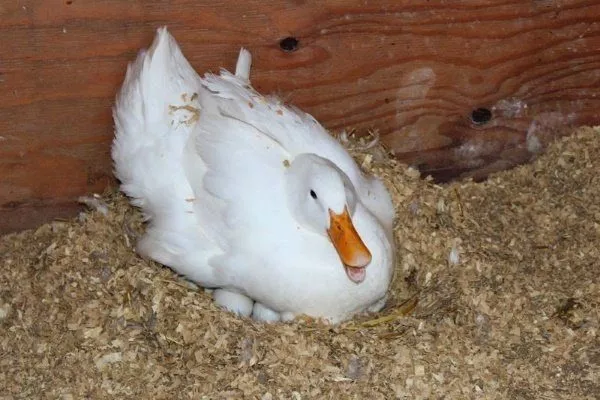
Goose egg-laying period
Typically, a young goose is ready for mating with a male at 180-300 days of age, with some variations. However, the problem is that when she reaches sexual maturity, the male is often not yet mature. This is partly the reason for low egg production and the late onset of the laying period.
In most cases, a goose begins laying eggs in early spring—in March or April—every other day. The first clutch is stressful for the bird, and its future fertility may depend on this.
In the wild, geese live in pairs. For a young goose to lay eggs, proper mating is essential, which means a mature and healthy male is needed. Typically, there are two to three goose per gander, which he periodically fertilizes. A natural or artificial body of water is especially favorable for this, as these are the preferred locations for mating.
Even without mating, the female still lays eggs, but the chicks do not hatch. Overall, the average flock of birds lays between 50 and 80% of their eggs fertilized during a single laying period.
Geese lay eggs three days after being fertilized by a gander, usually in the morning, every other day, and this process continues for about two to three months. If the goose is not allowed to incubate the eggs, a break of 30 to 60 days follows. Then the female begins laying again.
On private farms and in households, geese are not slaughtered, and, living next to people sometimes for up to 25-30 years, they lay eggs until the end of their lives.
Beginning of oviposition
The low productivity of female geese, compared to other birds, is due to their large size, resulting in a small number of eggs, despite their impressive size. They lay only 30-60 eggs per year. However, this gradually changes, and geese produce their largest number of eggs in their second or third year of life.
The main factors affecting fertility:
- age of the female;
- bird breed;
- living conditions;
- time of year;
- feeding regimen and diet.
- ✓ Take into account the breed’s adaptation to the climatic conditions of the region.
- ✓ Pay attention to the egg production history of parents to predict productivity.
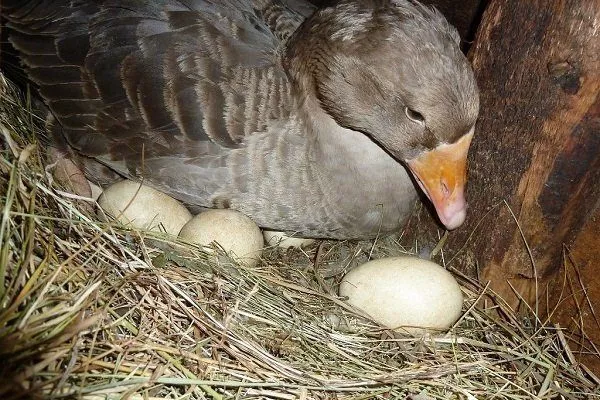
You can tell that your bird is ready to lay eggs by the following signs:
- a clear symptom of the beginning of the process is a drooping tail;
- the goose begins to show restlessness, cannot find a place for itself, and may rush around the poultry house;
- walks unevenly, swaying from one side to the other;
- is engaged in construction, plucking fluff from its chest, collecting straw and blades of grass, lining the nest with them.
If the eggs are needed for hatching, they are collected and then placed under the hen so that the goslings hatch at the same time. Storing these eggs in a cool place for up to a week is acceptable; storing them longer is undesirable, as the offspring may be weak and not viable. However, be prepared for the chicks to hatch one to two days apart, as even with the best efforts, the hen cannot ensure uniform heating for all the eggs.
When a farmer chooses natural hatching, the eggs are collected and placed with a hen, who incubates them for about a month. However, a hen can only hatch so many eggs at a time, with a maximum of 15. Artificial hatching is more practical for large-scale poultry production, and a special incubator is used for this purpose. In this case, the flock owner selects the eggs, candles them, cleans them of any impurities, and sets them in the incubator at a temperature of 37.8-38°C. With proper heating, turning, and maintaining adequate humidity, the goslings hatch in 30 days.
How many eggs does a goose lay?
Egg laying in geese is seasonal, and while there are exceptions, it most often occurs in the spring, generally occurring throughout five months of the year. Geese lay most eggs before 8:00 a.m. (60%), although they can lay before 6:00 p.m., but much less frequently. With a production rate of 30 eggs, a female may lay one egg at the end of February, 12 in March, 10 in April, and 7 in May. However, the number of eggs per month may vary among different breeds:
- The Toulouse hen produces 100 eggs in the first year, 140 in the second, and 120 in the third;
- Kholmogorskaya - in the first year - 100, in the second - 125, in the third - 160 pieces;
- Romenskaya - in the first year - 100, in the second - 125, in the third - 162 eggs.
There are breeds of geese whose egg production reaches its peak in the fifth year of life.
Although geese live for approximately 20 years, and females are used for approximately 6 years, keeping these birds as layers for longer is considered impractical, as their egg production begins to decline. Assuming an average egg production of 50 eggs per year, a geese can lay approximately 300 eggs during this period. Naturally, more prolific breeds can lay much more—up to 900 or more.
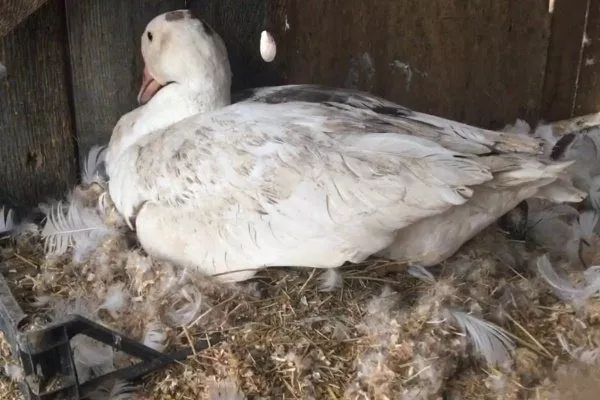
Goose eggs have white shells and weigh between 120 and 200 g. They can have two or three yolks.
Preparing the premises
The goose coop should be set up well in advance. It's best to have windows facing south or southeast, downwind from the living area. While the room should be bright, too many windows will cause overheating on hot summer days and excessive cooling in winter.
Furthermore, the building should not be erected on a site with a groundwater level greater than 2 meters above the ground, as it may be flooded during heavy rains or floods. For ease of feeding, the poultry house can be up to 1.7 meters high.
To prepare housing for laying hens, you need to:
- adjust the temperature – the most comfortable temperature for laying hens is considered to be from +20 to +25 OWITH;
- the floor of the room should be covered with sawdust and straw in a 5 cm layer;
- Usually there is one box with nests for three females, they need to be covered with warm cloth, if possible, it is better to keep the layers separately;
- the nests should be 50 cm wide and high, 60 cm long, with a 10 cm high edge at the front to prevent bedding and eggs from falling out;
- It is better to whitewash the walls, both external and internal;
- several trays with sand are placed in the room;
- It is desirable that the geese be kept in a separate building, away from other poultry;
- Gaps and cracks must be sealed, as drafts are unacceptable.
In warm, clear weather, geese are taken to meadows with lush, but not tall, grass, where each adult bird eats about 2 kg of grass daily. If the pasture doesn't provide enough food, the geese are fed additionally in the evening.
During hot weather, it's important to provide a shelter for the birds or move the hens into the shade of deciduous or fruit trees, where they can also find shelter from predators and rain. If a pond isn't available, provide a trough up to 25 cm high for the birds, and ensure it's constantly kept fresh.
Nutrition for good egg production
Birds are prepared for egg laying a month beforehand. To achieve this, their feed includes:
- oats, wheat and barley;
- legumes;
- oilcake, hay and greens;
- compound feed;
- root vegetables – beets, potatoes, carrots;
- animal feed (fish and bone meal).
- ✓ The ratio of grains in the diet should be 60% wheat, 30% barley and 10% oats to provide the required energy level.
- ✓ Adding fishmeal at a rate of 5% of the total diet improves egg quality and fertility.
Hay is harvested for winter and dried in dark, dry rooms. Bread, corn, boiled vegetables, beans, and peas are also added to the diet. Salt is essential for birds, and the daily requirement per bird is approximately 2 g.
Geese are fattened up, increasing the number of feedings to four times a day, alternating between wet and dry food. This is necessary to boost the bird's immunity and stamina, which directly impacts egg production. However, obesity is not allowed, so hens are checked by feeling under their wings – there should be no lumps of fatty tissue underneath.
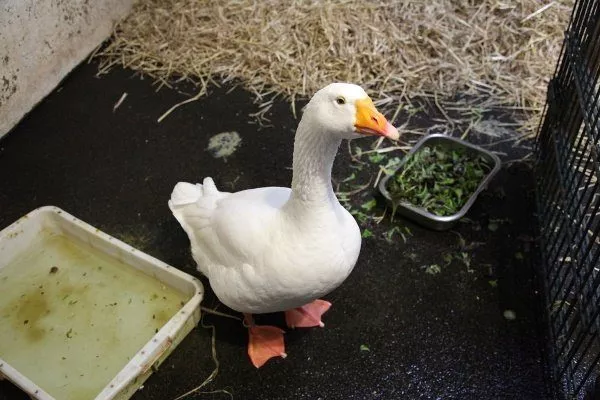
If geese are not laying eggs, the cause may be improper nutrition, which is causing problems in their bodies, or errors in the arrangement of the poultry house – temperature, light, and other parameters that are extremely important.
Winter egg-laying
To ensure that a goose lays eggs well in winter, it is necessary to create the most comfortable conditions for wintering and introduce an appropriate winter diet.
Poultry house arrangement
Durable wood or brick is used to construct a winter poultry house. During cold weather, the room temperature is maintained at no lower than 3-5 degrees Celsius. Ideally, 13-20 degrees Celsius is best. Geese are not afraid of the cold and are only kept indoors at night, during severe frosts, and in windy weather, but egg production increases in a warm room. Dampness, however, is harmful to them, so the air humidity should be maintained at 30%.
Special conditions are required for winter:
- the windows of the poultry house should initially be equipped with vents so that they can be closed at night during low temperatures and wind;
- the roof and floor are also additionally insulated;
- it will be necessary to provide artificial lighting, which should maintain the light regime for 13-15 hours a day;
- You can walk the birds in the yard, but first the walking area must be cleared of snow;
- For swimming, the birds are provided with an ice hole in shallow water, which is fenced with a wooden barrier or metal mesh to prevent them from diving; around such a pond, a straw flooring is made where the geese can lie down.
Birds should not have their paws cooled, as this can negatively affect their reproductive performance. Therefore, in winter, additional heating is used and the thickness of the bedding is increased.
Winter nutrition
Proper nutrition is essential in winter, and the farmer's most important task is maintaining the bird's weight, as it affects the geese's egg production not only in cold weather, but also in spring and summer.
Laying hens are fed grain, fresh hay, boiled root vegetables, sauerkraut, steamed chaff, and vitamin supplements. They are fed grain in the evening. Around February, meat and bone meal, chicken yolks, cottage cheese, and fish are introduced into the diet, and the grain intake is doubled. If grains are unavailable, they are replaced with soaked peas and boiled potatoes.
During the winter period, meals should be three times a day.
Helpful Tips
It is important to create suitable conditions for keeping geese, as well as to know the characteristics of this bird.
Some nuances will help to achieve high egg production of laying hens:
- It is not possible to allow two males to be present for one female - in this case, the ganders will be busy sorting out their relationships, throwing each other off and not allowing the goose to be trampled, and the eggs will remain unfertilized;
- Mating on water increases fertility several times, so if there is no pond nearby, you can put a barrel or a bathtub with water on the site;
- In order for a goose to hatch all her chicks, there should be no more than 12 eggs in the nest, but during this process she needs to be well fed and walked - about 20 minutes is enough for the bird to do this;
- You can tell which bird will be a good broody hen by the behavior of the female - when a person approaches, such a mother, although she raises her wings, remains in the nest;
- Free-ranging geese lay fewer eggs;
- The female can only incubate eggs in the nest in which she lays eggs, so it is not uncommon for a bird to refuse to incubate eggs when transferred to another location;
- During the brooding period, the ganders are not allowed near the geese, and the hens are separated by partitions so that they cannot see each other.
To ensure full egg production, geese require a balanced diet, rest, warmth, and free access to food and water. Given optimal living conditions, happy and healthy birds can achieve high egg production.