
Toulouse geese are extremely popular among farmers worldwide. This demand is due to the excellent taste of their meat and liver, as well as their low maintenance requirements and ease of care.
History of the breed's origin
Toulouse geese have spread throughout the world from France, where they originated. With great effort, breeders have succeeded in creating a wonder bird with excellent productivity. At the same time, they are also more cost-effective than almost all other birds of their kind.
For many years, French scientists have been crossing different types of geese in the hope of creating one that would surpass all other breeds and be in demand and favored by shepherds.
Years later, they finally succeeded in developing such a breed, which they named the Toulouse. It was derived from two breeds of geese, one of which was the common grey geese. After some time, Toulouse geese began to spread across Europe, Asia, and America. Eventually, Toulouse geese appeared in Russia, quickly becoming the most popular breed among farmers.
Description and characteristics of Toulouse geese
Let's take a closer look at this breed to understand how they differ from others and why they enjoy increased attention and love.
Appearance and physique
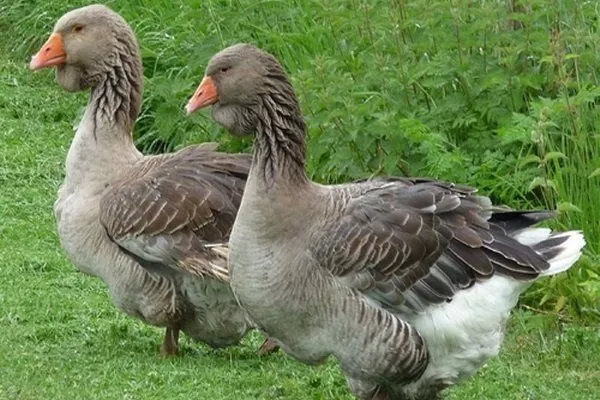
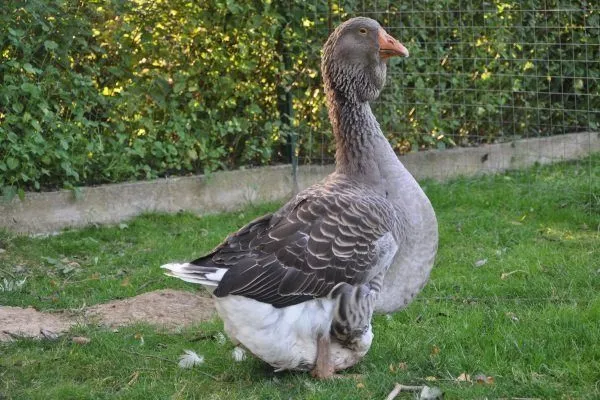
These birds possess distinctive characteristics that make them difficult to confuse with another breed. Tall, heavy geese have bright (young) and dark gray (adult) colors. It's also hard to miss their broad head, ending in a yellow-orange bill. The head appears flat. The body is massive and wide. They have strong limbs and a medium-sized, long neck.
The coloration can vary. It's not uncommon for the tips of the limbs to fade from gray to black. This can be seen on the neck and wings. Brown individuals occasionally appear—a very rare species. They've even been given a special name, "Buff-toulouse." Very few examples have been recorded among Russian farmers.
Geese are also classified by body type. Based on these parameters, they are further divided into four groups:
- Large folds of fat on the body, stomach, and a “wallet” on the neck near the head.
- With a "wallet", but without fat folds.
- Without a "wallet", but with a large fold of fat in the abdominal area.
- No "wallet" and no fat fold.
The first and second groups of geese are less prominent. They are sedentary and poorly fertile.
Weight indicators
Today, they are among the heaviest birds. This is because humans specifically selected only the most powerful representatives of the species—those that remain today. On average, ganders are heavier than geese, weighing up to 9-11 kg, with an adult weighing approximately 12 kg. Geese, on the other hand, are smaller—2 to 4 kg lighter, weighing 7-9 kg.
Geese grow at an exceptionally fast rate, making them popular with many farmers. They produce more meat and fat, and the fat itself accumulates quickly because the breed is sedentary. Farmers take advantage of this by specially fattening them.
Egg production
The breed's egg production is impressive. It depends on the goose's age. In the first year, she can lay up to 18-19 eggs. In the second year, she can lay 25 eggs. In the third year, she can lay over 40 eggs. The eggs themselves are strong, massive, with white shells. They can weigh 200-250 g.
Geese of this breed have a poorly developed maternal instinct, and are unable to guard their eggs. Therefore, when they lay eggs, they must be placed under geese of other breeds to incubate them. Or, if no other breeds are available, leave the egg in the incubator. Fertility is low; when raising young geese, about half of the eggs are fertilized. Survival rates are not high, averaging just over half.
Features of maintenance and cultivation
Warmth and dryness are the most important things in their care, as geese cannot stand cold temperatures at all, surviving only when favorable conditions are created.
- ✓ The room temperature should not fall below 20°C to ensure the comfort and health of the birds.
- ✓ Humidity levels should be maintained at no more than 70% to prevent diseases.
What should the room be like?
Geese are extremely heat-loving, and cold in the room will be a huge problem. Eliminate all drafts, cracks, and holes in the walls that will let in cold. The ideal temperature for keeping them is 20 degrees Celsius. Humidity levels shouldn't be too high, which won't have a positive effect on them either—no more than 70%.
Geese don't have very strong immune systems, so to strengthen them, the room needs to be cleaned daily and their droppings removed. The floor can be covered with a layer of straw or peat. The latter option is better, as it absorbs almost all moisture from the floor, but it must be kept dry at all times.
In winter and during cold weather, the layer should be deep—at least 25 cm. Before laying it down, ensure that it won't accelerate the growth of bacteria and pests. Use appropriate means to prevent the spread of bacteria (slaked lime). If infection has already occurred, use a decoction of chamomile, string, and other herbs. Bathe the geese in it every two weeks.
A small space is not recommended, and according to calculations, 1.5 square meters of space is required per flock. Allocate an additional half square meter for the room, as geese grow very quickly and need ample space. It is advisable to have several rooms in the area where you keep them. No more than 5-6 adult geese should be housed in any one room.
Winter maintenance
During the cold season there is a high risk of getting sick. goose diseases are much more difficult than in humans, so the diet must be rich in vitamins and nutrients, organic and mineral substances.
The bedding should be thicker and warmer. Avoid moisture in the room, just as during the warmer months. Monitor the temperature in the room where the geese are kept. Remember to follow sanitary rules: remove dirt and droppings from the room once a day.
Walking should still be a part of the birds' lives, but not for as long as in summer and spring. Take geese outside for an hour or two at a time—maximum. Before taking them outside, sweep away all snow, otherwise they risk frostbite and illness. Keep a close eye on them while walking, as the breed's immune system is weak.
Walking and water procedures
To ensure proper development and a strong immune system, geese need to be walked daily, preferably several times a day. Access to sunlight and fresh air is essential, and it's best to have a body of water nearby.
Geese of this breed need to be watered three times a week. There are cases where geese didn't need water at all, but in most cases, water has a positive effect on their health, albeit not significantly.
Breeding
During the egg-laying season, the goose is inactive. This period begins in early March (late February), and the goose incubates a new egg once a day, usually in the morning. A total of about 40 eggs will be laid per year.
Toulouse geese are completely lacking maternal instinct. They are unable to protect, care for, or incubate eggs. They do absolutely nothing to promote reproduction. In this case, two methods can help: either place the egg under a goose of a different breed, or use an incubator.
The incubator method is more popular, as it allows the eggs to hatch faster and, in some cases, even increases the fertility rate. You can also place the eggs under a goose of a different breed. While this may not be faster, it will allow you to increase your goose population much more effectively.
For goose breeding of this breed, it is worth following the following tips:
- It is essential to maintain the thermal conditions necessary for the geese to live.
- Constantly monitor the geese. You must keep an eye on them and immediately place the hatched eggs in the right place—an incubator or another goose. You can also use other birds for this purpose; chickens, for example, are suitable.
- Do not disturb the incubation period by leaving the eggs and the goose alone.
- Good lighting in the room, incubator.
- Balanced groundbait for geese.
- A special food used for new chicks.
The chicks gain weight very quickly. Compared to their adult life, they gain more weight while still chicks. By nine months, they weigh 4 kg.
After birth, they will need to be fed frequently—seven times a day. They should be fed only wet food. Chopped greens are excellent. This will continue for six weeks. After that, they will be fed three to four times a day, and then gradually transition to adult feeding.
From one week of age, you can start taking the goslings outside, but only in warm weather and for short periods of time—30 minutes. The time spent outside will increase as the goslings age. After a month, you can allow the goslings near a pond, but only in warm water—at least 17 degrees Celsius.
What to feed geese
The diet should be varied and nutritious, properly formulated, and appropriate for the birds' age. Include vitamin-rich and high-quality foods in the diet, as these will influence the goose's overall appearance.
Adult herd
Geese feed at two times: morning and evening. In the morning, they eat much less than in the evening. Many prefer to feed in the pasture in the morning.
Grain crops are the most suitable for feeding. Among them are corn, wheat, and others. Birds will also happily appreciate vegetables, especially cooked ones.
The quantity of food isn't as important as its mineral and vitamin content. Pay attention to these nutritional factors, as they affect the goose's health and the future flavor of its meat.
Geese should always have access to clean water. Equally important is a proper waterer, which should be selected based on the characteristics of the particular species. Preferably, it should be oblong (or rectangular).
- ✓ During the first days of life, feed the goslings with starter feed with a high protein content (at least 20%).
- ✓ Introduce greens into the goslings’ diet from the 3rd day of life, starting with finely chopped nettles.
Goslings
In the first period, after birth and the following weeks, feed the goslings Goslings need to be fed 7 to 8 times a day. The diet should be rich in vitamins and consist of food specially prepared for goslings. With each passing week, reduce the number of feedings by 3 to 4 times.
Up to one month of age, you can feed them wet cereals, wheat bran, and cooked vegetables. Young birds will also appreciate boiled eggs with some greens. After 40-50 days of age, you can gradually introduce whole grains (corn, wheat) into their diet.
Use greens in your diet every day – fresh or dried.
Advantages and disadvantages of the Toulouse breed
Most farmers love the breed for its many positive qualities, including:
- high growth rate;
- weight gain;
- quality of down and feathers;
- fat reserves;
- a delicacy in the form of a liver;
- early maturity, especially geese with "purses";
- Egg production – 40 eggs per year.
The described breed has the following disadvantages:
- low survival rate of young birds;
- high temperature requirements;
- high food requirements;
- low mobility;
- low percentage of egg fertilization.
Watch the video below for an overview of the Toulouse goose breed:
Reviews
Toulouse geese are an excellent choice for any farmer with some experience. Keeping Toulouse geese doesn't require a lot of financial investment or attention.