
Tula geese are bred not only for their meat delicacy but also for entertainment, as they possess excellent fighting qualities. These birds are also easy to care for and breed.
Origin of the breed
This breed is considered a fighting bird. It is believed that Tula storks emerged several centuries ago in response to the demands of wealthy individuals seeking entertainment by watching bird fights. The strongest and most ardent "fighters" were selected for further breeding, and this is how this breed was developed.
The origin of the name of these geese and why they are specifically called "Tula" is unknown. It is believed that goose fights were widespread and successful in Tula and the surrounding regions.
Description and standards of Tula geese
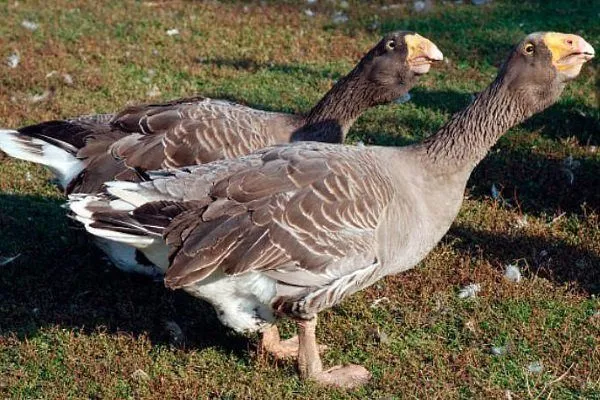
Visually, Tula storks are distinguished by their broad chest and robust build. These birds' sturdy legs are spread wide, and their strong, well-developed wings are held close to their bodies. Their heads have a broad forehead and a massive but small beak. Their necks are short and thick, and their eyes are steely or black.
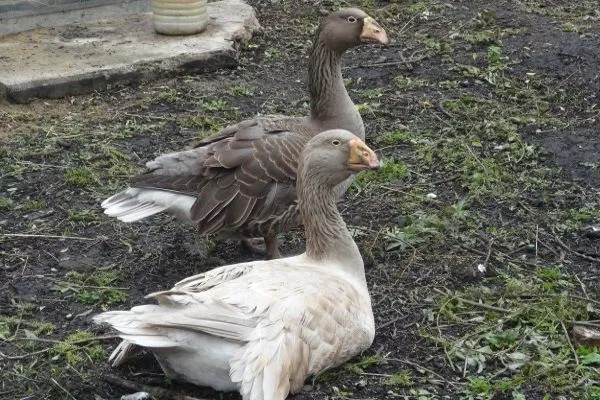
The plumage of these birds can be gray, whitish, or clayey. The latter have a light-brown head and a similar neck, chest, and back. The belly of geese is whitish, and the tail is lighter than the rest of the body.
Gray Tula geese typically have bluish or shiny black plumage. Their tails are grayish, sometimes whitish, and their underparts are white. Young ganders and geese have lighter plumage than adults.
When breeding these geese, poultry farmers ensure that they do not have the following defects inherent to this breed:
- red eye;
- beak and eyelids are orange;
- double fold in the abdominal area;
- hump on the back;
- inverted wings;
- crop just below the beak.
Types of geese by beak shape
| Name | Weight of an adult (kg) | Number of eggs per year | Aggressiveness |
|---|---|---|---|
| Straight-nosed | 8-9 | 25 | High |
| False-nosed (horned) | 8-9 | 25 | Very high |
| Steep-nosed | 8-9 | 25 | Average |
Due to their humped nose, Tula scaly-nosed ...
- straight-nosed – a rare type of the Tula breed, these birds have a straight beak, without a hump;
- horned (horned) – the upper contour of the bird’s beak appears concave, and yearlings also have small horns near the beak;
- steep-nosed – the upper contours of the beak are convex, which creates the impression that the beak and the goose’s head are located on the same level.
Characteristic qualities: pros and cons of the Tula breed
The undoubted advantages of fighting geese include:
- strong immunity;
- endurance;
- unpretentiousness in food;
- simple content;
- tasty meat;
- the opportunity to organize "bloodless" bird fights (compared to rooster fights, goose slaughter looks quite harmless).
For those who want to raise Tula geese, it is useful to know the disadvantages of this breed:
- slow weight gain – geese mature only in the 2nd year of their life;
- small body size;
- low egg laying rate;
- A belligerent nature, which makes it difficult for such geese to get along with other domestic inhabitants of the yard - males aged 4 years are considered especially dangerous.
The characteristics of the Tula breed of fighting geese are presented in the following video:
Weight indicators and productivity
The heaviest male weighs 10-11 kg, while the heaviest female weighs 9 kg. The average weight of male ganders is 8-9 kg, while that of female geese is 6-7 kg. As for eggs, female geese do not lay more than 25 eggs per year.
Purpose
Today, Tula geese are most often used as poultry, raised for meat. However, thrill-seekers still stage various spectacles, including bird fights. The fighting breed of geese is ideal for this purpose.
For food
The meat from Tula geese is exceptionally tasty. It's tender and juicy, with layers of fat evenly distributed throughout the bird, which is essential for gourmets who enjoy this delicacy.
Use in combat
Those looking for a bit of fun can use Tula geese to participate in bird fights. They're less scary to watch than roosters, as the fights don't draw blood. Supporting geese can include both the owners themselves and the geese, who are within view of the battling ganders.
Males fight using their wings. They use them to attack and defend themselves. Grabbing a wing with the beak is permitted. However, repeatedly biting the head and feet of another goose is prohibited. If this occurs, the goose engaging in such fighting is disqualified from the competition.
Males between 3 and 6 years of age are considered the most aggressive and powerful—at this age, their wing flapping is very powerful. Typically, ganders try to strike at the junction of their opponent's neck and body.
A fight typically lasts between 20 and 40 minutes. The bout ends when one of the fighters surrenders and leaves the battlefield. The winner is the goose that survives and fights off the resistance. Males with a high pain tolerance often win.
What conditions are required for maintenance?
These birds are not afraid of the cold and have strong immunity to diseases. However, it is essential to provide a warm roof over their heads and a spacious area for them to roam.
Please observe the following conditions when keeping fighting geese:
- Let the geese out for walks every day - nearby meadows, marshy areas or ravines are suitable for this purpose (start grazing when the chicks are already week old);
- If there are no natural pastures nearby, plant a variety of perennial grasses and cereals in an artificially created area for grazing;
- Waterfowl need water sources, but if there is none nearby, place a small trough of water in the yard so that the geese can bathe;
- provide the birds with a warm room with an internal temperature of at least +10 degrees - put a straw-peat litter on the floor of the room (in summer, sprinkle the floor with sand or sawdust);
- in the fall, before laying the flooring, treat the floor of the poultry house with lime;
- change the bedding in the area where the birds feed once every 5 days and once every 10 days where they sleep;
- Build a separate goose house for the chicks - cover wooden slats with mesh and cover with roofing felt.
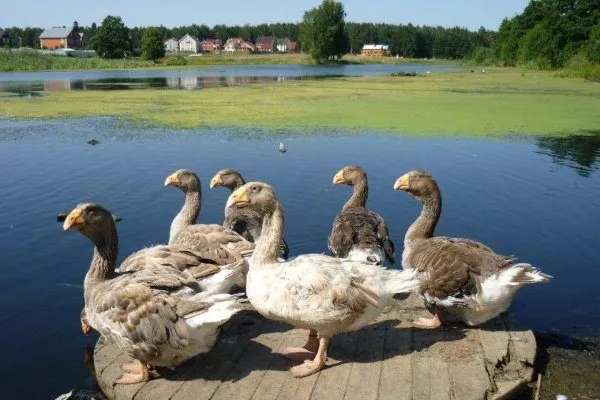
Calculate the yard area and the floor space based on the number of birds and their age. Young birds need at least 1 square meter per goose, 2-month-olds 5 square meters, and adult birds 15 square meters.
Nutrition: characteristics, norms and diet
Game geese are undemanding when it comes to food. During daily walks or swimming in ponds, the birds can feed themselves by foraging for food. However, they also need to be fed at home.
- ✓ Adding sprouted grains to your diet increases the absorption of nutrients.
- ✓ The use of fermented feed reduces the risk of gastrointestinal diseases.
Nutritional characteristics of Tula birds:
- Feed the birds three times a day (in winter, reduce feeding to 2 times), change the water once a day;
- feed the birds with cereal crops - millet, corn, oats (young geese need about 100-150 g, and adult geese - 80 g);
- Replenish vitamin deficiencies in winter with wet mixtures of grated beets or carrots, cabbage leaves - give young geese 200 g of these products per day, for adults increase the daily norm to 500 g;
- add shells and chalk to the feed (young goslings need 5 g per day, with the norm gradually increasing with age), table salt (1 g per day), as well as vitamins and minerals (20 g for young and 30 g for adult birds);
- If the birds are not released into the wild, feed them with wet mixtures, adding bone or fish meal (approximately 2 g for young birds and 3 g for adults), feed the birds with fresh small fish and other food that contains animal protein.
Be careful with wheat. Feed it sparingly, as overdosing on it will cause rapid obesity and reduce hatching rates. Avoid feeding geese rye and vetch.
Feed the chicks boiled egg yolks and finely chopped young onions. Then gradually introduce grass and wheat or cornmeal porridge with mashed potatoes into their diet.
Breeding Tula geese
Follow these guidelines when raising fighting geese:
- form goose families from the moment the birds are 8-10 months old - while choosing the healthiest geese, based on the calculation of 1 gander for 2-3 geese;
- Maintain a room temperature of around +20 degrees during egg laying and provide access to fresh air;
- adult females begin to lay eggs at the end of winter, and young ones - a little later, a few weeks (if you need to postpone the egg-laying period, artificially limit the daylight hours for the geese);
- leave no more than 13 eggs for incubation with one goose, so that she does not accidentally crush them;
- After a week, remove all empty eggs and replace them with eggs containing embryos from other hens - this will allow some of the geese to be freed from incubation;
- in another 7 days again egg-laying begins – it is important to isolate the males from the females, otherwise the geese may stop laying eggs;
- The chicks begin to hatch after about 28 days - transfer them immediately separately and only bring them to the mother in the evening (one goose can take in no more than 20 chicks);
- maintain the temperature at +20…+22 degrees for chicks;
- When the goslings are a week old, start letting them outside – at first, no more than 30 minutes at a time, then increase the time (while making sure that the babies don’t walk in the dew and don’t get too cold).
The average price of an adult Tula bird, its goslings and eggs
Tula geese can be purchased individually or in large groups. However, it's best to buy birds from farms or nurseries that offer the best possible conditions for raising Tula geese.
The average prices are:
- adult goose – 2-3 thousand rubles;
- goslings aged 2 months. – 300-360 rub.;
- eggs from the incubator – from 70 rubles per piece.
Reviews
Tula geese are prized for their delicious meat and excellent fighting ability. Poultry farmers also appreciate these birds' undemanding diet and strong immunity to disease, making them particularly advantageous for keeping and breeding.