
The Linda goose breed appeals to every poultry breeder, as these birds possess a wealth of positive qualities. Goose food is dietary and easily digestible, and the bird's liver is rich in vitamins and has a piquant flavor. Under ideal conditions, a goose will lay 100 eggs per year.
Origin of the Lindovskaya (Gorky) breed
Originating in the Nizhny Novgorod region, breeders sought to create profitable birds that could withstand a variety of conditions. The scientists decided to use Chinese geese as a parent breed, crossing them with Solnechnogorsk, Adler, and Arzamas breeds. This crossbreeding helped improve Linda's early maturity and increase her endurance.
However, after extensive crossbreeding, the down quality was poor, and weight gain was very slow. The breeders decided to cross the resulting specimen with Lander geese. The resulting bird met all the scientists' expectations, so no further work was carried out.
The breed standard was approved in 1994.
Often referred to as the Gorky breed, these birds quickly became a leading breed among poultry farmers. Approximately 60% of breeders prefer this breed. Lindas are also in demand in Hungary, France, and Germany.
Description of the breed
The main distinguishing characteristics among other breeds of geese – rapid weight gain, decorative appearance and large dimensions.
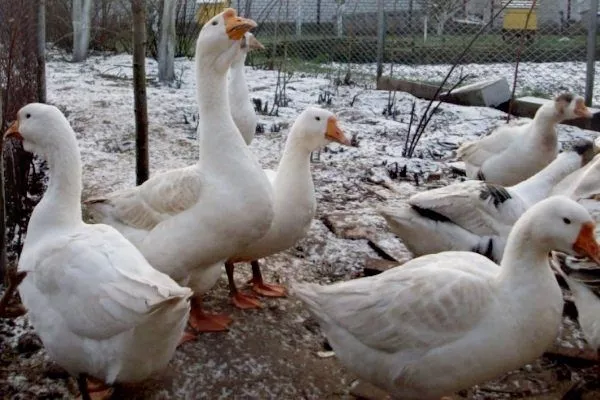
Lindov geese have white plumage without any inclusions.
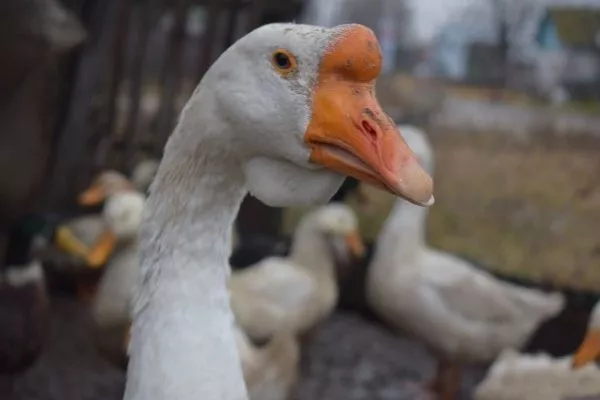
A Linda goose will definitely have a large bump on its forehead. By 7 months, it should already be there.
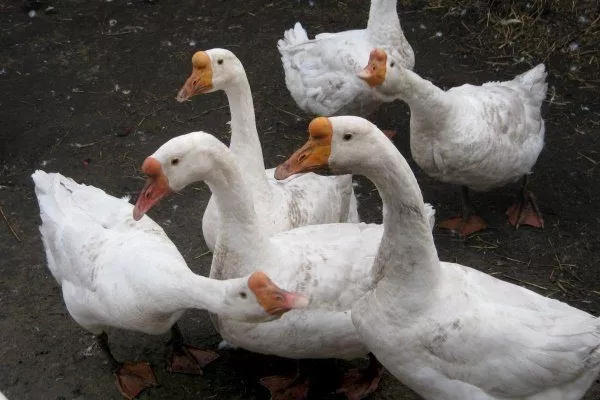
Lindov geese have long necks. They also have a small bump on their foreheads.
Appearance
Gorky birds have a unique appearance. They are considered meat-producing birds, and therefore have a corresponding size.
The main characteristics of Linda geese:
- the head is proportionate to the body, strong and large;
- the beak is red in color, large, strong, and a bump forms at the junction with the head;
- eyes are dark in color, small;
- the neck is large and long;
- the body is massive;
- the back is big;
- the tail is small;
- paws are large, set wide apart;
- dark orange skin;
- plumage is white, grey spots are allowed;
- thick fluff;
- The female weighs 7 kg, the male – 8 kg.
Temperament
Linda geese, inherited from their ancestors, boast a wonderful, peaceful disposition. They are very sociable and kind, and get along well with other breeds of geese and birds. They are known for their activity, agility, and curiosity.
Individuals of this cross are happy to run, make noise, and fly. Males rarely fight, but they may engage in combat with other birds if someone offends their females. These birds are friendly not only to other birds but also to people.
The instinct of incubation
Maternal instinct is not inherent in females. They either don't sit on the eggs at all or abandon them after a short time. However, some poultry breeders claim the opposite—Lindova geese are excellent brood hens and wonderful mothers. Scientists have yet to understand why some claim one way and others the opposite. In any case, it's best to use an incubator.
Linda geese boast excellent genetics, which is why the survival rate of young animals reaches 90%.
Weight indicators
Males weigh around 8 kg, but some Linda birds can reach 11 kg, depending on how they are cared for. Adult females weigh slightly less, around 7 kg. Regarding the taste of the meat, the birds have a thin, even layer of fat, with protein content of around 20% and fat content of 6%.
At the age of 3 months, goslings gain about 50% of their weight.
Productivity and egg production
Sexual maturity occurs earlier than egg production. Birds are sexually mature at 8 months, but they begin laying eggs at 9-12 months. During the first year, a female lays approximately 50 eggs, with the number increasing each year. Initially, the egg weight reaches 0.1 kg, later increasing to 0.16 kg. Egg production is not year-round, but seasonal—from February to early July.
Watch a video review of the Lindov breed of geese:
Advantages and disadvantages
The Linda breed, like other birds, has a number of advantages and disadvantages that must be taken into account when breeding birds.
Pros:
- Cold resistance and hardiness. This breed can be bred in any region; these birds can withstand both extremely cold and hot days.
- Rapid weight gain. With proper care, a hen can reach 7 kg by 5 months, increasing to 11 kg by 1 year. Maximum weight can be expected, but the tastiest meat comes from a hen weighing 6 kg.
- High egg production. With proper care, hens lay one egg per day, meaning they remain egg-laying throughout their entire production period.
- They do not have any genetic diseases, so the survival rate of young animals is approximately 90%.
- Friendly nature. These birds are non-confrontational, get along well with other birds, and can be housed in a common area.
- High profitability. The return on investment for these poultry exceeds 100%, thanks to their low food and energy consumption.
- High-quality goose liver. When fed in a specific diet, goose liver is suitable for making foie gras.
Cons:
- Breeding geese without access to water is difficult. Without a body of water, raising a flock is possible, but the value of the product will be significantly reduced.
- Goslings are at risk of contracting hymenolepiasis. To prevent this, you can add seaweed to their food.
- Susceptibility to vitamin deficiency. Lindov breeds often suffer from a lack of essential vitamins in early spring. To prevent this, supplement their diet with nutritional supplements and fresh grass.
- Excessively loud behavior. Geese communicate very animatedly with each other, their noise can be heard throughout the area.
Conditions of keeping and growing
To ensure high-quality meat products, it's essential to adhere to basic poultry husbandry guidelines. The premises should be spacious—at least 1 square meter per bird.
Food and water containers are installed in the enclosure. Nests are also necessary, and the ratio is one nest per four birds. The room temperature should be maintained at around 10 degrees Celsius. This breed quickly adapts to cold temperatures, so temperatures at this level will not negatively impact the birds.
The floor covering plays an important role. It is made from bedding, which can be straw or peat. It is laid in a layer of 0.05-0.1 m. Daylight hours for good goose egg laying – at least 12 hours. Lindas require a large area for exercise; in the summer, they may even sleep outside.
Feeding
A proper diet is the foundation for the birds' healthy development. Linda's geese's diet varies not only depending on the birds' age but also depending on the season.
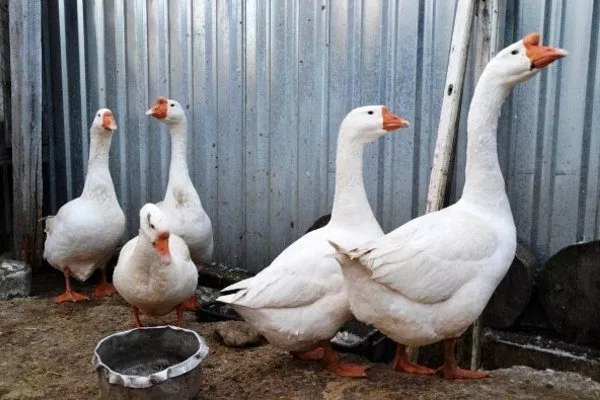
Adults
In summer, when geese are walking on the grass, they can enjoy the food lying under their feet. In the evening, they can be given mixed feed (0.15 kg per bird). If the birds are unable to forage for food themselves or are unable to reach a pond, fish meal or bone meal can be added to their diet. Containers with chalk and shells are essential.
In winter, the diet consists of grain, grated vegetables, boiled table scraps, and greens. Birds must have access to fresh water. In winter, birds drink little, using snow for water, but their water bowls should still be filled.
Young animals
At first, the chicks' diet consists of crushed egg yolks diluted with boiled water. On the fifth day, this food is replaced with cottage cheese and finely chopped herbs are added. Chicks respond well to bread. Despite the nutritional value of greens, geese don't tolerate them very well, so don't overdo it with herbs.
At 10 days old, young birds eat corn porridge and boiled potatoes. At three weeks, the menu is supplemented with chopped vegetables and root vegetables. After that, they can begin to eat food that grows underfoot. A sudden change in diet can lead to obesity or malnutrition. New foods should be introduced gradually, and their amount should not exceed 15% of the total diet.
More information about feeding goslings from the first days of life is available in this article.
Care
Caring for geese requires creating the right conditions. First and foremost, a warm, windless coop is essential, and secondly, a pond is essential. It's also important to monitor the quality and quantity of feed.
Breeding
Geese consume large amounts of feed, so they should be slaughtered when they reach 5 kg in weight. Only those valuable for future breeding should be retained.
Despite the high cost of breeding birds, Linda is highly profitable, with a single carcass yielding approximately 80% meat.
The breeding season begins in the last week of February and continues until early summer. During this period, the female can lay one egg per day. The eggs are collected and stored at a temperature of 5°C (up to 12°C). During storage, the eggs are turned once a day.
The first two eggs are unfertilized, but they are not removed from the nest so that the female does not leave it.
Raising goslings
Newborn chicks are left near their mother until they are completely dry. After this, the chicks are removed, their umbilical cords are cauterized with iodine, and they are moved to a separate coop with a temperature of at least 27 degrees Celsius. The chicks require 24-hour light for 10 days. Then, the amount of light is reduced to 16 hours, and by three months, to 14 hours.
- ✓ Optimal room temperature for young animals: +27°C for the first 10 days, then gradually decrease.
- ✓ The need for round-the-clock lighting for goslings in the first 10 days of life.
Birds should not be allowed outside until they are 1.5 months old. They are kept in an enclosed area with a bathing trough. Chicks are only allowed outside when they are over 50 days old. This regimen is important for salmonella prevention.
Until almost two months old, the young are very timid; loud noises should be avoided around them. Handling them should be done very politely and affectionately.
A breeder talks about mistakes in goose breeding in the following video:
What illnesses do Linda geese have?
These birds are susceptible to illness just like other goose breeds. Diseases are especially serious if they are improperly managed. The main preventative measures are regular cleaning of the house, vaccinations, and proper placement of the birds within the coop.
- ✓ Stress markers: decreased activity, refusal to eat.
- ✓ Signs of vitamin deficiency: dull plumage, weakness.
Before introducing the goslings, the room is thoroughly cleaned and disinfected. The bedding is changed, and the walls and ceiling are whitewashed. On the second day after birth, the goslings are given a weak solution of potassium permanganate and glucose to drink. This procedure helps boost the young animals' immunity.
Goslings are vaccinated against viral enteritis at the first week of life. To prevent salmonellosis, they are fed with a tylan-containing product every three months.
When it occurs goose disease in an individual, it is transferred to a separate room, and mandatory treatment is carried out in the poultry house to prevent further development of the disease.
Reviews
Their breeding potential, excellent productivity, and lack of special care and feeding requirements undoubtedly make these birds one of the best goose species. Both experienced and novice poultry farmers can care for them.