
Large Gray geese are a meat-and-fat breed. They are popular not only among producers but also among private farm owners due to their ability to quickly gain weight and their ease of care and feeding.
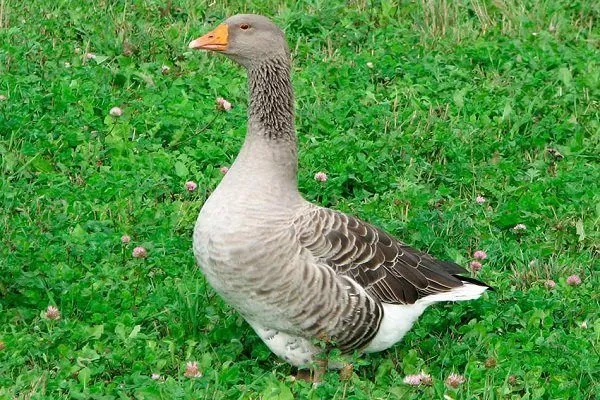
A large grey breed of goose
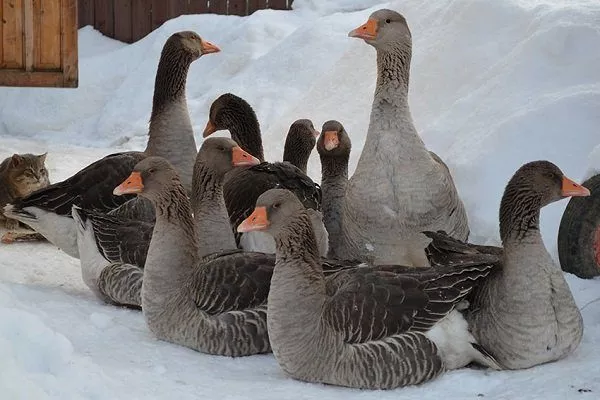
Large grey geese gain weight quickly.
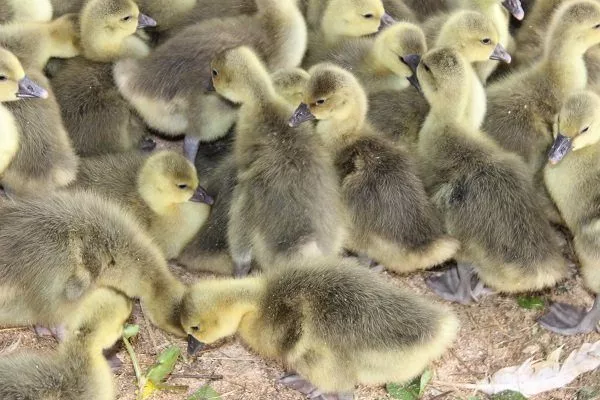
One goose can hatch up to 15 chicks from eggs.
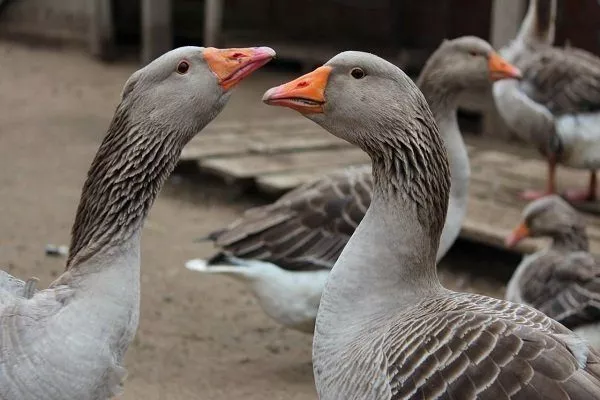
The large grey breed has an orange bill with a pink spot on the tip.
History of the breed
At the beginning of the last century, a new breed of goose, the Large Gray, was developed in Ukraine by crossing Romenskoy and Toulouse geese. The Toulouse breed is very easy to care for and has a high vitality. These birds gain weight quickly and are prized for the high quality of their meat.
The primary goal in developing the new breed was to increase the weight of the Toulouse variety while maintaining its original characteristics. The first experimental group was named Borkovsky.
During World War II, the birds were evacuated to Tambov, where breeders continued improving the geese. This is how they achieved the appearance of the Large Greylag Goose.
Description and standards of large greylag geese
To avoid making a mistake when purchasing geese of this breed, study the standards that individuals must meet:
- head is small in size;
- wallet and pine cone are missing;
- the beak is orange with a pink spot on the tip;
- neck of medium length;
- massive build, with protruding pectoral muscles;
- there are two folds of fat on the wide belly;
- Sturdy paws of bright orange color;
- The colour is predominantly grey, with light areas on the chest and white underparts.
Females are slightly smaller than males and have a more fragile body structure. Males typically weigh up to 7 kg, and when fed concentrated feed, they can reach 9.5 kg. Female geese weigh up to 6.5 kg on average.
Developmental defects
If you are planning to buy geese of this breed for further breeding or are choosing individuals from your geese for breeding, you need to examine them carefully.
Acceptable deficiencies in selection:
- the border at the base of the beak is white;
- flight feathers not grey;
- the pattern on the back and wings is blurred and does not look like “scales”;
- There is one fold of fat on the stomach instead of two.
If, upon inspection, you discover a purse under the beak or a lump on the forehead, the bird should be rejected. Also considered unacceptable are a small, pointed, and high-set chest and a poorly developed belly fold.
Pros and cons of the breed
The large greylag goose is considered one of the most successful breeds. Breeding these birds offers the following benefits:
- Easy to care for. Greylag geese are very undemanding in their diet, which significantly reduces their maintenance costs. They don't require a pond for breeding. They thrive indoors.
- Trouble-free offspring. Although these birds' egg production is average (around 40 eggs per season), their offspring are very viable, with 75% of chicks surviving. You won't have to care for the clutch or the young; the geese are excellent at this themselves. Furthermore, females lay eggs until they're 5 years old, compared to 3 years for the Toulouse breed.
- Fast results. The young grow quickly and by 9 weeks, they already weigh 5 kg. These birds are highly prized for their ability to produce livers, which can reach up to 400 g.
- Down and feathers during life. These birds can be plucked twice a year. The down and feathers of the large grey geese are very dense and are in demand for outerwear and underwear.
Another drawback may be the rather loud cry of geese, which they use to communicate.
Conditions of detention
These birds are relatively easy-to-care-for and frost-resistant, but that doesn't mean they require no care at all. To ensure your geese continue to produce high levels of eggs, and to ensure your young gain weight quickly and stay healthy, follow these tips:
- It is important to provide the geese with a dry and clean habitat to prevent goose diseases and reduce feed costs. After all, when a goose's feathers get wet, it loses heat faster and eats more to stay warm.
- It's best to designate a wooden or clay concrete enclosure for the birds, as long as it's draft-free. The floor should be raised at least 20 cm from the ground to prevent the bedding from getting wet.
- Sand and sawdust are excellent bedding in the summer, and straw in the winter. To improve warmth, add superphosphate (200 g per square meter). This also reduces ammonia emissions from poultry droppings. This bedding also serves as an excellent fertilizer in the spring.
- Bedding should be prepared in advance, at a rate of 40 kg per individual. For young birds, 7 kg of bedding material is sufficient. Straw nests with cardboard or wooden fencing should be built in the room. Feeders and waterers should be long and low.
- Although this breed of geese doesn't require a pond, they'll appreciate regular baths of clean water during the summer. The water should be changed frequently and kept clean. Polluted water can make geese sick. Therefore, stagnant ponds are also not suitable.
- If there are no trees in the yard under which geese can take refuge from the scorching heat, then it is necessary to equip a canopy for this purpose.
For an overview of the large greylag goose breed, including information on keeping and feeding them in the summer, watch the video:
Feeding rules
If you want your bird to gain weight quickly, you need to pay close attention to its feeding. Although large greylag geese aren't picky eaters, there are several techniques that will help you raise your young as quickly as possible.
Summer nutrition
To reduce costs during the spring and summer, pasture management is recommended. If you have a suitable meadow and pond nearby, feeding the geese once a day, morning or evening, is sufficient. Typically, this feeding includes legume and cereal silage, bran, fresh grass, and chopped root vegetables.
If geese are fattened for the purpose of increasing meat or liver, the supplementary feeding must include granulated feed and fatty products.
Winter nutrition
In winter, birds are fed three times a day. Succulent feed is given primarily in the morning, and dry feed in the afternoon. Succulent feed includes silage and root vegetables, which are boiled before consumption.
Dry feed includes legumes and grains such as wheat, oats, barley, corn, and peas, both crushed and whole. Hay is also fed. Geese eat the softest parts of it, and the remainder can be used for bedding. Dried leaves, collected in the summer, are soaked, crushed, and added to the feed. Dry branches are steamed and placed in an accessible place in the coop.
Throughout the year, it's recommended to provide the birds with vitamin supplements, and add chalk and gravel to separate feeders to improve digestion. Clean water should always be available in the waterers. Salt, bone meal, and duckweed (fresh or dried) can be included in the diet.
Reproduction
In the wild, most geese are monogamous, so when breeding this bird, keep in mind that there should be no more than 2-3 females per male. When initially forming a flock, it's best to leave more males, as the females may not accept all of them. Rejected birds should be removed from the flock and slaughtered. If such a goose is left behind, it will eventually die.
The advantage of the Large Grey Goose breed is that they are excellent brood hens. Incubation lasts 28-30 days. To ensure healthy offspring, a few rules must be followed:
- In February, a separate nest with high walls is built for each goose in a location where no one will disturb her. They are taken out to feed one at a time.
- The temperature in the place where the geese are kept is maintained at around 12-16 degrees, and daylight hours are extended by artificial lighting to 14 hours.
- Before laying eggs, geese are given more protein to boost their reproductive function. During laying and brooding, they are given fermented milk products and soy to meet their calcium needs. Failure to do so may cause the goose to peck at the eggs.
- Laying begins in March. This breed lays eggs every two days. They can be collected and kept in a cool place for later incubation.
- ✓ Eggs must be fresh, no older than 7 days.
- ✓ The egg size should be average, without deformations.
- ✓ The shell must be clean, without cracks or damage.
Read on to find out how to distinguish a gander from a goose. next article.
Raising chicks
In April, with proper care and good nutrition, a goose will hatch up to 15 chicks from her eggs. The main thing the owner must do is not to stress the bird out and not actively interfere with the rearing of the young.
- ✓ The temperature in the room for goslings should not be lower than 28°C during the first week.
- ✓ It is necessary to ensure constant access to clean water.
- ✓ Lighting should be on 24 hours a day during the first few days, then gradually decrease.
In the first week of hatching the chicks are being fed A ground mixture of corn or wheat with the addition of a boiled egg or cottage cheese is fed. Then, finely chopped boiled root vegetables and pulp are introduced into the diet. It is important that the prepared mixture is moist but crumbly and does not clog the nasal passages in the beak.
During the first two months, goslings experience active growth. For full development, they need to eat approximately 2-2.5 kg of grain and up to 6-9 kg of green fodder per kg of body weight.
If you're raising poultry for slaughter, it's best to keep them in a pen. Their diet should consist primarily of concentrated feed and greens.
At four months, geese gain sufficient weight and begin to feather. Further rearing is only advisable for breeding.
The following video shows how a large grey goose hatches its chicks:
Where to buy and what is the cost?
Large Gray geese are quite popular. They tolerate cold well and crossbreed successfully with other breeds, which is why they have spread throughout Russia.
These birds can be purchased from specialized nurseries.
Prices vary widely from producer to producer, especially for adult birds. Hatching eggs can cost between 100 and 150 rubles. A one-day-old chick costs between 160 and 400 rubles. Adult birds sell for between 800 and 2,000 rubles.
Reviews of the Large Gray Goose Breed
Reviews of this goose breed are positive. The bird's low maintenance makes care easy and quite economical, and the results are pleasantly surprising. While acquiring a Large Greylag goose was quite difficult in the early 2000s, today more and more breeders are breeding them, and many people are acquiring Greylag geese for their own farms.