
Kholmogory geese are among the best meat-producing birds. These hardy and viable birds have a robust build and a non-aggressive nature. They thrive in any region, but perform best in warm climates.
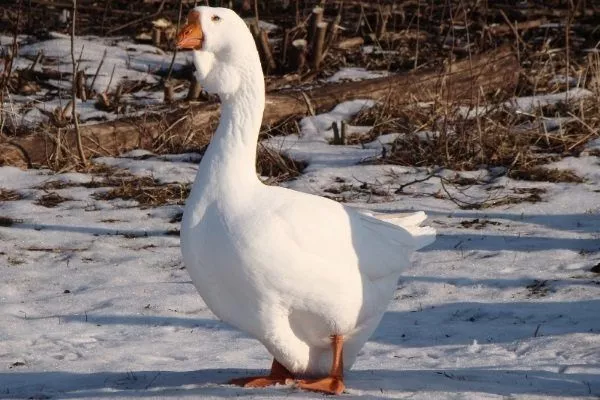
White goose of the Kholmogory breed
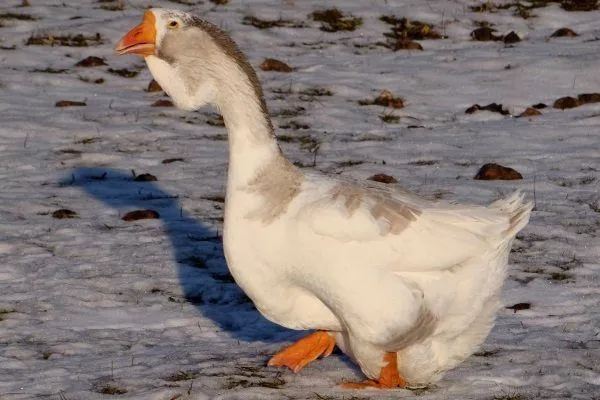
Kholmogory goose is grey-white
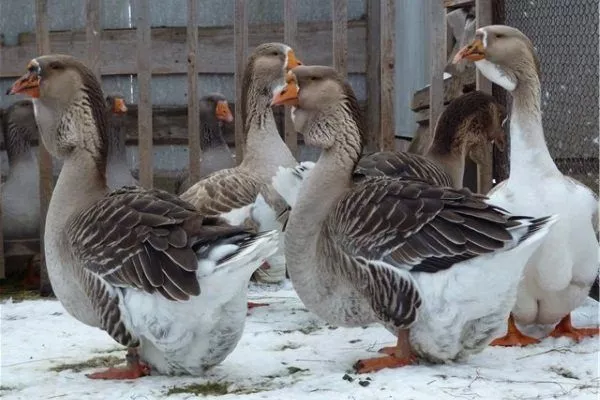
Greylag Goose Kholmogory
History of the breed's origin
Originating in the village of Kholmogory, Arkhangelsk Region, in the 19th century. Their ancestors are Chinese and Arzamas geese. Previously, Kholmogory geese had several varieties that differed significantly from each other, but over time, all distinctions faded.
Kholmogory geese are one of the oldest breeds of geese in Russia. It's easy to distinguish them from others—they have a beard hanging under their noses. In the 19th century, this breed was much loved; poultry farmers bred them on their estates, and some used them in hatcheries for commercial breeding.
Today, demand for these birds has decreased, and Kholmogory geese can only be found among hobbyists, despite their excellent production characteristics.
The decline in goose numbers occurred for several reasons. The Kholmogory breeding program was intended to produce geese for fighting, which required them to be very large and strong. Low hatchability of young also contributed to the decline.
Breeders sought to improve the geese's performance and began crossing them with other breeds. As a result, the Kholmogory goose became the ancestors of the Vladimir, Lindovskaya, and Solnechnogorsk breeds. As a result, the Kholmogory goose standard became somewhat blurred, but the breed is still considered unique and valuable in the poultry industry.
Peculiarities
Kholmogory goose breeds are distinguished not only by their high productivity but also by their rapid adaptation to any climate. In warmer climates, the birds are disease-free, produce numerous eggs, gain weight quickly, and can live for about 17 years, which is a very long time for geese.
Longevity is a key characteristic of geese, making them popular among poultry farmers. However, this characteristic poses certain challenges: for example, long-lived geese begin laying eggs at three years of age, which is very late.
Productivity
Geese lay eggs in the spring, rarely in late winter. A single female can lay around 20-30 eggs per season, each weighing 150-200 g. The eggs are of good quality, and the females have proven themselves to be excellent mothers. An incubator is not necessary; the geese will hatch the eggs themselves.
Good productivity is achieved by following all the rules for keeping and feeding the birds. For excellent meat production, birds need grain, flour, root vegetables, hay, cabbage, and lettuce. Sauerkraut is added to the diet to improve gastrointestinal function.
Experienced poultry breeders believe that the number of eggs laid depends directly on the length of daylight. This is also facilitated by the birds' habit of laying eggs at a consistent time. Daylight should last approximately 14 hours. The room temperature is especially important; it should not drop below 0 degrees Celsius. Otherwise, the eggs will freeze, the goose will thaw them, and she will not lay any eggs for a long time.
Experienced poultry farmers have observed geese for years. If a female begins laying eggs in one spot, they build a nest there and fill it with hay or straw. This helps increase the geese's productivity.
Is it worth buying the Kholmogory breed?
If your goal is to produce large quantities of meat rather than eggs, Kholmogory geese are an excellent choice. This breed is considered one of the leading domestic goose breeds for meat production. The only drawback is the breed's rarity, making it very difficult to find purebred young.
Content Features
Kholmogory goosebirds survive cold weather very well if the house is properly equipped and insulated. The main requirements for a winter "house" are excellent ventilation, no drafts, and heated floors.
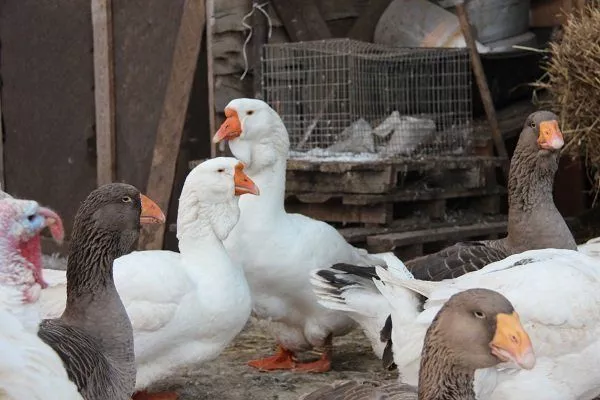
Setting up a goose house
When preparing for winter, all holes in the room are sealed. In the summer, the birds can make do with a simple canopy.
Birds love to peck at the walls of the room, so it's best to put up some netting first. The flooring can be made of sawdust, straw, or hay. However, keep in mind that hungry birds may eat the bedding material. In summer, birds graze on their own, but in winter, they need food, which not only nourishes them but also keeps them warm.
Kholmogory birds aren't afraid of the cold, but they are terrified of a lack of food. Litter in the coop will protect their feet from the cold, and food in containers will keep them warm.
The poultry farmer must always ensure that the litter is clean; birds of this variety have liquid droppings, so the floor material will always get wet and must be constantly cleaned and changed.
Goose droppings contain a small amount of ammonia, which not only harms the birds' respiratory system but also degrades the quality of their feathers and down. The plumage deteriorates and no longer provides warmth.
One individual requires 1 square meter of space for sleeping, and 6 square meters of space for walking per goose.
Nutrition
Geese are considered to be unpretentious birds; they love fresh greens and grains and happily eat bread.
In summer
Breeding costs are reduced during the warmer months. In summer, the birds roam the lawns, where they find all their nutrients in the fresh grass. They require a clean water source. Feeding is only allowed in the evening, when you bring the birds into the coop.
Vegetables are used to feed adult birds. Some poultry farmers believe that it's possible to feed them with compound feed. Feeding in the evening teaches domestic birds to return to the goose house every day. The run lasts until the first frost, but if the winter is not too snowy, they can continue to be released into the wild.
If there's little grass in the area, feed the geese some greens yourself. Carefully examine the plants, as many are poisonous. Geese also enjoy grains and beans. In summer, make sure there's plenty of fresh water.
The meat of these birds is renowned for its flavor. Raising meat-producing birds requires a carefully selected menu. Compound feed helps poultry farmers reduce their nutritional needs, but such a diet can also be created independently using herbs, grains, and beans.
In winter
In winter, the birds are not allowed to roam outdoors, except during mild winters in the southern regions. The birds are fattened three times. Food and water are also left indoors at night. Silage is the main meal. Spruce and pine branches are added to the diet; they enrich the body with vitamin C; they are dried and ground.
Hay, cake, and meal are sources of protein. Beans should be boiled and added to the feed. The best ones are sprouted barley, corn, and wheat bran. Monitor the birds' behavior; don't overdo it with food and mineral supplements. Dry feed upsets the birds' stomachs and disrupts digestion.
If fresh greens aren't available, you can supplement with special mixtures. Raw rye should never be fed to birds. Geese love bread, but too much of it is harmful to the birds; try to use it only as bait.
The breeder, Kholmogorov, shares her experience with proper feeding of geese in the following video:
Breeding
Kholmogory geese are excellent brood hens, but hatchability is low.
Reasons for low hatchability of young animals:
- One goose. For best fertilization, there should be at least two males in the goose house.
- Using a large goose. A large male goose cannot fully fertilize a female, and the size of the offspring is independent of the size of the parents. For breeding, it's better to use smaller males.
- Large weight of geese. Often, females gain a lot of weight and accidentally crush their offspring.
- Good brood hens. The females practically never leave the eggs, meaning they don't give them a chance to cool down, and cooling and moisture are essential for the embryo's full development.
- ✓ Optimal ratio of males and females in the flock: 1 gander per 3-4 geese to increase the fertility of eggs.
- ✓ It is necessary to control the weight of geese during incubation to prevent crushing of eggs.
Gosling hatchability is no more than 60%.
Incubation of eggs
You can also raise young eggs using incubation. Cooling and humidity are also important here. Humidity should be 70%, which is very difficult to achieve in an incubator.
- ✓ Maintaining humidity in the incubator at 70% using humidifiers or trays with water.
- ✓ Regular cooling of eggs (2 times a day for 15-20 minutes) to simulate natural incubation conditions.
Eggs are left to incubate for a week before being placed under a broody hen or incubated. The incubation period is one month at a temperature of 37.9 degrees Celsius.
More about breeding geese Read in our next article.
Raising goslings
After birth, it's important to pay attention to the baby's temperature, especially during the first three weeks. The temperature should be around 27 degrees Celsius, and by three months, it's reduced to 14 degrees Celsius.
The poultry farmer must constantly monitor the young for the first three days, as the babies do not know how to get up after falling, and this is mortally dangerous for them - other individuals can crush them.
Proper feeding is essential for the proper growth and development of goslings. A feeding schedule is essential: for the first three days, the young are fed seven times a day; by the time they reach one month of age, this number is reduced to four times a day.
A varied diet ensures rapid growth and development. For the first couple of days, feed them crushed egg and cottage cheese. These ingredients are mixed with ground grain and finely chopped greens. After four days, you can add root vegetables, mineral supplements, and oilcake. The feed should be moist but not sticky, so it doesn't clog the young birds' nostrils.
Goslings of this breed are sent out into the fresh air at the age of 1 week, initially for 20 minutes; by the age of 2 months, the babies can be left there for the whole day.
Read more about feeding goslings from the first days of life here.
Diseases
Kholmogory birds rarely get sick, but some ailments cause them concern:
- Cannibalism. Causes: cramped space, lack of nutrients, too much lighting. If you notice an individual pecking itself or others, remove it.
- Rickets. Affected birds have brittle bones and lay eggs with soft shells. To treat this condition, the birds are released into the fresh air and given fish oil supplements to their food.
- Poisoning. They become ill after consuming unhealthy food. The main symptoms are cramps, vomiting, diarrhea, and excessive water consumption. A vinegar solution can be used for treatment.
- Parasites. Feather lice are one of the main enemies of geese, and can be identified by their low egg production. Treatment involves treating the cages and the geese, and applying an ointment to the down.
Advantages and disadvantages of Kholmogory geese
Kholmogory geese, like other domestic birds, have a number of advantages and disadvantages that must be taken into account when breeding this breed.
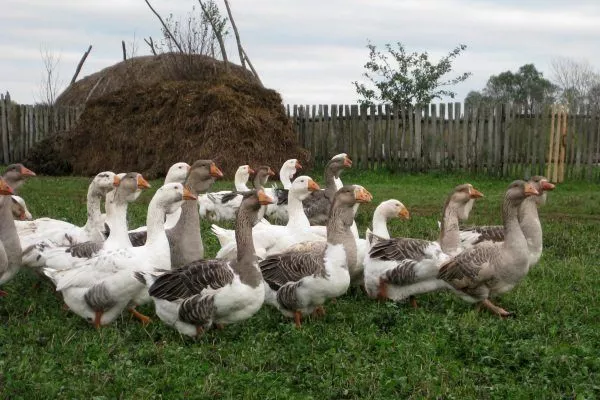
Pros:
- gain weight quickly;
- strong immunity;
- undemanding in care and maintenance;
- can be kept on lawns;
- the presence of maternal instinct;
- high meat productivity.
Cons:
- egg production is low;
- the large weight of females, which sometimes crush their offspring;
- the presence of a reservoir is required.
Disadvantages can be compensated for by following all the rules for care and maintenance.
Reviews
The young don't wander far; they graze with their families. We spend virtually nothing on feed. By autumn, our birds already weigh 5 kg, and we immediately send them to slaughter. A goose produces about 10 young birds per summer; we deliberately keep the hens longer to ensure they produce more offspring. For every 10 geese, there are three ganders.
Kholmogory geese are suitable for breeding in the southern regions of Russia, provided they have access to water and plenty of greenery. This allows the geese to forage for themselves, saving the owner money. Only the breeding stock needs to be fed, and only in winter.