
The Danish Legart goose breed is only just gaining popularity among poultry farmers in our country. It boasts excellent meat quality and flavor, gains weight quickly and efficiently, and consumes less feed than other breeds. This article discusses the care, feeding, and breeding of Danish Legart geese.
History of origin
The name itself suggests the country of origin of these geese: Denmark. The breed was developed by crossing many breeds to produce birds with excellent productivity, a large weight with a medium build, and minimal maintenance costs.
These geese arrived in our country not long ago and are just beginning to spread widely.
The correct name of the breed is Danish Legard, although they are often called Danish Legard.
Description and characteristics of the breed
The breed is considered one of the best in the world. Let's take a closer look at its key characteristics.
Table of the main characteristics of the Danish Legart breed:
| Goose | Goose | Egg production, eggs/year | Egg weight, g | The instinct of incubation | Egg fertilization rate, % | Gosling survival rate, % | Down yield, kg/year per individual | ||
| Weight, kg | Sexual maturity, days | Weight, kg | Sexual maturity, days | ||||||
| 7-8 | 270-280 | 6-7 | 260-270 | 33-40 | 150-200 | absent | 60-65 | 70-80 | 0.3-0.5 |
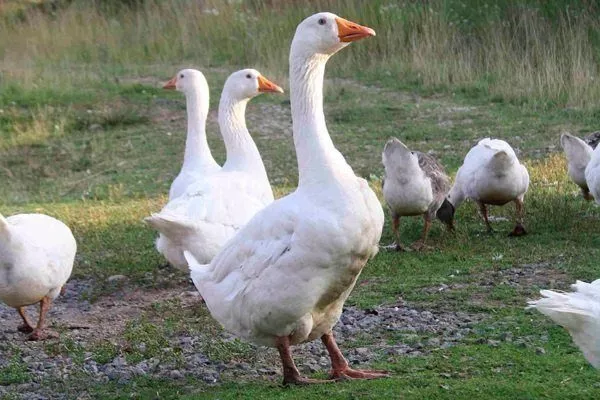
Appearance
The appearance of an adult bird can be described:
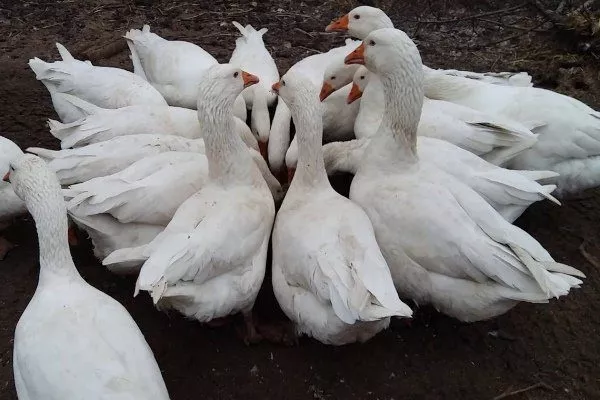
- plumage - snow-white, without inclusions;
- body - in males it is more square, in females it is elongated, the set is deep;
- back - straight and wide;
- abdomen - has a shallow fold of fat;
- legs - yellow to orange, metatarsus - long;
- neck - not very long, thick, with a bend;
- head – small, oblong;
- beak – yellow-orange, small, with a white bulge at the end;
- eyes – a characteristic feature of the breed is the blue color of the eyes;
- bones - not wide, graceful.
Appearance of goslings:
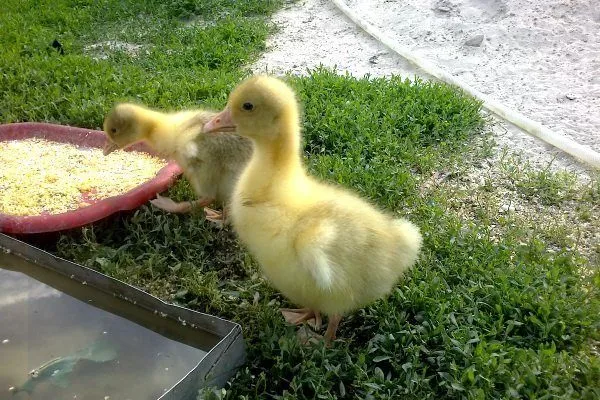
- the first brood has a yellow downy coat with dark spots;
- subsequent generations have yellow pubescence without inclusions;
- After the first molt, the coat of both broods becomes snow-white without any inclusions.
Character
The character of birds can be described:
- peaceful, calm and balanced birds;
- they are not aggressive, they do not attack other inhabitants of the poultry yard, strangers, children, and they do not start fights among themselves;
- they get used to the owner in a short time, respond to commands;
- they don't make noise.
They may show dissatisfaction during the nesting period.
Egg-laying period and average annual egg production
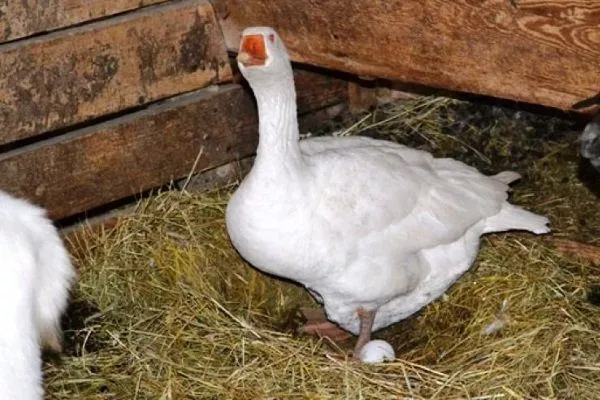
On average, sexual maturity occurs at 270 days. Females reach this stage several weeks earlier than males. During this period, they begin laying eggs.
Annual production is up to 40 eggs weighing 200 g each, which is considered high. However, their fertility rate is no more than 65%.
You can read more about goose egg laying in our other article. article.
Individual weight and meat productivity
The breed is primarily bred for meat. Adult males reach a weight of 8 kg, while females reach 7 kg.
The bird matures early. According to the stated characteristics, the chicks weigh about 6 kg at 8-10 weeks. And after another month, they weigh 7 kg.
Owners of the Danish Legart breed consider these figures to be somewhat exaggerated; according to them, a weight of 5 kg can be expected by 4-5 months from birth.
Poultry farmers attribute the accelerated weight gain of geese by 2-4 months to a marketing ploy.
Goose meat is considered dietary. It's tender and contains a small percentage of connective tissue, making it easily digestible. Fat deposits, located just beneath the skin, don't affect the quality.
The tasty, fatty liver of these geese is highly valued; with good feeding, it can reach a weight of 500 g or more.
Down productivity
Danish Legart geese are known for their high-quality down. Plucking can begin as early as 11 months of age.
Regular plucking is performed every 6 weeks. A single bird can yield up to 0.5 kg of down per year.
Content Features
Danish Legart geese are easy to care for, grow quickly, and don't require much effort from the breeder. There are just a few important points to consider.
Requirements for the premises
Geese are heat-loving birds. When setting up a coop, avoid any drafts or precipitation. During cold periods, insulate the floor and walls, for example, with wood.
The goose house is built on an elevated area, preferably next to a walking yard and access to a pond.
The poultry house must be equipped with:
- With thick wallsTheir thickness should be at least 20-25 cm. Suitable materials include brick, foam blocks, cinder blocks, and wood. The wall height should be 2 m.
- RoofBuild it from tiles, slate, or roofing felt. The constructed attic will serve as additional thermal insulation both in summer and winter.
- PaulMake it out of wood, concrete, or leave it earthen.
- Zone divider. Create 2 zones in total:
- for adults;
- for young animals.
Each zone should have a separate place for eating and resting at night.
- Nests. Install them at a rate of 1 nest per 2 geese in a shaded area, away from the entrance, preferably on the south side.
- Feeders. Installed in the poultry house. A separate "room" for feeding can be set up.
- Drinking bowls. Must always be freely available.
- With bedding. Suitable materials include straw, sawdust, sand, dry grass, and peat. The layer thickness should be at least 10 cm.
- Ventilation. Adequate ventilation is essential. Ridge ventilation is considered the best option.
- Windows. These should occupy up to 20% of the goose house walls. Be sure to insulate them for the winter.
- Additional lighting. During the breeding season, this is necessary to extend daylight hours to 14 hours. Install one 60-watt lamp per 6 square meters.
The goose house must support:
- Area per 1 individual. Geese don't like being crowded; one bird requires 1 square meter of space. In extreme cases, two birds per square meter can be kept. Overcrowding causes weight loss, egg production, and deterioration of down quality.
- Temperature conditions. The optimal temperature will be 22-26 °C.
Install additional heating if geese freeze in winter.
- Humidity. 50-60%.
Yard for walking
You can't keep a bird locked up all the time. It needs to be walked.
For these purposes, a pen is equipped:
- Space. There should be enough space for the geese to move freely. Ideally, 10 square meters per geese. The best location is on the south side of the coop.
- Fencing. Use mesh or build a wooden fence.
- Canopy. Install the canopy in a wind-protected area where geese, especially young ones, can hide from the sun and precipitation.
- Coating. Geese love to graze, so plant a variety of grasses in the yard. Greens from cereals will also be beneficial.
In winter, before releasing geese into the yard, you need to clear it of snow.
If free-range access is not possible on the farm, take the herd out to the meadow for grazing for the entire day.
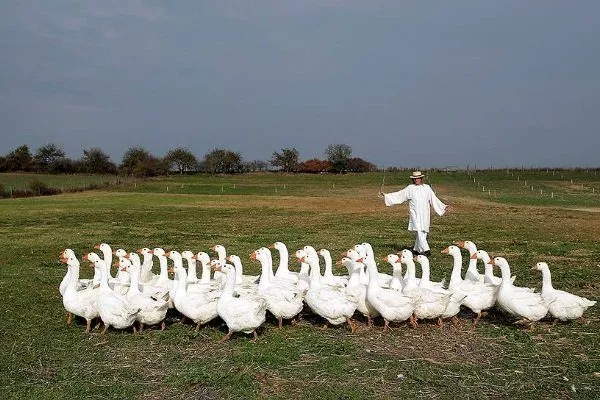
In summer, geese can be outside 24 hours a day, provided a canopy is provided.
Access to water
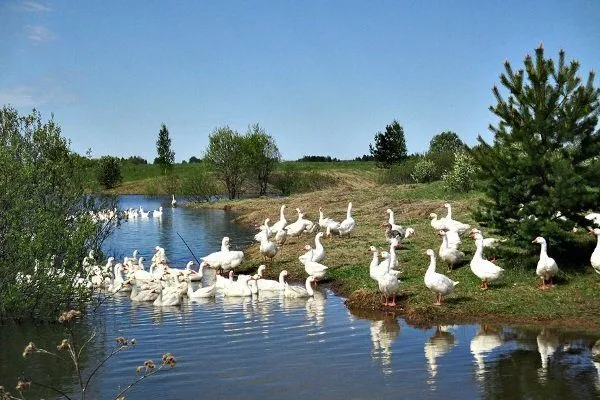
Geese are waterfowl and need access to water, whether it be an artificial pond in a walking yard or a river/pond in a meadow.
According to scientists, a lack of water does not reduce egg production or weight gain. However, free access to water is important because it provides a natural environment for mating.
Fertility of eggs increases with the possibility of mating in water bodies.
Feeders and drinkers
The number of feeders is calculated as follows: 1 piece per 10 geese or 15 cm of sidewall per 1 individual.
There should be 3 containers:
- For wet mixtures. It can be made of metal.
- For dry food. You can use plywood boxes.
- For mineral fertilizers.
Fermented milk products should not be given in metal containers.
Install waterers at a rate of one 2-meter-long waterer per 10 birds. A plastic pipe with the top cut off can be used. Change the water up to three times a day. In winter, add warm water and prevent freezing.
Disease prevention
Preventive measures for common diseases in geese include following the following care rules:
- Hypothermia and overheating. In summer, the temperature in the poultry house should not be allowed to rise above 30°C, and in winter below 0°C.
- Humidity in the room. Low humidity can cause inflammation of mucous membranes and eyes in geese, and dry feathers. High humidity increases the risk of fungal and bacterial diseases.
- Disinfection. After construction is complete, treat the walls and floor with lime. Then, disinfect the house once a month using a solution of lime, formalin, or copper sulfate. Afterward, ventilate the house for two hours.
- Regular cleaning and change of bedding. If this rule is not followed, there is a high probability of parasitic infestations.
- Cleanliness of feeders and drinking bowls. Clean feeders and waterers regularly. Change the water promptly, and discard any uneaten food, especially wet food.
- Clean air. If there is no ventilation in the goose house, there is a risk of fungal growth developing on the walls.
- Protection from overheating in the sun. Both adults and goslings do not do well in direct sunlight.
- Vaccinations. To preserve the goose population, they are required to receive the necessary vaccinations.
- Disinfect the premises before introducing a new batch of birds.
- Ensure that goslings are vaccinated in the first days of life according to the vaccination schedule.
- Change the bedding regularly and ventilate the room to reduce humidity.
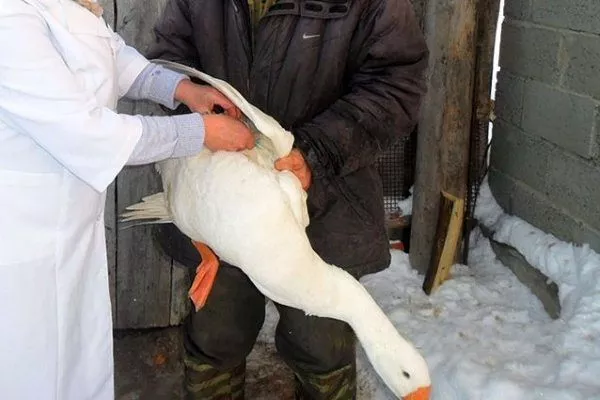
Danish Legart geese are difficult to treat, and sometimes it is impossible, so preventative measures are essential.
It is recommended to nurse weakened young animals:
- Milk-yolk mash. Dissolve a chicken yolk in 0.5 cups of fresh, full-fat milk. Add sugar, biomycin, or penicillin to the mixture. It helps with exhaustion. Feed until recovery.
- Maintaining the temperature in the room. It should be at +23 °C.
- Exercise. In sunny, windless weather, take the dog outside for 10 minutes.
You can read more about goose diseases, their varieties and characteristics. Here.
Feeding
The diet will depend on the age of the bird and the time of year.
In summer and winter
In summer, while grazing, geese consume up to 1-2 kg of fresh grass per day, so they don't require intensive feeding at home. In the evening, they can be offered grain feed.
During the winter period, you should take care of high-quality nutrition, which should consist of:
- Mixed grass hay. Alfalfa, clover, wheatgrass.
- Vegetables. Beets and carrots – for maintaining a healthy weight. Jerusalem artichoke – for boosting immunity and frost resistance.
- Cereals. Keep in mind that your diet cannot consist solely of grains. Their percentage is 30-40%.
- Mineral and vitamin supplements. Mineral supplements include chalk, sand, fine gravel, shell rock, and salt. To prevent vitamin deficiency, add up to 20 g of yeast feed per day.
You can also include the following in your diet:
- bran;
- dry compound feed with rowan, viburnum, rose hips, hawthorn;
- leaves and thin branches of birch, aspen, linden, acorns, pine needles, aquatic plants;
- earthworms, which can be raised in containers with manure and kept in the basement in containers with soil.
Feed the bird at least three times a day. Increase the evening dose several times. Supplement the evening meal with high-fiber food (bran, grass meal).
The need for clean water is determined by the formula: 4 liters of water per individual per 1 kg of dry food.
Table of the required volume of feed per bird for the winter period:
| Name of the feed | Consumption, kg |
| Hay | 20 |
| Beet | 30 |
| Carrot | 30 |
| Jerusalem artichoke | 30 |
Adult birds and young birds
Depending on the age of the bird, the change in diet is indicated in the table.
Feeding table for geese depending on age:
| Age, days | Dry food, g/day | Green fodder, g/day |
| 1-6 | 15 | 25 |
| 7-20 | 40 | 90 |
| 9:30 PM | 100 | 180 |
| 31-40 | 120 | 260 |
| 41-50 | 140 | 350 |
| 50 and adults | 160 | 500 |
Breeding
Since ganders mature more slowly than geese, if birds of the same age category lay eggs for the first time, it is better to remove them to encourage the females to lay eggs again.
Females begin to lay eggs in April.
If the flock consists of young geese and an old goose, the eggs will be fertilized from the first clutch.
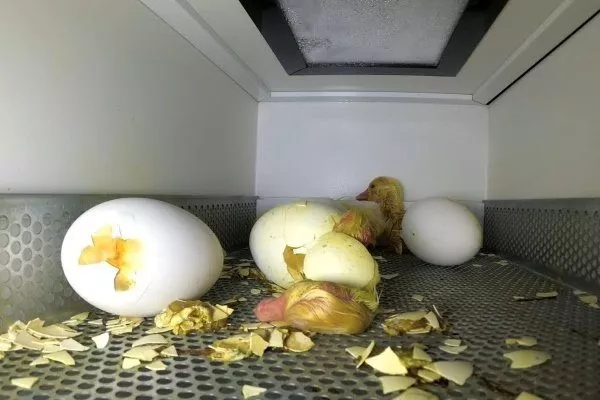
Danish Legart females lack the brooding instinct, so goslings must be hatched in an incubator.
While you collect the required quantity, store fresh eggs according to the following recommendations:
- the temperature should be 10-15 °C;
- lay the eggs on their sides;
- You can store eggs for incubation for no longer than 1 week, after which the chances of successful hatching of goslings decrease;
- On the 5th day of storage, turn the eggs over onto their other side, this will give you a better chance of preserving the embryo.
Criteria for selecting eggs for incubation:
- size – large or medium;
- clean;
- surface – smooth, without growths, without cracks;
- When checking with an ovoscope, the yolk spot is clearly visible, it is evenly located in the center, when turned it returns to its place, there are no inclusions in the white.
Temperature and humidity in the incubator
After placing the eggs in the incubator, set the temperature to 38.0–38.5°C and humidity to 80%. Adjust the settings according to the table.
Table of temperature and humidity conditions in the incubator by day:
| Period, days | Temperature, °C | Humidity, % | Cooling, times/day |
| 1 | 38.0-38.5 | 80 | - |
| 2-8 | 37.5-38.0 | 65 | 1 |
| 9-29 | 37.0-37.5 | 65 | 2 for 15-30 min. |
| 29-31 | 37.0-37.5 | 80 | - |
Incubation and hatching of eggs
The process and sequence of egg incubation:
- Place the eggs on their sides in the incubator;
- For the first 7 days, turn the eggs 5 times a day;
- Spray the eggs during the first 7 days;
- From the 7th to the 14th day, take a break from spraying;
- From the second week, turn the eggs over at equal intervals 3 times a day;
- On the 10th day, make the first culling of eggs by checking them with an ovoscope;
- from the 15th day, start spraying the eggs again;
- 21 days later, carry out culling again;
- from day 26, stop turning the eggs;
- Day 28:
- remove the eggs from the incubator to ventilate and spray them with a solution of potassium permanganate;
- Every 6 hours, moisten the eggs or cover them with a damp cloth;
- Place a cloth in the incubator to prevent the chicks from injuring their legs when hatching;
- Open the vents on the incubator lid.
- Day 29 – this is most often the period when chicks begin to hatch.
The hatchability of goslings, if all rules are followed, is 80%.
The exact hatching time is impossible to predict. It usually occurs between 28 and 31 days.
Caring for young animals
Caring for young animals involves maintaining cleanliness and providing them with balanced feeding.
- ✓ Optimal stocking density: no more than 2 individuals per 1 sq.m to prevent stress and reduced productivity.
- ✓ Temperature regime in the first days of goslings’ life: +28…+30°C with a gradual decrease to +18…+20°C by the age of one month.
The room where the goslings are kept must always be clean, feeders and drinkers must be washed and disinfected, and fresh water must be freely accessible.
Food should not be left for later; always prepare it before use and discard any leftovers.
At three weeks of age, goslings are allowed out for their first run. Set aside a designated area for this, ensuring their safety.
At this time, stop feeding the chicks so they can learn to eat greens on their own. Once they begin to get most of their diet from plants in the open air, you can reintroduce crushed grain or mixed feed.
Feeding goslings depending on age:
- The first day. After hatching and drying off, the chicks are immediately offered food. This promotes the elimination of the yolk from the body, resulting in faster growth and a reduced risk of mortality.
The diet consists of:- boiled eggs, pre-finely chopped;
- ground grain;
- corn grits;
- fresh greens, which should make up 50% of the total diet.
Goslings are fed every 3-4 hours (about 8 hours per day). Feed is provided in a tray or on a sheet of plywood.On the first day, fermented milk products are not offered.
- Until 14th day. The first 7 days they are fed 6 times a day:
- portions are increased by 30%;
- remove eggs from the diet and replace them with high-calorie protein foods;
- Peas (soaked overnight and ground through a meat grinder), bone meal, compound feed, and fish oil (as a vitamin supplement) are introduced into the menu.
- Day 15-30The chicks eat 3 times a day:
- the basis of the menu becomes greens, peas, grains;
- introduce boiled beets, carrots, and potatoes into the diet;
- Fresh wet mash can be given no more than 2 times a day;
- They monitor the gluten content of the food so that it does not clog the goslings’ nasal passages;
- fresh vegetables and root vegetables are mixed with chalk or shell rock;
- You can give a little cottage cheese.
There should be food in the feeders at night.
- After 1 month. Chicks are fed 3 times a day:
- the basis of the diet is green fodder;
- if there is no possibility of walking, the goslings are given freshly mown grass;
- In addition, the food should include grain, peas, mash, oil cake, bran, shell rock, chalk, and salt.
For more information on feeding chicks, please read our article. "How to feed goslings from birth?"
Advantages and disadvantages of the breed
The main advantages include:
- The Danish Legart's food consumption is 20% less than other breeds;
- the main diet consists of 90% grass from pasture;
- If there is insufficient grass in the pasture, geese consume mown grass from the garden plot and vegetable peelings, which significantly saves on purchased feed;
- accelerated weight gain;
- the meat yield is higher than that of other breeds;
- the carcasses have an attractive commercial appearance;
- can be an aesthetic decoration of the yard.
The disadvantages include:
- low egg fertility;
- relatively low survival rate of goslings;
- low egg productivity;
- no maternal instinct;
- high cost of breeding material and hatching eggs.
Where to buy?
In Russia, you can buy Danish Legart geese:
- Ptica Village (Bird Village) is a suburb of Pereslavl-Zalessky;
- Vip Farm, Moscow region, Mytishchi;
- Peasant farm Simbireva Iraida Innokentyevna, Moscow region, village Ivashkovo, Shakhovsky district;
- Kireevskaya incubator and poultry station, Tula region, Kireevsk.
Approximate prices:
- daily goslings – 250 rubles;
- week-old goslings – 400 rubles;
- adult geese – 3000 rub.;
- hatching eggs – 70 rubles.
Reviews
Danish Legart geese are easy to care for and feed, have a docile nature, and by four months of age, they gain sufficient weight for slaughter. Their eggs and snow-white down are highly prized. They lack a maternal instinct, so an incubator is necessary for breeding. This breed is ideal for homesteads.