
The white-fronted goose (formerly known as the brant) is a wild species. It is not bred on private farms. Its distinctive features, lifespan, distribution, lifestyle, and domestication are discussed below.
History of origin
The white-fronted goose is known to have appeared in the USSR in 1895. The birds migrated from the Caspian Sea; scientists believe this population shift may have occurred due to a sharp rise in sea levels. Residents of Pavlograd were the first to spot them, and later they were spotted in the Ural basin.
It is noted that since 2008 the goose population has sharply declined, this is due to a decrease in the area of winter wheat and intensive hunting of white-fronted geese.
This goose served as the "source" for the development of a new domestic breed, the "Pskov Bald." These birds were the result of crossing local geese with domesticated, wild white-fronted specimens.
Characteristic
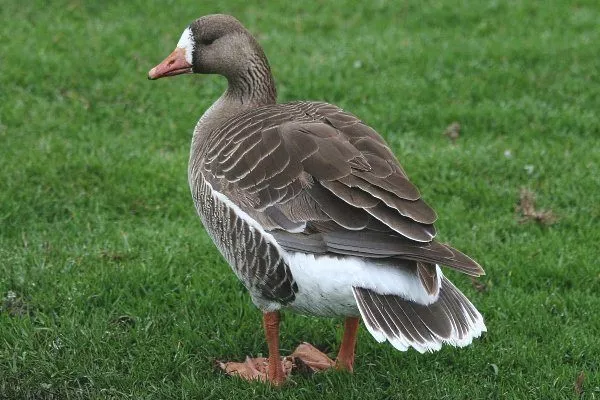
This waterfowl of the duck family is very similar to the greylag goose, but is more modest in size. The upper body is covered with brownish-gray feathers, the lower parts are light, and the undertail is white. Adult birds, over four years of age, have transverse black spots on the belly and upper chest. The older the geese, the larger they become.
A distinctive feature is a white spot on the head, located near the forehead. However, this appears two to three years after birth. Therefore, distinguishing a younger bird from a greylag goose is difficult. The spot is clearly visible against the dark mottled plumage and is surrounded by a dark border. It measures approximately 26 mm in diameter.
Other features:
- Beak. It reaches 40-55 mm in length. In adult geese, the coloring is uneven—flesh-colored (beige) with pink markings, ending with a white "claw." In young geese, the markings are gray.
- Paws. The color of the goose's feet also depends on its age. Young birds have yellow-orange feet, while older birds have orange-red feet. The bird can also be identified by the tail protruding from beneath its folded wings.
- Body length. The size ranges from 60 to 90 cm, with females being smaller than males. The wingspan can reach up to 1.5 m. By autumn, the bird's weight reaches 2.5-3 kg.
Geese spend most of their time on land, but this doesn't stop them from being excellent divers and swimmers. They usually fly to lakes and rivers to drink.
Distribution and habitat
The goose thrives in the tundra and forest-tundra, as well as on Arctic islands. They can be found in northern regions—Taimyr, Novaya Zemlya, Yamal, the west coast of Greenland, Eurasia, and North America.
European white-fronted geese migrate to southern regions for the winter—the Black Sea, Caspian Sea, and Mediterranean. Some geese migrate to Asia (both southeastern and southern). The North American population migrates south of the continent for the winter.
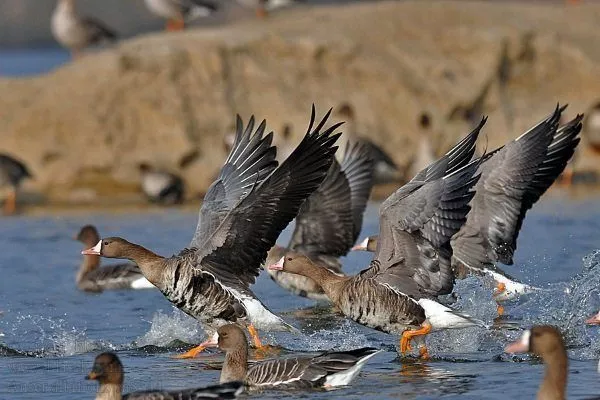
When choosing a wintering site, the presence of a body of water is not a primary consideration for geese. During migration, they prefer to stop near lakes and rivers, where they forage and rest.
Wildlifestyle and conservation status
In the wild, the lifespan of a goose is 17-20 years, but in captivity, it can reach up to 30 years. Since the population of this species is not a concern to experts, they are not protected and hunting is permitted.
Feeding and vocalization
White-fronted geese prefer plant foods—algae, herbs, berries, and horsetails. They are often seen in fields sown with cereal crops. This often leads to conflicts between the bird and humans.
Experienced hunters can easily distinguish the white-fronted goose from other migratory birds not only by its flight but also by its call. It also honks, but more loudly and sonorously.
Nesting
This species of waterfowl is one of the last to arrive for nesting—in May and early June, when the snow cover in the nesting areas begins to melt. If spring arrives late, the flock does not disband. The birds stay together in shallows and along the banks of bodies of water, waiting for favorable conditions to lay eggs and hatch chicks.
They nest in scattered colonies. Each pair's nest is located far from each other. Permanent pairs form before reaching sexual maturity, at two years of age.
One-year-old juveniles and birds not planning to breed migrate across the tundra for a long time. Their migration is protracted, but in the summer they arrive en masse to lakes and grassy plains.
The female builds nests among rocks and hummocks on a small hill or near bushes. They often build them in the vicinity of birds of prey, such as peregrine falcons and caiques, and enjoy their protection. She lines the nest with her own down and dry and fresh grass, creating a soft bed for the eggs. This helps prevent damage to the eggs.
A clutch contains 3 to 6 white eggs. The shell darkens during incubation. The incubation period lasts 28 days. The gosling hatches within 48 hours.
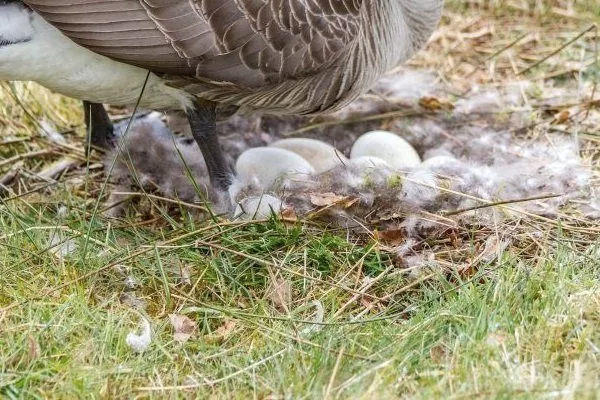
Only the female incubates the eggs; the male is constantly on guard. He guards the goose and its nest and the surrounding area. If the goose needs to leave the nest, she covers the clutch with a down cushion.
The future parents go to feed together, so the clutch remains unprotected for some time. In the wild, geese don't have many enemies in the tundra. The main predator is the Arctic fox, which loves to feast on eggs and chicks.
Raising offspring
Once the chicks hatch, the parents share equal care and attention. They guard and protect the young for two months. The goslings remain within their parents' sight, even though they soon begin to forage for food themselves and, by the end of August, begin to fly.
Before setting off on a long journey in the autumn, parents train their offspring so that they can withstand the difficult, long flight.
Molting
Adult geese begin to molt when the young begin to feather. Chicks molt twice in their first year of life—when down is replaced by feathers and before they leave for winter in the fall.
As soon as adult birds have changed their plumage in the summer, they flock again. They spend most of their time foraging for food. Before leaving, they need to gain strength. Geese feed intensively twice a day, in the morning and in the evening, flying from one place to another.
Domestication and productivity
The advantage of raising wild geese on a farm is their low maintenance. During the summer, they can be left to roam freely and require no additional feed. The white-fronted goose also has a high immunity to various diseases. It is frost-resistant and requires little maintenance.
- ✓ The need for wing clipping to prevent migration.
- ✓ Taking into account natural instincts when creating conditions of detention.
Geese can gain up to 4 kg of live weight in three summer months. Their meat is tasty and tender. However, hens are not particularly prolific egg layers, so they are not suitable as layers.
The white-fronted goose is a beautiful bird that lives exclusively in the wild and is a coveted trophy for hunters. A migrating flock of geese can cause problems for farmers by grazing in wheat fields. Generally, white-fronted geese have a calm disposition and thrive near farms. However, they are not deliberately bred.
Watch a video about the favorable conditions a breeder has created for White-fronted Geese:
This species of goose is not raised on special farms, but those who decide to do so should be aware that domesticated wild geese can breed in captivity under favorable conditions, but they retain their natural instincts. To prevent the birds from flying away in the fall, their wings are clipped.