
Beginning farmers rarely pay attention to the flooring of their goose house. But with experience raising geese, you realize that the health of your goose, and consequently the number of eggs laid and the number of chicks hatched, depend on the quality of the flooring materials, proper installation, and the choice of environmentally friendly bedding.
Requirements for flooring in a goose house
Floor coverings must meet basic sanitary and hygienic standards. There are also a number of other requirements:
- If the goose house is of the summer type, that is, mobile, the floor is made of wood (plywood or chipboard is usually used, since the materials do not add weight to the structure);
- It is recommended to equip the winter poultry house with a strong foundation (concrete mortar is used);
- the floor covering is designed at a slight angle, which simplifies the cleaning procedure;
- the presence of drainage ditches is mandatory;
- You cannot let geese out onto the floor without bedding, especially in winter;
- It is prohibited to use synthetic materials and raw materials that release toxins, as this leads to illness and death of birds;
- When laying, ensure the integrity of the floor covering (no cracks, holes, or any other openings, as these allow small rodents to enter, spreading infection and devouring young animals);
- Choose a waterproof material, otherwise rotting processes will begin.
What materials are used?
Only two main materials are used for the flooring of a goose house: concrete and wood. Both materials are environmentally friendly and safe, but each has its strengths and weaknesses. The key factor in choosing one is climate conditions.
Some goose breeders still use the traditional method of creating a clay floor. This method also meets safety requirements for the poultry house, but it is extremely rare.
Concrete floor
It's considered the most durable because it's moisture-resistant, preventing rot. However, this is only true if the mortar has a balanced composition. Then, the floor will not crack or crumble.
The main advantages of concrete pavement:
- the entire floor is sealed, which provides reliable protection against rats and mice;
- uniformity and evenness of the surface;
- absence of protruding splinters (geese can injure their paws on them);
- easy to clean, especially wet cleaning, since cement is not afraid of water;
- The goose house can be easily and safely disinfected with steam, liquids, and chemicals—it won't rot or absorb toxic substances.
However, there are also a number of disadvantages. The following factors should be considered:
- poor air permeability;
- cold surface, which is undesirable for regions with not very warm climates;
- Overheating in hot weather leads to fumes with a specific odor.
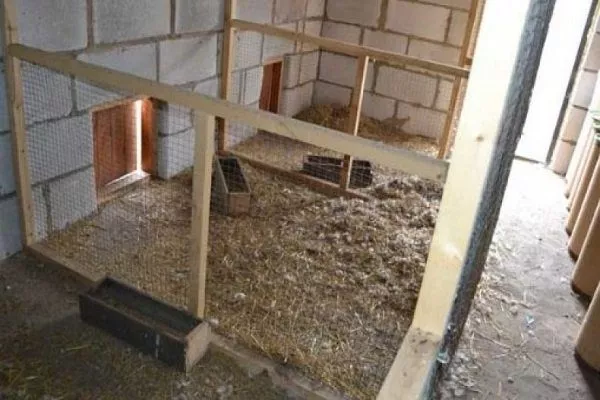
To prevent geese from freezing during prolonged frosts, which is especially important in the North, in addition to warm bedding, the floor is supplemented with a structure made of logs and wooden planks. It's best to make the structure removable (for summer).
Wooden covering
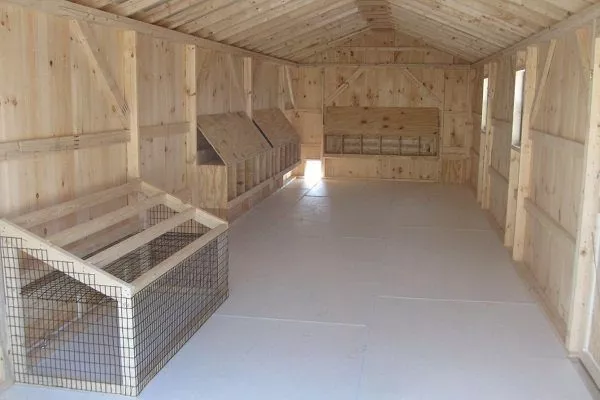
Wood is considered the most environmentally friendly material with excellent air permeability. It has its advantages:
- heat is retained even in the cold season, due to which the bedding is laid in a thinner layer;
- speed and ease of installation;
- Low cost of raw materials, and if you can find boards in your yard, the flooring will be free.
Among the disadvantages, the following are noted:
- subject to rotting at medium and high humidity (not suitable for regions with frequent rainfall);
- compared to concrete, the raw material is not durable;
- wood is easily gnawed by mice and rats, and insects can seep through the cracks;
- absorbs chemicals (after treatment with disinfectants, it will have to be ventilated for a long time).
What to put as bedding?
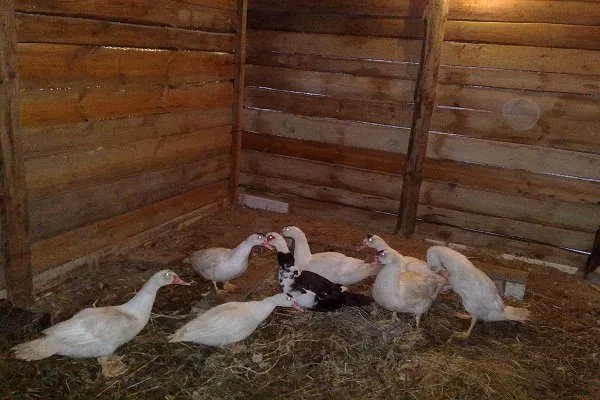
Bedding is always placed on the floor of the goose house. The farmer can use any available material, but it must be natural. This could be:
- hay or straw;
- millet husk;
- sunflower husks;
- wood shavings;
- sawdust;
- peat (sphagnum only);
- sand;
- shell;
- corn cobs, finely chopped.
What's more important isn't the material itself, but the requirements placed on the bedding. These include several subtleties:
- the raw material must be hygroscopic;
- Do not lay wet or dirty material, as this will promote the development of fungus and infection;
- the emanating odor does not contain any foreign impurities;
- litter consumption per individual is 35–40 kg per year;
- minimum layer thickness - 5 cm (only in summer);
- maximum - 30 cm (respectively, in winter);
- the material is replaced as it becomes damp (if the bedding is left wet, the goose feathers will become dirty and ruffled, which will contribute to freezing in cool weather);
- Before laying the litter in the fall, be sure to treat the floor covering with slaked lime (0.9–1 kg per 1 sq. m);
- nests, feeders And drinking bowls placed on the bedding;
- Mixing of several components is permissible.
- ✓ The optimal moisture content of the litter should not exceed 25% to prevent the development of fungi and bacteria.
- ✓ The thickness of the bedding in winter should be at least 30 cm to ensure sufficient thermal insulation.
Farmers usually don't throw away deteriorated bedding. Geese leave droppings on the material, which thrifty farmers actively use to fertilize crops and improve soil quality.
To further enrich the bedding, sprinkle Superphosphate on the floor (under the bedding) every few days (as the materials become damp). For 1 square meter, 200 g of the double product or 400 g of the single product are required.
Litter is designed not only to create hygienic conditions in the poultry house but also to insulate the floor. There are materials that retain and release heat very well. Therefore:
- in the cold season, they mainly use peat, straw, and hay;
- In summer, preference is given to sand or sawdust.
Floor installation
You can hire a construction professional to install the flooring, but most farmers build the goose house themselves. This doesn't require any special knowledge or skills. The main thing is to strictly follow the installation instructions.
Pouring concrete pavement
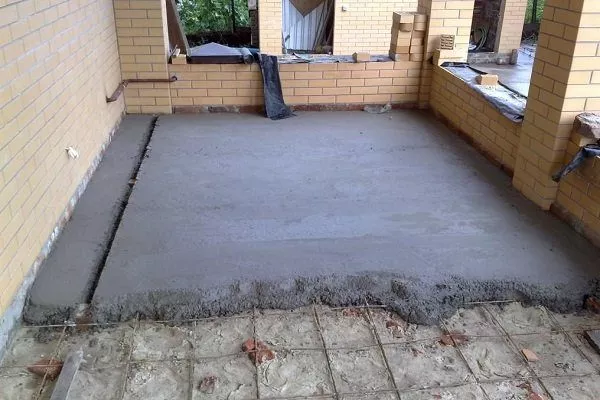
During the poultry house installation process, a pit is dug inside for the subfloor. The subfloor is then brought to standard condition using the following steps:
- Place a layer of coarse sand 2–3 cm thick.
- Place expanded clay or crushed stone on top. This will serve as a cushion and also act as a drainage system (to prevent liquid from eroding the overall structure).
- Now cover the surface with reinforcing mesh.
- Make sure that all embankments are uniform.
- Fill the base with cement mortar.
- Level the surface thoroughly.
Manufacturing of a wooden structure
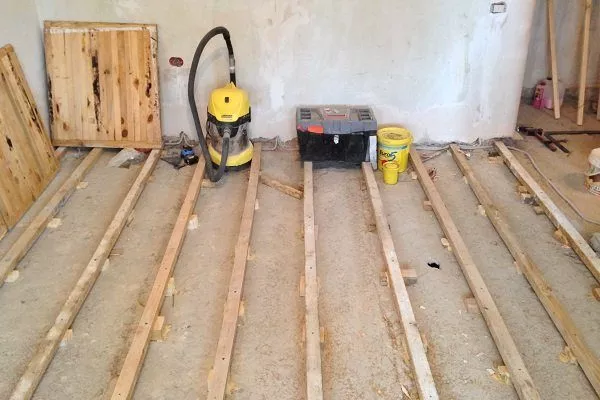
The technology for making wooden floors requires a more sophisticated approach. Here's the sequence of steps:
- Prepare the strip foundation.
- Place a roofing felt underlay on it so that the edges overlap.
- Place an even layer of wooden beams on top to act as a support and base.
- Now make a deck from planks that fit tightly against each other. Secure them with nails.
- Next, install any insulation material. Mineral wool and drywall are most commonly used. This step is not considered mandatory in the southern regions.
- Make a finishing flooring from plywood sheets or other wood material. Secure it again.
- If the surface of the finishing coat is rough, treat it with sandpaper or special tools.
- To prevent rapid rotting, treat all wooden elements with protective agents.
Clay construction
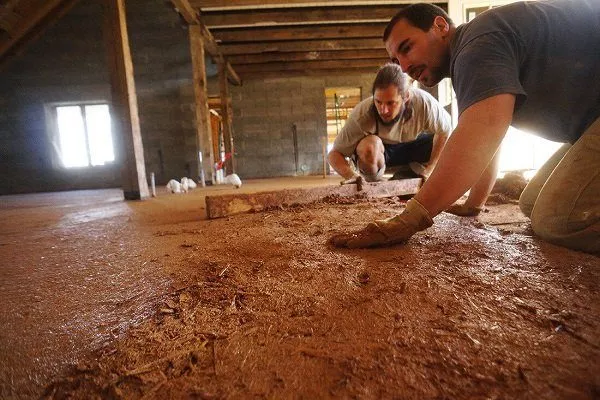
Such raw materials are practically never used in modern farming, but if there is free access to clay deposits, then this option is considered the most cost-effective.
Installation process:
- Remove a layer of soil of at least 10–12 cm, which will reduce the risk of rodents getting inside.
- Place a metal grid (mesh size from 1.2 to 1.5 cm) into the hole.
- Throw on a layer of clay 15–20 cm thick.
- Fill with water.
- Take off your shoes and socks and climb into the clay mixture.
- Stir the mixture until a plasticine-like structure is formed.
- Level the surface so that the thickness of the walls around the perimeter is 2–3 cm greater than the thickness of the central part of the floor in the goose house.
Features of nests placed on the floor
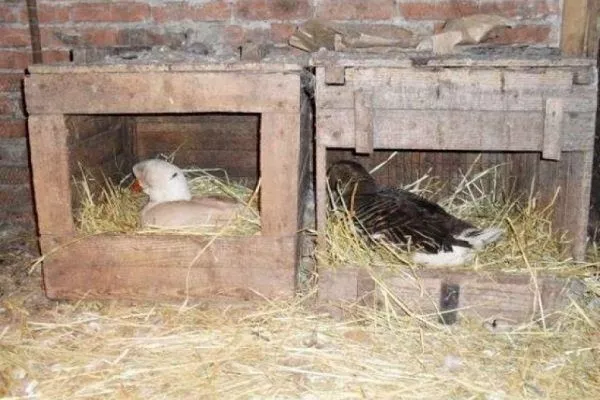
It's best to place egg nests on the floor along a wall. This increases the likelihood of their survival. Two or three geese require one nest.
Please note:
- inside the nest, be sure to place a bedding material identical to that lying on the floor;
- maintain the width of the structure - about 40 cm;
- limit the height to no more than 50 cm;
- vary the length from 55 to 60 cm;
- do not exceed the threshold level - no more than 10 cm;
- do not use metal parts as material;
- Place nests in shaded areas;
- Do not miss the deadline for changing the litter - once every 2 or 3 days.
Helpful tips
Experienced farmers use various tips and tricks when constructing and maintaining poultry house floors. They're happy to share their wisdom with newbies. Important recommendations:
- Cement particle board is the least susceptible to rotting in high humidity. Its investment is well worth it, as it will last longer than regular boards and plywood when used for finished flooring.
- Flat slate is acceptable for flooring. It's a cross between concrete and wood.
- Monitor the temperature in the goose house overall and at floor level. Geese prefer to roost at the bottom of the house, even if there are perches.
- The optimal temperature range is + 12–15°C in summer and + 17–21°C in winter.
- For young geese and small offspring, the required thermometer reading near the floor is +28°C.
- Place the thermometer at the bottom of the coop and cover it with protective metal mesh to prevent the geese from pecking at it.
- To prevent pathogenic microorganisms from developing during hot weather, remove the top layer of bedding (literally 1–2 cm) daily. Then sprinkle the surface with peat or lime. Only after disinfecting should you apply a clean layer.
- Change the nesting lining in the evening to keep the eggs clean.
- If the walls are cold, place the nests at a distance of 7–12 cm from them or insulate the goose house.
- Adjust the size of the egg-laying device yourself. They are often specific and depend on the breed of goose (small, medium, large).
- Place goose feathers inside the nest to attract females (not all individuals will sit on the nests immediately).
Installing flooring in a goose barn yourself isn't difficult. Depending on your abilities and skills, you can choose from a variety of materials. Each has its own advantages and disadvantages and varies in installation complexity. But simply laying the floor is only half the battle. It also needs to be covered with suitable and safe underlayment.
I'd like to thank the author and creators of this website. I truly do often find useful, and most importantly, very insightful, information here.