
Goose feeders must meet all the requirements for keeping these birds. They are sold in specialized stores and markets. If you're raising geese on a small or medium scale, you can make your own feed container to save money.
What should the feeder be like?
There are generally accepted standards for goose feeders, ensuring that the birds eat comfortably and the owner can easily serve the feed and maintain the device. When purchasing or making the device, consider the following:
- comfort for the goose – he must have free access to the very bottom of the feeder in order to peck out all the remains;
- convenience for the farmer – the design should be easy to remove and install; closed models should have an opening through which dry or wet food can be poured;
- ease of cleaning – feeders are cleaned periodically to comply with sanitary and hygienic standards, therefore the walls and bottom should not have recesses, depressions or other elements that hinder the process of thorough cleaning;
- quality of material – it must be made from environmentally friendly raw materials, otherwise the risk of poisoning the bird with harmful chemical compounds contained in the material increases;
- stability – the tanks cannot tip over, as this will lead to loss of food and the birds becoming skittish (if the feeder is installed on the floor, take care of its weight; if it is suspended, be sure to secure it firmly to the wall);
- safety – there should be no nicks, chips, sharp corners or anything else that could injure the goose on the entire surface;
- purpose – wet food cannot be placed in metal containers, as oxidation occurs (iron containers are only suitable for dry food);
- type of construction – should be such that the bird cannot climb inside with its paws, which would cause infection and make the birds sick.
- ✓ For wet food, plastic and stainless steel are preferred; avoid wood and regular metal due to the risk of oxidation and swelling.
- ✓ Make sure plastic feeders are free of BPA and other harmful chemicals that may leach when in contact with food.
Please pay special attention to the dimensions:
- For adults. Height – from 15 to 20 cm, volume for one head – 15-18 cubic cm.
- For young animals. Height – from 5 to 10 cm, volume – from 5 to 12 cubic cm.
To determine the exact height based on the age category of the birds, keep in mind that the feeder should be 2 cm above the level of the birds' backs.
Since geese scatter their food while eating, place a tray under the device, and to prevent precipitation and dirt from getting inside when feeding outside, install a roof.
Types of designs
Types of feeders differ in design features, materials used, intended use, feeding method, age of the geese, etc. They all have their own advantages and disadvantages.
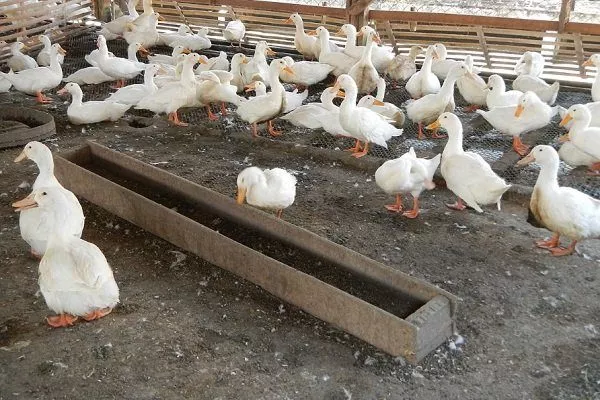
Open
These simple structures, without a top cover, consist of a rectangular or square box into which feed is poured. Some farmers simply install basins, but fail to consider the risk of them tipping over. Open feeders are hung on a wall or placed on the floor.
Advantages of open fixtures:
- ease of manufacture;
- low cost in stores;
- ease of cleaning;
- free access for humans and birds;
- Several geese feed at the same time, which is convenient for a large flock.
The following are among the disadvantages:
- the birds scatter food on the floor, so the owner suffers losses;
- There is a possibility of geese jumping inside, which violates hygiene standards.
Such designs provide for a free space of 20-25 cm for 1 head, so the length of the feeder is calculated based on these indicators and the number of birds in the flock.
With windows
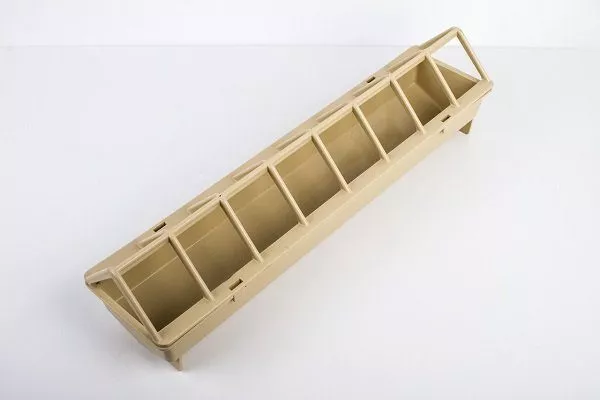
These are open-type mangers, but the top section is equipped with a lid. It has holes for the goose's head to stick through, preventing it from getting its feet in. If a lid isn't available, farmers simply cover the top with a grid of appropriately sized mesh.
The advantages of window structures are the same as in the previous case, but they are supplemented by the main indicator - birds have limited access inside with their paws.
There is one drawback: it is used only for dry food, since the simplest manufacturing option involves using wood (making a similar feeder from metal or plastic is quite difficult).
Bunker
These are three-component structures: a feed storage bin, a feed dispenser, and a feeding trough from which the geese consume their food. They operate by gravity-fed feeding, so the food gradually flows from the hopper into the feeding trough as the trough empties.
There are 2 varieties:
- Suspended version. This is a fully assembled model, containing all three components. The structure is wall-mounted.

- Ground adaptation. It consists only of a barrel-reservoir and a feed delivery pipe. The feeder is installed separately.
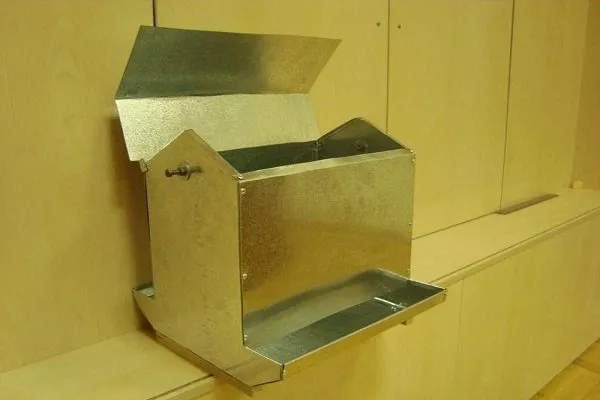
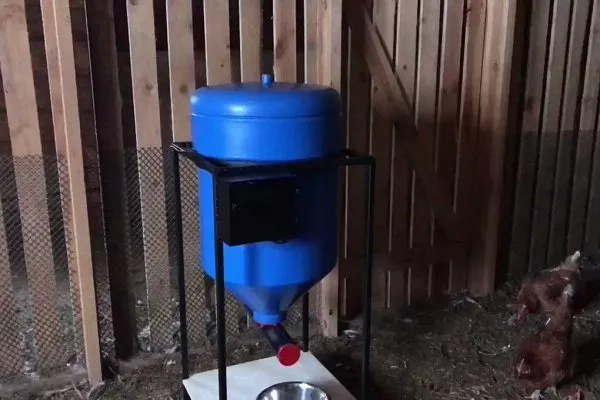
Advantages of bunker structures:
- there is no need to add feed several times a day, since the bunker tank is quite capacious - you add it in the morning, and by the evening the geese have eaten it all;
- lack of access to the main portion of food that is placed in the tank, due to which the food remains clean;
- the ability to adjust the quantity and speed of feed delivery.
There are two disadvantages: the high cost in the store and the difficulty of making it yourself.
Automatic
The ideal option for large farms or those who don't have the time to feed their birds frequently. This is a type of hopper feeder, but more complex models are also available, consisting of the following elements:
- receiving hopper;
- feed distribution pipes;
- gear motor;
- several feeders for individual feeding;
- hanging and fastening system.
Main advantages:
- autonomy of feeding;
- high performance;
- convenience for geese and humans.
Disadvantages: high price for the finished product and self-production, complex design.
Features of the devices
Goose feeders are categorized by their intended use—their specific feed (dry or wet). There are also varieties that differ depending on the age of the birds, as it's not possible to feed both adults and young birds from the same type of feeder.
For bulk mixtures
Any feeder can be used for dry food. There are no requirements for the quality or type of materials, as the absence of moisture prevents oxidation reactions.
Bulk mixtures include:
- grain feed;
- compound feed;
- crushed chalk and shells;
- sand;
- gravel;
- granulated additives and the like.
Farmers most often use wooden implements because they are the least expensive and easy to make, especially if they have wooden elements (boards, slats, or beams) lying around.
For wet food
Any material cannot be used for wet mixtures, as oxidation occurs, resulting in the release of substances toxic to geese, which leads to illness and even death.
Optimal raw materials:
- Plastic, plastic material. An excellent option that is easy to care for, meaning you can wash it under running water using any detergent.
- Metal. Suitable for all feeds except fermented milk formulas. Only galvanized steel and other types of stainless steel are used.
Wooden devices are not recommended as the wood swells over time and feed leaks through the cracks, resulting in loss.
Feeders for wet mixes must be completely sealed, so it's impossible to make metal ones at home without a welding machine and other equipment. For this reason, if buying a ready-made model isn't possible, farmers use plastic containers.
For young animals
From the very first day of life, goslings are provided with feeding trays with sides from 1.5 to 2.2 cm high. After 2-3 days, the trays can be moved slightly higher, as the chicks can now jump over and climb inside.
By the 15th day, the height of the side should be 14 cm. This structure should be changed until the goslings reach 30 days of age, after which they are considered almost adults and can feed from common containers.
Other features:
- install enough structures to accommodate all young individuals approaching at the same time;
- optimal dimensions: width 14 cm, length 90 cm;
- For ease of feeding and transportation of feeders, it is recommended to make a handle along the length of the structure (a wooden slat is used for this).
How to make a goose feeder with your own hands?
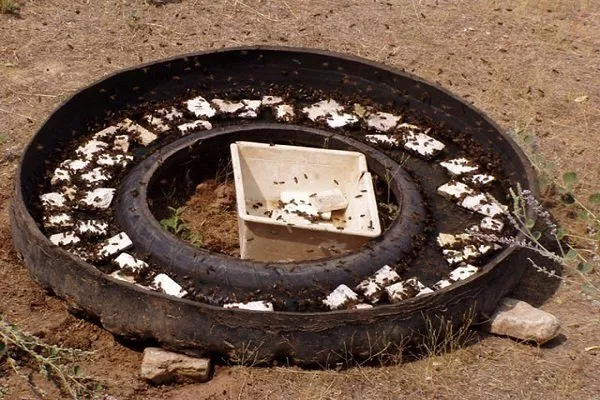
Goose feeders are expensive in specialized stores, so many farmers prefer to make their own. Various materials are used, including plastic pipes, wood, metal, and so on, while some even manage to use scrap materials, such as car tires, basins, buckets, and barrels.
Bunker
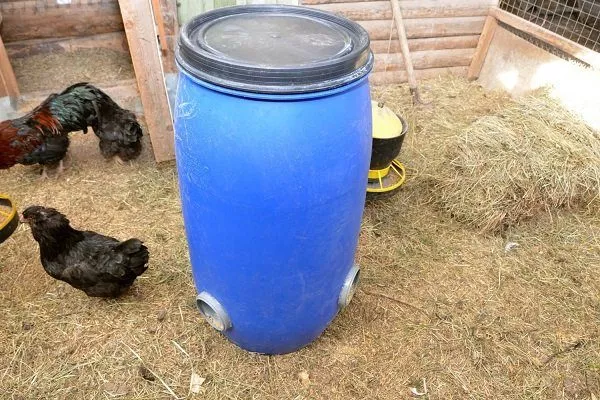
Building such a structure isn't as difficult as it seems at first glance. It's important to purchase the necessary materials and prepare the tools. It can be made from a barrel and a plastic pipe.
What you will need for option 1:
- barrel made of plastic or metal;
- hacksaw;
- hot melt glue;
- pieces of plastic pipes at an angle of 90°.
Manufacturing process:
- Use a marker or felt-tip pen to mark the entire diameter of the barrel from the bottom. The height should be between 30 and 40 cm.
- Take a corner piece of pipe and cut it into 2 parts strictly along the bend.
- Place pipes on both sides of the barrel, outline them with a marker and cut out round holes.
- Insert the pipes into them and treat the joints with hot glue.
- Place the hopper on the floor, fill it with food, and close the lid.
If you don't have a barrel, use plastic pipes.
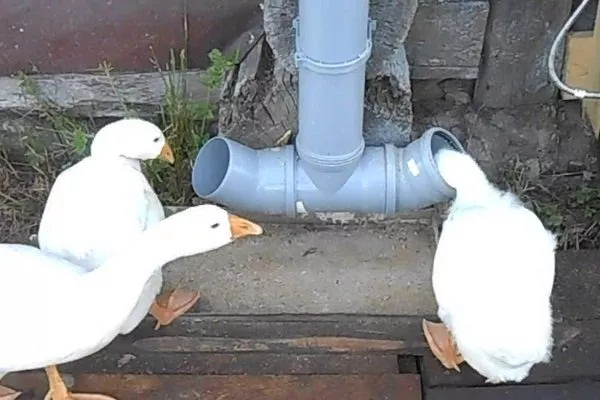
Prepare the following materials:
- a piece of plastic pipe for the tank (length 1-1.2 m, diameter 9 cm);
- tee (coupling);
- 45° elbow adapters;
- fastening clamps;
- plug;
- screwdriver, screws, hammer.
How to make:
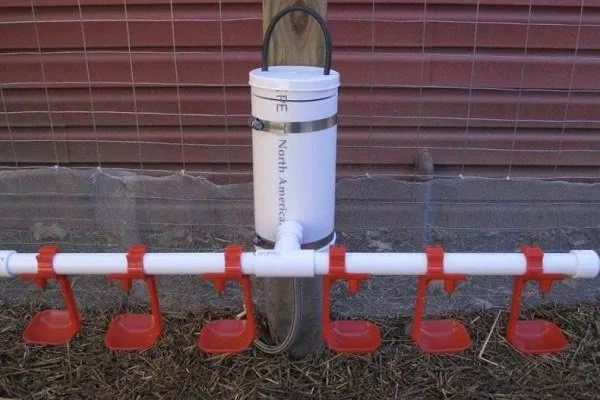
- Attach the bunker pipe to the center of the tee.
- Place the corner adapters onto the ends of the coupling sticking out to the sides, tapping them in place with a hammer;
- Fasten all parts with screws using a screwdriver.
- Attach with clamps to the support post.
- Pour in the food and close the hole at the top with a plug.
To visualize the work process step by step, watch the video:
Wooden
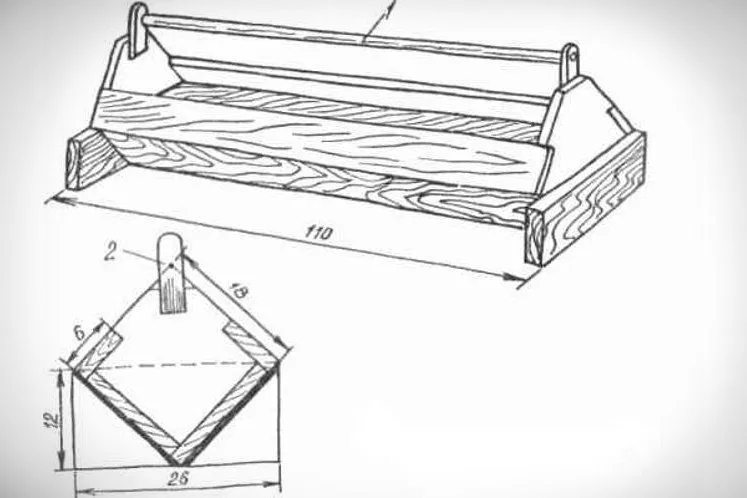
A very simple design that requires a little skill. And also the following:
- wooden slats – 4 pcs. (2 wide and 2 narrow);
- rail for the crossbar-handle;
- plugs – 2 pcs.;
- bars according to the size of the slats;
- hammer and nails.
Sequence of work:
- Knock together a box from wide and narrow slats so that the bottom is at a 90° angle.
- Nail wooden plugs to the sides, and a block to them to stabilize the structure.
- Attach a strip to the plugs, which functions as a handle.
This design prevents food from being scattered and prevents geese from getting inside.
Scheme:
For wet food
For wet mixes, you can use two simple feeder options. Namely:
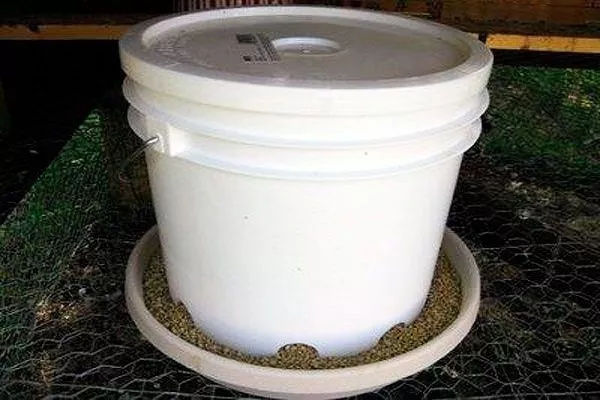
- From a plastic bucket. Manufacturing process:
- Make 4-5 holes on the sides near the bottom.
- Take any container such as a deep plate.
- Glue the bucket bottom to it.
- Pour in the food and close with any lid.
- From a water pipe. How to do:
- On one side, make holes along the length with a diameter of 20-25 cm (or one large one).
- Insert a plug on one side and an angular adapter on the other side with the hole facing up for filling with feed.
- Install the structure on any base.
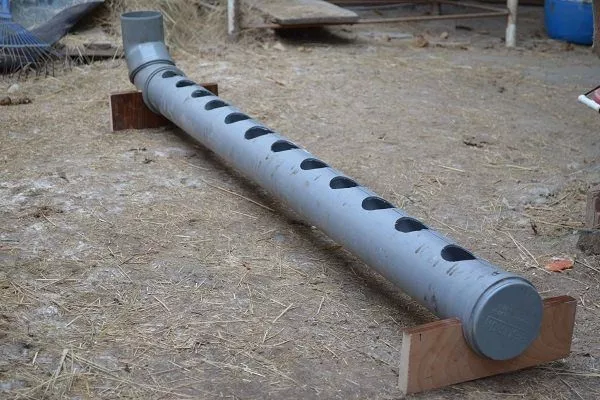
A simple option is to cut a plastic pipe into 2 parts and place them on any base.
Helpful Tips
To ensure the feeder accurately meets its intended purpose and application, strictly follow all step-by-step manufacturing instructions and model selection requirements.
Experienced farmers also recommend paying attention to the following aspects:
- Make sure the fastening is secure, especially if the feeder is located on a wall, as geese are heavy birds and the structure may fall under their weight;
- for the same reason (due to the weight of the bird's body), choose high-strength materials so that the structure does not crack during use;
- Do not mount the feeder in such a way that it will be impossible to remove it later - do not forget that it must be washed and disinfected, and food residues must be removed, and this should be done quite often;
- When working with plastic, metal and wood, always file down the cut areas, otherwise the geese will injure their necks or heads;
- If you have made a bird feeder and it turns out to be too low, simply nail legs to it.
- Remove any food debris daily and wash the feeders with hot water.
- Once a week, disinfect the feeders with a vinegar solution or special products.
- Check the integrity of the feeders monthly, especially the attachment points and joints.
Goose feeders should be selected and used according to their intended purpose. Wet feeders should not be placed in wooden structures, but any model can be used for dry feed. Before purchasing or making one yourself, carefully consider all options – choose one that is convenient, safe, and affordable.