
Both male and female pigeons have strong parental instincts, so human intervention is usually not required when hatching chicks. Parents feed and care for their young well. However, there are situations when newborn chicks are orphaned. What should breeders feed them, and what feeding guidelines should they follow to ensure the chick survives?
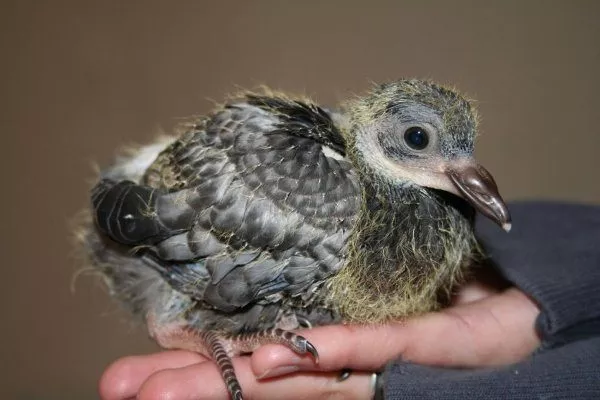
Why do chicks require special nutrition?
Chicks that remain with one parent from the first days of their lives most often die from lack of food on the ninth day. If both parents are lost, the entire brood dies within the first day. This is due to several factors:
- During the first week of life, chicks feed on their mother's "milk"—a semi-liquid, mushy substance. The mother produces this curd-like secretion in her crop. Pigeon "milk" is so nutritious that within two days, the chick's weight doubles. It's impossible to produce identical "milk" on your own, making it quite difficult for a chick to survive without its parents.
- Pigeon chicks are born helpless, blind, and hairless, making them completely dependent on their parents, or, in their absence, on humans. Their heads are disproportionately large relative to their bodies, making them unable to stand on their feet. Their beaks are enormous and constantly open, indicating that the chicks have a keen appetite and require a lot of food. However, only the strongest chicks, those who can adapt to this new diet, survive.
- ✓ The ambient temperature should be maintained at 35-37°C during the first days of life.
- ✓ Humidity in the room should not exceed 60% to prevent the development of fungal diseases.
A person can come to the aid of babies in time and feed them, but even in this case, their mortality rate in the first week after birth is very high.
Diet for the first week
For a chick to survive its first week of life without its parents, it will need to be fed foods similar in composition and calorie content to pigeon milk. So how is this very first "baby food" formed for pigeons? It happens as follows:
- The regurgitated stool, which consists of crushed grains, passes from the female's stomach into her crop. There, it mixes with a secretion—a milky liquid.
- The thick porridge made from the grains becomes liquid and digestible, meaning that the effect of pigeon “milk” is similar to the effect of human or any mammal’s saliva.
- After four days, the parent's crop begins to contain very softened grains the size of a hemp seed and a small amount of sand particles. This is the chicks' natural "baby food."
It's impossible for humans to create the same food, so we have to look for the closest possible alternatives. The best alternatives are:
- Chicken yolkThis is ideal food for newborn chicks because it contains a balanced concentration of nutrients. It is given warm.
- Combined or starter composition for feeding chicksThe dry mixture should be steeped in boiling water and diluted to the desired consistency—a mushy mass. It can also be served warm. This is an acceptable feeding option, but it is inferior in nutritional value and caloric content to chicken yolk.
Some pigeon breeders use dry baby formulas to feed their chicks, but experts categorically prohibit feeding them to the younger generation, as they are unsuitable for them in terms of both their composition and structure.
The chicks need to be fed yolk or a diluted solution at least six times a day, as their metabolism is very high. The difficulty lies in the fact that during the first week, the chicks are unable to feed themselves; in the wild, the mother regurgitates food directly into the chick's beak. For humans, it's best to use disposable 10-20 cc syringes or pipettes to feed the chicks, following these steps:
- Draw food into a syringe (pipette).
- Place a nipple on the tip of the instrument.
- Insert the nipple into the pigeon's beak and carefully squeeze out the required portion of food.
A person should pay special attention when inserting the nipple into the chick's beak. This is a rather complex process, and forcing it is not recommended, as it can easily injure the beak. So, what should you do? A little trick can be used: before feeding, touch the chick's head with your finger several times. This will be enough to get it to lift its beak and open it.
This is a natural reaction for all baby pigeons: initially, they are deprived of sight and hearing, so their parents signal that they are ready to feed. They lightly tap their heads with their beaks, and the chicks open their beaks. Humans can perform a similar ritual.
If you're force-feeding a chick, grasp its head with one hand and pry open its beak with two fingers, then gradually introduce food with the other hand. The process of force-feeding a chick is demonstrated in this video:
If you choose the right food and handle it carefully, newborn chicks won't die and can survive the first 18-20 hours. After this, they need to be trained to feed themselves; otherwise, they will not gain weight well and will lag behind in development. To enable them to eat without human assistance, attach a rubber nipple to the syringe and cut it at a 45° angle. The hole should be large enough for the chick to insert its beak and begin feeding independently.
Diet for the second week
| Name | Ripening period | Productivity | Disease resistance |
|---|---|---|---|
| Barley | Early | High | Average |
| Peas | Average | Average | High |
| Millet | Late | Low | Low |
| Wheat | Early | High | High |
| Vetch | Average | Average | Average |
| Millet | Late | Low | Low |
From the second week onward, mortality among the chicks drops significantly. The chicks open their eyes on the eighth day, their hearing improves, and their feathers develop. It's important to continue feeding them properly to ensure they gain weight and develop quickly. Furthermore, from the second week onward, they begin to be prepared for "adult" food.
Starting around day 9-10, the mother stops feeding her young a mushy mass from her stomach. Their diet now consists of softened grain from the mother's crop and plenty of water. Gradually, the parents spend less time swelling the grain in the crop. Throughout this time, the glands continue to function, but gradually it decreases, resulting in a decrease in the amount of "milk" produced.
Artificially fed chicks are given cereals:
- barley;
- peas;
- millet;
- wheat;
- vika;
- millet.
The feed is prepared as follows:
- Grind the beans in a coffee grinder to make flour. The finer the grind, the better.
- Steam the flour with boiling water and leave for 5-8 minutes.
- Add a small amount of honey to the grain mixture to boost the chick's immunity and mix.
- Enrich the chick's food with minerals, particularly calcium, to promote active growth. To do this, add dry crushed eggshells, chalk, or a small amount of red clay to the porridge. Avoid buying chalk blocks from office supply stores, as they contain significantly less calcium than chalk sold in specialized pet stores.
Fill a syringe with the resulting mixture and feed the chick. The number of feedings remains at six. Feed the chicks until their crops are full.
To help chicks get used to people more quickly, they should be fed in the same clothes. Also, avoid making loud, sharp noises or clapping, as the chicks shouldn't become anxious or fearful before feeding. You can speak to them in a quiet, even voice.
By the end of the second week, the chicks can be given whole grains as food, little by little.
Diet for the third week
With proper feeding, by the third week, the pigeons become stronger and more active. They are now fed on demand—they make quite loud squeaking sounds, making it impossible to miss a meal.
Three-week-old chicks need to be introduced into the menu:
- Finely chopped greensIt is a source of minerals and vital substances for the growing organism. Grass is fed to the chick in the same way as grain, that is, by hand-feeding it into the open beak.
- Whole grainsThey should be steamed first by soaking them in hot water for 5-10 minutes. If the grains become significantly larger after steaming, they should be cut in half and fed to the chicks in halves. Dry grains can get stuck in the chicks' throats. Place no more than 2-3 steamed grains in the chick's beak. If the chick's crop is full, stop feeding. Don't expect the chick to eat from your hand on its own during this period, so you'll have to manually open its beak and insert food.
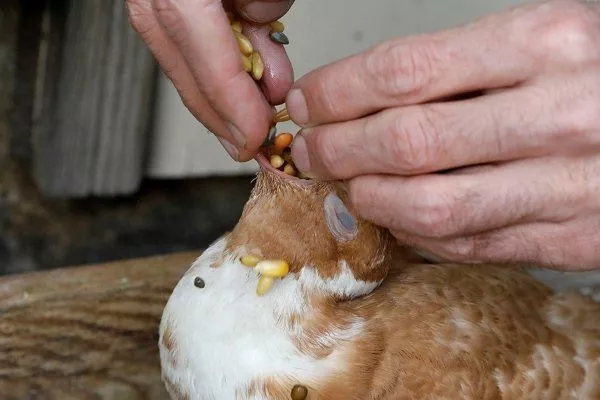
In the third week, the number of meals should be reduced to 4 times a day.
Give water only after feeding. It should be warm. To give the chick water, pour water into a shallow bowl and dip its beak into it, being careful not to let any water get into its nostrils. The first few attempts will be unsuccessful, as it won't immediately understand what's expected of it, but don't give up. Soon, the chick will understand that this is the water it needs.
Feeding month-old pigeons
A month-old chick's diet changes completely. The basic menu consists of the following foods:
- boiled chicken egg, finely grated;
- boiled carrots, finely grated;
- white bread, soaked in water and rolled into small balls.
New food should still be manually introduced into the chick's beak. To support immunity, it is recommended to add fish oil, but no more than twice a day.
The following products should also be included in the menu:
- a variety of domestic vegetables and fruits, but you cannot mix different types, that is, you can only give one finely chopped fruit or vegetable at a time;
- millet porridge cooked in water without adding salt, oil or other ingredients, small lentils and field beans (such food must be included in the diet of short-billed pigeon breeds).
It is forbidden to give raw millet to chicks.
When the chick begins to learn to fly, its menu will also need to be adjusted, reducing the amount of wheat, but increasing the content of legumes - vetch and peas.
Particular attention should also be paid to drinking. By this time, the birds are drinking plenty of clean water, so they should always have free access to it; otherwise, a lack of it will negatively impact the chicks' digestion. Avoid boiling the water, as high temperatures kill not only pathogens but also beneficial microorganisms. The water bowl should be cleaned regularly, and the water changed.
By the end of the first month, the chick should be fully capable of feeding and drinking independently. Only then can it be released into the community dovecote.
Feeding pigeons older than one month
| Name | Ripening period | Productivity | Disease resistance |
|---|---|---|---|
| Sorrel | Early | High | High |
| Clover | Average | Average | High |
| Dandelion | Early | Low | High |
| Cabbage and lettuce leaves | Average | High | Average |
| Spinach | Early | High | High |
| Alfalfa | Late | Average | High |
Once the chicks reach one month of age, they are transitioned completely to adult food, but this is done gradually, spreading the transition out over a full week. The diet is adjusted as follows:
- reduce the proportion of bread and eggs;
- increase the amount of grain crops.
- Start introducing whole grains in small portions, mixed with your usual porridge-like food.
- Gradually increase the proportion of whole grains in your diet over the course of a week.
- Monitor the chick's reaction to the new food and adjust the diet if necessary.
The most useful for them will be:
- ground peas;
- corn;
- wheat;
- sunflower seeds.
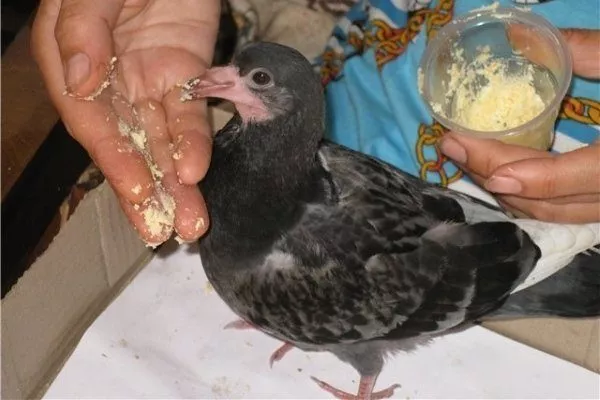
Green salads, shredded on a medium grater, should also be a daily part of your diet. They are made from the following greens:
- sorrel;
- clover;
- dandelion;
- cabbage and lettuce leaves;
- spinach;
- alfalfa.
You can add grated carrots and sprouted oats and barley to them. The sprouted grains themselves should not be ingested by the bird. Salads should not be salted, but a drop of unrefined sunflower oil is allowed.
Vitamins and minerals
For normal development and growth, pigeons require sufficient vitamins and minerals. Eggshells are a good source of minerals. To reduce the risk of rickets, bone meal, crushed chalk, or shell rock can also be added to the feed.
It's best to add vitamins to the water starting from the chicks' 15th day of birth. They need the following vitamins:
- A (retinol);
- group B – B1 (thiamine), B2 (riboflavin), B3 (nicotinic acid), B5 (pantothenic acid), B6 (pyridoxine), B9 (folic acid), B12 (cobalamin);
- D (calciferol);
- E (tocopherol).
However, it is important to adhere to the recommended vitamin dosage, as an excess of vitamins can cause hypovitaminosis, which can slow down the chicks' development and impair the functioning of their immune system.
To avoid overdosing, it's best to purchase multivitamin supplements from pet stores. They already contain all the necessary nutrients in the right concentrations.
What should not be fed?
Fruits and vegetables are beneficial for a growing chick, but not all of them are permitted. Specifically, the following crops are prohibited:
- potato;
- tomatoes;
- avocado;
- citrus;
- papaya;
- mango.
It is also prohibited to give:
- salt and salty foods;
- milk and dairy products (cause dysbacteriosis – a condition associated with a disruption of the intestinal microflora);
- fish, meat and meat products, since this is very heavy food for chicks, which they cannot digest (their consumption can cause the death of pigeons);
- rye and rye bread, as they cause strong fermentation in the digestive tract, which leads to bloating and diarrhea;
- Sunflower seeds in large quantities (their peels can get stuck in the crop and damage it, and they also have a negative effect on the liver).
Video: How to feed a pigeon chick?
The following video clearly demonstrates how to feed a pigeon chick:
Newborn pigeons are fragile from birth and susceptible to various adverse conditions. However, with some effort, they can be raised and cared for. This requires strictly following all feeding recommendations, maintaining timely vaccinations, and regularly cleaning the loft.
Thank you so much for this article! A dove settled on the windowsill, laid eggs, and raised them for 10 days. Yesterday, one was gone. The remaining one is sitting and pacing the windowsill. The mother hasn't been seen for over a day, although she keeps checking in. The wind is still howling strong today. If the dove doesn't return by sunset, we'll feed her ourselves, as per your article. Thanks again!
Hello! I had a similar situation. A dove appeared under my neighbors' window. She was sitting in a flowerpot. One day, my husband accidentally noticed that there were two eggs in there! Since then, for five or six days now, we have been tirelessly watching this family. I was worried about the dove because I couldn't figure out if the dove was replacing her. Doves form very good pairs and raise their offspring together. How can I know if they are replacing each other? Maybe it's a funny question, but I didn't know anything about birds before. I really don't want her to go hungry. Or exhausted. On the other hand, she won't be able to eat, drink, go to the toilet, or go for a walk for a week. Is she supposed to stay in the flowerpot? But who changes her and when? So it turns out she abandoned the nest at her own risk since my husband saw the clutch. People, please tell me, if anyone knows what to do. The neighbor whose window the birds have taken a liking to is an elderly woman. I hope she won't hurt them. But she's unlikely to pour water, and at the same time, scaring them would be a disaster. What should I do? I'm so worried about these birds, I keep an eye on them all the time, I read information, and I don't know what to do. Please tell me if you know.
Hello and thank you