
Because pigeons hide their offspring Because pigeons hatch in hidden places, no ordinary person can accurately say how many days they incubate their eggs. It's unlikely anyone is particularly interested, but for pigeon breeders, this question is considered important.
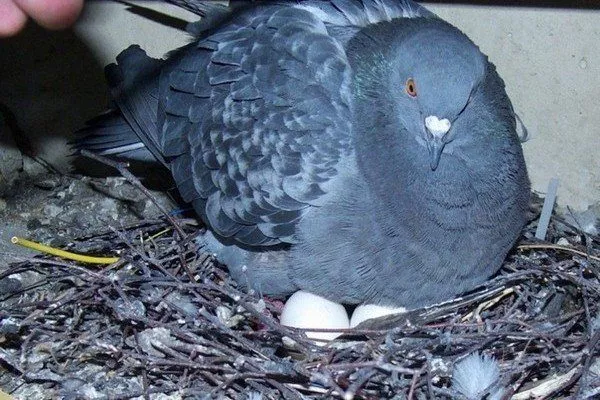
Oviposition and number of eggs
Pigeon eggs are distinguished by their shell strength and distinctive sheen; their color can be white or cream, depending on the breed. The first egg is laid a couple of weeks after fertilization. The number of "egg-layings" ranges from two to three per cycle. Pigeons lay four clutches annually, meaning one clutch per season.
- ✓ The optimal humidity in the nest should be 60-70% to prevent the shell from drying out.
- ✓ It is necessary to ensure that there are no drafts or sudden temperature changes in the room where the nest is located.
After one egg hatches, a certain amount of time must pass (the bird rests) before a second and third egg is laid (approximately 24 hours later). During this period, the embryo in the first egg may die. To prevent this, the egg must be temporarily placed in an incubator.
However, it also happens that a dove immediately begins brooding after laying the first egg, which leads to differences in hatching rates. To ensure the chicks hatch at the same time, remove the first egg and replace it with a dummy one. When the bird lays the next egg, replace it with a real one. Young birds have the most difficulty laying eggs, so they may even abandon the nest.
| Parameter | Optimal value | Critical value |
|---|---|---|
| Temperature in the nest | 36.1-40.7°C | <35°C or >42°C |
| Humidity in the nest | 60-70% | <50% or >80% |
For successful pigeon breedingBirds must be at least one year old and no more than five. When crossing different breeds, birds of similar age don't always pair. In this case, a young female and an older male are selected.
The process of incubation
The female begins to incubate the eggs after the expected number of eggs have hatched.
| Name | Average egg weight (g) | Shell color | Number of eggs in a clutch |
|---|---|---|---|
| Rock dove | 20 | White | 2 |
| Domestic pigeon | 22 | Cream | 2-3 |
Temperature
The temperature range for incubation ranges from 36.1 to 40.7 degrees Celsius. There is a 4-5 degree difference in temperature between the top of the egg (where the female sits) and the bottom (at the bottom of the nest).
How long does the incubation process last?
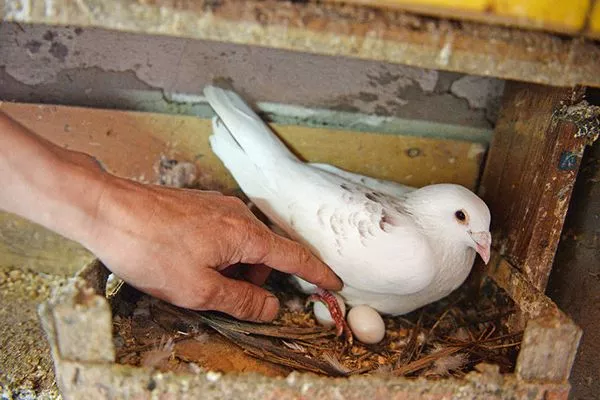
The incubation period varies, as it is influenced by various factors. On average, it lasts from 8 to 19 days. During this time, the dove turns her eggs several times.
What determines the duration of incubation:
- First of all, it depends on the breed. For example, rock pigeons hatch the latest, while some other breeds only need eight days to hatch.
- Temperature conditions – the warmer the conditions, the earlier the chicks hatch.
It also happens that the pigeons don't hatch at all because the embryos die. In this case, the female sits on the nest for too long. There are many reasons for this:
- genetic predisposition;
- crossing of relatives;
- infection of the dove;
- nest contamination;
- excessive vibration of the nesting site;
- improper diet of the mother dove (deficiency of minerals and vitamins);
- high humidity.
To obtain offspring during breeding, it is necessary to periodically check the embryos' condition. The first check is performed 3-4 days after the start of incubation. For this, the eggs are illuminated with a lamp. The embryos' incubation period corresponds to the incubation period of the eggs.
Who hatches the eggs?
The dove is responsible for incubating the eggs, but since doves are so protective, the male also plays an active role. About a couple of times a day, he replaces the female so she can feed. He does this during the day. If the expectant mother fails to return to the nest in time, the male begins to panic, emitting loud cries.
Watch an interesting video of the entire process of a pair of pigeons incubating a clutch:
If you've decided to start a pigeon coop to breed these wonderful birds, be sure to read up on mating, laying, and incubation techniques. Remember that each breed has specific breeding criteria and rules that must be strictly followed.