
The history of pigeon posting dates back to ancient times. These birds were used in warfare and helped deliver important information over long distances. Read this article to learn whether breeding homing pigeons is still relevant today and which breeds are best trained.
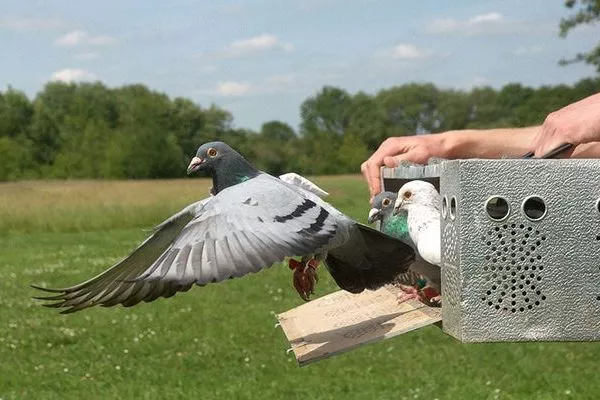
Historical information
The first mention of pigeon post can be found in the Bible. The Old Testament tells of Noah sending out a dove to check the land for habitation, and the bird returned to him with an olive branch.
In Ancient Rome and Greece, birds were used to transmit military messages and important information for the state.
Pigeon post became widespread in Egypt during the reign of Nureddin, who ordered the construction of numerous postal towers, thereby establishing communication throughout the country.
Later, pigeon post was used to transmit love letters and important news.
Pigeons played a significant role during World War II, delivering urgent messages to the front.
How does a bird know where to fly?
It's a misconception that a homing pigeon can be sent anywhere in the world and that it will deliver a message. In fact, the only place pigeons can reliably fly to is their nest.
This instinct is called "homing." Even when transported over long distances, a pigeon returns to its natal home. This ability is due to the presence of magnetic receptors located above its beak. With these, the pigeon detects magnetic fluctuations, which differ at every point on the earth. Even a newborn chick can accurately detect the magnetic field of its nest.
In addition, pigeons have a phenomenal memory for birds and are excellent at orienting themselves, allowing them to unerringly find their home.
How far can it fly?
Pigeons fly at speeds of approximately 70 km/h. They are capable of flying over 300 km in a single flight without stopping. Trained pigeons can cover distances of up to 1,000 km.
Is it relevant today?
Pigeon post remains relevant today. In European countries, the birds are used to deliver highly sensitive information. However, instead of letters, they now attach a microchip or flash drive to their legs. This ensures the security of the transmitted information, as it is more difficult to access than when sent online.
Pigeons are also used for advertising purposes, delivering announcements or promotional messages. More romantic individuals even use birds to send love letters.
Today, training pigeons for sport is popular. There are entire Olympics where pigeon owners compete to see how strong and enduring their charges are.
You can learn more about the historical and modern use of pigeon post by watching the video below:
Breeds
Not all pigeon breeds are suitable for mail delivery. Only strong, resilient, and easily trained birds can handle this task. The most popular are described below.
| Name | Flight speed (km/h) | Maximum distance (km) | Size (cm) |
|---|---|---|---|
| English quarry | 70 | 1000 | 50 |
| Belgian | 65 | 800 | 40 |
| German postal | 60 | 700 | 35 |
| Russian postal | 75 | 900 | 45 |
| Czech | 55 | 500 | 30 |
| Dragons | 80 | 1100 | 55 |
English quarry
This breed's lineage dates back to ancient times. It is believed that their ancestors delivered mail throughout ancient Egypt and China.
English pigeons are valued for their good flying qualities, speed and endurance.
The main qualities of pigeons:
- Body constitution. Pigeons are quite large, reaching up to 50 cm in height. However, they have small, neat heads.
- Eyes. Expressive thanks to the clearly defined eyelids.
- Wings. Long. Closely attached to the body.
- Beak. Thick. It has wart-like growths on it. This characteristic distinguishes English pigeons from other breeds.
- Tail. Elongated. Almost reaches the ground.
- Plumage. Hard, mostly monochromatic. Birds can be white, black, or brown.
The most popular variety is the Carrier.
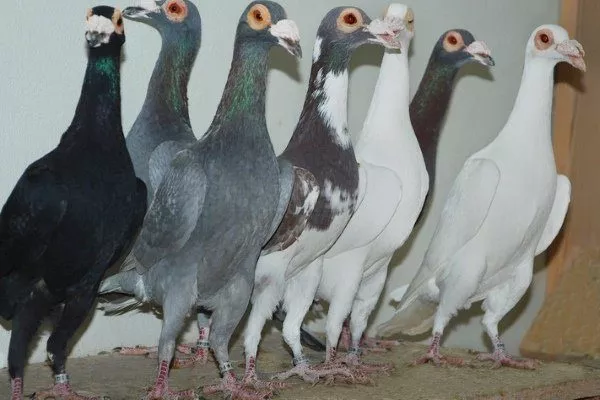
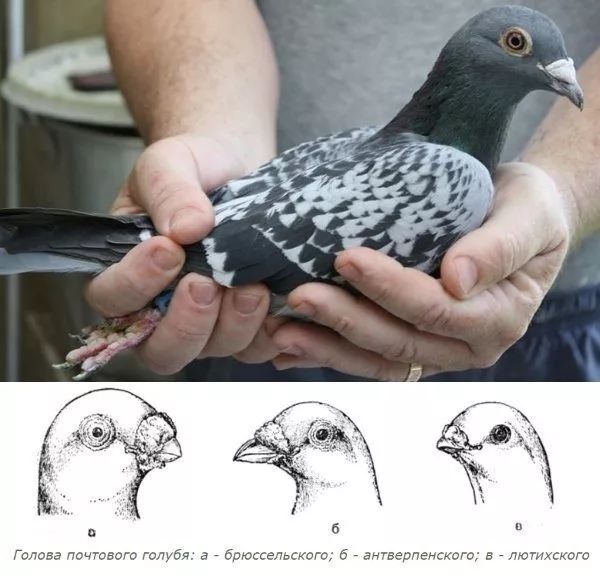
Belgian (Antwerp, Brussels, Luttich, etc.)
They were bred at the beginning of the 19th century by crossing several species of pigeons.
The breed is highly valued because the birds have excellent navigation skills and are capable of flying very long distances.
What other traits does the breed have:
- Body constitution. The birds are medium-sized and can grow up to 40 cm. They have a rounded body shape and a broad, well-formed chest.
- Eyes. Black in color. Outlined by pale eyelids.
- Head. Small, rounded with a growth on the beak.
- Tail. Long and narrow.
- Plumage. Shiny and silky. Color can vary from light to dark.
- Wings. They lie close to the body and have shortened feathers.
It is widely believed that Belgian pigeons acquired their good flying qualities through crossbreeding with seagulls.
German homing (show) pigeons
This breed was developed by crossing English and Belgian pigeons. Breeders aimed to create a strong and beautiful breed with excellent flight characteristics.
Although early attempts were unsuccessful and only produced a species of aesthetic value, today German pigeons are highly valued as a postal breed.
Their qualities are as follows:
- Body constitution. Pigeons have a fairly broad chest. They are powerful and stocky.
- Wings. They do not fit tightly to the body, protruding slightly forward.
- Neck. Very long. With a small head.
- Beak. Flat.
- Color. It can be varied. Doves can be blue, white, or brown.
- Size. The birds are quite miniature.
- Tail. Shortened.
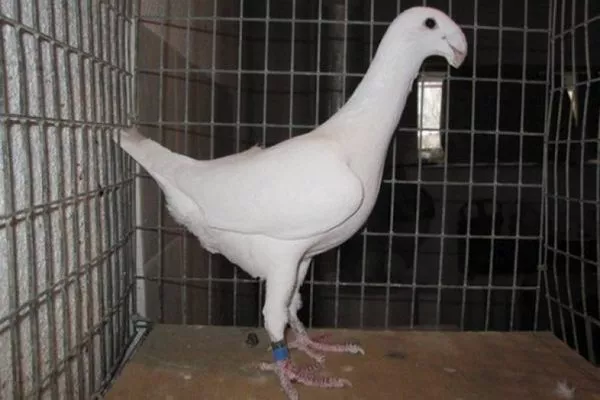
Russian homing pigeons
Birds of this breed have a rather beautiful profile with a rounded head. They are stately and graceful.
Among the main characteristics of this breed:
- Wings. Powerful. Pressed close to the bird's body, with curved tips.
- Legs. Elongated in shape. Quite strong. They lack feathers.
- Color. Predominantly white, but there are varieties with variegated plumage.
- Beak. Convex. Widens at the base.
- Eyes. They have a predominantly red-orange iris.
The most highly prized are the Ostankino variety. They can be distinguished by their black eyes.
Czech
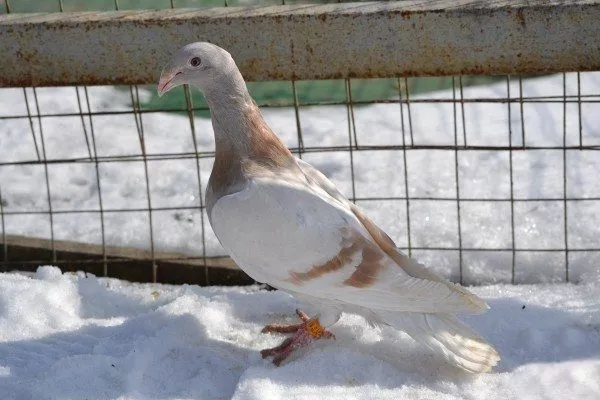
Birds of the Czech breed are used for postal purposes when short-distance flights are required.
Czech pigeons are very loyal and easy to train.
What else are these birds valued for:
- Body constitution. The pigeons are small in size, but very stately.
- Beak. Small. Has a soft growth at the base.
- Eyes. Large, expressive. Mostly black.
- Tail. Short, wide.
- Neck. Elongated.
- Wings. Fits tightly to the body.
- Plumage. Smooth. The color can be light or brownish.
Dragons
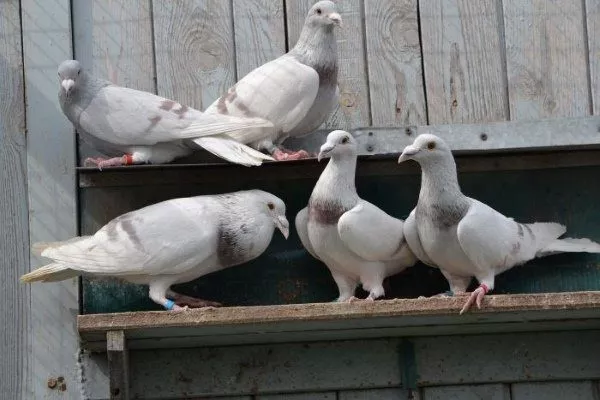
This breed was the first to be used for mail delivery. This is due to the pigeons' activity and excellent spatial orientation.
The value of Dragons is also determined by their unpretentiousness in maintenance.
Breed parameters:
- Body constitution. Dense. With a small head. The chest is rounded.
- Eyes. Large. They have a reddish-orange iris.
- Beak. Long. Closes tightly.
- Neck. Medium size. Tapers towards the head.
- Wings. Strong, powerful, long.
- Tail. Long, sloping downwards.
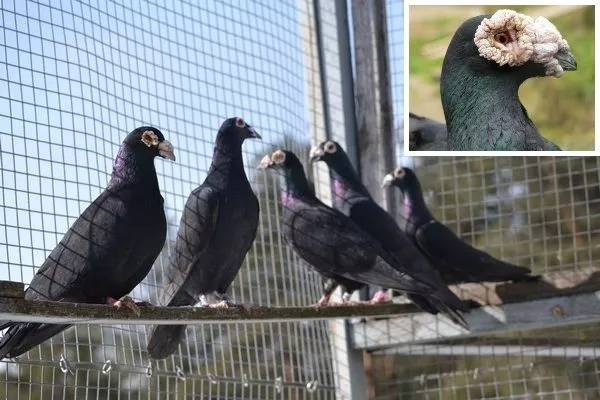
- Plumage. The color is predominantly dark.
Conditions of detention
As for the conditions for keeping pigeons, you need to remember the following rules:
- Nutritional norm. One pigeon requires 400 g of feed for 7 days. If training is intensive, the norm increases to 800 g.
- Feeding frequency. Birds need to be fed 3 times a day.
- Feeding time. It is better to give food immediately after sunrise, after lunch and before sunset.
- Diet. Pigeons can be fed yellow peas, lentils, and vetch. Mix a little lime or salt into the feed. For variety, you can add flaxseed, potatoes, and oats. The water should be changed daily.
- Living conditions. Dovecotes where the birds are kept must be dry, clean, and protected from the wind. A dovecot in the attic of a house can be used. It is essential that the pigeons have free access to and from the nest.
Education
Before pigeons can be used as carriers, they must undergo a full training course.
- ✓ Start training with a distance of no more than 5 km, gradually increasing to 100 km.
- ✓ Use pigeons between 6 weeks and 2 years of age for best results.
- ✓ Provide pigeons with rest for 48 hours after a flight over a distance of more than 50 km.
It is better to start training pigeons at the age of 6 weeks.
The following activities are being carried out:
- Test flights. They are produced around the dovecote where the bird lives. The course lasts 1.5 months.
- Short-distance flights. The pigeon is carried a short distance from its home and then released to return to its original nest. The distance is gradually increased once the effect of each flight has been reinforced.
You shouldn't shorten the distance, as this may negatively impact the learning process.
- Increasing distance. Over time, the pigeon will learn to find its home from several hundred kilometers away. However, it's important to remember that a one-year-old bird is unlikely to be able to travel more than 300 km.
- Rest. Before each short-distance flight, the bird must rest for at least one day. For long-distance flights, at least 90 hours are required.
- Motivation. To reinforce the effect, birds returning home should be given a treat. Care must also be taken to choose a partner for the pigeon, otherwise it may find one elsewhere and not return home.
- Activity. It is necessary to ensure that the bird is constantly active to maintain optimal physical condition.
- Weather characteristics. It's best to start training in clear, dry weather, as this will make it easier for the bird to find its home. Once the skills are mastered, you can try releasing the pigeon in the rain.
- Time of year. The ideal time for training is considered to be the period from April to October.
- Time of day. The dove must be released into flight in the morning, before noon.
- Flight conditions. Birds must be transported to the departure point quickly to prevent them from becoming lazy while in the basket. It's best to release them from an elevated position. It's important to remember that they navigate better in open terrain than in uneven ground.
- Catching pigeons. It's better to catch birds during the day with nets rather than by hand. Handle them carefully to avoid developing a wary, timid attitude toward their owner.
At night, you can pick up pigeons with your hands.
Today's use homing pigeons Homing pigeons can become not only an exciting hobby and sport, but also a business. Training a homing pigeon requires considerable time and patience. It's important to choose the right breed, time for training, and consider its physical development. This is the only way to raise a perfectly trained homing pigeon.