
Few people have seen newborn pigeons, so the question often arises: where do pigeons hide their chicks? After all, these birds live not only in the wild but also on city streets. They actively interact with children and adults, accepting food from hands without fear. However, they stubbornly refuse to display their offspring.
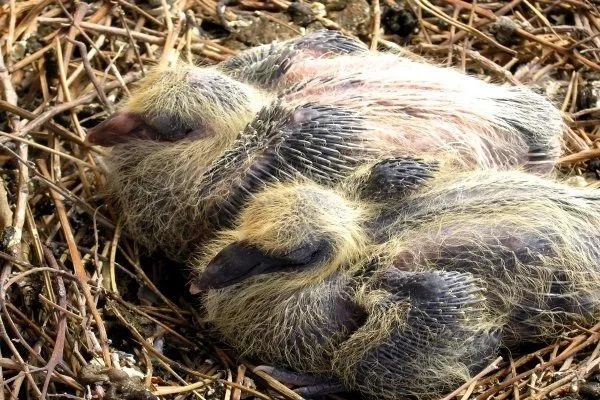
Is it possible to see the pigeons?
Like any feathered creature, pigeons incubate eggs and build nests. However, they do so in places hidden from human eyes. For example, in the attic, in gutters, under balconies, in trees, and in various niches. In other words, places where neither humans nor predators can spot or reach them. Pigeons, being very caring parents, are simply concerned for the safety of their young, which is why they nest so secluded.
- ✓ Availability of shelter from direct sunlight and precipitation.
- ✓ Availability of food and water in the immediate vicinity.
- ✓ No drafts or sudden temperature changes.
Another reason why it's impossible to see baby pigeons is the late age at which they leave the nest and begin their independent life. This is why people encounter young birds, but not small chicks.
Where do pigeons hide their chicks?
Pigeons are known for their dedication to each other. For example, males perform courtship dances, including pirouettes and bows, to attract a female. During this time, they pay absolutely no attention to other pigeons or people. What can we say about the period when a pair of pigeons is searching for a nesting site? During this time, they engage in brutal fights with other avians, solely to secure the desired spot. They also protect their chicks in the same way, but in this case, they prefer to hide them away from strangers.
In the wild, many pigeon breeds nest in rocky gorges, while others nest in tree branches. Within city or rural areas, finding nests with young is difficult, as they build them in places where humans are absent. If it's an attic, it's always one that people don't visit; if it's a balcony, it's on the side where human hands can't reach.
They especially love old and unusual buildings (theaters, circuses, Khrushchev-era buildings, and the like), where they can find refuge among colonnades, architectural sculptures, etc.
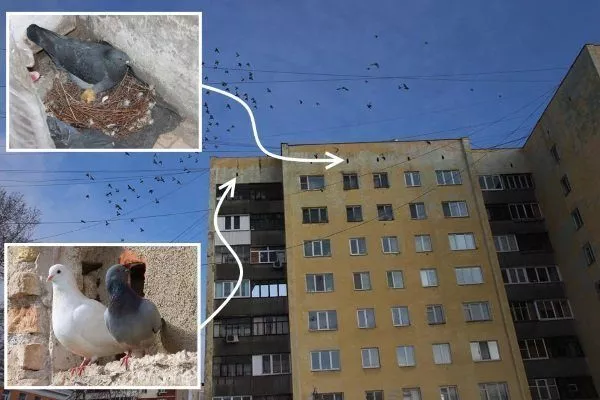
Why?
It's already known that pigeon chicks leave their parents' nests at a young age, that is, when they become independent. This is due to the parent pigeons being overprotective of their young. But there are other, more significant reasons:
- Their nests are so hidden that enemies have difficulty reaching them. Pigeons practically don't have any nests anyway, so they don't try to mature quickly.
- Pigeons feed their chicks with their own milk, which lasts for a long time (only flamingos and some penguin species do this).
Pigeons are completely uncompromising about their own safety, even to the point of abandoning nests with their chicks when danger approaches. For this reason, people should not even attempt to find the birds' nests to look at the chicks. Otherwise, they will die.
How do pigeons grow up?
Scientists studying pigeons have long since discovered that female pigeons have the ability to incubate their eggs frequently. This occurs within a couple of weeks of hatching. Since the young are under their parents' care for a long time, it's common for a single nest to contain individuals of varying ages and, consequently, sizes. When a female pigeon is incubating a new brood, but also has chicks, their upbringing falls entirely on the male.
The process of growing up:
- Pigeons are born blind and featherless, with only a light downy coat visible on their bodies.
- They cannot be left alone, as they do not yet have a constant body temperature.
- During the first 15 days, the chicks grow actively, increasing in size, and only after this time does their development slow down (they grow a couple of times larger).
- Over the course of a month, the down is gradually replaced by feathers, so after entering the flock, the pigeons are no different from adult birds.
- The beak is fully formed after 2 weeks.
| Stage | Duration | Characteristic signs |
|---|---|---|
| Birth | 0 days | Blind, without feather covering |
| Active growth | 15 days | Rapid increase in size |
| Beak formation | 14 days | The beak becomes full-fledged |
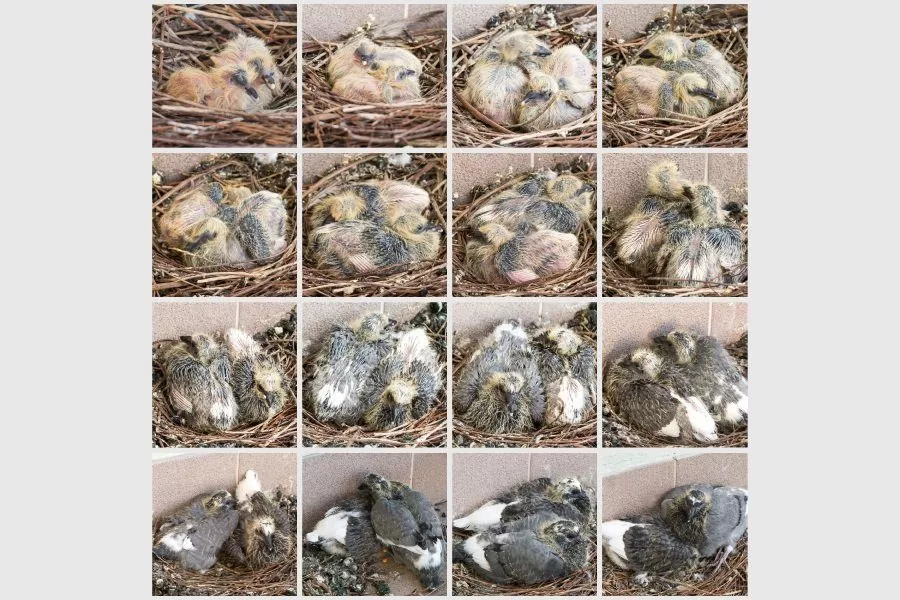
If the female dies, the young are raised by the female pigeon. If the male dies, the female pigeon is unable to raise her offspring on her own. Despite their intense care, a pair of pigeons almost always abandons sick young, keeping the pigeon population healthy.
The chicks' emergence into the flock
Pigeon chicks leave the nest and join the flock starting at 28 days after birth, but the maximum period is 34 days. These chicks are still quite young and often overlooked by humans. However, there are significant differences:
- Grown-up chicks are very shy, as they are not yet familiar with the surrounding environment and people.
- Their plumage is significantly different—it's dull, lacking bright colors. They also lack the iridescent feathers of adults.
- There's no swagger (when pigeons stroll down the street, completely unafraid of people). The young don't approach for crumbs and remain solitary.
- Young individuals move quite quickly. This can be called running.
- If the pigeons leave the nest after 28-30 days, they will definitely follow their parents everywhere, begging for food.
- Chicks that have crossed the 34-day mark are already looking for food on their own, but still try to stay close to their father and mother.
- Quite often, during the daytime, a whole flock of young animals is formed, as they feel more confident together.
Breeding pigeons This is a very secretive process. Pigeons choose the most secluded corners, inaccessible to humans, to raise their chicks. They feed them with royal jelly for a long time, care for them, and don't let them out into the world until they are fully grown. This is why it's impossible to detect young pigeons.
A very cool article – I learned a lot of interesting things. And most importantly, everything is detailed and truthful. We need more articles like this.