
The wood pigeon is a wild wood pigeon, often called the wood pigeon. It is distinguished by its large size, which is especially noticeable when compared to other pigeons. It thrives in forested areas and is able to hide from predators.
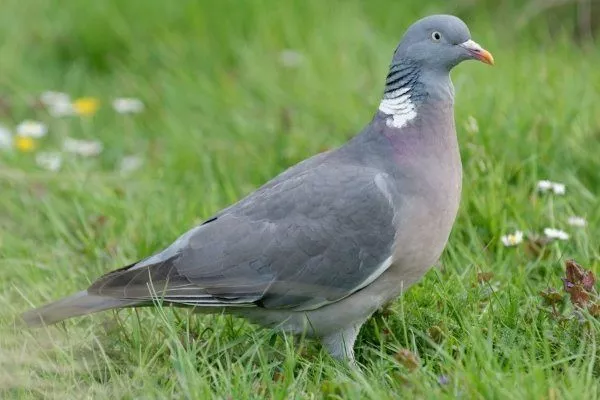
Description of the bird and its characteristics
Wild wood pigeons are distinguished by their striking plumage, attracting attention with their bluish-gray hue. This coloring provides a unique means of concealment from predators. Because of their camouflage, enemies cannot see the pigeon, giving them a greater chance of remaining undetected. The plumage on the chest is red, while the plumage on the neck is greenish with a metallic sheen. In the sun, the birds' feathers glow incredibly beautifully.
Compared to their urban relatives, wood pigeons are much larger. Their body length, including tail, is over 40 cm. They can weigh over one kilogram. Individuals weighing over one and a half kilograms have also been observed.
The birds have a small, ash-colored head. Round, black eyes occupy the face, with a yellow rim around the pupil. The bill is curved red at the base with a sharp, yellowish tip. The head is perched on a gracefully arched, metallic-looking neck, with two distinctive white spots on the sides of the plumage.
Wood pigeons have a small tail that opens in flight, revealing a white transverse stripe. Their wingspan reaches 80 cm in flight. When the bird flies, beautiful white stripes cross the wings. Their large wingspan allows them to reach speeds of up to 180 km/h. Seasonal migrations pose no threat to wood pigeons, as they can cover distances of up to 1,000 km without stopping.
The body rests on slender, pinkish-red legs. Sharp claws allow the bird to grasp branches with ease.
During the first weeks of life, the chicks' plumage bears little resemblance to that of an adult pigeon. The young are predominantly a dirty gray. Only with age do the chicks become attractive and interesting.
Distribution area
The wood pigeon has a fairly wide distribution. It inhabits virtually all of Europe, except for the northern regions. In some areas, the bird does not reside year-round, migrating to warmer climates during cold spells, but returns in the spring. During this time, it is often spotted feeding in winter wheat fields.
Wild birds spend most of their time in coniferous forests, and less often settle in park areas, building nests there.
Vocal qualities and behavior
As early as dawn, wood pigeons begin to emit their characteristic loud "kru-ku-ku-ku-ku" sounds. The pigeons perform energetic flights, producing a sharp whistling sound with their wings. During the breeding season, these birds are secretive, hiding in tree foliage and becoming silent if they hear animals or people approaching.
The pigeon feeds in the same area, not far from its nest. It is wary during migration, usually stopping in areas difficult for other animals to access.
Population status and conservation
The wild wood pigeon thrives on order and silence. It would seem that urbanization would lead to a decline in rural populations, which would ensure peace in the forest. However, due to the significant growth of hiking and driving, pigeons are abandoning the habitats to which they have become accustomed. Wild pigeons have almost completely ceased to inhabit suburban forests, frequented by mushroom pickers for almost the entire summer.
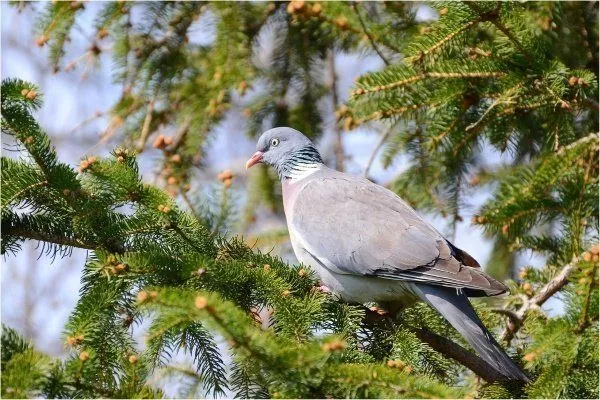
Wood pigeon numbers began declining in the late 1940s, driven by the use of pesticides in agriculture, which led to the death of the birds in large quantities. Today, the bird population is equally decimated by hunters, for whom hunting wild pigeons is a gamble. Wood pigeons easily escape even if shot, making it difficult to recover a dead bird, leading to continued hunting.
The Azores Islands are home to a subspecies of wood pigeon, Columba palumbus azorica, which is listed as endangered. It inhabited the forests of all the major islands of the archipelago, but today is found exclusively on the islands of Pico and São Miguel. Another subspecies of wood pigeon, Columba palumbus maderensis, which settled on the Madeira Islands, was exterminated at the beginning of the last century.
Lifestyle and duration
Like most wild animals, pigeons prefer to remain cautious. This is because wood pigeons are helpless against large predators. However, their ability to fly at high speed helps them avoid danger. If a predator is nearby, pigeons become silent and freeze, thus concealing their presence. The bird's wingspan, which produces a loud, whistling sound in flight, can alert the animal to the presence of a wood pigeon.
Birds also dislike people. They prefer to build their nests no closer than 2 kilometers from human settlements. While there are some that nest very close to people, they are rarely seen in large cities. They prefer remote forests—they feel comfortable and safe there, and they have the opportunity to raise their young.
Wood pigeons are energetic and sociable among themselves. They form sizable flocks, sometimes numbering over two dozen birds.
Under favorable living conditions, wild wood pigeons can live up to 16 years.
Nutrition
The pigeon's diet is primarily plant-based. Only very rarely will the birds consume animal food. They occasionally consume caterpillars or earthworms. They prefer grain crops, wild grasses, and legumes. However, they will eat any grains found on the ground.
The wood pigeon's dietary preferences depend on its habitat. If it lives in a coniferous forest, it will happily feed on tree seeds. As the vegetation changes, so do its food preferences. Wood pigeons enjoy beech berries and oak acorns. They will also enjoy wild strawberries, blueberries, viburnum berries, and lingonberries.
| Habitat | Basic diet | Additional food sources |
|---|---|---|
| Coniferous forest | Tree seeds | Young buds, clover leaves |
| Deciduous forest | Acorns, beech fruits | Strawberries, blueberries |
Birds of this breed are known for hoarding food, storing it in a fairly capacious crop (it can hold about eight acorns). The bird picks up its food from the ground, and enjoys browsing on low-growing plants.
If the wood pigeon inhabits dense forests, it plucks fruit from trees mid-flight. It can even peck at young buds. Long winters often force the bird to feed on clover and cabbage leaves. Because of its varied diet, the wood pigeon can thrive in virtually any environment.
Reproduction
Wood pigeons can produce offspring three times a year. Breeding usually begins in April, when the birds return from wintering. Breeding continues until the end of the first month of autumn.
How is a pigeon pair formed?
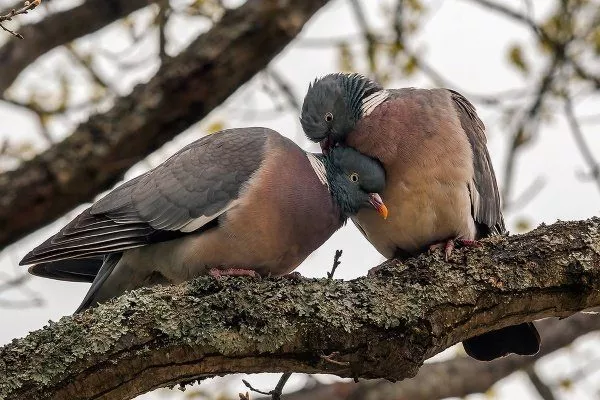
Pigeons reach sexual maturity at 10-11 months of age. It's at this point that, to attract females, males perch in treetops and begin cooing loudly. This is usually how they begin their day, as they're accustomed to making these sounds early in the morning.
Once the female notices the pigeon, he descends and circles around her, cooing constantly. This courtship behavior eventually leads to the laying of eggs.
Nest arrangement
Before incubating their eggs, woodcocks prepare a suitable nest. They are very meticulous about their construction. Before picking up a twig for construction, the birds carefully tap it with their beaks, as if testing its strength. Only after they are satisfied that the material is of suitable quality will they use it for nesting.
Particularly impressive is the speed with which wood pigeons build their nests, taking only a few days to complete. They create a sturdy frame using thick branches, weaving smaller, more flexible twigs between them. The result is a nest with a flat bottom and a loose cocoon with several openings between the branches.
Pigeons build their nests no more than two meters above the ground. Only the lazy wood pigeons use the remains of other birds' nests, such as those of falcons, magpies, and crows.
Hatching eggs
Typically, a female lays two small white eggs per clutch. The birds incubate the eggs for two weeks, with both parents actively participating. After hatching, the chicks feed exclusively on pigeon's milk—a curd-like secretion accumulated in the parents' crop. They then begin to eat other foods typical of adult birds.
- ✓ The temperature in the nest should be maintained within 36-38°C for optimal egg hatching.
- ✓ Humidity around the nest should not exceed 60% to prevent the development of fungal diseases in chicks.
Caring for offspring
Wood pigeons are quite caring and efficient parents. They feed their chicks and teach them the intricacies of flight. After just 1.5 to 2 months, the chicks become quite independent and can take care of themselves.
Wood pigeon hunting
Wood pigeon hunting is a sporting event, exciting and thrilling. The only drawback is the birds' natural wariness. However, this very trait fuels hunters' enthusiasm, fueling their desire to secure a trophy pigeon.
A hunter must be restrained, patient, cautious, and cool-headed. In spring, in authorized areas, it's possible to hunt wild pigeons using decoys. Experienced hunters imitate the birds' calls, luring them into their "nets." In summer, decoys are most often used for hunting. This is an equally common bird decoy. Artificial birds (similar to wood pigeons) can be purchased from specialty stores or made at home.
True scaly-sided pigeons, accustomed to living in flocks, happily fly up and perch nearby when they see their "fellows," which is how experienced hunters catch them. It has been observed that the more decoys used for hunting, the more pigeons will be attracted to the decoy.
In Russia, the use of airguns for hunting wild pigeons is prohibited. However, some offenders flout the law and use airguns to catch the birds.
Natural enemies of the Wood Pigeon
The most dangerous predators for the wood pigeon are birds of prey. Pigeons suffer not only from falcons and hawks, but also from jays, squirrels, hooded crows, and magpies, which destroy wood pigeon nests and eggs. Martens, which can move freely among the treetops, also prey on the wood pigeon.
Because wood pigeons are large and bulky, they are unable to take off very quickly. When landing on the ground, they often become prey for badgers and foxes.
Wood pigeons suffer greatly from human activity, causing significant declines in their numbers. Some people believe that wood pigeons are damaging trees and therefore destroy the birds.
Wood pigeons are wild wood pigeons that pose no danger to humans. Their appearance is particularly striking: they are quite large but fast, immediately fleeing upon sensing danger. They are adept at camouflage. They care for their young, raising and training them themselves.