
Volga Ribbon pigeons are attractive birds that have won the affection of not only pigeon fanciers but also those who appreciate the breed's qualities. These birds are often bred for ornamental purposes, becoming a beautiful addition to any yard.
Historical data about pigeons
Russian breeders succeeded in developing a young breed in the early 20th century. They used Volga Red-breasted, Rzhev, and Dapple-winged pigeons for crossbreeding. These birds are always recognizable due to their striking appearance.
Most banded pigeons developed in the cities of the middle Volga region, hence the name "Volga pigeons." Because many local breeds with a "magpie" pattern were predominantly blue, they were appropriately called "red-breasted."
Population size and genotype estimation
No breed census has been conducted. Volga pigeons are bred in the following countries:
- Germany;
- Bulgaria;
- Russia;
- Hungary;
- Holland;
- Poland;
- Belarus;
- Switzerland;
- Kazakhstan;
- Ukraine;
- Lithuania.
The breed is numerous. The number of birds with red plumage is almost ten times greater than that with yellow feathers. According to breeding nurseries, the breed is homozygous. Each bird has a consistent pattern and color at birth.
What do Volga pigeons look like?
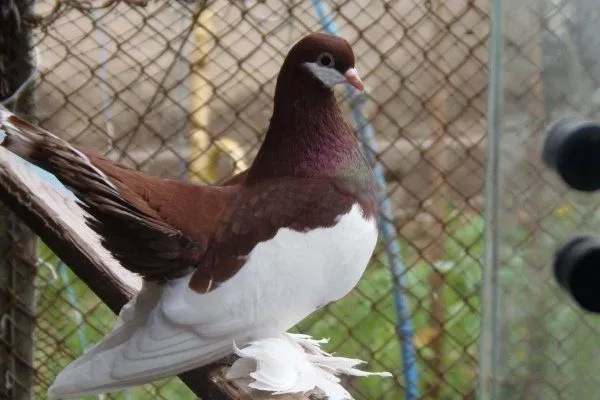
Volga Banded Pigeons are small in size. They are characterized by a stately build. Their distinctive feature is the beautiful color scheme of their plumage. Their head is walnut-shaped, with a flat crown and a relatively broad, rounded forehead that slopes steeply to the base of the bill.
Pigeons of this breed have dark, small eyes with narrow, smooth eyelids of a pale flesh color. Volga birds have a short, pointed, closed bill of a light pink hue. The head is set on a short, full, beautifully elongated neck. The chest is quite broad and convex, corresponding to a wide but short back, sloping toward the tail.
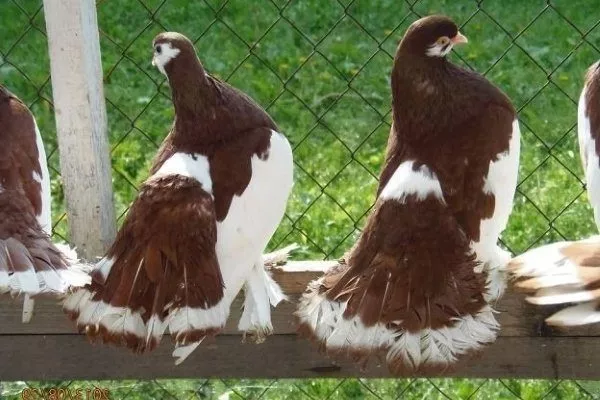
The birds are easily identified by their drooping wings—they hang slightly lower than the tail and are composed of flight feathers. The tail of pigeons is raised, broad, and flat, typically containing 12-16 feathers. The body is supported by short, feathered legs. The plumage on the scutellums matches the ground color. The feathers are cherry-white, sometimes yellow-white. Pigeons have no belts.
Flight qualities
Only proper and regular training leads Volga Ribbon pigeons to demonstrate their flight qualities. Excellent living conditions are equally important for good performance. Birds of this breed are capable of demonstrating excellent performance in a slow, circular flight, lasting 2-3 hours, sometimes longer. They are capable of reaching great altitudes.
What color are the birds?
Volga pigeons are distinguished by a unique color scheme, dominated by sharp boundaries. The texture is rich, smooth, and glossy. The plumage of the head, neck, back, chest, rump, and tail is cherry red, occasionally yellow. The lower mandible, cheeks, eyebrows, legs, belly, throat, and wings are all white.
A distinctive feature is a white stripe on the tail. This stripe is one to two centimeters wide and runs across the tail.
Features of maintenance and breeding
Keeping this breed requires a pre-built, spacious dovecote. It should be bright and dry. An aviary for walking is also required. Since Volga Banded pigeons are very clean birds, a dovecote bath should be installed. The bath should be compact enough to be easily removed after the birds have bathed.
A pigeon fancier must regularly clean the dovecote; the birds must be kept clean, and therefore their bedding must be changed regularly – this will help prevent infection with various diseases.
Pigeons' undemanding nature allows them to be kept in aviaries. A dovecote can be built on the ground, on a wall, or in an attic. The aviary should be at least 1.5 square meters in size. The coop should be equipped with feeders and waterers, nests, and perches without perches.
- ✓ The ratio of grain to other components of the diet must be strictly observed to ensure a balance of nutrients.
- ✓ Introducing vitamin supplements into the diet is especially important during periods of molting and breeding.
Volga pigeons are fed a standard diet, with 70-80% grain. Root vegetables, green grass, vitamins and minerals, and legumes are also essential.
Advantages and disadvantages
The Volga Banded Pigeons' advantages include their haughty calm—the birds are reserved and quiet. They are also excellent parents, with a well-developed sense of paternity, characterized by impeccable incubation of eggs and feeding of chicks.
Minor disadvantages include the following factors:
- medium size, large, round but proportional head;
- slight deviations from symmetrical coloring;
- sloping forehead, thick neck without tapering, high chest;
- light red or light yellow, but rich plumage;
- tail opening less than 90 but more than 60 degrees;
- Leg length more than 3 but less than 4 cm.
The following serious shortcomings are also identified in birds:
- violation of the standard pattern, pale band, lightening of the color on the tail feathers;
- large body, square or narrow head with yellow or different colored eyes;
- dark legs, oval tail;
- eyelids of yellow, red, pink tint;
- multi-fleshed tail, tail with feathers peeled off along the edge;
- tail opening angle less than 60 degrees;
- thin long beak, dark or perpendicular beak;
- long back;
- vertical neck, no shaking.
Regarding reviews, owners of this pigeon breed consider a significant drawback to be the birds' rapid adaptation to humans, requiring care and a specific grooming regimen. Another drawback is that these pigeons will only demonstrate their flying abilities after intensive, lengthy training.
Volga pigeons are often bred purely for ornamental purposes—the birds add beauty to a yard and bring joy to their owner. These birds are undemanding in terms of diet and maintenance, so breeding them is virtually hassle-free.