
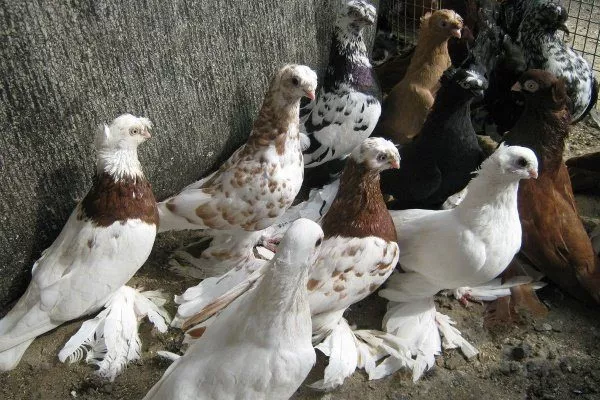
Uzbek pigeons are renowned worldwide for their incredible beauty, exceptional flight qualities, and friendliness. They are distinguished by their coloring and flight style. For these unique qualities, they have been nicknamed "fighting" or "flying-playful" pigeons. These birds are in demand not only in their native Uzbekistan but also in other countries, despite their high cost of keeping.
History of the breed
Little is known about the history of this breed. Iranian breeds, such as Biyas, became widespread in Central Asia in the early 15th and 16th centuries. In 1890, after the war with the Kurds, they arrived in Andijan. According to current history, several pigeon families moved to Uzbekistan with an Iranian pigeon breeder. He continued his beloved hobby in his new home. Poultry breeders from Andijan then crossed the Iranian birds with their own breeds. The resulting variety was named "Andijan pigeons."
The ancestors of modern "Uzbeks" from Turkey and Iran were first noticed in Kyrgyzstan and Kazakhstan; it was only in the 20th century that they began to be bred in Uzbekistan.
Subsequently, Uzbek breeders conducted extensive work, resulting in the development of birds with a recognizable appearance. Crossbreeding was conducted between imported breeds and short-billed local birds. The international community first became acquainted with Uzbek pigeons in the 1970s, in Bulgaria. In 1986, a breed standard was developed, and two decades later, flight performance assessment was expanded.
Types of Uzbek pigeons
Modern Uzbek pigeons are medium-sized birds (33–37 cm in length) with a strong, lean build and a broad, convex chest. Their bodies are low-slung, their necks arched, and their wings long and closed over the tail. Their plumage is dense, and their coloring varies depending on the species.
There are several dozen color variations of pigeons. Particular attention is paid to the shape of the head—it's small and rounded, with a broad forehead. Not all varieties have sideburns, forelocks, and other "hairstyle" elements, but some do. Pigeon eyes are quite large, pearly, black, or light gray.
Regardless of color, modern "Uzbek" pigeons are represented by five main varieties. All are similar, although they have significant differences in plumage and other areas.
Types of pigeons:
- two-crested;
- naso-crested;
- forelock;
- crestless;
- short-billed.
| Name | Beak length (mm) | Presence of a forelock | Plumage type |
|---|---|---|---|
| Two-crested | 8 | Yes | Dense |
| Noso-chubbye | 8 | Yes | Dense |
| Crested | 8 | Yes | Dense |
| Crestless | 8 | No | Smooth |
| Short-billed | 8 | No | Smooth |
Two-crested
The country's most famous breed. These birds are distinguished from their relatives by their more massive build. Their heads and legs are shaggy, giving them a massive appearance. A crest covers the cere on the back of the head, as well as on the forehead, just in front of the eyes. Double-crested pigeons are considered fighting pigeons, but recently the breed has split into two lines:
- fighting;
- exhibition, endowed with decorative qualities.
The double-crested variety was one of the first to be developed. It was developed in the early 20th century. Persian, Turkish, and Chinese breeds served as the basis. These birds differ in coloration and flight characteristics. Coloration can vary: pure white, red with black markings, red, deep black, fawn, and others.
Noso-chubbye
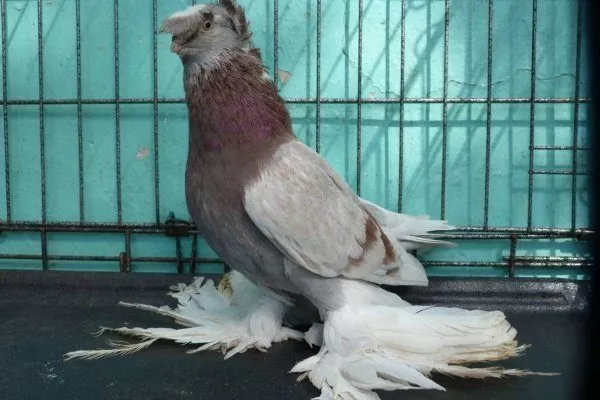
As the name suggests, this variety has a distinctive feather covering over the beak and cere. Part of the beak—the base of the nostril—appears to be hidden behind the feathers. The crest can extend over the entire forehead, even covering the eyes. The crest is sometimes so large that the beak is simply impossible to find. However, according to the breed standard, it should not completely cover the beak.
The size and density of the forelock are strictly assessed at shows and flight competitions. The primary requirement is that the forelock be sufficiently large. All existing forelock shapes are acceptable.
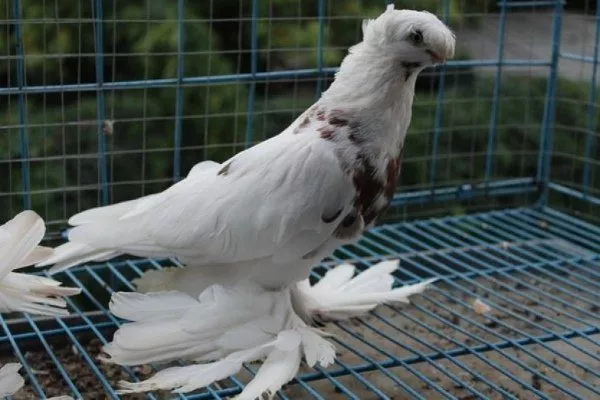
The Noso-chubye is one of the most valuable varieties of Uzbek pigeons.
Crested
Like their double-crested cousins, these birds are called "chelkary" pigeons. They have a crest on the back of their head. Like that of the nasocrested pigeon, it looks harmonious, but requires proper grooming, especially before shows. During shows, the bird is combed with an artificial crest to give it a more elegant shape. This is necessary to ensure a more presentable appearance.
The crest on the back of the head reaches up to 2 cm in height. Size may vary, but show pigeons have specific length and shape requirements. It's important to note that for breeds intended for flight, this characteristic is not as important as for decorative pigeons. However, it can influence the pigeon's evaluation and performance.
Crestless
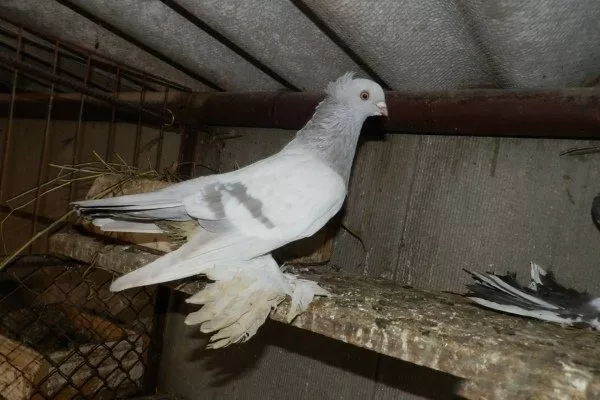
These pigeons differ the least from ordinary city pigeons. The breed's appearance is as follows:
- the head is small;
- the neck is short;
- plumage is smooth, crests are absent;
- There are also no raised feathers on the body.
Unlike the species described above, these pigeons have feathers that lie tightly against their bodies. Breeders of this variety understand that any deviation from crestlessness (the presence of any protruding areas) is a fault. Therefore, these pigeons are generally culled. There are exceptions, however, when interesting "Uzbek" specimens are found.
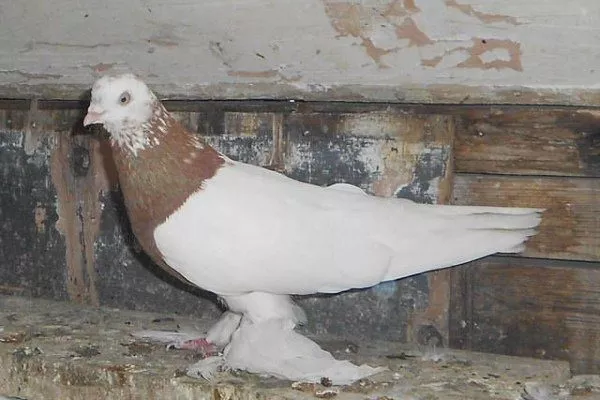
Short-billed
The appearance of these birds is assessed not by the shape and length of their feathers or the presence or absence of crests, but by the length of their beak. This parameter is given special attention in Uzbekistan. The country has adopted a special system for determining whether a bird's beak meets standard parameters.
Its size and length are inversely proportional to the individual's value. Purebred pigeons have beaks no longer than 8 mm. Furthermore, the bird's nose has its own distinctive features: it is rounded, similar in shape to a parrot's beak.
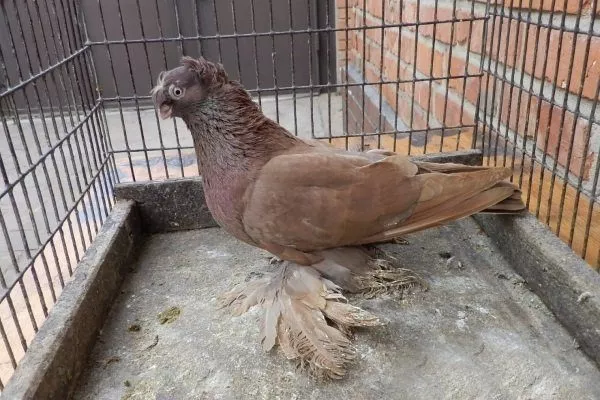
Short-billed Uzbek pigeons are usually considered exhibition specimens, although there are also show specimens, i.e. flight and play ones.
Color options
Pigeons bred in Uzbekistan are prized for their distinctive plumage. Specimens with beautiful plumage have always been prized. Breeders and owners outside the country focused primarily on the birds' plumage and conformation.
The plumage color of Uzbek pigeons varies from bluish-black to snow-white. Some varieties (soch, which means "starling," and chinni) change color during molting.
The standard for Uzbek pigeon coloring was developed and approved in 2002. There are dozens of possible plumage patterns. Among the most well-known variations are:
- White (in Uzbek "ok").
- Black, raven (kara).
- Gray-blue (kui).
- Lilac, the bird has a belt on its body.
- Hakkä. The plumage is predominantly black or blue-gray.
- Shirkhodzy or gray-brown. All color variations have a speckled mark on the breast, usually white.
- Ash (ud) and silver.
- Red.
- Yellow, lemon or novatty.
- Chinnie (porcelain), which changes color after molting. They are hatched completely red or yellow, but the color varies.
- Almond (Chelkar). Birds of a grayish hue mixed with black.
- Chocolate and coffee (malla and ok-malla). Most often of the waist type.
- Maroon or gulbadam. Light with spots.
- Brindle (comp.). At birth, the plumage is black with flashes of light shades.
- Awlaki. A special subspecies of white with splashes of various shades.
Uzbek shaggy-legged pigeons
The Shaggy-legged or Cosmonogated pigeon breed is considered separately. This is the local name for the breeds of these birds bred in Uzbekistan. Over the past half-century, these birds have lost their flying qualities, as breeders focus primarily on decorative qualities and keep them in aviaries. However, good genetics remain.
The birds are still popular in their native country. The scaly-legged pigeons belong to fighting breeds, but this species is considered a separate one. They are both ornamental and flight and game birds. This is the most valuable variety of "Uzbeks."
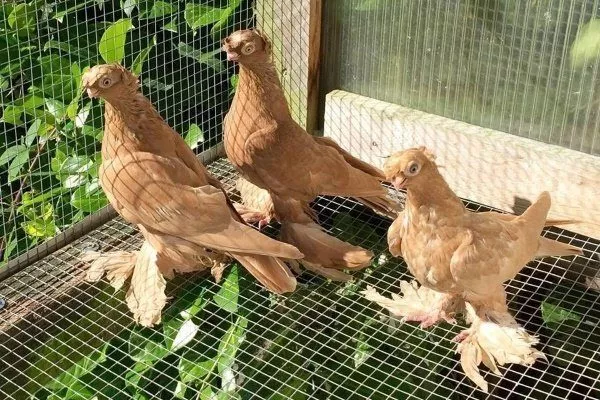
The main difference from other Uzbek breeds is the long, shaggy feathers on their legs. The feathers reach 10-17 cm in length.
Ragged-legged pigeons have other characteristic external features:
- average value;
- elongated body;
- the back and tail form a straight line;
- round or cubic head shape;
- wings are small;
- the beak is short;
- plumage pressed tightly to the body;
- on the legs there are hawk feathers, the so-called “spurs” (at least 5 cm);
- The tail consists of 12 tail feathers.
With rare exceptions (except for the Avlak), Uzbek pigeon varieties are bred to be a single color. After their first or second molt, the birds acquire the coloring and plumage pattern characteristic of their breed (the colors are shown above).
Some pigeons change color until old age. Like other fighting pigeons, shaggy-legged pigeons enjoy long, high-altitude flights. They readily perform various acrobatic tricks and are excellent fliers. The long feathers on their legs enhance their aerial displays.
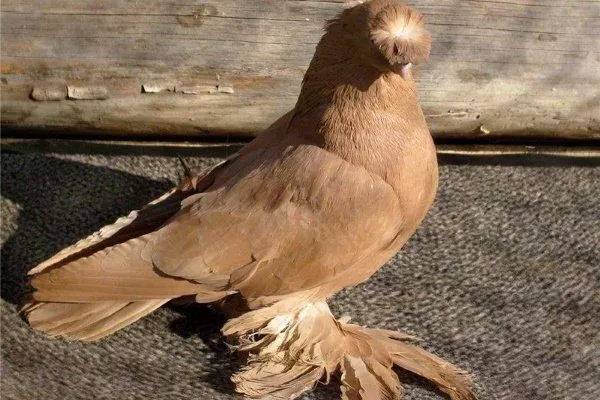
Standards for show shaggy-legged birds
For decades, breed standards for the Uzbek shaggy-legged pigeon were developed and modified. Professional breeders from all over the Soviet Union expended considerable effort to develop pigeons that were ideal by generally accepted standards, endowed with distinctive exterior and flight qualities.
Today, the country hosts annual exhibitions showcasing modern astropods. Participants are evaluated on a 100-point scale according to current standards.
Exterior
The body structure of these pigeons is neat and not massive, with a slightly elongated body and a low stance. Ideal show-quality birds measure 32-35 cm (12-14 inches) tall. The plumage does not intersect with the tail, but rather lies on it. The neck is wide, convex, slightly curved, and extended forward. The back and tail form a straight line. The tail has 12 feathers. The short legs are heavily feathered.
The appearance parameter is assessed at shows with a maximum possible score of five points. Unacceptable faults include drooping wings, short hair on the legs (less than 6 cm), and an elongated head. Such pigeons are not judged.
Points (1-2) can be deducted for:
- the body length does not correspond to the required 32 cm;
- loose plumage;
- medium length legs.
Plumage color
The feather coloration of ruffed-legged pigeons is highly variable, and this is one of the distinctive features of this breed. According to some estimates, ruffed-legged "Uzbeks" have up to 80 plumage patterns. These are divided into four main color groups:
- white;
- single-color or smooth-colored.
- variegated.
- waist.
Plumage color is one of the most difficult elements to perfect. Breed standards award a maximum of 10 points. A score is awarded if the plumage meets the required parameters and has the required luster. A lack of luster results in a minus of 1-2 points. If the color deviates from the standard, up to 5 points are deducted.
Judges evaluate birds differently depending on their coloring. For example, with white pigeons, instead of coloring, they look at additional features such as whiskers, eyebrows, or sideburns. In the Belted group, up to 5 points can be awarded for the coloring of the belt.
Beak
Breeders (and participants) can receive 25-20 points for this parameter for white and multicolored individuals. Additional points are awarded for a downward-pointing beak, level with the forehead on a single vertical line. Beak size requirements are higher for white-plumaged birds, as these parameters are more well-developed in most.
To accurately measure a beak, you need to find the distance from its tip to the intersection of the nostril line and the surface line of the area above the beak. The main criteria are:
- size up to 3 cm;
- low landing and deflection;
- noticeable width;
- thickness;
- correspondence to white plumage - white beak (for other colors there may be a gray tint).
Eyes
The shape and color of the eyes of ruffed-legged pigeons are assessed on a five-point scale. The following requirements apply:
- noticeable, expressive, fairly large eyes;
- white doves have black eyes;
- in multi-colored birds - silvery, light gray or blue shades;
- The pupils are round in shape and located in the center of the eye.
Breed faults include eyes with a reddish rim, which is deducted up to 5 points. Birds with a yellow rim are not shown at all. Irregularly shaped or off-center pupils can result in a deduction of up to 2 points. Smaller eyes are deducted 2.5 points for white pigeons and 0.5 for other colors. Odd-eyed birds are unacceptable.
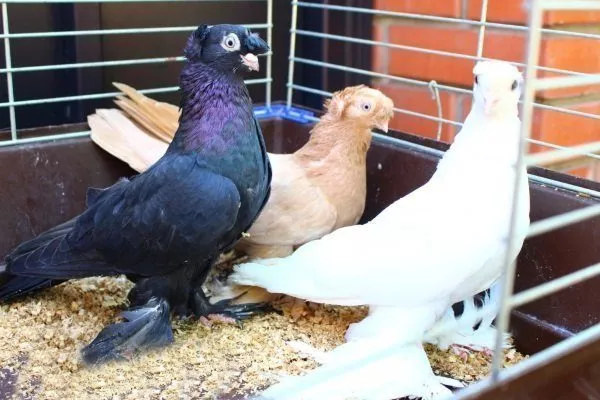
eyelids
This parameter is no less important than the shape and color of the eyes. Pigeons' eyelids should be large and open, with soft, white skin. A bird can receive 5 additional points for perfect eyelids (according to the judges' standards). Small eyelids are considered an acceptable fault. Rough eyelids or eyelids of various shades—black, red, or yellowish—are unacceptable.
Head
Ragged-legged pigeons should have a broad, round or faceted head. A steep forehead is required. Compliance with all requirements is worth 20 to 25 points (for colored and white breeds). Additionally, 2 points are added for the presence of sideburns or whiskers. The following are considered faults:
- noticeably narrow head;
- its clearly elongated shape.
Forelocks
In this category, two types of birds are evaluated: those with a crest above the beak (prosciutto) or two crests (double-crested). Pigeons are permitted to have several types of crests on their heads—both forecrests and hindcrests. The main requirement for both is sufficient size. The more luxuriant the plumage on the back of the head, the more valuable the individual. A total of 15 points can be earned for meeting all criteria. This score is made up of the points for the hindcrest and forecrest (7 and 8 points, respectively).
If we are considering a variety of crested pigeons, the presence of a crest in the form of a wide cap that does not distort the shape of the head is acceptable.
Pigeons with a horn-like forelock and a pointed or sideways posterior crest are unsuitable for show. Potential faults in this area include:
- small forelock size;
- difference in shape from the accepted standard (up to 7.5 points are subtracted from those with a nose and up to 4 from those with two forelocks).
Spurs
The main requirement for pigeon spurs is that they blend harmoniously with the feathers on the legs. They should converge almost at one point – at the undertail area. According to standards, ideal spurs are long and blend with the leg feathers. A score of 5 points is awarded for this position. Half of the points earned will be deducted if the spurs are shorter than 5 cm. Pigeons with shaggy legs, no spurs, or spurs shorter than 4 cm are not scored at all.
Cere
The cere of pigeons—the thickening near the upper beak—should be prominent, slightly raised, and wide. According to standards, it lies tightly against the head. A shaggy-legged competitor receives 5 points for compliance, and loses half points if the cere is not long and raised. Unacceptable faults include a rough or scaly surface of this area of skin.
Shaggy hair
The most carefully assessed feature of the scaly-legged pigeons is their leg feathers. According to the rules, they must consist of at least three layers of feathers and be fan-shaped. The ideal length of the feathers is 10 cm or more. They should completely cover the toes. Permitted faults:
- 9 cm of hair (minus 1 point);
- 8 cm of hair (minus 2 points);
- less than three feather layers (up to 2 points);
- incorrect form (1-2 points).
You can see what Uzbekistan's shaggy-legged pigeons look like in their various color variations in this video:
What should a dovecote be like?
Uzbek pigeons don't have any special care requirements. The pigeon fancier's main task is to create comfortable living conditions for the birds and keep their habitat clean. The first step is to arrange the birds' habitat.
- ✓ Make sure the dovecote is protected from predators such as cats and rats.
- ✓ Check that the room provides sufficient ventilation without drafts.
- ✓ Make sure that it is possible to regulate the temperature inside, especially in winter.
A dovecote should be warm, spacious (for nesting), protected from predators, and easy to clean and maintain. Dovecotes come in various designs. The most common are listed below.
Ground
A dovecote-aviary or dovecote-aviary is a standard structure whose construction consists of a vertical element defining the side space and a roof. The exterior design, birdhouses, and aviary size are chosen based on the owner's preferences and the number of birds. Standard dovecotes are built to house 12 pairs of birds, but any capacity is possible.
Ground-mounted dovecotes are the most complex to construct. When constructing them, the following parameters must be taken into account:
- The volume required for comfortable living is at least 1 cubic meter for one couple.
- The window area is not less than 0.1 of the floor area.
- Room height from 1.5 to 1.9 m.
- Two doors - external and internal for ventilation in the warm season.
Attic
This type of construction is preferred by owners of private homes. If there's suitable attic space, it's a convenient and cost-effective way to set up a pigeon house. The advantage is that it doesn't require extensive construction work, as it utilizes the existing space. The advantages of an attic dovecote are obvious:
- Ease of construction.
- Easily accessible.
Inside, the breeder furnishes the home in a manner similar to standard poultry houses. The designated area is demarcated with wire mesh, boards, or plywood sheets. The outer side of the attic is constructed as a run for the birds. The box is constructed from wire mesh.
If necessary, the room is insulated, for example, if the dovecote is not located in a residential building that gets heated in winter, but rather in a barn. Fluffy-legged pigeons are heat-loving, as they are native to warm climates. It's important to take this into account and ensure the dovecote is insulated during winter.
Hanging
The simplest and most economical dovecote design. It's typically used to house a small number of birds, up to 3-4 pairs. What does this simplest design consist of? A box of the appropriate size, suspended from the ridge or gable of a private house, or another structure (barn, garage, or outbuilding). The main rule is to install the box high enough—0.5 m below the highest point of the roof—to keep the birds out of reach of predators.
Hanging dovecotes are suitable for beginning pigeon breeders, but they are not always suitable for successfully breeding expensive pedigree birds (and shaggy-legged pigeons are quite fussy) due to design flaws. These include:
- capacity limit;
- difficulties in controlling the life of birds (growth of chicks or the ability to clean them);
- the climatic conditions inside the house are little different from natural ones;
- lack of an enclosure;
- danger of penetration from outside.
Tower type
A practical, though challenging to build, design is a tower, also built on the ground. The dovecote can have an even number of sides (4, 6, 8) or be spherical. The house is at least 4 meters high and is multi-layered. The lower level can be used for storing equipment or feed, while the subsequent floors can be used for the pigeons. Each floor has an exit to the outside and access from the inside.
Dovecot towers are typically chosen by experienced breeders. While construction is expensive, the benefits are well worth it.
Advantages of this design:
- safety;
- protection from predators;
- the ability to provide the necessary space for birds;
- easy accessibility for owners.
Keeping pigeons
As pets and objects of close attention from breeders, Uzbek pigeons require proper housing and daily care. Only a healthy and happy bird can delight its owner with its appearance and beautiful flights, as well as take pride of place at exhibitions.
Necessary conditions
The well-being and reproduction of domestic pigeons are the sole responsibility of their owner. If well-maintained, the birds live an average of 15-20 years and produce offspring until they are approximately ten years old. This breed is peaceful. A large number of individuals can coexist in a single, spacious aviary. However, each bird requires its own space. Therefore, pigeons are provided with their own nesting place, such as a perch.
To ensure that the costs are justified, it is recommended to adhere to the following conditions for keeping pigeons:
- Avoid drafts. The dovecote floor should be free of cracks, covered with sawdust, and the walls should be strong.
- Ventilation. If there are few windows, a ventilation system can be installed.
- The optimal room temperature is 20 degrees Celsius. Any higher temperature can lead to mites and other parasites infesting the dovecote.
- Lighting. Windows or lamps should provide the birds with the necessary amount of light.
- Disinfection must not be forgotten. Dovecote owners must be aware that any products toxic to birds are prohibited.
- Nests should be built on bedding, such as straw, hay, or felt. Sometimes nests are cut from a thick piece of foam rubber.
- The nest size is from 20 to 25 cm in diameter, up to 8 cm deep.
- It is important to ensure the safety of domestic birds by limiting contact with wild pigeons and other birds (for example, sparrows, which carry various diseases).
Maintaining cleanliness
Uzbek pigeons, especially the shaggy-legged variety, require cleanliness. The dovecote should be cleaned daily. A thorough cleaning should be performed up to three times a year, removing the birds from the loft during this time. When the birds are not present, thoroughly clean all feeders and waterers by rinsing them with boiling water and a baking soda solution, and scrub the walls and flooring to remove any dirt. The litter should also be replaced.
The floors in the home of shaggy-legged birds must be cleaned daily, removing debris and dust.
During cleaning, special attention is paid to the bathing area, as Uzbeks love water activities, not only in warm weather but also in winter. They also drink water from the bathing area, so it's important to ensure the water is fresh and changed after each bath.
Birds' appearance also needs to be monitored. This applies not only to cleanliness but also to the birds' health. The owner should monitor for parasites and promptly quarantine any sick pigeons. Inspecting a pair of pigeons is sufficient to prevent the spread of mites.
Feeding Uzbek pigeons
Wild birds feed on grain, grass, and plant seeds. This is the optimal diet. Domestic birds should be provided with a similar diet, 20 to 35 grams of feed per day.
The menu recommends including products such as:
- pearl barley or barley – 40% of the total volume on average;
- wheat (millet) – up to 30%;
- corn, legumes, sunflower seeds, oatmeal – about 10%;
- millet – 10%;
- greens (cabbage, sorrel, etc.) – 10%.
In summer, pigeons are fed three times a day, while in winter, they are content with two meals a day. Feeding varies seasonally (more vitamins in the cold season, fresh food in the summer). Furthermore, depending on food availability, its composition may vary in a given region.
The menu sometimes includes items such as peas, fresh vegetables and fruits, and cottage cheese. Some breeders select individual feed for each individual. Pedigree show birds receive special attention, and rightly so.
Reproduction and breeding
Pigeons breed in the spring, although winter breeding is also perfectly acceptable if the birds haven't become overtired during the summer or after hatching. The pigeon fancier must have everything prepared in advance for breeding—the aviary cleaned and nest boxes installed. But choosing a partner is crucial. The birds choose their partner themselves, but for show birds, the selection may be artificial.
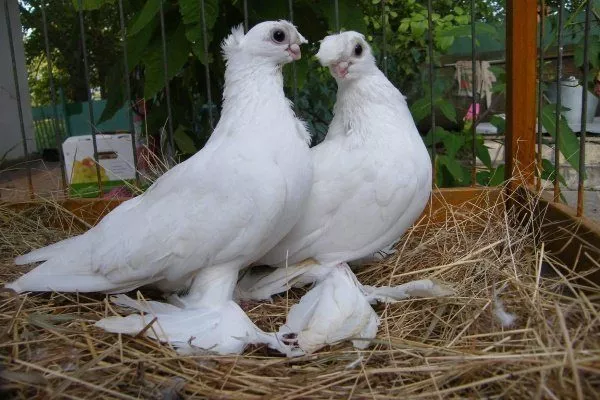
A female can lay up to three clutches per year, with two eggs in each.
Seven to eight days pass after mating, and the female lays eggs, usually two, with a one- to two-day pause. When the first egg hatches, it is recommended to hide it in a protected, warm place, replacing it with a dummy egg. Only then should it be placed next to the second. The pigeon fancier closely monitors this process. They must ensure that the female remains in the nest and incubates both eggs simultaneously. Incubation lasts an average of four weeks, during which time the birds should not be disturbed unnecessarily. Nests are checked when they are missing.
Once the chicks hatch, they don't require any special care. The pigeon pair will take care of the babies themselves. At one month of age, the chicks are fed millet and other finely ground grains. For preventative measures, antibiotics should be added to the chicks' feed, and they should also be monitored for parasites and vaccinated on time.
Buying and selling pigeons
Uzbek pigeons are highly prized in their historical homeland of Central Asia, but are not in high demand in Russia. Finding a good collection of Uzbek fighting pigeons, especially double-crested ones, is a rarity. Purchasing purebred birds is advisable from reputable sources, such as a specialized breeder. They are also bought and sold at fairs and exhibitions. You can also find advertisements online. However, it's difficult to be sure of the quality of such goods.
The cost of purebred birds is as follows:
- The price for Uzbek pigeons starts from 1,500 rubles.
- For the shaggy ones you will have to pay twice as much - 3000.
Interesting facts
The name of the Uzbek fighting pigeon breed likely derives from the unique flight style of these birds. In the air, the pigeons flip over their tails, striking their wings together. This produces a clicking sound, known as a "fight." It is clearly audible even from a great distance.
In flight, birds love to pirouette. Their play is varied, the most prized being the "pole" play, where the pigeon interrupts horizontal flight and abruptly ascends. They can soar several meters into the air, turning up to 15 times. Sometimes the bird flies upward and extends its legs forward, moving them as if climbing a ladder. This is called "rowing."
Beautiful and swift Uzbek pigeons will delight their owners with both their excellent flight qualities and their appearance. Anyone can breed them if they wish; these birds are very demanding but resilient. Pigeons require comfortable living and breeding conditions, and this requires breeders with a certain amount of knowledge and skill.