
Nikolaev high-flying pigeons are known for their endurance—they can fly high in the sky for very long periods without interruption. To achieve this, the birds require proper training and proper care to ensure they remain as energetic and healthy as possible. More details are available in the article.
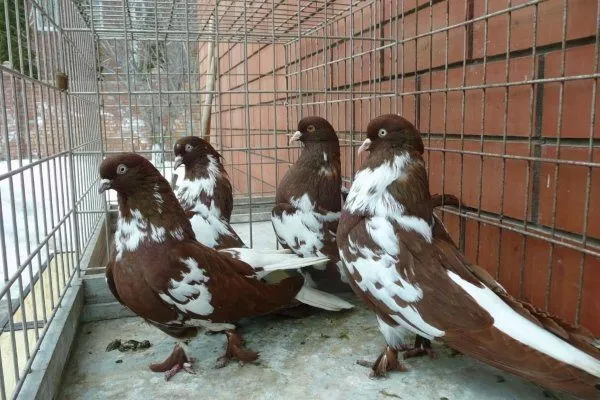
Description
This breed of pigeons has a special body structure, thanks to which they take off quickly:
- body length 40 cm;
- the body is long with a large chest;
- dense plumage over the entire body, except for the legs;
- wings are loosely attached to the body, long;
- strong wing muscles;
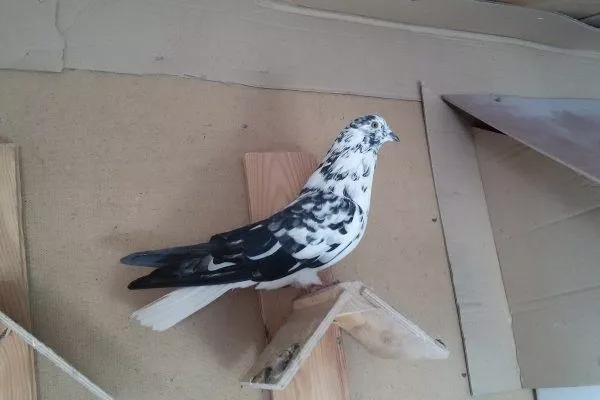
- The plumage color can be different: black, blue, yellow, gray, red, speckled, white with black spots on the head and neck or with multi-colored inclusions.
- regardless of color, the tail is white, wide, straight and consists of approximately 15 tail feathers;
- head is narrow, round;
- eyes are small, yellow or orange;
- beak – medium in size, thin, the tip is curved downwards;
- the neck is short;
- when the bird is standing, the body is tilted at 45 degrees relative to the ground;
- The male differs from the female in the size of his body (he has a larger one), as well as in his wider neck and lighter colored feathers.
These birds are typically quite boisterous, especially the males. Despite this, they are excellent parents to their offspring. The chicks, in turn, are similar in personality to the adults from birth – just as active.
Flight qualities
Nikolaev high-flying pigeons are the only birds of their kind that take off and land vertically, rather than circling.
When flying, pigeons need a headwind.
There are four flight styles in total:
- "butterfly" - continuous flapping of wings tilted slightly forward and a fully extended tail;
- "lark" - straight, slightly fluttering wings are perpendicular to the body;
- sideways flight – vertical takeoff, wings positioned at 90° to the body;
- sickle style - the wings are located in front of the body and curve in an arc, resembling a sickle.
The most common type of flight is the "butterfly", but untrained Nikolaev pigeons fly in the "lark" style.
Workout
To develop endurance and a specific flying style, pigeons need to be trained regularly.
Properly trained pigeons can fly without rest for 6 to 10 hours.
Before proceeding directly to training, you should make sure that the young individuals:
- calmly fly high;
- can stay in the air for a long time;
- They don't get lost when they see people and animals.
- ✓ The pigeon must be at least 1.5 months old to begin training.
- ✓ The bird should be active and interested in its environment.
- ✓ No signs of disease or physical defects.
If all these qualities are absent, then such a pigeon can serve exclusively for decorative purposes.
Training begins at dawn, when the air is crisp. It lasts no more than six hours a day, with breaks in between.
The entire lengthy training process is divided into stages:
- Acclimating pigeons to the trainer. This requires them to come to the breeding center every day wearing the same clothes. This way, the birds will remember you and will start eating from your hand, not being afraid of approaching, and perching on your shoulder.
- From 1.5-2 months, pigeons are released from the nursery into the aviary for a short time.
- After 5-7 days, the birds are released from the aviary onto the roof of the dovecote. This stage lasts up to 5 days.
- The young birds can fly around the nursery with a leader pigeon, who teaches them a certain flying style.
- After 6-7 such training sessions, you can release the pigeons to fly one by one or in a flock, but without a leader.
- After a short time, the birds will begin to spend 20-40 minutes in the air.
- When the flight time reaches 45 minutes, the youngster can be released with an older pigeon that flies in the same style.
There are several prohibitions for training pigeons:
- training is temporarily stopped when the pigeon begins to molt and the fifth flight feather falls out - this process has a negative impact on the ability to fly;
- females should not be trained before laying eggs;
- Birds with different flight styles cannot be released at the same time.
Birds sometimes fall during training. There are several common reasons for this:
- inappropriate time for training (too hot, foggy);
- windless weather;
- various diseases;
- The birds lost their orientation.
We invite you to watch a video about what Nikolaev high-flying pigeons look like, where they are kept, and how they are trained to fly the butterfly flight style:
Conditions for keeping adults
Pigeons tolerate cold weather well, so even in winter they are kept in a spacious dovecote: 1 square meter per pair. Basic housing conditions:
- the optimal temperature in winter is +5 ℃, and in summer +20-25 ℃;
- additional lighting in the dovecote should extend daylight hours to 12 hours per day;
- Before the first mating (in the spring), a place for laying eggs is arranged for the pigeons (boxes with sides), sawdust, branches, feathers and down are placed on the bottom.
- For the winter, females and males are kept separately.
- ✓ Separate housing of males and females in winter to control reproduction.
- ✓ Availability of boxes with sides for egg-laying in the spring.
- ✓ Using sawdust, branches, feathers and fluff to build a nest.
In addition to the coop, pigeons need an aviary; this is where the birds get used to flying and undergo their first training. This should be a large, spacious room with conditions as close to natural as possible. The walls and ceiling are covered with mesh.
Pigeons eat about 50 grams of food per day.
They need a complete, varied diet:
- wheat grain;
- vegetables, especially cabbage and carrots;
- peas and lentils (boiled);
- bread;
- In winter, foods containing a lot of fat are added to the diet: sunflower seeds, rapeseed and oats.
To ensure good bone and body development, fish oil, bone meal and chalk, as well as mixtures of vitamins and minerals, are added to the food.
Breeding chicks
There are two ways to hatch Nikolaev high-flying pigeon chicks, which we will discuss below.
The natural way
During natural breeding, birds usually find their own mates, but to obtain genetically pure offspring, humans can also do this. To achieve this, the matched pair is placed in a separate cage during the mating season.
The hens that lay the most eggs are those that are 1-2 years old. Their very first clutch may contain only 1 or 2 eggs.
Pigeons are good parents and take turns incubating eggs.
After hatching, the chicks live with their parents, who produce crop milk. The chicks feed on this milk for the first 10 to 30 days.
Incubator
Due to their highly developed maternal instinct and the good care they provide for their chicks, raising pigeons in an incubator is only recommended in cases of extreme necessity.
To do this, you need to do the following:
- Inspect the eggs, select only whole ones, without cracks or damage.
- Place them in a box lined with cotton wool and leave them in a room with a temperature of 10-15°C for no more than 12 days. During this time, you can collect the maximum number of eggs for hatching in an incubator.
- Place the material in an incubator at 37.5 ℃.
- Every day you need to turn the eggs and check for the emergence of an embryo.
- After about 18 days, the chicks are born.
With incubator breeding, the probability of obtaining healthy offspring is much lower than with natural breeding.
Feeding and care
Feeding occurs according to the following principles:
- Food must be given to chicks 6 times a day.
- If they are hatched in an incubator, instead of mother's milk, they are fed pureed chicken yolk mixed with cow's milk. This mixture is carefully poured into their beaks with a pipette.
- To teach a chick to drink water, dip its beak into a container of water. This should be done carefully to prevent choking. You can also add vitamins to help with feather development.
- From 14 days on, a whole egg is ground with the white and sugar is added, and peas, barley, millet, wheat, and corn are introduced. You can also introduce porridge, steamed with boiling water and then cooled, with the addition of powdered milk, chalk, or crushed eggshells.
- At the age of three weeks, steamed small grains and chopped greens are added to the diet.
- Starting at one month of age, prepare a mixture of grated raw carrots, soaked white bread, and a hard-boiled chicken egg. Form this mixture into balls and place them in the young birds' beaks.
- Add fruits and vegetables to the diet.
Read on to learn how to feed chicks yourself. Here.
Caring for pigeon chicks includes:
- For chicks hatched in an incubator, a separate warm room without drafts is needed for the first month of life;
- in hot weather, chicks can be dipped up to their necks in cool water;
- Monthly young birds can be kept together with adult birds.
Diseases and prevention
| Name | Symptoms | Prevention |
|---|---|---|
| Whirligig | Green and loose stool, loss of appetite, cramps | Regular examination, vaccination |
| Smallpox | Small growths in the beak area, general lethargy | Hygiene, disinfection |
| Paratyphoid | Lack of appetite, unsteady gait, half-closed eyes, drooping wings | Cleanliness in the dovecote, vitamins |
| Ornithosis | Difficulty breathing, general weakness, loss of appetite | Ventilation, cleaning |
| Coccidiosis | Poor appetite, loose stools, apathy, convulsions and blurred vision | Clean water, high-quality food |
| Trichomoniasis | Yellow coating in the throat, the bird cannot eat and then breathe | Disinfection of drinking bowls and feeders |
| Anemia | Lethargy and loss of tone in the motor muscles and neck muscles | Quality nutrition, supplements |
| Thrush | Lethargy, loose stools, growths on the mucous membranes | Hygiene, prevention |
Both young and adult Nikolaev pigeons are highly susceptible to disease. Therefore, it is important to be able to distinguish between healthy and sick individuals.
Caring for pigeons also includes regular checks for diseases.
Healthy birds are distinguished by:
- dense build;
- development appropriate to age (for chicks);
- symmetrical pupils, clear, bright eyes;
- with easy breathing;
- smooth mucous membranes of pale pink color;
- dense and uniform plumage;
- good appetite and interest in food;
- soft, non-liquid stool.
Diseases and their symptoms:
- Whirligig – a viral disease. Symptoms: green and loose stool, loss of appetite, convulsions.
- Smallpox – the skin and mucous membranes are damaged. This manifests itself as small growths in the beak area and general lethargy.
- Paratyphoid – damage to the nervous system, intestines, and eyes. Main symptoms: loss of appetite, unsteady gait, half-closed eyes, drooping wings.
- Ornithosis – The respiratory system suffers. Observed symptoms include difficulty breathing, general weakness, and loss of appetite.
- Coccidiosis – an intestinal disease. Symptoms include poor appetite, loose stools, apathy, convulsions, and blurred vision.
- Trichomoniasis – inflammation of the digestive system and throat. It can be detected by a yellow coating in the throat; the bird is unable to eat and then breathe.
- Anemia – associated with parasites or poor nutrition. Externally, it manifests itself only as lethargy and loss of tone in the motor and neck muscles.
- Thrush – a fungal disease. Symptoms: lethargy, loose stools, growths on the mucous membranes.
Pigeons primarily contract diseases through contact with other birds, animals, and rodents, as well as from contaminated grain and water. Read about other common pigeon diseases and their treatment methods. here.
To avoid diseases:
- the room where the pigeons are kept must be dry;
- ventilation system is required;
- the poultry house must be cleaned regularly;
- wash and disinfect all equipment in a timely manner: drinking bowls, feeders;
- get vaccinated on time;
- give the necessary vitamins.
Nikolaev high-flying pigeons boast unique flight abilities, able to stay aloft for up to 10 hours. They are easy to care for. Training them to fly is easy if you know and follow basic instructions. The main problem is illness, which can be easily prevented with good hygiene and preventative measures.