
Sickle-billed pigeons are birds with an interesting appearance and unique flight characteristics. These small pigeons are easy to care for. Many farmers note the many advantages of these birds. With a responsible approach to care and feeding, you can produce healthy birds with high performance.
Description and characteristics of the bird
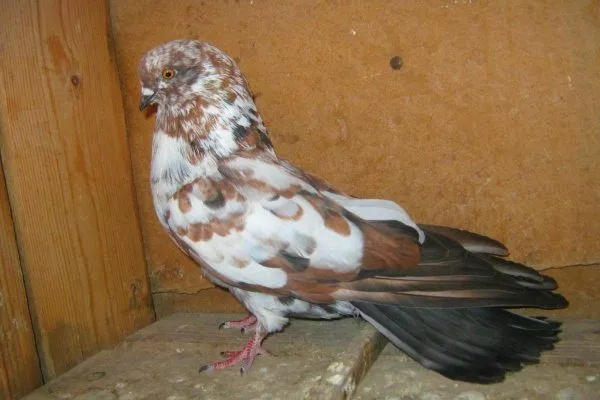
Sickle-winged pigeons are small in size, but they impress with their muscular, well-developed bodies. They have a small head and a curved profile. Their bodies are supported by short legs, and their bodies are covered in dense plumage. When folded, their wings almost reach the tip of their tail.
A distinctive feature is the convex fourth joint on the wings. This allows pigeons to perform a sickle, making their flight a truly spectacular experience. Individuals come in a variety of plumage shades. A clear indication of the breed is the light color of the eyes.
When the chicks are two months old, they begin training them in their unique flight style. These birds are called "turnaround" birds due to their resilient stamina and ability to endure long flights. They prefer to fly alone. It's best to train them in the morning and evening.
Origin and distribution
Pigeons first appeared in the country, then part of the Russian Empire, at the very beginning of the 20th century, where they were introduced into dovecotes in the city of Nikolaev. But the breed itself was developed in ancient times. Syria and Turkey still dispute the origin of the sickle-winged pigeon. In Sanskrit, the pigeon breed means "beautiful creature."
After the birds first arrived in Mykolaiv, many fanciers were delighted with them and eager to obtain them. Thus, the pigeons arrived in Ochakov, where they were brought by a certain fancier named Kaiser, who made a major contribution to the breed's development along with his friend Kirichenko. Their breeding efforts resulted in the development of several varieties of sickle-winged pigeons:
- Musicians;
- Garkushinsky;
- Kalachovsky.
Breeders were meticulous in selecting their birds, favoring pigeons with excellent flight qualities, which distinguished them from other pigeons. Over time, the sickle-shaped wingbeat became the signature feature of this breed. Subsequently, these sickle-shaped birds acquired another name: Ochakov reversed pigeons.
Flight Features
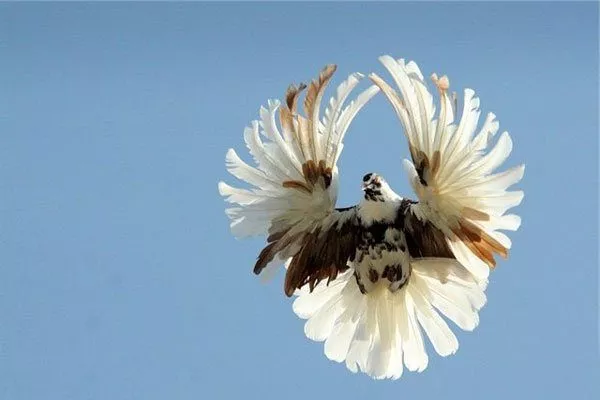
These birds are called "inverted sickle-winged" birds. There's a reason for this. When they flap their wings, the outermost feathers invert and touch each other at the tips, creating a circle. This unique feature allows for phenomenal flight. These birds move through the air horizontally to the ground. But if you look up at them, it seems as if they're flying in slow motion.
Sickle-billed pigeons have some distinctive features:
- they have excellent orientation in the area;
- they always fly regardless of the time of year;
- do not react to the influence of air masses;
- Their flight is effortless, light and smooth.
This applies exclusively to purebred birds, whose numbers are declining as a result of selective breeding. Sickle-billed pigeons return home only after a few days. No one can explain this behavior. Some individuals never return to the loft at all.
Is it possible to keep a bird in captivity?
Pigeons require a separate room. In the wild, they build their nests in small caves and rock crevices. Today, there are several types of dovecotes: free-roaming, aviary, and dovecot with a feedlot.
A dovecote is an enclosed space with small openings for the pigeons to fly out. Narrow windows provide light in this type of space. A dovecote with a feeding area is an aviary attached to the dovecote where the birds will roam. The inside of the dovecote should be dry and clean.
Sickle-billed pigeons tolerate cold very well and can even live in an aviary, provided it is protected from rain and snow. The door to the aviary should be equipped with a threshold to prevent accidental stepping on the bird while it's sitting on the floor.
The optimal height for a dovecote is considered to be a room with ceilings 15 cm higher than the breeder. This facilitates easy catching of birds and makes cleaning the loft much easier for the breeder.
Nests are built indoors using wooden boxes. Be sure to cover the room with a roof and install perches, feeders, and waterers. The perch should be smooth and painted, 2.5-3.5 cm wide. Place grain and greens in separate feeders.
Direction of breeding
Sickle-billed pigeons are bred for their beautiful flight. Breeders exhibit their pets at shows. During competitions, the birds are judged on the following qualities:
- suit;
- wing setting;
- constitution;
- flight data;
- orientation;
- virtuosity.
Competitions are held to determine flight altitude and duration. Based on the results of the competitions, birds are assigned categories. There are elite pigeons, first-, second-, and third-class birds. A pigeon can also be assigned the "failure" category.
Diet
Sickle-billed pigeons prefer plant foods, especially seeds, berries, fruits, grass, and nuts. Breeders often introduce corn, barley, and wheat grains into their birds' diet. It is recommended to feed the birds at regular times and in the appropriate amounts.
- ✓ The grain must be dry, without signs of mold or fungus.
- ✓ High protein grains such as wheat and barley are preferred.
- ✓ Avoid high-fat grains, such as sunflower seeds, in large quantities.
Pigeons' diets should also include wet mash, which consists primarily of greens, bran, and grain. Some breeders feed their pigeons compound feed.
In a separate feeder, the pigeon fancier needs to put gravel to promote better digestion of food.
Sickle Care
Sickle-winged pigeons are energetic and undemanding birds. They can adapt to even the most unfavorable conditions and climates, and pigeon fanciers describe them as resilient birds. These qualities make this breed suitable for even the most novice fancier. Sickle-winged pigeons breed well and care for their young.
However, there is one factor that can negatively impact the well-being of this breed of birds: confinement. They won't survive in attics, balconies, or other spaces where they lack the opportunity to enjoy open space. It's equally important to ensure that the space is clean, dry, and well-lit.
Reproduction
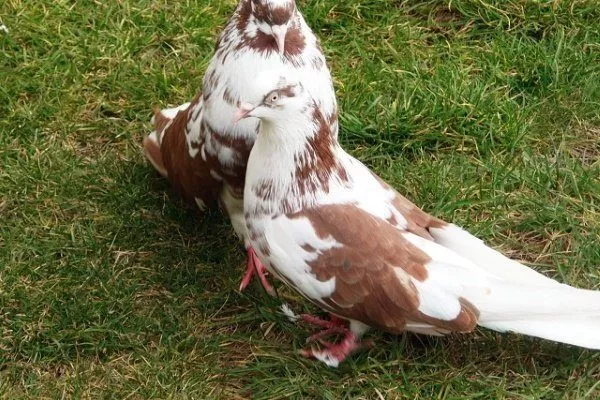
Sickle-billed pigeons are monogamous birds, typically forming a single pair bond. During the mating season, males court their chosen mates, cooing, dancing, and fluffing their feathers. In the wild, pairs seek out restricted-access sites to build their nests. They may build their nests under the eaves, in unoccupied attics, etc.
For a female dovecote to feel comfortable, it's important to have a small window in her nest. This way, the male will be able to carry building materials into it himself, and the female will be able to construct it herself using twigs and blades of grass.
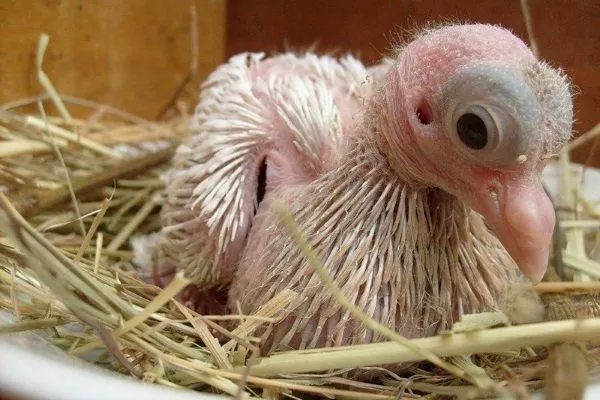
The birds mate year-round, resulting in the female producing approximately seven clutches of eggs throughout the year. Both parents incubate the eggs for 16-19 days, taking turns. A clutch typically contains 1-2 eggs. The hatched chicks are blind and unadapted. In the first days of life, the chicks feed on pigeon milk, which contains protein-based nutrients. As the chicks grow, plant seeds are introduced into their diet. After 1-1.5 months, the young are fully capable of flight and self-care.
If the pigeon fancier plans to train a new generation, then when the young birds are 35 days old, they are taken from their parents to a new place of residence and training begins.
Oviposition
Each laying cycle typically yields a pair of eggs. During the first laying cycle, a female may lay only one egg. Females are known to lay eggs in the first half of the day.
Egg production begins 8-10 days after mating. After the first egg is laid, the second egg is laid 40-45 hours later. To avoid incubating the first egg before the second, the fancier removes the laid egg and replaces it with a dummy egg.
Incubation
Sickle-billed pigeons are good parents. The females incubate the eggs themselves. Males replace the females twice a day so that the female can feed. The distance between nests should be as large as possible, depending on the size of the dovecote. If the room is small, it is recommended to install partitions between the nests or use wooden boxes.
The chicks are born after 16-19 days. The incubation period is shorter in warm weather and longer in cold weather. The dove turns the eggs in the nest several times a day. Pecking lasts 8-10 hours. The chicks are born without assistance. If assistance is needed, the baby chick may not survive.
Keeping chicks
The parent pigeons keep the chicks warm and feed them milk, which accumulates in their crops. The young are removed from their parents when they are 25-28 days old. After this, they are fed a mixture of small grains. Water is placed in the open air for the chicks to learn to find it on their own. Vitamins are added to the drinking water to ensure the chicks receive the minerals they need to thrive.
- ✓ Activity and interest in the surrounding environment.
- ✓ Clean eyes and nostrils, without discharge.
- ✓ Even plumage, without bald spots.
It's important to give chicks water from a clean bowl, as they're not in good health at one month of age. At two months of age, the preparatory stage of raising chicks begins—they begin training.
How to feed a pigeon chick is described in detail Here.
Diseases and problems with breeding
Keeping birds requires caring for their health. It's crucial to practice disease prevention, clean the premises regularly, provide clean water, provide a balanced diet, and keep waterers and feeders clean.
Pigeon breeders should be aware that overcrowding in the breeding colony is essential and that sick birds should be removed promptly. Sickle-billed pigeons are hardy birds, but are prone to illness. infectious and non-infectious diseases.
Birds can contract non-infectious diseases if they are improperly fed and housed. Adjusting their diet can help prevent vitamin deficiencies and hypervitaminosis. Using high-quality feed and feeding it to your birds in full quantities will help prevent crop and stomach inflammation.
Infectious diseases are dangerous because one sick bird can infect all the others, potentially killing them. The most dangerous are pyocyanosis, ornithosis, pox, salmonellosis, and coccidiosis. These diseases are transmitted through eggs, causing chicks to die within the first week of life.
Inbreeding is no less dangerous. Such breeding risks producing weak offspring.
Interesting facts
There are several interesting facts about sickle-winged pigeons. Below are a few:
- Although reverse sickle pigeons are prized by fanciers, their flight performance is significantly impaired. The reason is that breeders don't take regular and proper training seriously. Without proper training, the birds won't perform at their best.
- Pigeon fanciers often forget that mating sickle-winged pigeons with other breeds is undesirable, as this can lead to a deterioration in their flight and a loss of their distinctive features. The birds become less interesting and unique.
- It is believed that, far from the winds of Crimea, pigeons cannot demonstrate their originality in flight, since the southern climate has contributed to this for decades.
Sickle-billed pigeons attract attention with their extraordinary high-flying abilities. With serious training, these birds will delight their owners with incredible feats. This breed can take first place in competitions.