
The Altai region is famous for several breeds of pigeons. All birds have distinctive characteristics hidden in their appearance. Each breed requires specific care and nutrition. The birds are kept for ornamental purposes, as their beautiful plumage and stately figures attract attention.
| Name | Origin | Behavioral features | Productive qualities |
|---|---|---|---|
| Peacock dove | Ancient India | High fertility, neatness, elegance | They cannot fly for long periods of time. |
| Black-tailed breed | Altai region, 19th century | Dense and intensely saturated plumage | Lethal qualities are poorly developed |
| Shawl Altai breed | Altai Krai, 20th century | Attractive appearance, endurance | Unpretentiousness in nutrition and maintenance |
Peacock dove
Origin of the name. The pigeons got their name due to the presence of an unusual and luxurious tail, which is similar in appearance to the tail of a peacock.
Behavioral features. Besides being beautiful and graceful, peacock doves are also highly prolific. Peacock doves are also very neat and graceful, periodically displaying their skills: they throw their heads back, puff out their chests, fully spread their tails, and stand motionless.
History of appearance. It is impossible to determine the exact origin of peacock pigeons, but they were first heard of by people in ancient India.
Productive qualities. Pigeons cannot fly for long periods, covering kilometers. They tend to move along the ground, spreading their tails and displaying their beautiful feathers. Many pigeon fanciers desperately try to teach their charges to fly in circles. Occasionally, the results exceed all expectations, leading to the birds being sent to various exhibitions.
Exterior features. True purebred male pigeons of this breed have broad, strong legs, set wide apart. The legs have a red tint. The feather color varies from blue-gray to yellow-white.
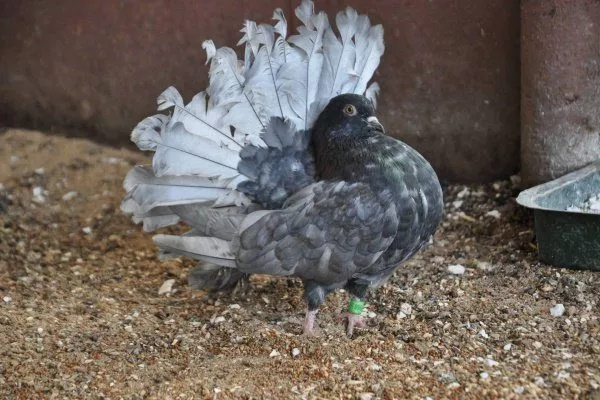
Doves have small heads, large dark eyes, and a small reddish or flesh-colored beak. They have a rounded, compact body and a concave back. The upper and undertail coverts are covered with numerous feathers; the more feathers, the more luxurious the bird's appearance.
The number of tail feathers directly depends on the genetic purity of the feathers. A purebred pigeon has 30-35 tail feathers. Birds of this breed are virtually impossible to train. Most pigeon fanciers speak negatively of these birds, calling them lazy and incompetent. The most a peacock pigeon can do is perform classic circling flights over its habitat.
Maintenance and care. Pigeons are kept in an aviary, so they spend the entire warm season outdoors. Each pair of pigeons in the aviary requires at least 1 square meter of space. The dovecote for the winter is equipped in the same way. Daylight hours should be up to 12 hours. The room should be dry and well-ventilated.
During the winter, the temperature in the dovecote is maintained at -10 degrees Celsius, as the birds have average temperature tolerance. During this time of year, the breeder separates the males and females. Wooden perches will need to be installed in the aviary and the dovecote, allowing the birds to rest comfortably on them with their feet.
Peacock pigeons should not be kept with other breeds. They are prone to stress, which can negatively impact their appearance and breeding performance.
Feeding. Feeding peacocks requires careful attention and a serious approach. Feeding varies at different times of the year. Proper diet influences many factors in the animals' lives. In winter, pigeons should be fed a high-carbohydrate diet to replenish their energy reserves. During this time, feeding legumes or chopped vegetables is not recommended.
Black-tailed breed
History of origin. This pigeon breed originated in the Altai region. Its history dates back to the 19th century, but initially, it wasn't particularly popular. Over the course of a century, breeders and experienced fanciers improved the breed's performance, and today, this bird is known throughout the country and even beyond.
External characteristics. The birds' main distinguishing feature is their dense, intensely saturated plumage. It is for this color that black-tailed pigeons are prized. If a bird's colors are dull, they will not be in demand.
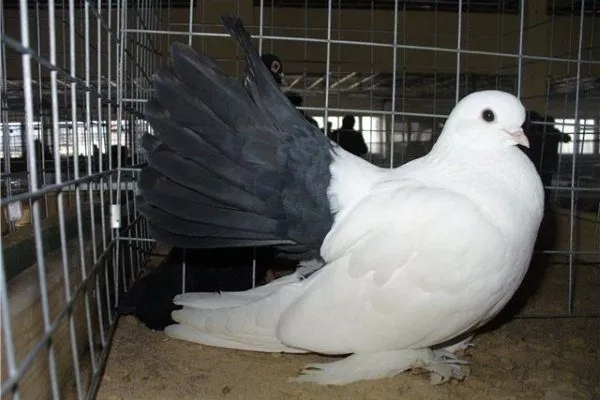
Animals have a special exterior:
- an elegant and elongated neck, on which is located a small and round head with small, round black eyes and a rough, pale pink beak with a blunt tip;
- monolithic wings, tightly pressed to the body (because of this, the birds have poorly developed lethal qualities);
- around the entire circumference above the head there is a feather decoration resembling a fan;
- small and short limbs with long feathers;
- a thick mane that makes the bird elegant and stately at the same time;
- a lush, high-standing tail with a blue-black tint;
- snow-white plumage on the body;
- harmoniously built body, full and wide chest, short back.
Maintenance and care. These birds are kept exclusively in aviaries. Each aviary must be equipped with special devices to ensure proper living conditions:
- Drinking bowls and feeders. It's permissible to use water bowls similar to those used for chickens and guinea fowl. Experienced pigeon breeders recommend using pneumatic waterers designed to prevent birds from contaminating the water, keeping it fresh for a long time. Feeders should preferably be retractable.
- Containers with mineral feed. You can't do without an additional bath for a certain period of time.
- Presence of poles. This will allow all the birds to be accommodated as comfortably as possible. Preferably, regular tree branches, pre-treated and free of twigs and foliage. There shouldn't be too many perches, but enough. They should be spaced far enough apart to allow the birds to fly from one perch to the next.
Shawl Altai breed
History of appearance. The Altai Shawl pigeon breed is renowned for its attractive appearance. These birds began to be actively bred in the 20th century. These are the "kachuny" pigeons.
Appearance. These birds have a unique and distinctive appearance, thanks to their unique body shape and interesting coloring. The shawl pigeon has a small, rounded head with a prominent, high forehead. A distinctive feature is the presence of a crown-like crest, which extends around the entire circumference of the back of the neck. The pigeon also has a mane that merges seamlessly with the crest.
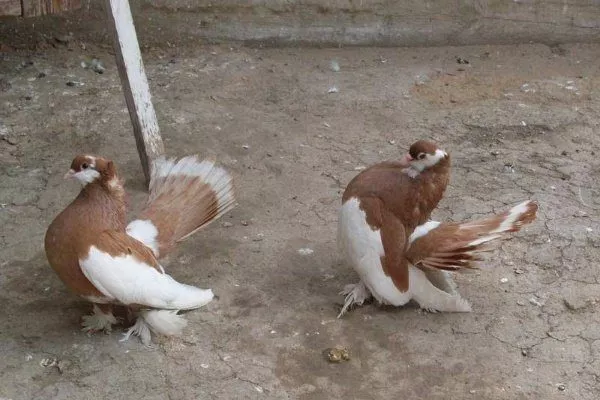
These birds are characterized by a long, well-set neck, which becomes thinner toward the top, making them even more attractive. The pupils are small and dark, and the eyelids are smooth and even. The eyes are bare, with light pink skin. A small, pastel-colored beak sits on the face, with a slight thickening at the base.
These birds are distinguished by their high, deep chest. Their bodies are compact and shortened. Their bodies rest on small but well-placed legs. Their backs are short, making it appear as if their tail is growing directly from their necks. Their limbs are covered with dense feathers.
Although the bird appears compact, it has large wings that barely reach the ground. Specimens with black, red, yellow, and cherry-colored feathers are found. Any coloration blends seamlessly with white feathers.
Maintenance and care. Pigeons adapt well to various climates, are hardy, and undemanding in terms of diet and care. Due to the dense feathers on their limbs, pigeons constantly get them wet and dirty. For this reason, the dovecote should always be clean, dry, and warm. It is advisable to provide bedding in the room; lime and wood shavings are used for this purpose.
They can thrive in aviaries. One and a half square meters of space is required for each pair of pigeons. The coop must be equipped with feeders and waterers, nesting areas, and perches without poles. A dovecote bath is a must.
Diet. The feeding of pigeons of this breed is unconventional. Their diet consists of 70-80% grain, root vegetables, legumes, minerals, vitamins, and green grass.
Today, there are several breeds of Altai pigeons. Each bird has its own attractive appearance and behavioral characteristics. Proper care is required to ensure excellent performance.