
Turkmenian Agarans are among the elite of pigeons. This breed is among the most expensive and prestigious in the world. Agarans stand out among their peers for their exquisite appearance and excellent flight qualities. This breed successfully combines decorative qualities with flight ability.
Origin of the Agarans
These beauties originate from western Afghanistan, and their ancestors are believed to be Iranian pigeons. Experts claim that Agarans arrived in Turkmenistan around the 16th century, allegedly brought there by Afghan nomads. Scientists base this conclusion on historical records.
Turkmen pigeons arrived in the Russian Empire in the early 20th century. The breed became especially popular in the 1950s, when domestic pigeon breeders, impressed by the breed's flight characteristics, began breeding and improving it.
In Turkmen, “agaran” means “camel milk cream” – the pigeons received this romantic name for their coloring.
Today, Agarans are a national treasure of Turkmenistan. This breed is popular in its homeland, Russia, and several European countries. Turkmen fighting pigeons are especially popular in Siberia.
Exterior and characteristics of the breed
You can recognize Turkmen fighting pigeons by the following characteristics:
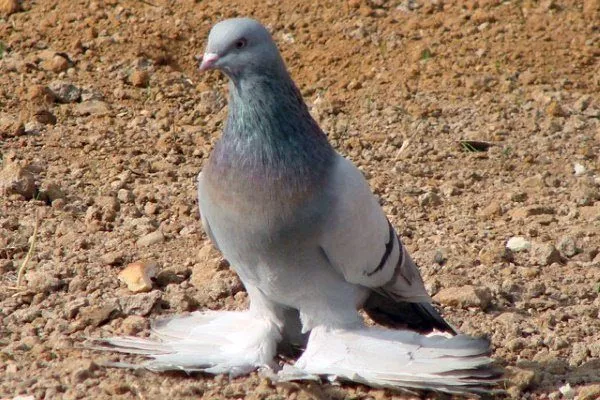
- compact body, graceful build;
- the head is small, rounded, with a forelock;
- large expressive eyes, gray, orange or yellowish in color;
- refined light eyelids;
- the beak is set at a right angle to the forehead, it is short and closed, usually light in color;
- neck of medium length;
- the back gracefully flows into the tail;
- the wings are long, in the tail area there is a point of their intersection;
- shields are light yellow or white;
- the feathers are long, characterized by high density and thickness;
- paws with spurs covered with feathers;
- a luxurious tail of 12 or more feathers.
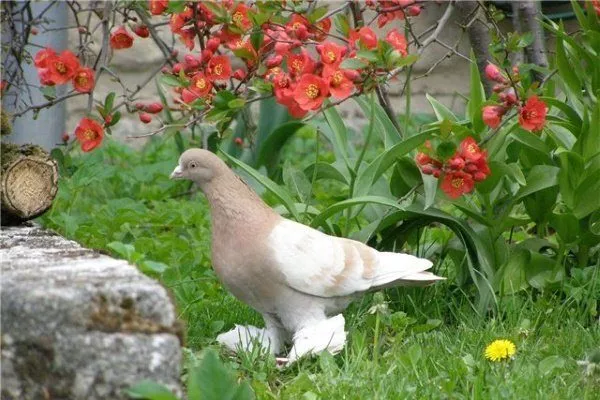
Agarans are primarily beige in color—the dominant color is coffee diluted with cream. Their bodies and heads are silvery-ash, and their wing shields are white. Modern agarans come in both multicolored and solid colors.
When breeders were improving the Agaran breed, they focused primarily on flight performance. There were no strict requirements for color. This is why Turkmen fighting ducks come in so many different colors. Agaran ducks come in a wide variety of colors—blue, gray, yellow, and golden.
The neck and chest are most often yellow, sometimes with an orange tint. The body and head are silvery or ash-gray. The wings have bands, and the tail is edged. The wings are white or yellowish. The tail is marbled grayish, with black speckles on the tail.
Breeding objectives
Turkmen pigeons are popular among pigeon fanciers. The beauty of these birds is undeniable—it's no wonder Agarans are so often "invited" to weddings. This is despite the fact that white is rare in this breed. These beautiful birds, when used as wedding doves, put on quite a show for spectators.
Flight Features
Agarans can somersault in flight, hence their nickname "fighting pigeons." Few breeds can perform somersaults in the air. While in the air, this breed can hover by rotating around its own axis. This feat is accompanied by a noisy flapping of its wings. Turkmenian fighting pigeons don't have a particularly long flight time—only four hours—but some breeds can stay aloft for much longer.
Agaran flights:
- Leaning stance and spiral body rotations.
- The bird's legs move during the curved exit, making it appear as if it is climbing into the sky.
- Spiral rotations are performed by the bird taking a tilted stance, then hovering and making a full turn.
Advantages and disadvantages
Advantages of Turkmen fighting pigeons:
- undemanding to maintenance conditions;
- they willingly sit on eggs, care for and feed the chicks;
- excellent flight qualities.
Although the breed is elite, it still has its shortcomings:
- Low fertility—only 2-3 chicks per year. For comparison, tipplers, for example, produce up to 12 chicks per year.
- They can't be kept in aviaries permanently. If they aren't released into the air, their health deteriorates, and they can even become ill. They lose their flight ability, including altitude and flight time.
- When pigeons tumble in the air, they risk their lives – they often fall and hit the ground.
Since Agarans produce few offspring, owners take care of the birds, and still the numbers of this breed are not large.
Maintenance and breeding
The biggest problem with breeding Turkmen storks is their low fertility. Being undemanding in terms of food and living conditions, they are very reluctant to breed. Three chicks per year is the maximum that agarans can produce; more commonly, they produce one or two chicks.
During the breeding season, agarans require enhanced nutrition. Their diet should be supplemented with more vitamins, proteins, and fiber.
| Period | Proteins (%) | Fat (%) | Carbohydrates (%) |
|---|---|---|---|
| Ordinary | 15-20 | 5-10 | 60-70 |
| Reproduction | 25-30 | 10-15 | 50-60 |
Pigeon breeders should be aware of the peculiarities of breeding the Turkmen breed:
- The females are patient brood hens and caring mothers.
- Agarans feed their offspring on their own.
- Both parents care for their offspring equally.
- During the mating season, the pair is placed in a separate cage.
- The pair is selected so that they match each other in terms of external characteristics and flight capabilities.
- At one month of age, the chicks can eat independently. They are gradually introduced to solid foods, including insects and grains.
- At one month the chicks are vaccinated.
- At the age of two months, young agarans are already capable of independent flight.
- This breed reaches sexual maturity at one year of age.
- ✓ Compliance with the flight qualities of both parents.
- ✓ Absence of genetic diseases in the pedigree.
- ✓ Color compatibility to preserve breed characteristics.
Turkmen pigeons are kept both in dovecotes and in light aviaries.
What you should know about keeping the breed:
- Regular cleaning of dovecotes is important to maintain cleanliness.
- Change the water regularly – drinking bowls should be filled with clean water.
- Turkmen doves rarely fight, so other breeds can be added to the loft. However, it's still important to monitor the birds' behavior—if a fight does occur, the Agarans can seriously injure their neighbors.
Experienced pigeon breeders of the Turkmenian Fighting breed advise against confining birds in aviaries for extended periods. Otherwise, they will lose their flight skills and become unable to soar to high altitudes. And if confinement is prolonged, the Agarans may even lose their flight skills entirely, perching on fences and flying no higher than rooftops.
Similarity to other breeds
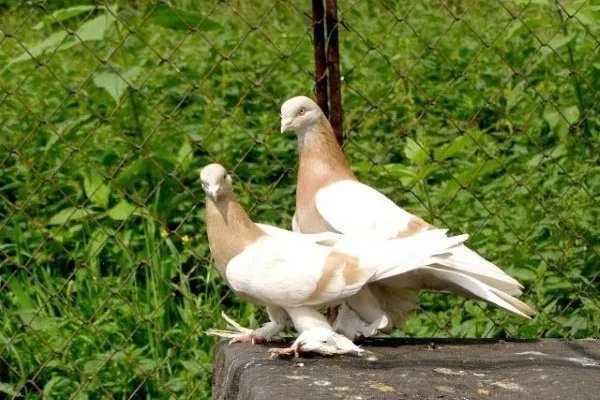
Agarans can be confused with other fighting pigeons due to the variety of colors in this breed. Many people doubt whether such a breed even exists, and who can be classified as one.
Turkmenian fighting pigeons resemble Tasmans—they are Uzbek shaggy-legged fighting pigeons. Tasmans are fawn (light coffee-colored). Agarans can be distinguished from Tasmans by several external characteristics. Tasmans have:
- shortened legs;
- the upper tail coverts, outer tail feathers and outer part of the wings are white;
- On the wing shields there are dark brown stripes.
The problem of recognizing the Agaran breed is complicated by the lack of clearly defined standards. But one thing that Agarans have in common is their unrivaled playfulness in flight.
Pigeon fanciers' reviews of agarans
According to reviews from both amateur and professional pigeon breeders, agarans are excellent flyers. At the market, they fetch around $200 per bird, which discourages buyers. Many fanciers complain about:
- The high cost of the breed.
- Difficulty of breeding – it is not possible to obtain offspring in sufficient quantity.
- The loss of valuable birds—birds can be killed while tumbling or fall prey to predators. Given the high cost of birds, such losses are especially devastating.
- Difficulty recognizing the breed. Controversy often arises, with beginners confusing Agarans with Tasmanians.
Experienced pigeon breeders advise being more selective when choosing birds—these days, instead of genuine Turkmen game birds, half-breeds are often offered. To breed true Agarans, careful pair selection is essential.
Turkmenian fighting pigeons are every fancier's dream. However, this breed requires constant attention and flight training. Breeding these pigeons requires patience and the necessary knowledge.