
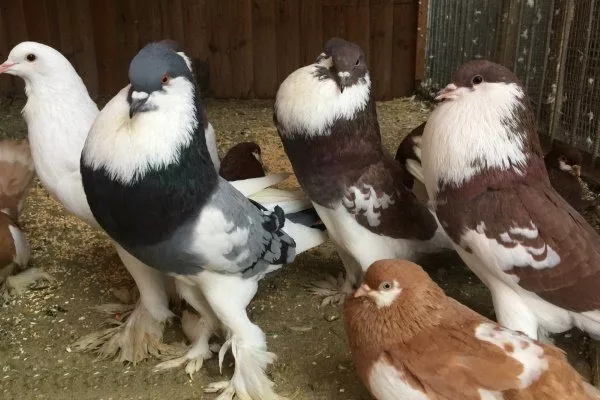
The Poutysh is a striking and memorable pigeon breed, the dream of most breeders. Their slender body, proud posture, and calm disposition make them popular for breeding, despite the fact that Poutysh pigeons require special attention and care. Their flight performance is far from ideal, and they are generally kept for ornamental purposes.
History of origin
Most poultry breeders consider Western Europe, such as the Netherlands or Belgium, to be the homeland of the pouter. In the 16th century, this variety enjoyed a wave of popularity in these countries. However, the history of this ancient breed is controversial. Written records dating back to 1345 mention Spanish pigeons that inflate their crops. It is this characteristic that distinguishes pouters from other breeds of pigeonsThere is a theory that it was from Spain, which was under the rule of the Habsburg dynasty in the 16th century, that the Dutysh came to Europe.
For several centuries, pouters have been bred and crossed with other species, resulting in over 20 varieties of the breed. But even today, poultry breeders aren't resting on their laurels and continue to develop new subspecies of these pigeons. Since breeding is carried out in many countries and regions, the most popular varieties of this breed originate from various parts of Europe: England, Norway, Hungary, Germany, the Czech Republic, and elsewhere.
Characteristics and features of Dutysh
Some species of pouters differ strikingly from their fellows—in appearance, height, coloring, the presence or absence of features such as leg hairs, etc. Each variety has its own strict standards, and pigeons are often culled. However, pouters do have some common characteristics. These include:
- An amazing ability to inflate its air sac to an incredible size: even its beak gets lost in it.
- The neck is spherical, turning into a crop. It narrows at the chest.
- Medium build. Chest with down. Elongated, large body, positioned almost vertically.
- Long tail.
- The head is round, small with a high forehead.
- Narrow wings. When they lie on the tail, they do not cross.
- Legs in "pants" (not all individuals).
- The plumage color varies from pure white or black to colored, silvery, and blue-gray.
Only pouters that meet international standards are invited to exhibitions. The video below will tell you more about what purebred birds look like:
Varieties of the breed
For breeding these birds, you can choose from two dozen varieties of this breed, one or more – as desired. Keeping pouters together is possible, but with other pigeons this is problematic.
| Name | Size | Color | Peculiarities |
|---|---|---|---|
| Czech Saddleback | 45 cm | Two-color | Pear-shaped goiter |
| Brno | 32-35 cm | Various | Dwarf variety |
| Pomeranian | 50-52 cm | Various | Hair on legs |
| Big English | 40-50 cm | Various | Epaulets on the wing shields |
| Dwarf | 32-34 cm | Various | Heat-loving |
Czech Saddleback
A pigeon from Moravia, specifically the city of Brno. It is one of the oldest breeds in Czechoslovakia. The birds are quite large (up to 45 cm in length) with a medium-sized head that lacks a crest. The body is harmonious, and the tail continues the back, while the chest and shoulders are broad. The medium-length wings are properly folded and carried flat against the body. The legs are located in the rear third of the body; they are long – 15-17 cm – and densely feathered. The eyes of the saddleback pigeon are black or another dark shade, but are sometimes tinted red. The eyelids are flesh-colored or red.
The crop is large and wide, resembling a pear. The bill is strong, wedge-shaped, and slightly curved at the tip. A small, light-colored cere lies tightly against it. The bill's color matches the plumage, which is bicolored. It can be yellow, black, glaucous, or red. Other parts of the body, such as the belly, legs, wings, and so on, remain white. A colored stripe covers the crown and forehead on the head. This is the primary characteristic of the saddleback pigeon.
Brno
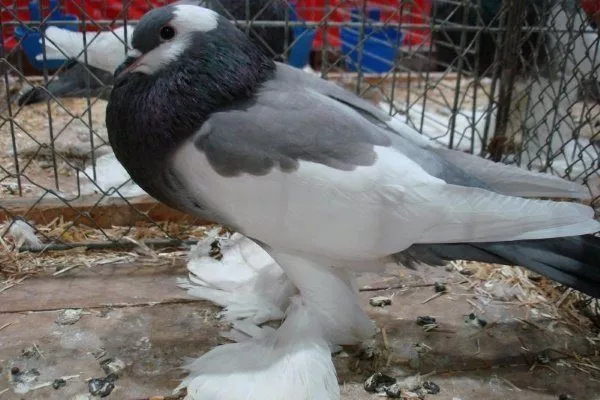
These pigeons also originate from the Czech Republic—Brno and Prague—but are unlike their predecessors in size. The dwarf variety of pouters has a body length of only 32-35 cm (males and females). Their stance is upright, but their tail does not touch the ground. Their wings are crossed, or, if their backs are narrow, they stand apart from their body. Their legs are long. Their figure is slender. When the Brno pigeon stands upright, it appears as if its body below the crop is constricted by a belt. The crop itself is a perfect, spherical shape.
This bird's coloration is distinguished by a wide variety of patterns. Among the Brno variety, there are solid-colored and belted individuals, stork-like and speckled. Pectoral striations can be white or black, while a single color (always very bright) is found in individuals with the following color patterns:
- yellow;
- red;
- black;
- pale yellow;
- blue;
- silver, etc.
These pigeons are remarkable for their temperament and graceful build. The cooing of Brno pouters is not as deep or loud as that of their relatives. Their voices are higher pitched. When courting a female, the male doesn't simply coo; he hops, stepping only on her toes. He doesn't bend at a 45° angle, but maintains an upright posture. This variety is a good flyer, so the birds can be trained.
Pomeranian
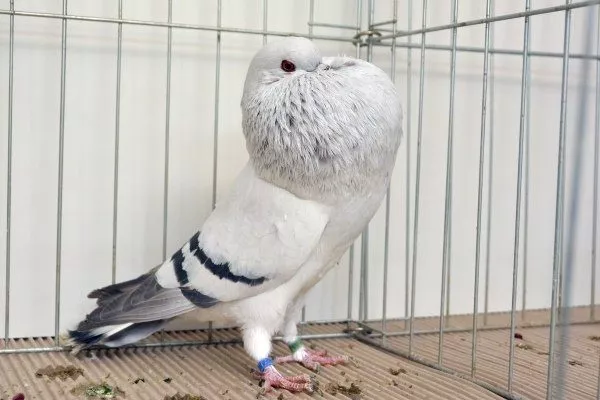
Pomeranian pouters were developed in the 19th century in Western Pomerania on the island of Rügen in the Baltic Sea. Breeders based their breeding on birds from Holland, England, and Belgium. In 1869, the variety received its official name. The Pomeranian is a powerful, large specimen (reaching 50-52 cm). Its body is slender, its posture is graceful, and its head is uncrested. The wings lie close to the body. The tail is slightly curved. The legs have shaggy feathers with long feathers (up to 14 cm). The crop is large and pear-shaped. A distinctive feature of the breed is the throwing back of its head when inflating the crop.
The bill of Pomeranian pectorals is small and similar in color to their plumage: beige in light-colored individuals, dark brown in others. Eye color also depends on the bird's plumage. Common plumage patterns include:
- pure white without the addition of other shades;
- white with a colored tail, for example, blue and black;
- colored - red, black, yellow, gray, with dark belts on the shields or a white heart on the crop;
- multi-colored with white legs, tail, belly and wingtips.
Big English
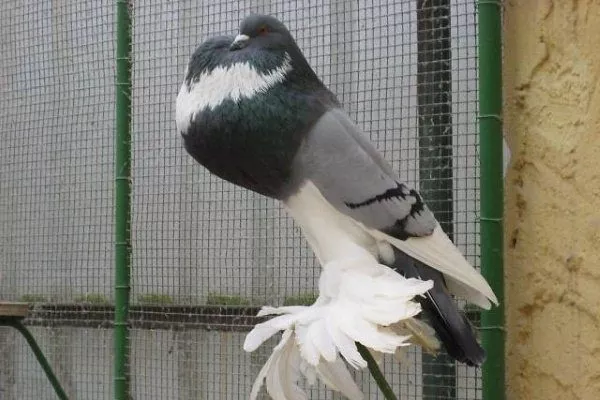
A purebred representative of the species. Like the Pomeranian, these pigeons are considered large representatives of the pouter type. Breeders developed them in the 17th century from Dutch and Roman breeds. They had a huge influence on pigeon breeding, being used to develop other pigeon varieties and improve pouters. The English-bred pigeons have the following conformation:
- Individuals grow up to 40-50 cm in length.
- They have an oval, smooth head and a slightly convex forehead.
- Almost vertical stance with elastic, well-developed crop.
- Next to the strong beak there is a small cere, the color of which matches the plumage and appears powdered.
- The waist is thin, with a vest (that's what they call its front part).
- The back is in line with the tail. There is a distinct depression between the shoulders.
- The wings are tightly closed and lie flat on the tail, which is rounded at the end.
- The legs are close together, measuring about 18 cm from hip to middle toe. The feathers on the legs are short, and the feathers on the toes form a so-called "plate."
The plumage of English puffins ranges from white to black (for example, reddish, yellow, blue-gray, and silver). Some birds are patternless—that is, pure white without any impurities. Colored individuals have a white belly, flight feathers, and chest (crescent). The wing shields are decorated with "epaulettes" of small feathers, which can number from 5 to 12. These birds are prized worldwide for their beautiful appearance. Despite their large size, these pigeons are active and love to rise and soar through the sky.
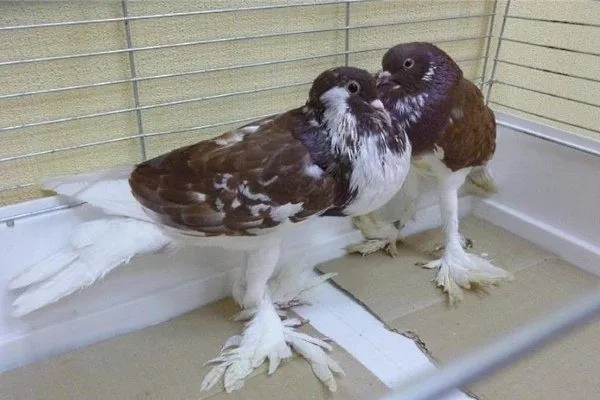
Dwarf
Some varieties of Pouters are classified as dwarf. However, this dwarfism is only in comparison to other, larger members of the breed. For example, English Pouters reach 32-34 cm in length, compared to 50 cm (the average length for English Pouters). Brno Pouters are also considered miniature. Both of these varieties have long legs. The Amsterdam Pouters, however, are short-legged, and are known as Amsterdam (Dutch) Pouters.
The term "dwarf" usually refers to English pouters. These miniature specimens were first discovered in the 1880s, resulting from a cross between Brno and English pigeons. They closely resemble their British ancestor in appearance, differing only in size. A distinctive feature of this breed is that it is kept entirely in aviaries; these birds are extremely heat-loving. They can even be kept in apartments.
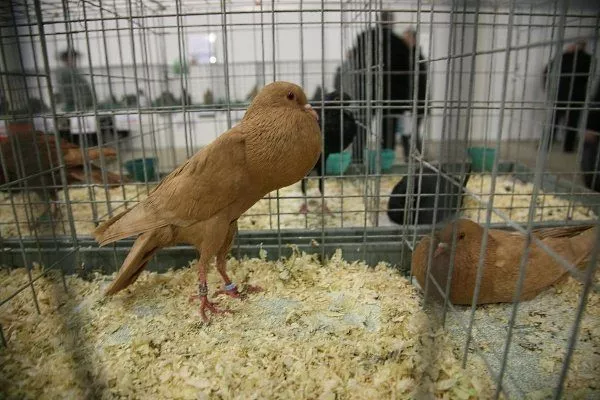
The Dutch Short-legged Puffin is popular in its native Netherlands. It is medium in size, reaching no more than 35 cm. Its crop is traditionally spherical, its body smooth, its legs medium in length, and its head lacking a crest. Its bill is thin and short, and its eyes match its coloring: light-colored individuals have brown eyes, while others have shades of yellow and red. The plumage of the Dutch Short-legged Puffin can vary widely, including silver, blue, black, or white. Some individuals have a speckled pattern and a band on their body.
Requirements for the premises
Breeding pouter pigeons is a challenging endeavor, as this species is quite demanding in its care. There are several factors owners should consider:
- Males are pugnacious. Their character is not easy.
- Keeping pouters with other pigeon breeds is not recommended. There have been cases where such proximity has resulted in crop punctures.
- Despite their strong constitution, the birds have a weak immune system and are susceptible to various diseases.
To avoid exposing pouters to the risk of illness, they must be kept dry and clean. There should be no drafts in the room. If the birds are kept in an open cage, they should be protected from the wind as much as possible. A comfortable temperature for pouters is 20 degrees Celsius (68 degrees Fahrenheit) during the warmer months and no lower than 5-6 degrees Celsius (41-43 degrees Fahrenheit) in winter.
According to veterinary service requirements, general disinfection of the dovecote is carried out twice a year.
Feeding and watering
The typical diet of pouters is similar to that of other breeds. It includes grain and hard-boiled eggs as the main source of protein, carbohydrates, and fat, as well as greens, vegetables, fruits, and fish oil for vitamins and minerals. It is recommended to supplement the diet with ground eggshells, which provide calcium, and herbal infusions to strengthen the birds' immune system.
- ✓ The daily feed requirement for standard puffins is 50 g, for dwarf puffins – 40 g.
- ✓ During the winter, the food portion is doubled, but the animals are fed only twice a day.
The menu for pigeons should include products such as:
- barley;
- wheat;
- corn;
- legumes;
- apples and pears;
- cabbage;
- potato;
- carrot;
- sorrel;
- nettle.
The standard daily ration for pouters should be 50 grams of food, while dwarf pigeons eat slightly less – 40 grams. In summer, pigeons are fed three times a day; in winter, only twice, but the standard ration is doubled. The vitamin content of the food should also be increased.
Pigeons primarily eat dry food, including grains and seeds. They also need plenty of fluids. Fresh water should be available at all times. Avoid using water that's too cold, and change it daily. Pay special attention to the water bowl: choose glass or ceramic, clean it regularly, and use disinfectants (such as chloramine). The water in the bird bath should also be replaced with clean water at least once a week.
One of the oldest pigeon breeds, the pouter is deservedly popular among breeders. Caring for them isn't the easiest. However, if you take into account a few care tips, even a beginner can breed these birds.