
Fighting pigeons got their name from the noise they make in flight. This subspecies of racing pigeons prizes the beating of their wings, accompanied by a distinctive sound. Their unusual flight isn't the only advantage of fighting pigeons; distinguished by their exquisite appearance, they combine remarkable flight and decorative qualities.
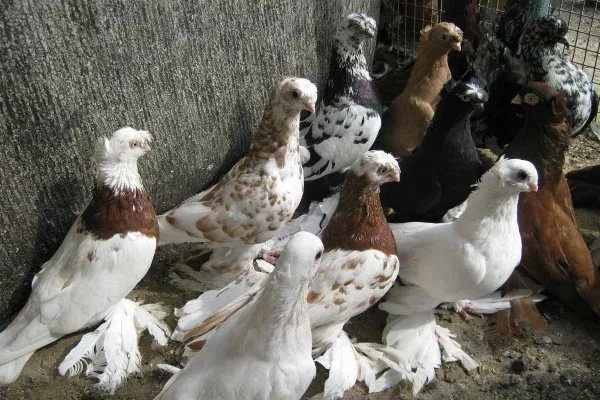
What is special about fighting pigeons?
Pigeon breeders prize fighting pigeons above all other breeds. This ornamental subspecies stands out from its peers for the following characteristics:
- Each flap of the wings is accompanied by a loud clicking sound, creating the impression that the birds are beating the air.
- Birds can somersault – this is a complex trick that not every breed can perform.
- They are capable of soaring to enormous heights. Once they disappear into the pole, the birds simply disappear—they are impossible to see. They can reach heights of up to 1.5 km.
- They can fly for several hours without stopping. Typically, continuous flight time is 3-6 hours. However, sometimes pigeons fly all day without stopping to rest.
- They can fly in a variety of styles. They change them during the flight, creating a complete performance for the audience.
- They can fly in the air, flapping their wings or doing somersaults.
- Excellent orientation. They remember the location of static objects well. They can fly long distances.
- Increased endurance, undemanding maintenance and unpretentiousness in nutrition.
The origin of fighting pigeons and pigeon breeding centers
There's a common belief among pigeon breeders that fighting in nature is a flaw, a defect, for pigeons, as such birds become easy prey for predators. Purebred fighting pigeons are the result of artificial selection. Breeds capable of somersaulting and flapping are the result of centuries of selective breeding.
Most pigeon breeds originated in the Middle East. It was here that the first domesticated pigeons emerged, later brought to Europe and America. Today, there are several breeding centers for fighting pigeons. Each region has its own preferences for breeding fighting pigeons. The main pigeon breeding centers are:
- Türkiye. Considered the birthplace of pigeon breeding. Good flyers. Neat body of medium size. Dull plumage.
- North Caucasus. With their superior flight performance and majestic appearance, North Caucasian fighting pigeons are renowned worldwide for their decorative qualities.
- Asia. The Uzbek breed is the basis of Asian fighting pigeons. They are distinguished by their short beaks and graceful appearance. A striking example is the magnificent Agaran.
- Azerbaijan. Here, little attention was paid to external characteristics; the main emphasis in breeding was on flight characteristics.
- Europe. They favor fighting breeds, but they don't have their own "native" breeds. European pigeon fanciers prefer Turkish and Asian breeds.
Flight specifics
The main advantage of fighting breeds is their aerial play. They exhibit the following flight styles:
- Rising into a pole. Birds flap their wings rapidly as they ascend vertically. Upon reaching maximum altitude, the pigeon performs a 360-degree turn and somersaults backward. Birds can repeat this "exercise" over and over again, or they can make it more challenging by employing a twisting technique.
- Screw. One of the variations of climbing a pole. The pigeon, making a turn, moves upward in a spiral trajectory.
- Paired. Performed by a pair of doves ready to lay eggs, it's a captivating sight—all the elements are performed in sync.
- Ribbon. This type of flight is often equated by pigeon fanciers with a “marriage” – the bird flies and flaps its wings without hovering or rising into a column.
- Hanging. A signature trick. Unlike the pole-like rise, it's performed more gently and smoothly. The bird hovers in one spot and rapidly flaps its wings.
Breeders have their own criteria for assessing flight quality. Pigeons are considered faulty if the following phenomena are observed during flight:
- Aerial stunts are not accompanied by sound;
- There is a wing fight, but there are no somersaults or other aerial tricks;
- when performing a circular somersault, he makes more rotations than necessary;
- the bird cannot perform a 360 degree turn;
- When doing a somersault, he makes a turn of more than 360 degrees.
Pigeon breeds that perform the spin are more prone to injury than others. During this exercise, they can become disoriented, causing them to hit houses or trees and die.
What breeds are there?
There are many breeds of fighting pigeons, differing in appearance, plumage color, and feather arrangement. Breeders, while working to improve their flight qualities, ignored their appearance. This is why fighting pigeons are so diverse in appearance; within a single breed, individuals can exhibit a wide variety of colors. Let's look at the most popular breeds.
| Name | Weight (g) | Body length (cm) | Wingspan (cm) |
|---|---|---|---|
| Baku | 300 | 34 | 65 |
| Chile | 280 | 32 | 63 |
| Marble | 290 | 33 | 64 |
| Baku hryvnia | 310 | 35 | 66 |
| Baku white-legged | 295 | 33 | 64 |
| Turkish (takla) | 270 | 31 | 62 |
| Uzbek (two-crested) | 320 | 36 | 67 |
| Iranian | 330 | 37 | 68 |
| Krasnodar (Reds) | 300 | 34 | 65 |
| Pakistani | 290 | 33 | 64 |
| Persians | 310 | 35 | 66 |
| Leninakan | 300 | 34 | 65 |
| Maykop | 280 | 32 | 63 |
| Blagodarnensky | 290 | 33 | 64 |
| Tumblers | 270 | 31 | 62 |
| North Caucasian cosmach | 320 | 36 | 67 |
Baku
They were identified as a separate breed in the mid-20th century. Through selective breeding, their appearance was improved. While retaining the flying abilities of their ancestors, Baku cats have become much more attractive.
Description. External characteristics of the breed:
- head is oval-shaped, smooth or with a forelock;
- neck of medium length;
- the beak is straight and thin, slightly curved;
- eyes are yellow, pupil is black;
- the back is sloping, the body is spindle-shaped, dense;
- the plumage fits tightly to the body;
- powerful wings - fit tightly to the body, do not cross;
- paws are medium, with or without brushes;
- claws are white or flesh-colored.
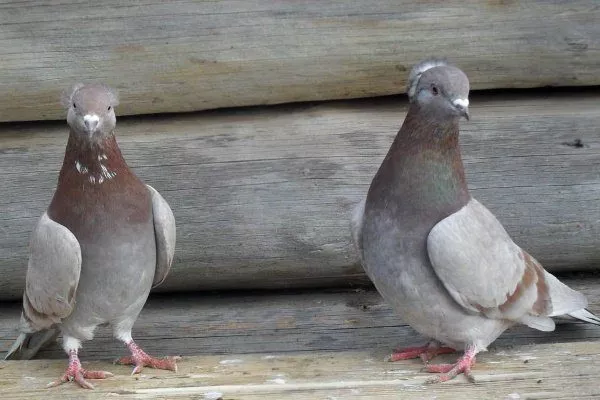
Crest-billed pigeons have two-colored crests—white in front and colored behind. The plumage is so dense that if you hold a Baku pigeon in your hand, it feels like a smooth stone.
Flight. They fly in a scattered formation, not forming a flock. Each bird performs its tricks solo. Soaring high, the pigeons are virtually invisible from the ground. Flight duration is 2-12 hours. The height of the "column" during flight is 15 meters, during which the bird performs up to seven somersaults. Each somersault is accompanied by a characteristic clicking sound.
Other features. High immunity. Fertile and easy to reproduce. Good orientation. Return home 500-600 km. Faithful and devoted.
Chile
This is the most spectacular subspecies of Baku fighting pigeons. The breed is popular in Russia, but Chili pigeons are virtually unknown in other countries.
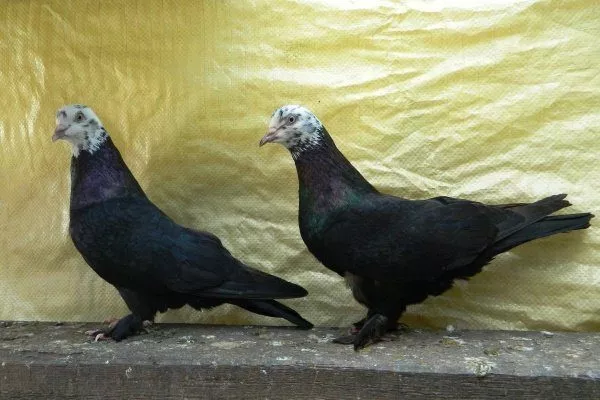
Description. The plumage is variegated—black, dark gray, or red. The speckles are snow-white. They often have two-colored crests. The front part is variegated, while the back part is the same color as the main plumage. Exterior features:
- dense, elongated body;
- on the paws there are brushes;
- yellowish eyes;
- the neck is medium in size, with a beautiful arch;
- the chest protrudes forward;
- broad shoulders;
- wings are pressed tightly;
- on the neck and chest - a purple tint;
- the beak is straight, white, curved at the end;
- If the head is dark, then the beak is black.
Flight. They can fly for hours at a time. They take off vertically and launch into combat at altitude. They gracefully descend into a pole and somersault swiftly. They hover effortlessly in the air.
Other features. Breeders prize the breed for the complexity and spectacularity of its somersaults. Each bird has its own unique flight pattern. Each Chili pigeon flies at a specific altitude, and the length of its flight is also unique. They are easy to care for.
Marble
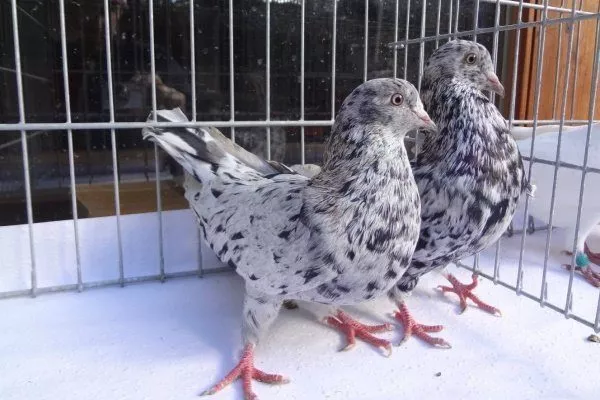
Another variety of Baku fighting pigeons. They are mottled like the Chili, but their coloring is a mosaic of feathers of different colors. One of the most beautiful breeds, their representatives often participate and win at international shows.
Description. The plumage is mottled, with dark spots. The bronze specimens are the most prized, with their brassy coloration and randomly scattered black or scarlet spots.
Flight. It rises upward without performing any preliminary circles. Spreading its tail and wings until it resembles a ball, the marbled pigeon soars upward, hovers, somersaults, performs a variety of tricks, and each time returns to its owner. Various types of fighting are demonstrated—pillar, ribbon, and spiral.
Other features. The saturation of the plumage color is a criterion by which the age of marbled pigeons is judged. Juveniles have lighter shades than mature individuals. After their first molt, the young birds darken, and their plumage takes on various tones.
Baku hryvnia
They are considered universal "pilots." They were bred in the first decades of the 20th century in the city of Baku.
Description. A harmonious body with a well-proportioned head. The forehead is elongated, the back of the head is rounded. The beak is long, and the eyes are dark cherry. The neck is beautifully arched, the wings are long, and the legs are medium-sized. The plumage is dense and white. There is a distinctive pattern on the back of the head. The "print" colors are yellow, black, and red.
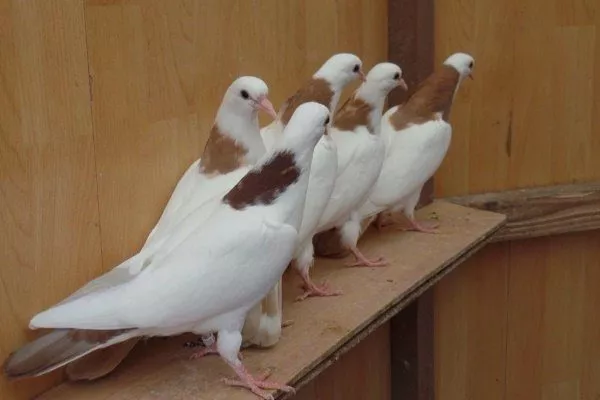
Flight. They perform all types of flight perfectly - combat, entering a pole, gaining altitude until disappearing from visibility.
Baku white-legged
Another variety of Baku pigeons with excellent flying abilities.
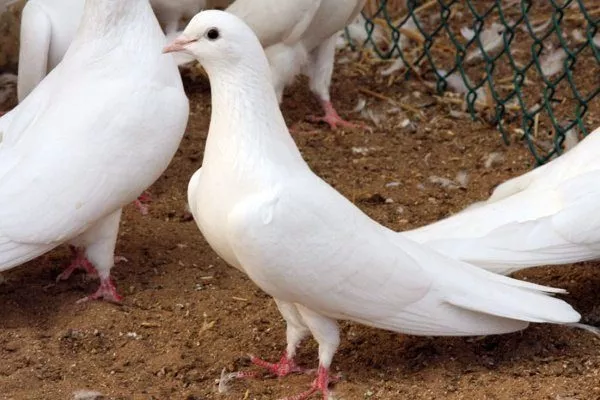
Description. This breed is similar in appearance to the Baku Grivuns, which are crestless. The distinguishing feature is their snow-white coat. Their legs are bare and reddish. They have a compact build. The body is elongated, the head is long, with or without a crest. The forehead is sloping, and the beak is white. The plumage is dense, with a violet sheen.
Flight. Flying high. They put on a beautiful display.
Turkish (takla)
Turkish fighting pigeons are divided into three types: Takla, Donek, and Kalabek. The Takla is the most popular breed of the Turkish group and one of the oldest pigeon breeds. The word "takla" translates as "somersault." There are several types of Takla: double-crested, crested, nasocrested, and long-nosed.
Description. There are many varieties of the Takla, each with its own distinctive appearance. However, there are some common characteristics: a standard body, slender, without excessive bulk. Any color can be dominant in the coat. The most common colors are blue and variegated. The tail is marked with white. The head has a white cap. The legs are feathered and have forelocks. There is no single standard for the Takla.
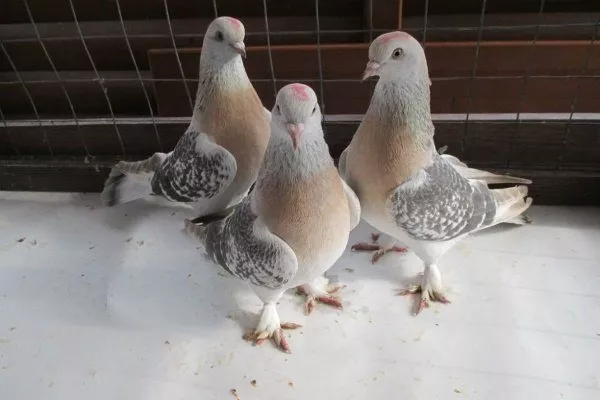
There are many subspecies of the breed, here are just a few of them:
- Urfa. Long tails and wings drooping to the ground. Plumage is yellow-brown with bluish hues.
- Mardin. A low but picturesque flight. They resemble tumblers. Their plumage is all shades of gray.
- Sivash. They have a shorter flight than the previous subspecies, but a stronger fight. They sometimes have crests and white tails.
- Antalya. They are distinguished by their high flight. They are miniature and rare.
- AnkaraMiniature birds in shades of silvery blue, brown, red, white and yellow.
Flight. They perform masterful somersaults and master the art of propeller flight. They demonstrate a captivating display of their wings. They are capable of long flights—up to 10 hours. They demonstrate a unique flight: they take off vertically, repeat somersaults several times, plummet downwards for 2-3 meters, and then return to their previous altitude.
Other features. Growing a takla requires regular training.
Interestingly, the ability to "screw" into flight is linked to the bird's plumage. The paler the plumage, the more beautiful the flight. It has been observed that pied taks often fail to "screw" into the sky at all.
Uzbek (two-crested)
The double-crested "Uzbeks" were the first to be developed within the breed. There are over a dozen subspecies, differing in plumage and build.
Description. The signature feature of Uzbek pigeons is the crest, which is present in almost all members of the breed. Double-crested pigeons have lush plumage, shaggy tufts on their feet, and a crest on their head that extends from the forehead to the neck—the entire head. This shaggy appearance gives the bird a massive appearance.
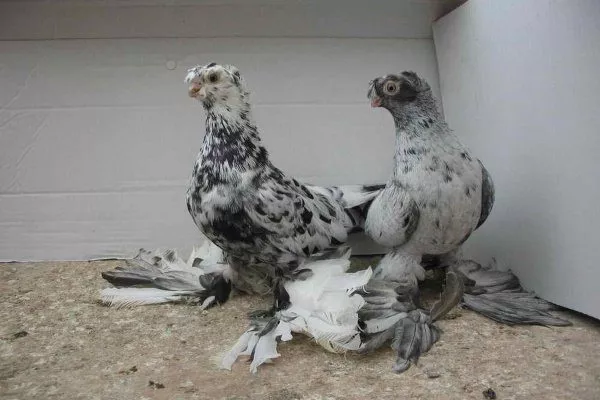
Plumage depends on the subspecies:
- Chinny - dark red, tail and wings - white.
- Gyulsary - black with a white head.
- Awlaki – mostly white with variegated wings.
- Chelkari - marble color.
- Hakkä - black, tail - white.
- Gulbadam – white, with a reddish or yellowish spot on the neck.
- Tasmanians – coffee-colored. The tail, head, and chest are dark brown. The uppertail, outer tail feathers, and outer wing feathers are white.
Flight. The long flight is accompanied by amazing tricks.
Other features. Breeders are working to improve the breed's plumage – these birds are not only good flyers, but also have ornamental value.
Iranian
An ancient breed of pigeon, developed over 5,000 years ago, Iranian pigeons are very expensive. Another name for the breed is Persian.
Description. There is no uniform standard for appearance; individuals vary in plumage, the presence of crests, leg brushes, etc. Common features include a long bill and a broad tail with 12 tail feathers. The wingspan is 60-70 cm. The head is usually smooth. Birds with black, blue-gray, yellow, scarlet, and almond plumage are considered the most sought-after.
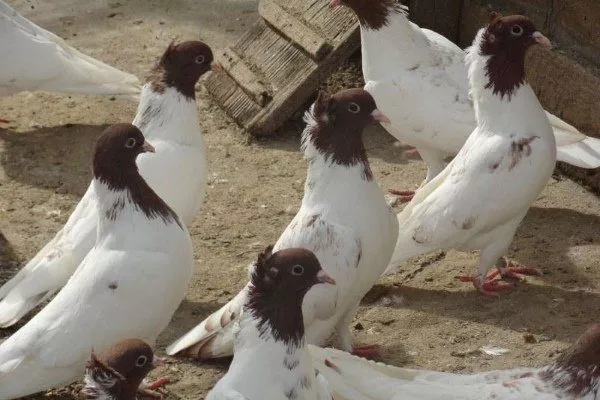
Flight. They fly slowly and tend to hover in one place for long periods. Flight duration is 3-5 hours, with a maximum of 10 hours.
Other features. There are several subspecies of the Iranian breed. The best known are the Tibriz and Hamadan fighting kosmachi.
Krasnodar (Reds)
This breed is prized more for its beauty than its flight. Their flight is short but impressive. There are many subspecies of Krasnodar pigeons, the most popular being the Artamon, Neverovskie, and Blagodarnenskie.
Description. Compact body. The head is small, the crown is flat. The bill is white, slightly curved downwards. The wings are long, lying close to the body. The plumage is varied, the most beautiful being red. A proud stance and a harmonious build.
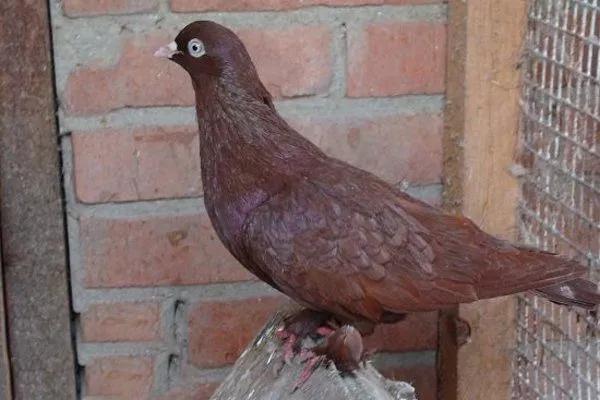
Flight. Flight duration is 1 hour. Flight altitude is medium. They fly in flocks and individually. Their flight is short and swift, and they enter the pole well – slowly and smoothly. They perform somersaults sharply, flapping their wings loudly.
Other features. Often bred for meat, the breed is popular in the Krasnodar, Voronezh, and Rostov regions.
Pakistani
Pakistani pigeons owe their worldwide fame to their unusual flying style, which is not replicated by any other breed.
Description. The bird is beautiful, with a varied plumage, mostly light. The dominant color is white, and the back, wings, head, neck, and tail have a distinctive feather pattern that remains the same throughout life. There are several subspecies of "Pakistani." Some birds are bare-legged, others have "breeches," and some have a tuft or no tuft. The tufts can be peaked or pointed. The tail is long. Eye colors include red, orange, and blue.
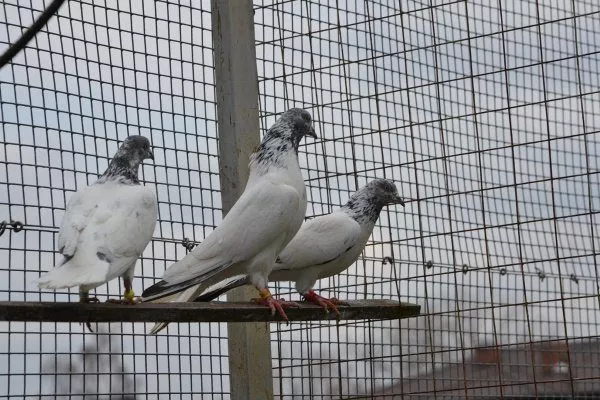
Flight. The bird, rising up and entering the pole, does somersaults, which are accompanied by a loud fight.
Other features. The breed is prized in Russia for its unique flight, beauty, and ease of care. However, the birds require attention and regular training. Flight ability is genetically inherited.
Persians
Persians are renowned for their flight abilities. Some are capable of "butterfly fluttering" and "shuttle-walking."
Description. They are distinguished by the unusual structure of their feathers—they appear split at the tips. This gives the birds a curly appearance. The head is rounded, with a wide, convex forehead. Some birds have a crest on the back of their heads. The eyes are pearly. The legs are feathered. The plumage is richly colored—yellow, red, and dark brown.
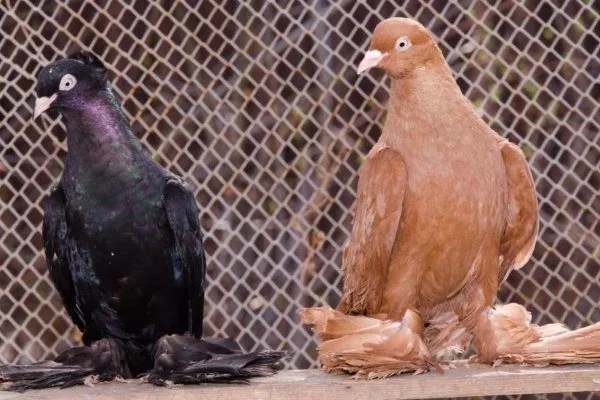
Flight. They fly at high altitudes. They prefer to fly alone. They can stay in the air for up to 11 hours. They rise rapidly into a column, performing sharp somersaults.
Other features. They are easy to train. They have excellent orientation and always find their home. If left untrained, Persians lose their flight ability and fly at low altitudes—1-2 meters. They are fertile and good parents, raising their young themselves.
Leninakan
This is an extremely hardy and resilient breed. In Armenia and Russia, efforts continue to refine this breed, improving its flight qualities.
Description. A strong, beautiful, streamlined body. The head is smooth and rounded. The beak is medium-sized and light in color. The eyes are black. The tail is straight.
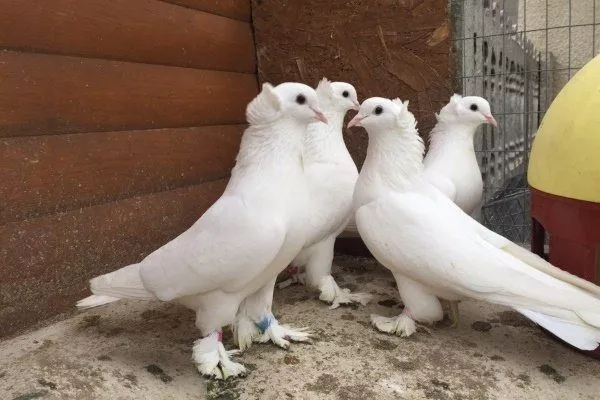
Flight. A continuous flight lasts 6-8 hours. They quickly gain altitude, enter a pole, and somersault.
Other features. Freedom-loving. If transport is necessary, they should be accustomed to their cages beforehand to prevent them from becoming ill from anxiety. They are attached to their nesting site and require constant training. They are well-oriented in space.
Leninakan pigeon pairs are very friendly and loyal. Breeders advise against releasing a male and a female at the same time. The female will distract the male from performing tricks.
Maykop
The official name is Maikop short-billed fighting pigeons.
Description. The birds are small, with wide, long wings. The head is small and neat. The feet are shaggy. The plumage is smooth and shiny. The eyes are large and bulging. The coloring is solid or two-colored.
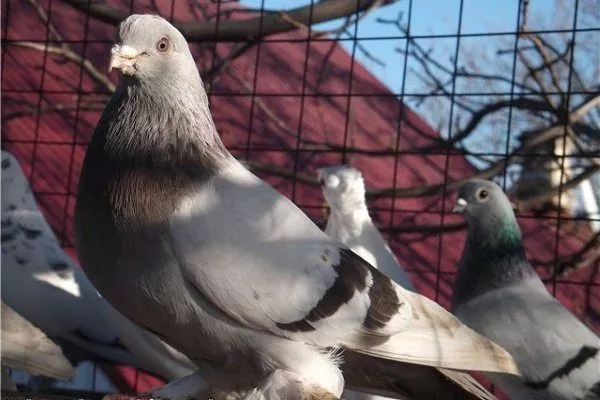
Flight. They fly swiftly and rhythmically. The fight is loud, and the exit into the column is abrupt.
Other features. The breed combines decorative qualities with excellent flight characteristics.
Blagodarnensky
The breed was developed in the North Caucasus in the 1950s. They were bred to hatch chicks, and these birds weren't particularly beautiful.
Description. These birds are medium in weight and size. They have a large crest on their heads. The crest can be located in various places, including above the beak and on the crown. The most common coloring is red and white. The head is small and graceful. The beak is white or yellow. Breeders prize black pigeons over other black birds, which are very rare. A drawback of black pigeons is their low stamina. The most resilient variety is the one with feathered legs.
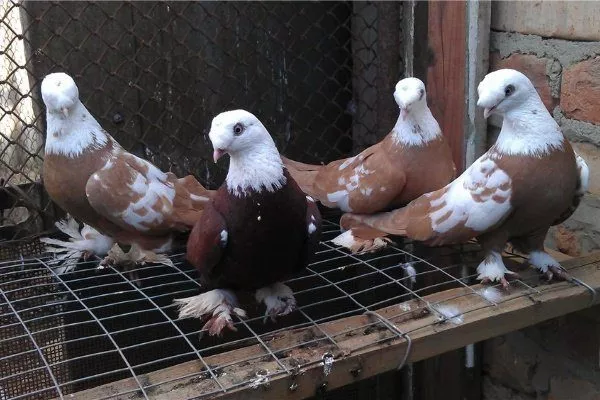
Flight. In flight, they perform masterful somersaults, performing various feats. However, today, this breed is valued more for its decorative qualities than its flight abilities.
Other features. They have a calm and friendly disposition. They are undemanding in terms of food and living conditions. They thrive in urban environments.
The breed was named after the town of Blagodarny in Stavropol Krai. The town's coat of arms and flag even feature an image of a red and white dove flying over a bridge.
Tumblers
One of the most valuable breeds. There are several varieties and hundreds of subspecies, including the Ribbon Tumbler, the Orlov Tumbler, the Odessa Tumbler, the Volsk Tumbler, the Vienna Tumbler, the Kursk Tumbler, the Moscow Tumbler, the Kishinev Tumbler, and others. Tumblers possess unique flight abilities unmatched by other breeds.
Description. Tumblers have a small body and head. They have dark eyes with light-colored eyelids. The beak is short, the forehead is high, and the neck is elongated and long. The legs are short and widely spaced. The tail is fluffed and raised. Tumblers can be with or without a tuft. Their coloring is variable. They weigh approximately 800 g.
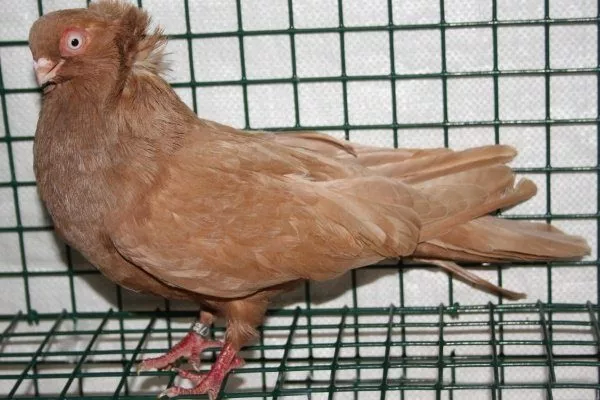
Flight. They are distinguished by their unique flight. They perform a flight similar to a wheel. They somersault through their wings, tail, and head. They can remain at high altitudes for long periods. Not every tumbler can perform complex maneuvers—there are birds with greater and lesser abilities.
Other features. Strong and resilient. Requires intense training to maintain their shape.
North Caucasian cosmach
Kosmachi is an ancient pigeon breed. Today, enthusiasts in the North Caucasus are working to restore the flight qualities of these lost varieties.
Description. A large body with long legs. The head is small, with a crest. The eyes are black or silver. The bill is white. The coloration and pattern vary depending on the subspecies. The plumage is red, yellow, black, glaucous, coffee-colored, and marbled. The head and primary flight feathers, undertail and uppertail coverts, and tail feathers are white.
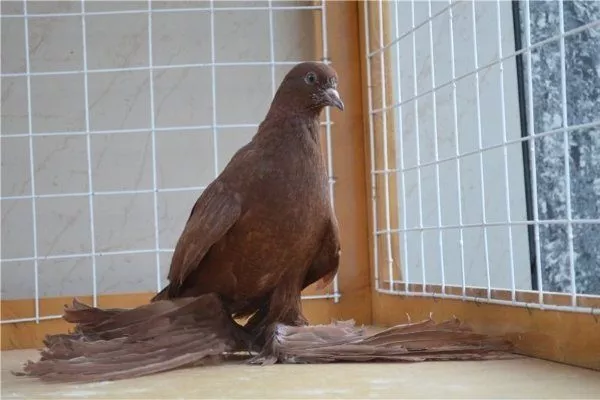
Flight. They fly quickly, suddenly coming into a standing position. They then perform somersaults—5-10 times in a row, producing characteristic clicking sounds—a "fight." Flight time is up to 5 hours.
Other features. They are hardy and undemanding. They live up to 20 years and reproduce until they are 10-12 years old. When acquiring a new pigeon, a month-long quarantine is required.
Where and in what conditions are pigeons kept?
Fighting pigeons are quite long-lived, with some individuals reaching 35 years of age. The average lifespan is 15 years. However, achieving this longevity is only possible with proper care. Above all, these birds require a comfortable home and adequate food.
Most fighting breeds are easy to maintain and maintain. Training is essential, as without it, fighting pigeons lose their abilities. The following are used for housing the birds:
- cells;
- enclosures;
- dovecotes.
The premises in which pigeons are kept must meet the following requirements:
- availability of high-quality ventilation;
- distance between floor and ceiling – from 1.5 m;
- When calculating the volume of the enclosure, you need to proceed from the condition - there should be 1.5 square meters per individual;
- the pigeon house should be equipped with perches, the thickness of the perch should correspond to the circumference of the bird's paw;
- bedding thickness – more than 5 cm;
- monthly – disinfection, cleaning – regularly;
- room temperature – from +20 to +30 °C.
Feeding Features and Diet
The health and beauty of pigeons depend on a well-balanced diet. Experienced pigeon breeders say no commercial feed can fully satisfy the needs of fighting pigeons, so they need a comprehensive diet:
- Dry grain mix. These mixtures contain almost all the necessary minerals.
- Fine gravel or river sand – to effectively grind food in the stomach. These are provided in a separate feeder.
- Legumes. Contain B vitamins, calcium, sulfur, and phosphorus.
- Cereals:
- Millet. It is recommended to give brighter varieties of millet - they contain more vitamins.
- Barley. Ideal food. Recommended to be given chopped.
- Wheat. It's high in protein and low in fat, making it a valuable product for pigeons.
- Rice. A nutritious product rich in various beneficial elements.
- Corn. It's only given to large birds. It's not recommended for small birds due to the large size of the grains.
- The water should be warm—room temperature. It should be settled or purified. Tap water should sit overnight to allow the chlorine to evaporate.
- During the breeding season, birds are given hemp seeds. The dosage should be clarified in the instructions; too much hemp seeds can be harmful to the birds.
- Flaxseed is given as a cough suppressant. Overdose can cause diarrhea.
- Sunflower seeds are a must-have in the diet. It's recommended to feed them 10% of the total feed.
- Instead of vitamin supplements, give fresh chopped greens - nettles, dandelion leaves, cabbage, spinach.
Pigeons are fed twice a day – in the morning and evening. Once the birds have finished eating, the feeders are removed. The daily feed requirement for one adult pigeon is 40 g. This 40 g is divided into two meals – part in the morning and the other in the evening. For example, pigeons might be given 10 g of feed before summer and 30 g before bed.
Table 1 shows the composition of the daily diet in percentage terms.
Table 1
| Name of ingredient | Feed volume, % | ||||
| winter | summer | molting | race | young animals | |
| wheat | — | 10 | 10 | 5 | 20 |
| barley | 40 | 20 | 10 | 20 | 20 |
| oats | 40 | 10 | 20 | 10 | — |
| corn | 1 | 10 | 10 | 10 | 10 |
| millet | — | 20 | 10 | 10 | 30 |
| lentils | 10 | 20 | 10 | 10 | 10 |
| peas | — | 10 | 35 | 35 | 10 |
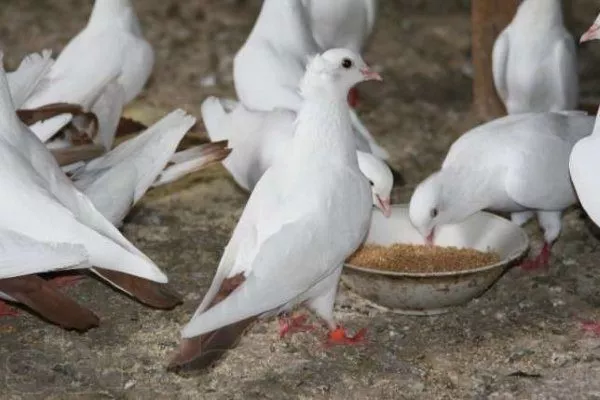
Store feed in dry rooms. All grains fed to pigeons must meet the following requirements:
- be well dried;
- be free from impurities and contamination;
- have no signs of mold or mildew.
Winter diet
During winter, pigeons' diets are adjusted. Feeding less protein reduces sexual activity and prevents egg laying. In winter, pigeons are fed no legumes, but barley and oats instead. They can also be fed porridge made from various grains cooked in salted water.
To keep the birds' plumage soft and fluffy, flax and rapeseed are added to their diet – about 4 g.
During the winter, it's also recommended to feed dried greens—dill and parsley are good choices. Instead of grain, you can feed potato mash with wheat bran. The recommended winter feeding rate is 40 g. An approximate daily diet for one winter day:
- oats – 40%;
- crushed corn – 10%;
- lentils – 10%.
Diet during molting
Pigeons' molt begins in June and lasts until mid-autumn. During this period, the birds require more protein to develop new plumage. However, care must be taken to ensure that protein-rich foods don't trigger increased sexual arousal. To achieve this, increase barley and oats in their diet, and eliminate wheat.
During molting, pigeons are fed rapeseed and cabbage leaves. The recommended feeding during molting is 40-50 g. Approximate diet:
- peas – 20%;
- oatmeal – 20%;
- millet – 10%;
- corn – 10%;
- vetch and barley – 10%;
- juicy vegetables and greens – 30%.
Breeding Features
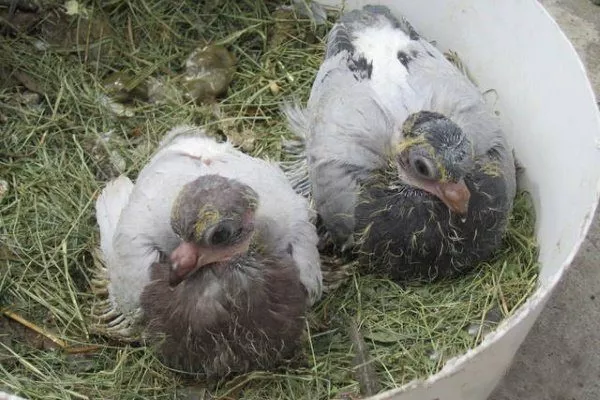
Game birds are prolific breeders, and can hatch up to eight eggs in a single clutch. The female sits on the eggs; the male does not participate in incubation. The chicks hatch hairless and completely helpless. However, they grow quickly and develop feathers. By two weeks old, the chicks begin to leave the nest. After two months, the birds look like adults.
If there are no nests in the pigeon coop, the birds will make their own, using whatever materials are available. Once the nest is built, there's no need to move it—the birds will be upset, as they become very attached to the fruits of their labor. Therefore, it's best to plan for nests in advance.
Breeding pigeons at home begins in the spring. Before laying eggs, prepare a separate aviary, thoroughly wash, clean, and dry it. Then, nest boxes with low sides are installed. Plaster and fine sawdust are sprinkled into the corners.
In nature, random mating predominates. But if a breeder wants to produce offspring with specific characteristics, they can't rely on chance. For pigeon breeding, it is recommended to use:
- Inbreeding. Related individuals are mated—parents and offspring, brothers and sisters, or cousins. This form of crossbreeding improves the quality of the breed and preserves its positive characteristics. Inbreeding can be used over long periods of time, crossing several generations.
- Crossbreeding of similar individuals. Two healthy parents pass on positive traits to their offspring. This method allows for the use of extraneous genetic potential not inherent to the breed, and is intended to improve the breed's original characteristics.
- Linear breeding. Allows for precise understanding of the consequences of mating and the inheritance of characteristics. Unlike inbreeding, individuals with more distant relatives are used.
Keeping chicks
The optimal temperature in the room where the chicks live is 36-38°C. At the beginning of the second week, the temperature can be lowered to 20°C – by this point, the chicks are able to independently maintain body temperature regulation.
Nutrition and diet
Until they're a month old, pigeon chicks require almost no food—unless they're raised by their parents. In the second week, they need water. To teach them to peck, they're given small grains from the third or fourth week. From 25 days old, the chicks can visit the common aviary and make short flights.
Feeding ration for pigeons:
- The first week of life. Give the chicks a mashed and warmed chicken yolk. You can also feed the chicks a chick formula, stirring it until it becomes a porridge.
- Second week of life. Mix the yolk with millet, barley, snap peas, and honey. Add a teaspoon of honey, crushed eggshells, and red clay. Crush the grains and pour in warm water.
- 3-4 weeks of life. Water, chopped vegetables and fruits, and greens are introduced into the chicks' diet. From day 22, the chicks can be fed white bread. A few drops of fish oil can be added to the food once or twice a day.
- ✓ The food should be easily digestible and rich in protein.
- ✓ Water must always be available and clean.
- ✓ Avoid overfeeding to prevent obesity.
When accustoming the chicks to water, on the 15th day, their beaks are tilted so that water doesn't get into their noses. Once they reach one month of age, the chicks transition completely to adult food.
Chicks require special fat-rich food; they need more nutrients than adults. The food is given in crushed form. To strengthen their immune system, pigeons are given herbal infusions such as string, chamomile, and thyme.
The feeding process
For the first few days, hatched chicks feed at three-hour intervals. It's best if the parents are attentive and provide their offspring with enough food. If the adult pigeons are unwilling to feed the chicks, the breeder will have to take over.
The chicks are fed:
- The first 3 days –A mixture of milk and egg yolks. Before feeding, the mixture is placed in warm water.
- Second option – feeding with regular infant formula. The milk formula is drawn into a syringe and then injected into the crop.
In the second week, the chicks are able to feed themselves. Starting on the sixth day, the chicks can be given pelleted feed. The pellets are crushed, dissolved in water, and then injected into the beak with a syringe. Feedings are twice daily.
Don't overfeed the chicks. Excess food won't do their growing bodies any good. However, they should have constant access to water.
The chicks should be fed 1 part dry food to 3 parts water. If the temperature rises, more water should be provided.
Training of fighting pigeons
If you don't train your fighting pigeons, you'll have to say goodbye to their beautiful flight. Although skill is genetically ingrained in these breeds, they quickly lose this skill without regular training.
Rules for training pigeons:
- Pigeons should be driven when they reach 40 days of age.
- You can’t train birds to fight before the right time – they may stop “playing” altogether.
- After molting, the “games” become less frequent and shorter.
- "Slaughter"—a refusal to "play"—is often a genetic problem. Such birds are culled.
- The optimal number for the rut is 15 birds.
- Pigeons that move slowly in a circle and “play” every two minutes during the first half hour are considered especially valuable.
To ensure fighting breeds maintain a high level of flight, perform complex tricks, and display spectacular "play," they must be trained regularly. These beauties, who demonstrate the wonders of flight, often grace special occasions and weddings, and participate in sporting competitions and exhibitions.