
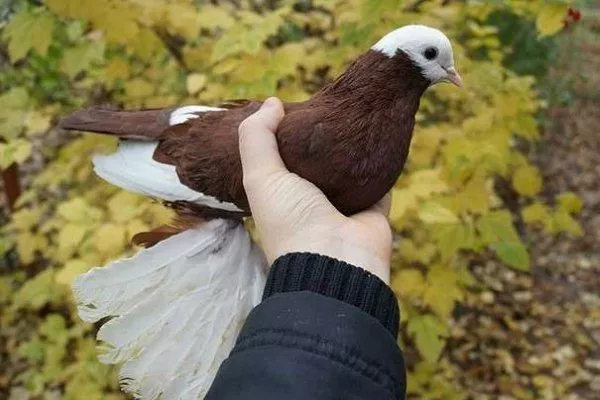
Armavir birds immediately attract attention with their unusual, unique appearance. This breed is unique, and few fanciers care for them. However, Armavirs are not overly demanding or fussy, which is a great advantage when breeding.
Origin
Before delving into the origins of Armavir pigeons, it's important to understand their nomadic lifestyle. Pigeons were domesticated many centuries ago. When people migrated, they took not only all their fur but also their livestock, including pigeons. Thus, in the 18th century, a previously unknown breed of pigeon arrived in Kuban with settlers from Tashkent, Samarkand, and other cities. These birds had a relatively short beak, and their legs were covered with a sparse number of feathers.
Then began a long process of selection. Breeders developed a breed with ideal characteristics for 150 years, and eventually produced pigeons with long feathers on their legs.
The breed was named after the city where it was actually bred.
During the Great Patriotic War, the bird population declined drastically and was on the brink of extinction, but thanks to the experience and tireless efforts of specialists, the breed was saved. Even today, the Armavir pigeon breed is not very numerous; they are primarily bred by fanciers in the North Caucasus region.
Varieties
The breed is represented by two types:
- the white-headed shaggy mane, distinguished by its unique pattern created by white and colored plumage;
- short-billed shaggy mane, which is usually uniform in color.
Representatives of these two species belong to fighting breeds.
What are fighting pigeons? They're birds that make a distinctive clicking or flapping sound with their wings during flight, known as "fighting."
Each variety has its own distinctive features, but distinguishing them among the diverse crowd of pedigree pigeons is not difficult. It's not for nothing that these birds are called "shaggy pigeons." Their legs are covered with long feathers called "shaggy pigeons," which, along with their proud gait, graceful posture, and distinctive flight style, make them recognizable among thousands of other avian species.
White-headed shaggy
| Name | Beak length | Plumage color | Length of feathers on the legs |
|---|---|---|---|
| White-headed shaggy | 22-25 mm | Yellow, red, coffee, black | 6 cm |
| Short-billed shaggy | Short | White, black, amber, chocolate, gray, dark chestnut | 6 cm |
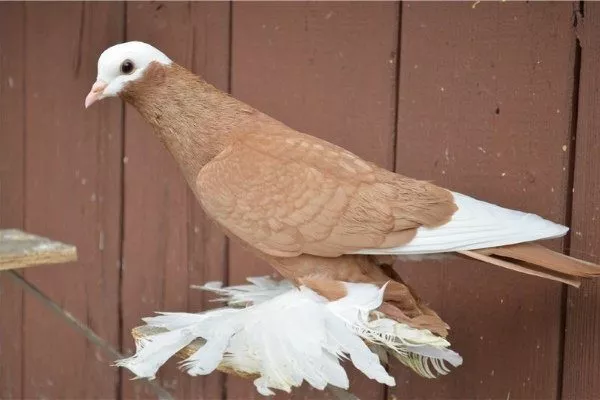
In the Caucasus, it is called "bald," whether its head is adorned with a forelock or not. The pigeon's head is elongated, flat at the crown. It may be adorned with a shell-like forelock, extending from one ear to the other and then blending into a mane.
All white-headed birds have black eyes and white (yellowish is acceptable) eyelids. The graceful, thin bill is pale pink and curved downwards. Its standard length ranges from 22 to 25 mm. The cere is a pinkish thickening of the skin located at the base of the upper beak. The body is massive. The neck is short and slightly curved. The wings are held tightly to the body. They are long, with their edges reaching the end of the tail. The tail feathers are semicircular. The legs are covered with long, straight feathers and have spurs. The coat can be yellow, red, coffee-colored, or black.
There are several disadvantages that are not allowed in this type:
- this is the motley variety of pigeons;
- any eyelid color except standard colors;
- the size of the beak cannot be larger or smaller than the standard;
- It is considered a defect if the hair is completely dyed red;
- their size and the size of the spurs should not be less than 6 cm;
- the presence of three or more white feathers in the tail.
Short-billed shaggy
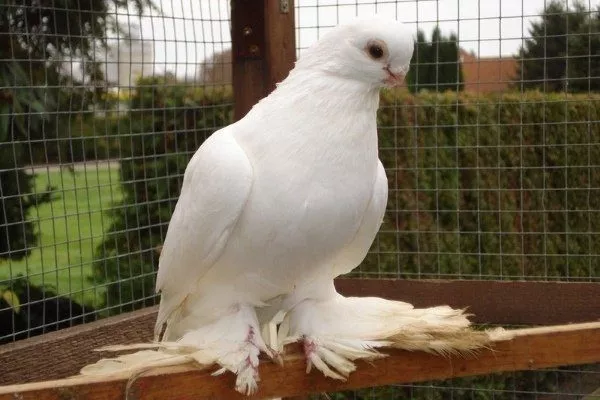
It differs from the previous species in its head structure—it is more rounded, with a broad, steep forehead that may be adorned with a crest. The bird has wide eyelids (1-2 mm) that are white or light yellow. The eyes can be black or gray, depending on the plumage coloration.
White individuals have black eyes, while all other colorings have gray eyes. The short, thick bill is curved downwards. Birds with shorter bills are more prized. The smooth cere is white. The chest and back are broad—the former slightly convex, the latter tapering toward the tail. The wings are held tightly to the body, reaching to the tail, which contains up to 12 tail feathers. The legs are covered with feathers, resembling a skirt.
The plumage is dense. Colors include white, black, amber (light and dark), light chocolate, gray, and dark chestnut. Each feather is streaked, with the coloring becoming darker toward the edges.
A bird is considered a defect if it has:
- narrow or elongated head;
- If she has different colored eyes, or they are red or yellow, then she is rejected;
- The coloring of eyelids in any color other than white is not allowed in the breed;
- or a beak shaped like a hairpin - thin, long;
- the length of the feathers on the legs cannot be less than 6 cm;
- individuals with feathers sticking out in all directions on the legs or with gaps are rejected;
- Colored birds in kosmas cannot have more than four white feathers.
Conditions of detention
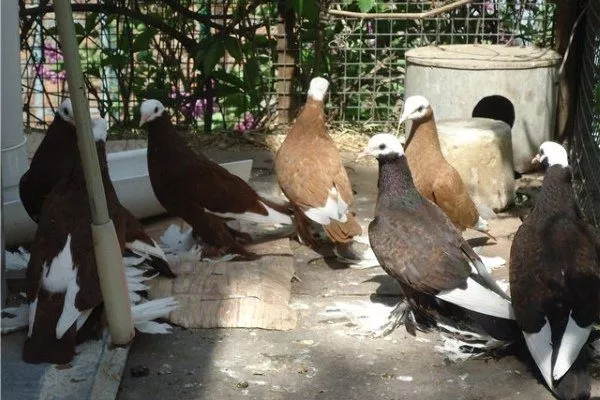
Armavirs are considered an elite breed, so they began to be kept in closed aviaries and cages. This environment negatively impacted their flying abilities, and it is precisely for the beauty of flight that these birds are prized.
It rises to a height of 50-100 meters, where it flies easily and calmly for 45-90 minutes. The pigeon can rise into a vertical column, reaching a height of about 10 meters. During flight, its call is dry and loud. The birds perform two to nine somersaults in the air, depending on their training.
Moreover, lack of freedom also negatively impacts reproduction. And given their small numbers, this is simply catastrophic. Therefore, if you decide to breed this unique breed, you must provide the birds with comfortable living conditions and allow them to perform training flights.
- ✓ The optimal temperature in the poultry house should be maintained at 18-22°C to ensure the comfort of the birds.
- ✓ Humidity in the room should not exceed 60% to prevent the development of fungal diseases.
Poultry house
If the birds are kept in a coop or other building, they are equipped with smooth perches. The walls are plastered and treated with whitewash. The floor is covered with litter 6 cm or more thick. For a pigeon to feel comfortable, it needs its own space. The recommended space per bird is 1.5 square meters.
Pigeons are unpretentious in terms of care and maintenance, but to prevent the development of diseases, the poultry house is disinfected monthly.
Before this procedure, the room is cleaned of droppings, fluff, and dirt using a scraper. Then, the room is washed with soapy water and treated with a blowtorch. This eliminates pathogens even in the most hard-to-reach places.
During warm weather, a full disinfection is carried out—a set of measures aimed at thoroughly treating the premises from various insects, microbes, and viruses.
It includes:
- mechanical cleaning;
- wet cleaning;
- aerosol treatment.
When mechanically cleaning, use a scraper to clean the walls, floors, waterers, feeders, and perches. Next, rinse all items and areas with hot water and caustic soda. After wet cleaning, ventilate and dry the dovecote.
The final step is treatment with formaldehyde vapor. For this, use 45 grams of formalin, 30 grams of potassium permanganate, and 20 ml of water per cubic meter. All components are mixed in a ceramic container in the poultry house. The mixing process causes a chemical reaction, resulting in the formation of a gaseous substance. After leaving the container inside the house, close all windows and doors tightly and leave for two hours. After treatment, ventilate the room well. The vapors penetrate all cracks and crevices, preventing any microbes from surviving.
To prevent the formation of mold and mildew, regularly ventilate the dovecote in warm and dry weather.
Feeding
Proper nutrition is the key to bird health. An unbalanced diet can lead to digestive problems and vitamin deficiencies.
Pigeons are fed twice a day—morning and evening. Each bird receives 40 grams of food. In summer, 10 grams are given in the morning and the remaining 30 grams in the evening. After the birds have finished eating, the feeders are removed along with any remaining food.
The summer menu consists of wheat, peas, oats and corn (10% of each) and barley, lentils and millet (20% of each).
During the moulting period, the most nutritious and protein-rich grains are left in the diet - millet, oats, barley and peas.
During the rutting season, the proportion of wheat in the menu is reduced to 5%, the amount of peas is increased to 35%, oats, corn, millet and lentils are taken at 10% each, and barley at 20%.
The winter menu consists of barley and oats (40% each), corn and lentils (10% each).
It is essential to install a container with small gravel in the room; the bird needs it for normal digestion of food.
Finely chopped fresh nettle, dandelion, spinach, and cabbage leaves will provide pigeons with vitamins. They are given daily in the summer.
The water in the water bowls should be at room temperature. If using tap water, let it sit for 12 hours to allow the chlorine to evaporate.
Diseases and vaccinations
Vaccinations are essential for birds to boost their immunity to diseases and prevent epidemics. They are administered in early spring and fall, when weather and temperature fluctuate sharply. Vaccinations are administered at minimum intervals of 10 days; after one injection, the next can be given only 10 days later.
They are often vaccinated against salmonellosis and Newcastle disease. While only the lazy haven't heard of salmonellosis, the latter disease is little known to most of the population.
Beginning pigeon fanciers should know that Newcastle disease, also known as "whirly whirly," is an airborne viral disease that kills over 2,000 pigeons annually. The virus destroys the bird's nervous system and attacks all internal organs. In its final stages, the bird constantly tosses its head, its neck becomes twisted, and inflammation of the brain is diagnosed.
The disease spreads quickly among livestock, and wind carries the virus over long distances. Prevention has proven effective in combating this disease, so it's better to be on the safe side and vaccinate promptly.
- Give the first vaccination against salmonella and Newcastle disease in early spring.
- Repeat vaccination in the fall, with an interval of at least 10 days between different vaccines.
- Monitor birds after vaccination for possible side effects.
The treatment of pigeons against Newcastle disease with the La Sota vaccine is described in this article.
Features of reproduction
Pigeons are faithful birds and choose a mate for life. Therefore, an equal number of males and females should be kept in the enclosure to ensure that each finds a mate during mating season.
Females perform their role as mothers well, incubating and caring for their young independently. Only short-billed Armavir hens will require assistance. Due to their short beak, they are unable to properly feed their chicks. Experts recommend placing the eggs of this variety with other bird breeds.
So, the Armavir Kosmachi is a beautiful and unique breed that requires regular flight. Only then will it retain its amazing flight skills, which so captivate people and make time stand still.