
Pheasant meat has long been considered a delicacy, and year after year, the number of people wanting to try it only increases. It's not enough to just hunt the game—you also need to know how to cook it, which means plucking and butchering it. Pheasant skin is very thin and delicate, so if you handle the carcass improperly, you risk damaging it. Such damage will cause the carcass to lose juices, which will negatively impact the taste of the meat.
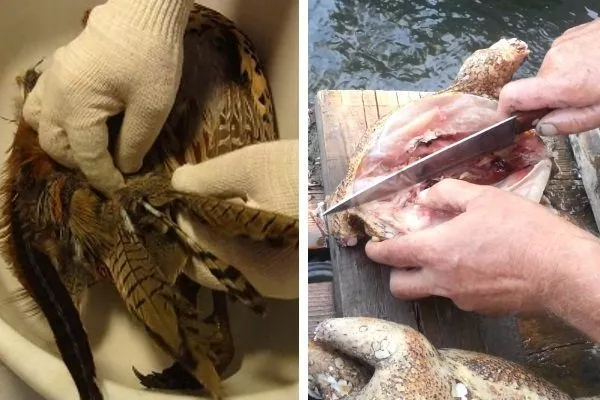
Pheasant Plucking Methods
The fastest way to remove feathers from a pheasant, requiring little time or special tools, is in the field. This means the process should begin while the bird is still warm, and it should take no more than 15 minutes. Performing the same process at home requires a slightly different approach. It's important to remember that a pheasant is not a chicken, and there are some nuances to removing its feathers.
As mentioned, pheasant skin is much thinner, so the key to plucking is precision. If you plan to cut the meat into pieces for stewing, for example, it's best to keep the process simple and remove the skin entirely, feathers included.
To work at home you will need:
- a deep basin to prevent feathers from flying all over the kitchen;
- If you plan to work outside, it is enough to simply lay down newspapers or diapers;
- scissors for cutting off excess parts;
- tweezers or small pliers to remove any remaining small feathers and down, as well as hairs along the spine.
Removing large feathers
The process should start from the tail and move towards the head, having first placed the carcass in a basin.
Follow this pattern:
- First, pluck out the tail feathers lengthwise, one at a time - these feathers have thick roots, they are deeply and firmly seated in their place, and it is simply not possible to carefully remove several at once.
- Then it’s the wings’ turn, simply cut off their shoulder parts with flight feathers.
- Proceed to remove large feathers from the back, carefully holding them with your fingers and slightly stretching the skin where the feather is attached.
- To remove any remaining small feathers, use tweezers.
- Larger feathers are removed in the direction of growth.
- Remove very small feathers on the chest, legs, and neck with quick movements in the opposite direction of their growth. Remember, as with larger feathers, to hold the skin in place with your fingers.
The video below shows the process of plucking a pheasant:
Be careful not to tear the skin, as this will allow juices to escape and the bird will be tough and dry after baking.
Can I pour boiling water over it?
When processing poultry, such as chickens and geese, the carcass is often doused with boiling water, since feathers are removed much more easily from steamed skin.
However, this shouldn't be done when plucking a pheasant, as its skin isn't as porous and thick, and steaming it won't have any effect. Quite the contrary—processing a wet carcass will only be more difficult. Therefore, pheasant feather removal should be done dry.
But there is an exception. Quite often, poultry arrives frozen, feathers included, to preserve freshness. In this case, the carcass can first be rinsed with hot water to bring it to room temperature. After this, the bird should be thoroughly dried with towels, and then proceed to removing the feathers using the method described above.
Removing the down layer
A defeathered pheasant remains covered in a layer of down, which must also be removed. This is usually accomplished by carefully searing the skin with a flame. Any fire source will do—a stovetop, a lighter, a torch, or a campfire—but avoid exposing the skin itself to an open flame to avoid burning it.
Before singeing, you can rub the carcass with flour, then the very small feathers remaining after plucking, as well as the down, will dry out and stand up straight, which will simplify the procedure.
- ✓ Use flour to rub the carcass before singeing to help remove the fluff.
- ✓ Use a piece of lard wrapped in a piece of canvas to remove lint in the field.
If you don't want to deal with an open flame due to inexperience, you can remove the fluff with a piece of lard wrapped in a piece of canvas, or simply roll it with your fingers. These methods are often used in the field.
After the carcass has been completely cleared of feathers and down, rinse it under running water. Be careful with the water temperature—too hot a water temperature can damage the skin, which has already been scorched by an open flame, or make it look less than presentable.
Remember that a baked pheasant carcass is a delicacy, an exquisite dish, and therefore it should look accordingly.
How to cut up a pheasant?
Professional hunters typically don't immediately remove the feathers from a pheasant shot in a designated hunting ground, but they do gut it right away. The carcass is gutted, taking care not to rupture the gall bladder. The lungs are also removed to prevent the meat from tasting bitter.
After this, the cavity is stuffed with nettle leaves or pine needles. This simple procedure will keep the meat fresh for 3-4 days without freezing. However, this approach isn't universally practiced, and if you've got a whole carcass, complete with feathers, down, and entrails, you'll have to gut it as well.
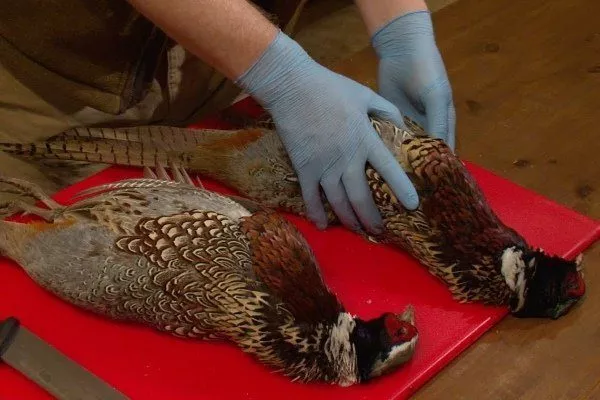
If plucking the pheasant didn't cause you any significant difficulties, then further processing of the game won't be a serious problem either.
Kitchen utensils
Make sure you have all the necessary kitchen tools, without which it will be much more difficult to cut up the carcass properly.
You will need:
- medium sized cutting board;
- meat carving knife;
- tweezers;
- twine or thin nylon cord.
How to gut?
The gutting process is very simple to implement:
- First of all, cut off the paws at the knee joint with a knife.
- The rest of the procedure proceeds from top to bottom. Start at the upper chest, where the neck begins. Remove the contents of the crop through the previously made incision.
- Make an incision in the peritoneum. Carefully, using two fingers, grasp all the entrails—the heart, stomach, and liver—and pull them out. Be careful not to spill the stomach contents, contaminating the meat.
- The intestines and gall bladder can be discarded and are not eaten.
- The stomach should be cut open, washed thoroughly and the inner lining removed.
- It's customary to leave the head on, as it makes the dish more impressive, but the eyeballs and nostrils are removed. The ears also need to be cleaned.
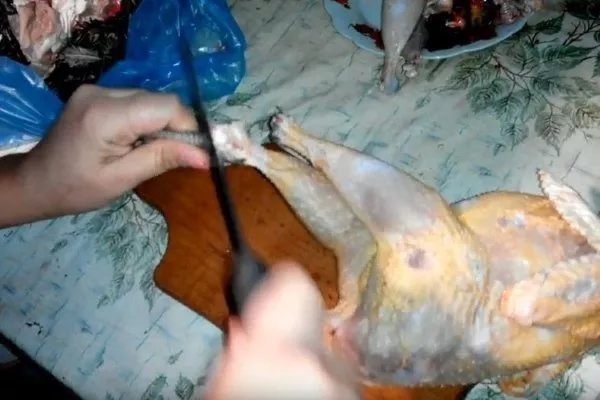
we cut off the paws at the knee joint with a knife
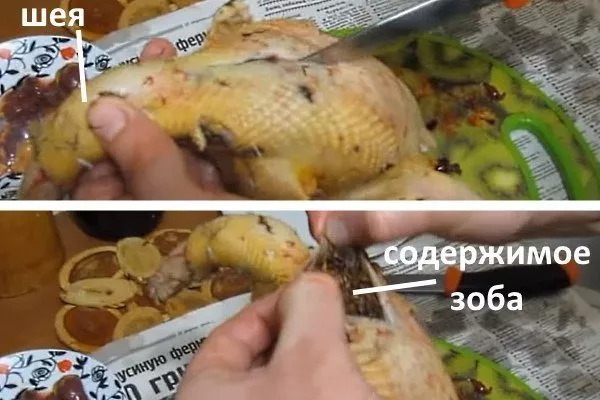
we remove the contents of the goiter through an incision on the sternum
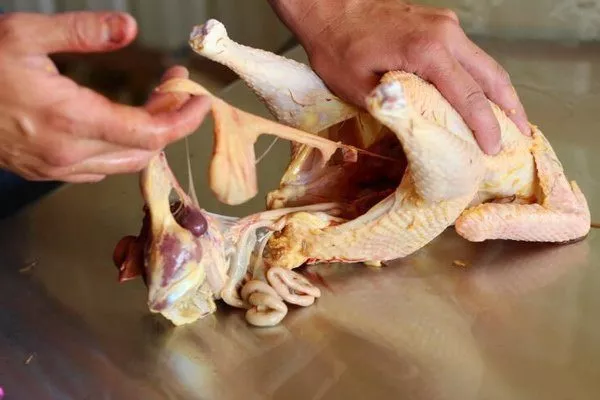
we make an incision in the peritoneum and take out all the entrails
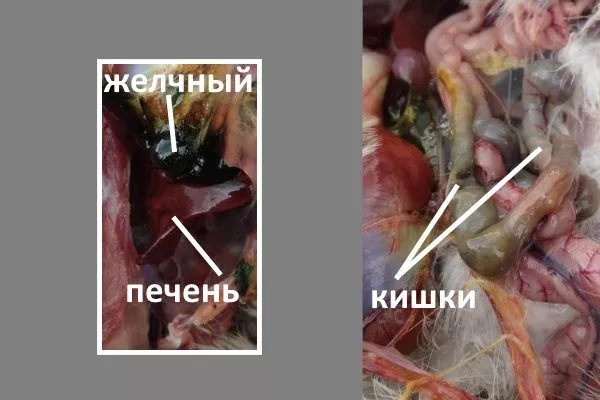
We throw away the intestines and gall bladder; they are not used for food.
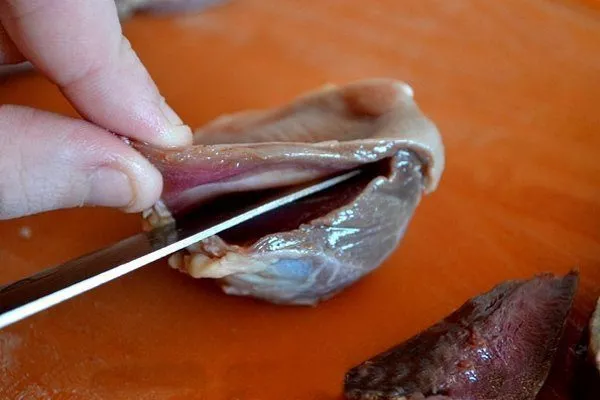
we cut the stomach and wash it
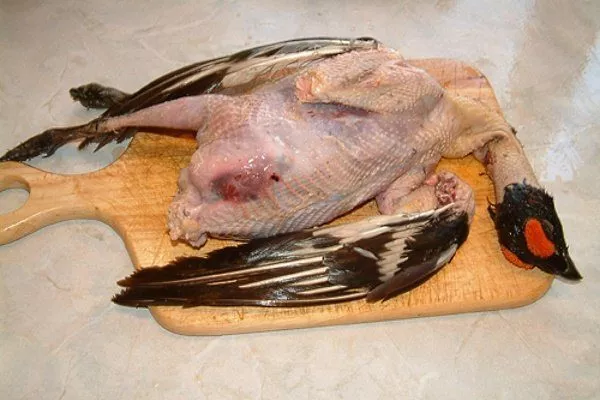
we receive a gutted carcass
The carcass, thus freed from its entrails, must be thoroughly rinsed under running water and dried with thick paper towels.
Some prefer not to open the crop to avoid wasting time cleaning the carcass of its contents. In this case, the step-by-step instructions for removing the crop and viscera are as follows:
- On the neck, just below the beak, cut a small hole, grab the esophagus in it and cut it off.
- Make a small incision just above the goiter, and through this incision carefully cut off the larynx and goiter with the remainder of the esophagus.
- Using tweezers, remove the tip of the main portion of the esophagus and tie it with string. This is done to prevent any digestive contents from entering the carcass's internal cavity during subsequent removal.
- Make an oblong incision along the abdomen, from the anus to the abdominal bone. Carefully open the abdominal cavity. Make sure the intestines are not damaged by the incision and that there is no risk of spilling their contents.
- Place two fingers into this incision, it is easiest to do this with the middle and index fingers, carefully grasp all the organs except the intestines, and remove them.
- Next, it is necessary to make an incision around the anus and pull out the intestines through it.
How to cut up a pheasant carcass for cooking?
The most traditional way to cook game is to roast it whole in the oven. However, there are other culinary recipes that involve further cutting the carcass into individual parts and pieces.
The procedure for cutting a pheasant into smaller pieces is not much different from that for poultry. Follow these step-by-step instructions:
- Cut off the head.
- Cut off the lower part of the legs at the joint, right down to the muscle tissue.
- Separate the neck from the carcass.
- Turn the bird over onto its back, grab it by the thigh and make a cut above the joint, deep to the bone.
- Separate the legs from the carcass one by one. Since pheasants are quite large, you may need to cut each leg in half. To do this cleanly, use a knife placed on the joint and applying firm pressure. Avoid splintering the bone; cut precisely along the joint.
- Find the joint where the wing meets the body and separate the wing from the main body by moving the knife along the joint. For convenience, support the wing with your hand.
- Place the knife in the middle of the carcass, make two parallel cuts on the sides of the spine and separate the back part from the sternum.
- Trim the fillet from the breastbone if necessary.
The video below shows how to quickly remove the fillet from a carcass:
When butchering the carcass, special attention should be paid to the tubular bones. The problem is that these bones in pheasants are thin and fragile, and therefore produce numerous splinters when cut.
To avoid this, don't use chopping tools; use a knife only. Cut carefully to ensure the bones remain intact and you don't risk ruining the dish. The carcass' preparation is complete, and you can proceed directly to cooking it in the oven.
Before beginning this process, the legs and wings are tied to the bird. Typically, the bird is laid on its back, a string is passed through the ham, the breast, and the other ham, then the free ends of the string are tied together, securing the wings.
If you don't plan to cook a pheasant the traditional way, that is, whole in the oven, it makes sense to save yourself a lot of time by completely eliminating the procedure of removing large feathers and down from the carcass, and simply removing the skin entirely.
It's worth keeping in mind that this also removes the bird's fat deposits. The procedure itself is very simple: grab the skin around the neck and pull it toward the legs. The skin is soft and delicate, and comes off easily. Don't worry if the skin tears during the process—keeping the skin intact is only important when roasting the whole bird.
How this is done is shown in the video below:
By allowing yourself to grossly violate the algorithm and sequence of actions, excessive haste, or carelessness in manipulation, you risk rendering an exquisite and expensive delicacy completely unfit for consumption.