
The pheasant is a game bird and is one of the most beautiful domesticated birds. There are approximately 32 subspecies, distinguished by plumage coloration. The external difference between males and females is clearly visible and becomes noticeable at an early age. This rule is the same for all varieties, regardless of whether they are wild or domesticated.
| Name | Body length (cm) | Weight (kg) | Plumage color |
|---|---|---|---|
| Male pheasant | 85 | 1.7-2 | Bright, colorful |
| Female pheasant | 60 | 0.5-0.8 | Calm, with spots |
The difference between a female pheasant and a male
The first differences between a male and female pheasant can be detected at day old by examining the chick's cloaca—males have a tubercle on the inner wall, while females do not. At 1.5 to 2 months of age, differences in tail coloration and length become noticeable.
- ✓ The presence of a tubercle on the inner wall of the cloaca in day-old male chicks.
- ✓ The difference in color and tail length becomes noticeable at the age of 1.5–2 months.
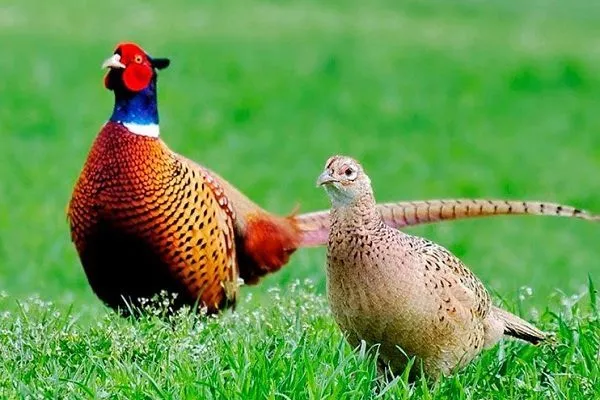
Adult specimens differ dramatically from each other. Males are larger than females, reaching approximately 85 cm in length and weighing up to 1.7–2 kg. Females typically weigh approximately 1.2 kg less than males and are approximately 60 cm in length.
But the most important difference is the plumage coloration. Males are brightly colored, with various combinations of brown, green, purple, fulvous, gold, and blue. They also have a long, wedge-shaped tail and spurs on their legs. The skin around the eyes is red and featherless.
Females have a more subdued coloration. These include a combination of dark brown, sandy, silver, and yellow with small spots/streaks and predominantly dark-colored finials.
Different subspecies of pheasants have distinct plumage colors. But regardless of the color, females are always inferior to males in terms of beauty and brightness.
Behavioral features
The pheasant is the fastest and most agile runner of all members of the Galliformes. When running, the male extends his neck and head forward and lifts his tail, thereby reducing drag and increasing speed.
The hens prefer not to show their presence. Their dull plumage helps them achieve this. They hide in dense bushes, tall grass, or thickets of reeds and rushes. Pheasants emerge from their hiding places to forage for food.
The pheasant can be heard in flight. Its call is somewhat similar to that of a rooster, but more resonant and abrupt. Only males vocalize; hens are generally silent.
These birds live in large families. However, when cold weather sets in, they split into single-sex flocks. Male flocks can number up to a hundred individuals. Female flocks are more modest, with only 10 females per flock.
The behavior of domesticated birds is no different from that of free-ranging ones. Pheasants living on farms and game reserves are just as shy and cautious. They have highly developed natural instincts, regardless of how they were born: in the wild, in captivity, or in incubator.
Mating season
With the arrival of spring, pheasants begin their mating season. Males divide their territories and begin courting females. Each "master" fiercely defends their territory, engaging in fierce fights with rivals.
A male chooses a mate once for his entire life. After that, he has no interest in other female pheasants. During the mating dance, the male rises and beats his wings, making unusual sounds. He circles the female, thus displaying his beauty.
After fertilization, the female pheasant builds a nest in tall, dense grass. She digs a hole in the ground and lines it with grass and feathers. Females lay eggs from about mid-March until early summer.
Eggs They are gray-green in color. During incubation, the female rarely leaves the nest, only to feed. This causes her to lose approximately half her body weight. During the brooding period, the hen stops leaving the nest. The incubation period for the eggs is 21 days.
Pheasant chicks hatch covered in thick down. A day after hatching, they can feed themselves and run quite quickly. After the first week, the chicks can glide and fly at low altitudes.
Naturally hatched chicks (including those hatched in captivity) stay with their mother for up to two months. During this time, she teaches them everything they need to know—how and where to find food, who to hide from, and where. Those hatched in an incubator rely solely on their instincts.
Features of keeping females and males
Females and males in captivity are kept in the same conditions. For their breeding Usually, enclosures are built. There are two types:
- Closed aviaries are covered with a nylon mesh on top, which prevents the bird from flying away and from injuring itself when trying to fly up.
- Open aviaries are built at a great distance from humans. Their walls are approximately 2.5 meters high. Humans rarely visit these areas (about once a week), bringing food for the birds. Pheasants fly into these areas for food and shelter in times of danger. In practice, closed aviaries are more commonly used.
A family may consist of a pair (male and female) or a male and several females. Males and females are not kept separately.
Young birds are always housed in a separate enclosure. Its size depends on the number of birds, with the assumption that 2 square meters are required per bird.
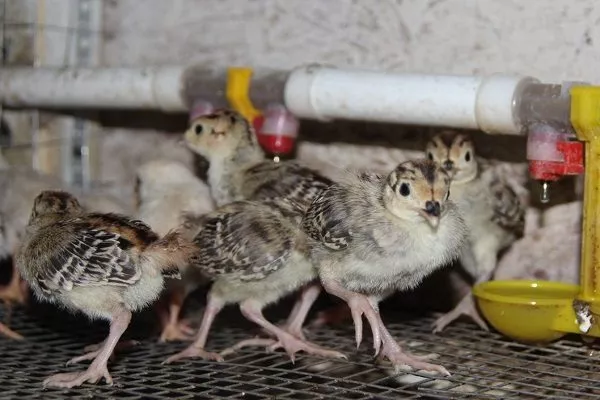
When keeping different breeds of pheasants, it's important to consider their specific characteristics. Southern breeds require a warm shed where they can hide during cold weather. Breeds that don't tolerate high temperatures well require shrubs and trees in the enclosure.
Some particularly large breeds require larger enclosures. For less demanding species, a shelter made of branches will suffice for shelter in inclement weather.
Nutrition
Until three weeks of age, chicks are fed a special compound feed. Millet, hard-boiled eggs, green onions, and nettles can be added to it.
Afterwards, the chicks are transferred to a diet consisting of millet, ground barley, wheat, and corn. It would be a good idea to add Rost-type compound feed.
While the chicks are growing, it's time to prepare their future enclosure. To do this, sow it with millet. By the time they move in, the area will be covered with young green shoots, which will serve as food and shelter.
Adult birds are fed wheat, millet, corn, and ground barley. Coarse sand and chalk should always be included in their diet. Combined feed is a good supplement during molting.
Pheasant care should be organized so that the birds are always well-fed and kept clean. It is necessary:
- remove trash regularly;
- wash feeders and waterers;
- keep the area around the food place clean;
- Make sure that rodents do not get to the birds.
It's crucial to prevent stress in pheasants. Discomfort arises both from the interactions within a complex bird community (fights between males, dominance of stronger individuals at the feeder) and from human exposure.
The pheasant is a very beautiful and unusual bird. Observing it in the wild or breeding it in captivity is fascinating and exciting. And with the right approach to raising your flock, you can improve your livelihood. Despite the dramatic differences in appearance between males and females, both sexes require the same care and maintenance, simplifying the breeding process for farmers.